2024-07-15 21:06
Issuers have been asked to submit their final S-1 documents by Wednesday. ETH exchange traded-funds issuers were told by the SEC that funds can start trading July 23, according to sources. The SEC had no further comments on the recently submitted S-1s and the final versions needs to be submitted by Wednesday. ETH outperformed BTC on Monday, on the news of potential ETF trading approval. Prospective issuers of a spot ether (ETH) exchange-traded fund (ETF) were told by the Securities and Exchanges Commission (SEC) on Monday that the funds can begin trading next Tuesday, two sources familiar with the matter told CoinDesk. SEC officials told one issuer that the regulator had no further comments on the recently submitted S-1s and that the final versions needed to be submitted by Wednesday, one of the source said, adding that the funds can subsequently be listed on exchanges on Tuesday, July 23. A second source said it's possible that trading could start on Tuesday, after the ETFs are deemed effective next Monday. Bloomberg Intelligence senior ETF analyst Eric Balchunas first reported the development on a social media post. The issuers submitted amended S-1 documents last week but have yet to disclose some of the details, including how much management fee they will be charging investors. Only a few issuers, including VanEck and Invesco Galaxy, have so far revealed their fees. Once live on the market, the spot ether ETFs could see inflows of up to $5 billion in the first six months, crypto exchange Gemini predicts. Steno Research said it expects inflows of up to $20 billion in the first year. The price of ether rose as much as 7.3% on Monday, outpacing bitcoin's 6% gain, on the news of ETFs starting to trade next week. The broader market index CoinDesk 20 climbed 5.6% today. Nik De also contributed to the reporting of this story https://www.coindesk.com/markets/2024/07/15/sec-tells-eth-etf-issuers-fund-can-start-trading-tuesday-source/

2024-07-15 20:12
The second amended complaint accuses Tether of manipulating the price of bitcoin and violating antitrust laws. Plaintiffs in an ongoing class action lawsuit against Tether and Bitfinex have filed a new, slimmed-down complaint accusing the crypto companies of manipulating the crypto markets and violating antitrust laws. The second amended complaint, filed in the Southern District of New York (SDNY) on Monday, accuses Tether and its sister crypto exchange Bitfinex of operating a “sophisticated scheme to artificially inflate the price of cryptocurrencies” by pushing Tether’s dollar-backed stablecoin, USDT, into the cryptomarket without it being fully backed by U.S. dollars, therefore “creating the illusion of increased demand” for cryptocurrencies, “facilitating trading of [cryptocurrencies] on credit and loaned funds” and ultimately driving up crypto prices. The complaint is the third to be filed in the same case, overseen by U.S. District Judge Katherine Polk Failla. The first complaint was filed in 2019 and an amended complaint followed in 2020. The case has had several hiccups, including the removal of the original plaintiffs’ counsel, crypto law firm Roche Freedman (now called Freedman Norman Friedland), after video recordings of attorney Kyle Roche appearing to admit to filing frivolous investor lawsuits to help client, surfaced in 2022. In the newest iteration of the complaint, attorneys for the plaintiffs levied three causes of action against the defendants – violating the Commodities Exchange Act (CEA) via market manipulation, monopolization, and agreement in restraint of trade – the latter two causes of action both alleged violations of the Sherman Antitrust Act. It’s a slimmed down version of the previous complaints: the original complaint contained eight causes of action, and the amended complaint contained 12. The suit contained chat and deposition logs from the companies' operators, allegedly admitting to manipulative actions. "[Tether Chief Financial Officer Giancarlo] Devasini also acknowledged at his deposition that issuing a substantial credit line 'that is not backed by anything of an enormous amount of money' would cause customers to 'use this fake money to buy an enormous amount of Bitcoin and, therefore, the price will increase,'" the suit said. A spokesperson for Tether said the claims in the second amended complaint, “as with the prior complaint” are “wholly without merit.” “Ultimately, it is the facts and evidence that matters, not plaintiffs’ false and misleading allegations,” the spokesperson for Tether said. “We remain confident that we will prevail in this litigation, and that plaintiffs’ nonsensical conspiracy theories will be rejected.” Last year, lawyers for Tether and Bitfinex filed a memorandum of opposition against the plaintiffs’ motion to amend their complaint for a second time, calling it “in reality a motion for leave to start over” after the discovery process had concluded, but in June, Failla ultimately granted the plaintiffs’ motion for leave to file the second amended complaint. The lead plaintiffs in this case are U.S.-based crypto traders Matthew Script, Benjamin Leibowitz, Jason Leibowitz, and Pinchas Goldshtein, though several other civil class action suits and their plaintiffs have also joined the case. Attorneys for the plaintiffs did not respond to CoinDesk’s request for comment. https://www.coindesk.com/policy/2024/07/15/plaintiffs-file-new-slimmed-down-complaint-in-class-action-lawsuit-against-tether/
2024-07-15 19:20
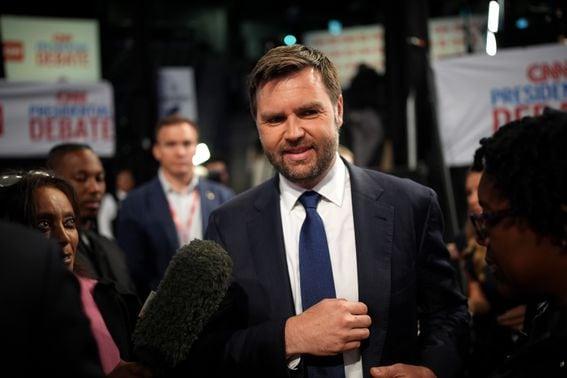
Trump said that the Ohio Senator “will be strongly focused on the people he fought so brilliantly for, the American Workers and Farmers.” Former President Donald Trump, the presumptive Republican nominee for leader of the U.S., announced he chose crypto-friendly Sen. J.D. Vance (R-Ohio) as his vice presidential candidate. “After lengthy deliberation and thought, and considering the tremendous talents of many others, I have decided that the person best suited to assume the position of Vice President of the United States is Senator J.D. Vance of the Great State of Ohio,” Trump wrote on social media app TruthSocial. “J.D. has had a very successful business career in Technology and Finance, and now, during the Campaign, will be strongly focused on the people he fought so brilliantly for, the American Workers and Farmers in Pennsylvania, Michigan, Wisconsin, Ohio, Minnesota, and far beyond.” Vance’s odds of being nominated for vice president on crypto-based prediction market platform Polymarket stood at 70% on Monday, by far the highest among all competitors. The "Hillbilly Elegy" author and venture capitalist was a favorable choice among leaders in the crypto space given its previous efforts to bring clearer legislation. He most recently drafted a bill that would revamp how the U.S. regulates digital assets, according to Politico, which sources said would be even more crypto-friendly than a bill that was passed by the House in June. North Dakota Governor Doug Burgum and Florida Sen. Marco Rubio were also seen as likely candidates to be Trump's running mate, but were reportedly informed earlier Monday that they were out of the running. Vance has not disclosed buying or selling any cryptocurrencies in his most recent Senate financial disclosure, though in 2022 he disclosed he held between $100,000 and $250,000 of bitcoin. https://www.coindesk.com/policy/2024/07/15/pro-crypto-ohio-senator-jd-vance-is-donald-trumps-vice-president-pick/
2024-07-15 16:53
The second-largest crypto exchange, OKX, asked key trading firms for more information about their clients, in what appears to be an effort to root out misuse of a VIP fee program. Crypto exchanges appear to be cracking down on who is eligible for the discounted trading fees they offer to their largest customers. OKX, the second-largest exchange, just asked prime brokerages for more information, following changes at larger rival Binance. Cryptocurrency exchanges are cracking down on brokerages that bundle clients' orders to enjoy lower, VIP trading fees. In a letter reviewed by CoinDesk, OKX, the second-largest exchange by volume, recently asked prime brokers for details of subaccounts including the names of the entities or individuals that control each subaccount and the jurisdiction in which they are located. OKX said it needs the information by July 17. "A failure to do so may result in undisclosed subaccounts being restricted from trading and/or subaccount closure," the letter said. Earlier this month, OKX's larger rival Binance changed its Link Plus interface, effectively closing a loophole that let prime brokers use a multitiered fee system to offer rebates to clients. Binance said the measure was "to uphold compliance and ensure a level-playing field for all users, whether they access Binance directly or via an intermediary." That news was first reported by Bloomberg. Exchanges offer their biggest customers discounted trading fees, treating them like VIPs to boost the odds they'll stick around. Prime brokerages – firms that provide trading services for professional, and often large, investors – could, in theory, funnel several customers' trading through a single account at an exchange, qualifying for those lower fees. "This is being done very much for the purpose of disbanding clients under brokers to price them separately," said a person familiar with the prime brokerage industry who asked to remain anonymous. OKX declined to comment. Bybit, another large crypto exchange, is "closely monitoring the recent developments regarding the removal of the prime brokerage multi-tiered fee structure by other platforms," said Eugene Cheung, the firm's head of institutions. "However, we have no plans to make any changes to our fee structure. Our commitment remains steadfast in ensuring compliance and the best interests of our users," Cheung said in an email. https://www.coindesk.com/business/2024/07/15/a-crypto-trading-clampdown-expands-beyond-binance-to-another-large-exchange/

2024-07-15 16:11
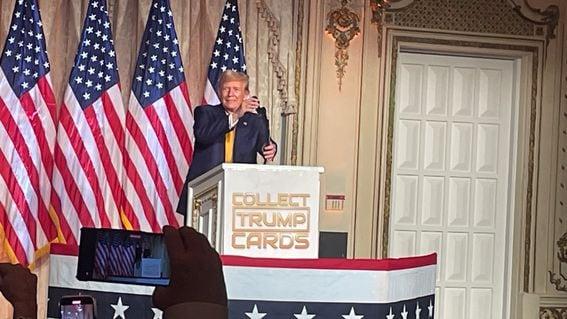
His appearance in Nashville, still a go despite injuries sustained in Saturday's shooting, will cement cryptocurrency as a mainstream political topic. Former U.S. President Donald Trump is still scheduled to speak, in person, at a Bitcoin conference in Nashville later this month, despite injuries he sustained from a failed assassination attempt Saturday. For crypto, this is huge. Crypto is now on the campaign trail in an official capacity, extending beyond throwaway lines to appease whichever voting demographic and fundraising PAC is to be appeased that day. The shred of legitimacy the industry has been begging for since its inception has arrived, embodied in an orange man at a conference about an orange coin. I’m no political strategist, but I always found it strange when presidential candidates spend time campaigning in states they have no risk of losing. Trump, or any Republican candidate for that matter, is not going to lose Tennessee in the 2024 presidential election (let’s face it, folks: Joe Biden is no Bill Clinton). And yet, Trump is stopping by a Bitcoin conference in the Volunteer State, during the immensely busy campaign season, in the same way a candidate makes stump speeches in airplane hangars for the military vote and in front of factories in the name of the American blue collar, with Teamsters in tow, for the union vote. Even though the polls and data suggest that most people don’t use or own crypto — 7% of American adults used or held crypto in 2023 (according to the Federal Reserve), 28% of Republicans hold or had once bought crypto (according to crypto investment firm Paradigm), 52 million Americans own it (according to crypto exchange Coinbase) — it’s still part of Trump’s reelection strategy. The GOP has even added crypto to its official platform marketing materials (in the unabridged, pdf-downloadable version) under the “Champion Innovation” subpoint, just above “Artificial Intelligence” and “Expanding Freedom, Prosperity, and Safety in Space.” Trump’s appearance in Nashville has a clear message: The content of the conference is more important than the location. There are enough single-issue crypto voters out there to make a difference for Trump. (At least, enough if you factor in prospective donations from the crypto rich: A Trump fundraiser at the event costs more than $800,000 a seat.) The Republicans have been jostling (against … no one, except maybe Independents or Libertarians) to be viewed as the pro-crypto party in the United States. One example is the preemptive anti-CBDC official declarations by people like Florida Gov. Ron DeSantis (perhaps to appear anti-China and pro-capitalism). Another is the voting effort in the House of Representatives to overturn President Biden's veto of a pro-crypto resolution falling neatly on party lines (save one Republican dissenter and some bipartisan support via 21 democrats). To me, it appears that in this election cycle, crypto is standing in as a feather in the cap for the individual freedom talking point GOP voters love, to the point where Trump has completely backtracked on his anti-crypto rhetoric. In 2019 Trump tweeted: “I am not a fan of Bitcoin and other Cryptocurrencies, which are not money, and whose value is highly volatile and based on thin air. Unregulated Crypto Assets can facilitate unlawful behavior, including drug trade and other illegal activity....” Then in 2021 he said Bitcoin is a scam against the dollar” during a Fox Business interview. But then earlier this year at a Mar-a-Lago dinner he voiced his support, saying “…if you’re in favor of crypto, you better vote for Trump”. Clearly, there are votes to be won and Trump wants them. 50 million voters, 100,000 votes: It’s going to get weird We’re due a healthy scoop of reality. Say there are 50 million crypto holders, as Coinbase suggests. Are they all really single-issue voters? No. Of course not. In an interview with CoinDesk’s Marc Hochstein last year, founder of crypto research firm Messari and social media rabble-rouser Ryan Selkis, who has declared "‘war" against Chairman Gary Gensler's SEC and Sen. Elizabeth Warren’s (D-Mass.) anti-crypto army, tacitly acknowledged that not everyone who held crypto would vote for the pro-crypto candidate. But you don’t even need that to win. "Certain states are only won or lost by tens of thousands of votes. So you don't need to have 50 million people become single-issue voters. You only need a couple hundred thousand in the right areas," said Selkis. He’s right. I submit that the 2024 U.S. presidential election will be decided by something like 100,000 votes (not the popular vote, of course, I mean net votes in the battleground states) and so if a candidate is to win, he needs as many votes as he can get in the high-stakes areas. And because President Biden appears to have no interest in dealing with or courting the crypto vote (a significant misstep, in my opinion, as appearing pro-crypto isn’t enough to turn people off a candidate so long as the positioning is correct), every single-issue crypto voter is likely to vote for Trump and try to influence those around them to also vote for Trump. In this way, it makes perfect sense that the GOP believes crypto is a worthwhile place to win some of those critical votes. What’s more, the conference is a spectacle which people are traveling to Tennessee for. Trump won’t be speaking to Tennessee voters, he’ll be speaking to a geographically diverse (dare I … say … decentralized?) cross-section of American voters (that is, if you can get Bitcoiners to vote …). It simply makes too much sense. Crypto is very clearly now solidified in the mainstream. And even though crypto is weird, American politics has been weird too. And the weirdness will continue: it’s going to be weird having Secret Service agents scattered about the Bitcoin conference, it’s going to be weird that mainstream media (and not just their financial or tech reporters) will be in attendance to cover the proceedings, and it’s going to be weird when President Trump again says he wants all the remaining Bitcoin to be Made in America. I guess that when the going gets weird, the weird turn professional. Note: The views expressed in this column are those of the author and do not necessarily reflect those of CoinDesk, Inc. or its owners and affiliates. https://www.coindesk.com/opinion/2024/07/15/trumps-speech-at-bitcoin-conference-will-mark-a-pivotal-moment-for-crypto/
2024-07-15 15:57
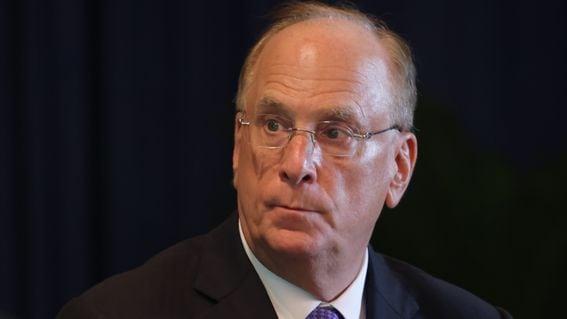
The company's iShares Bitcoin Trust (IBIT) added roughly $4 billion in assets in the second quarter. BlackRock's Larry Fink said bitcoin is a legitimate financial asset that everybody should hold. This comes as the asset manager on Monday posted better-than-expected second quarter earnings. BlackRock's iShares Bitcoin Trust (IBIT) added $4 billion in assets during the quarter. BlackRock (BLK) CEO Larry Fink reiterated his belief that Bitcoin (BTC) is an asset that everybody should consider holding as part of their portfolio. “My opinion five years ago was wrong,” Fink said in an interview with CNBC. “I believe bitcoin is a legitimate financial instrument,” Fink's appearance Monday morning came following BlackRock's second quarter earnings results, which topped analyst estimates as assets under management increased 13% year-over-year to $10.6 trillion. A minor contributor to the company's AUM figure is its iShares Bitcoin Trust (IBIT), which launched in January and has accumulated more than $18 billion since, including $4 billion in the second quarter. Bitcoin, Fink continued, should be part of every investor’s portfolio as it potentially allows for uncorrelated returns and provides financial control. “It is an instrument that you invest in when you’re more frightened,” said Fink. "It is an instrument when you believe that countries are debasing their currency by excess deficits.” “There’s a real need for everyone to look at it as one alternative,” he concluded. https://www.coindesk.com/business/2024/07/15/blackrocks-larry-fink-bitcoin-is-legitimate-financial-instrument/