2024-07-10 12:31
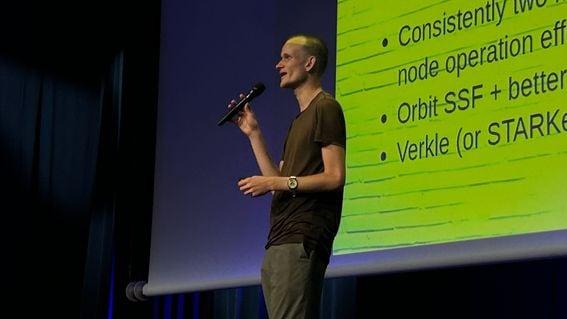
The co-founder and intellectual leader of the largest smart-contracts blockchain ecosystem addressed a packed room at the EthCC conference in Brussels. BRUSSELS – Ethereum co-founder Vitalik Buterin gave a keynote talk about hardening the Ethereum blockchain as a base layer, in front of a packed room full of an estimated 1,100 attendees, at a developer conference in Brussels on Wednesday. Buterin spoke at length during his presentation at the Ethereum Community Conference (EthCC) about the strengths and weaknesses of the largest smart-contracts blockchain and its sprawling ecosystem, including his concerns about transaction censorship, as well as a proposal to increase the “quorum threshold” from 75% to 80%. Buterin said he believes the strengths of the Ethereum ecosystem include that it is a “large and reasonably decentralized staking ecosystem,” and that it is a highly international and intellectual community. Weaknesses of the blockchain still need to be addressed, Buterin said, including the difficulty of solo staking given the requirement for 32 ETH to become a validator for the blockchain, and that running a node is technically complicated. He said both of these issues “are very addressable.” The Ethereum community's intellectual leader ran through an array of technical improvements – meant to fix the various weaknesses that exist on Ethereum – that would allow for “protocol simplification.” “So if you want a robust ecosystem, it needs to be simple," Buterin told the crowd. "It should not have these, like, 73 random hooks and some kind of backwards compatibility because of some random dumb thing that this random guy called Vitalik came up with in 2014.” 51% attack Buterin also expressed concerns about a 51% attack on the blockchain, sharing that the collective Ethereum community assumption would be that everyone rally together, force a minority soft fork and slash the attacker. “It depends on a lot of assumptions around coordination, ideology, various other things, and it's not clear how to do something like that as well in 10 years,” Buterin said. One of Buterin’s more concrete proposals that he was advocating for came from the idea that recovering from chain attacks becomes very hard if that chain finalizes; increasing the quorum threshold to 75% to 80% might help prevent that. “I think there's value in really doubling down on these strengths, and at the same time, recognizing and fixing our inadequacies and making sure that we actually live up to our very high standards,” Buterin told the crowd. Buterin has frequently made an appearance at EthCC in past years. In 2023 he spoke about challenges surrounding "abstraction," and the year before that he spoke about Ethereum ahead of the Merge. https://www.coindesk.com/tech/2024/07/10/vitalik-buterin-reflects-on-strengths-weaknesses-of-ethereum-hardening-the-blockchain/
2024-07-10 11:39
The online platform is said to be linked to the nation's ruling family and allegedly hosts posts offering services including deepfake scams, money laundering and so-called pig butchering. Huione Guarantee, a Cambodian online platform said to be linked to the nation's ruling family, hosts merchants who allegedly supply scam operators and have collected as much as $11 billion in crypto, according to a research report. Services offered by merchants' customers include production of deepfakes, money laundering and website development for "pig butchering" scams, according to Wired. Huione Guarantee, a Cambodian online financial platform linked to the nation's ruling family, is a marketplace that hosts merchants whose customers include scam artists, particularly those helping develop pig-butchering scams, that have raked in $11 billion, Wired alleged, citing its own research and information from crypto-tracing firm Elliptic. Wired said the platform, which provides deposit and escrow capabilities for peer-to-peer transactions conducted over the Telegram messaging system, hosts listings that can be used for activities including deepfake scams, money laundering and so-called pig butchering, in which a victim is wooed before being financially drained by their apparent admirer. Users transact primarily using USDT, the world's largest stablecoin. Because USDT can be traced over the blockchain, Elliptic said it was able to follow the fund flows. “I’m not sure whether Huione Guarantee was originally established with this in mind, but it’s certainly become primarily a marketplace for online scammers,” Tom Robinson, Elliptic’s cofounder and chief scientist, told Wired. According to Elliptic, Huione Guarantee is "part of Huione Group, a Cambodian conglomerate with links to Cambodia’s ruling Hun family," which includes Cambodia’s prime minister, Hun Manet. Officials of Huione Guarantee could not be reached by CoinDesk: Telegram addresses on the website were closed, and an email sent after business hours in Cambodia did not elicit a response. The office of the Council of Ministers of Cambodia did not respond to an email seeking a comment sent after office hours. The website includes the disclaimer: "Huiwang Guarantee does not participate in nor understand the specific business of customers. As the guarantor, we are only responsible for one party receiving the goods and the other party receiving the money," according to a Google translation. In May, companies including Coinbase, Kraken, Meta, Ripple, Tinder and Hinge formed the "Tech Against Scams" coalition to protect users. USDT's popularity as a medium for money laundering was mentioned in January by the United Nations Office on Drugs and Crime (UNODC). USDT issuer Tether said at the time that the stablecoin had been singled out. When blockchain analysts choose to publicize their findings without engaging directly with counterparties this “encourages a bystander effect, where individuals and in this case companies, observe wrongdoing but choose to record it for social media engagement and notoriety – rather than prioritize intervention,” a Tether spokesperson said today. Read More: UN Says Tether Plays Major Role in Illicit Activity in East Asia; Stablecoin Issuer Hits Back CORRECTION (July 10, 13:20 UTC): Clarifies throughout that the activities are offered by third-party merchants through the platform, not by the platform itself. https://www.coindesk.com/policy/2024/07/10/cambodias-huione-guarantee-enables-global-scams-worth-11-billion-report/

2024-07-10 10:35
BTC held largely steady amid the continued divestment of coins, having failed to keep gains above $59,000 during the Asian hours. The wallet associated with the German Federal Criminal Police Office (BKA) moved 5,103.5 BTC during the European hours, according to Arkham Intelligence. BTC held largely steady amid Germany's continued divestment of coins. Bitcoin (BTC) holds steady at around $58,500 amid German state Saxony's fresh movement of coins on-chain, having failed to keep gains above $59,000 during the Asian hours. At press time, the leading cryptocurrency by market value traded at $58,470, down 1.6% from the high of $59,450 reached at 1:06 UTC, according to data tracked by CoinDesk. Per Arkham Intelligence, so far today, the German Federal Criminal Police Office (BKA) has moved over 10,853 BTC worth $637 million, to exchanges Kraken and Coinbase and market makers like Cumberland and Flow Traders, continuing its proactive approach of liquidating BTC seized from a privacy website. On Tuesday, CoinDesk reported that it was the German state of Saxony that has been moving bitcoin for the past few weeks in accordance with standard procedure. The state began selling BTC in the second half of June and has since liquidated 30,997 BTC, roiling the crypto market. BTC has dropped over 15% in the past four weeks, with prices hitting a low of $53,550 at one point last week. As of writing, the wallet tied to BKA held 13,360 BTC ($784.96 million). The steady price action suggests the market is slowly getting comfortable with the divestment and potential selling by Mt. Gox creditors. "The market seems to be growing more comfortable with the outflows from Mt. Gox and the German government. The spot Bitcoin ETFs are now seeing strong inflows again, indicating signs of a trend reversal. This is further supported by the RSI, which shows that the undersold level we highlighted a few days ago was seen as an opportunity by investors," Valentin Fournier, analyst at BRN, said in an email. "We continue to expect positive news from [Thursday's U.S.] CPI, but we anticipate the Fed will delay rate cuts until September. Possible hawkish comments, as seen after the strong PCE on June 28, could lead the market to react as if inflation is not decreasing. Therefore, we recommend taking profits ahead of a potentially shaky end to the week." Still, the broader outlook remains positive with major economies in an expansionary phase of the business cycle and traditional market exhibiting peak optimism for technology stocks. https://www.coindesk.com/markets/2024/07/10/bitcoin-steady-at-585k-as-german-state-saxony-moves-300m-in-btc/

2024-07-10 09:47
She has previously called for crypto to be regulated while recognizing the technology's potential. U.K. Prime Minister Keir Starmer named Tulip Siddiq as City Minister on Tuesday. Siddiq has previously called for mitigating the risks that crypto poses as well as harnessing the sector's potential. U.K. Prime Minister Keir Starmer named Tulip Siddiq as Economic Secretary to the Treasury and City Minister, a position that involves overseeing financial services including crypto. Siddiq, who held the Shadow City Minister post while in opposition, was appointed after the Labour party's landslide election victory last week. The party said recently it will support the Bank of England's digital-pound plans and wants to make the country a tokenization hub. In a New Statesman article two years ago, the 41-year-old wrote about both the threats and potential she saw in the crypto and blockchain industry. "Properly regulated crypto assets have the potential to transform our economy and the financial services sector," Siddiq, who represents London's Hampstead and Highgate constituency, said in the article. "Many innovative companies are embracing different forms of blockchain technology to improve transparency in finance and to create high-skilled, high-productivity jobs across the UK." She has also spoken about crypto fraud in parliamentary debates, and urged for more to be done to mitigate this. The Conservative Party's City Minister at the time, Andrew Griffith, said measures were being put in place to help tackle fraud via the Economic Crime and Corporate Transparency Act in response, which passed into law last year. That legislation was promoted by the Home Office, which will now be headed by Yvette Cooper. While in government, the Conservative Party said it wanted the country to be a crypto hub. Last year, it passed legislation for crypto to be treated as a regulated activity and held consultations on a phased approach for regulating crypto that started with stablecoins. Siddiq's predecessor, Bim Afolami, promised to usher in secondary legislation for stablecoins and staking but did not manage to do so before the election. Members of the crypto community told CoinDesk they expect the Labour government to push ahead with these plans. https://www.coindesk.com/policy/2024/07/10/tulip-siddiq-appointed-as-uk-city-minister-with-responsibity-for-financial-services-crypto/

2024-07-10 09:00
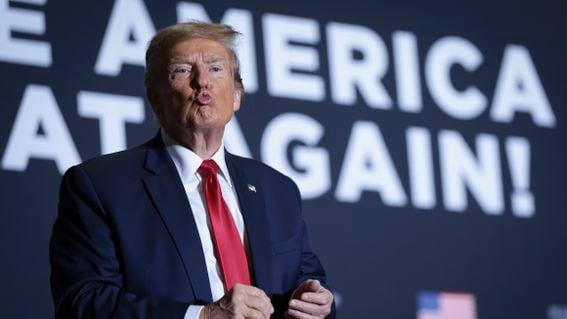
A Paradigm-sponsored poll of Republicans shows that some of them who weren't fans of former President Donald Trump like his newfound support for digital assets in the U.S. Former President Donald Trump's recent embrace of cryptocurrency after his long-standing skepticism may win him some votes among reluctant Republicans as he seeks a return to the White House in November, according to an industry-sponsored poll released on Wednesday. His party's presumptive nominee for president, Trump made a series of positive remarks about aiding the U.S. crypto sector that has caught the attention of some voters, the poll paid for by crypto investment firm Paradigm indicated. The snapshot of Republican sentiment suggested 13% of those who weren't planning on voting for him felt his crypto position made them see him in a more positive light, according to the data compiled by polling firm Echelon Insights. Most of those surveyed (60%) believe Congress needs to come up with regulations for crypto businesses, the polling suggested, and the Republicans generally don't like how today's financial system operates. "Republicans understand the appeal of crypto and support congressional action to establish clear and predictable rules," Katie Biber, Paradigm's chief legal officer, and Alex Grieve, the company's government affairs lead, wrote in an analysis of the data. The poll of more than a thousand likely GOP voters was conducted in mid-June, well before the televised debate that threw the race between Trump and President Joe Biden into some turmoil. Trump cruised toward his party's nomination in this year's primaries, and the party convention is approaching next week to make it official. More than one in four of the Republicans polled had dabbled in crypto ownership (28%), and that involvement skewed toward younger, male and non-white demographics. Those responding almost universally (94%) believe their personal financial records should remain private, and among the smaller subset of people familiar with central bank digital currencies (CBDCs), 68% opposed it for the U.S. The results were a bit narrower on whether the U.S. government ought to pave the way for the private sector to produce payment products that can compete with China's digital yuan: 40% of the people were for it and 31% against. Polling of voters this year has revealed complicated impressions of crypto. This poll showed slightly more of the Republicans answering the questions had a positive impression of crypto (36%) versus a negative view (30%), but the 3.5% margin of error leaves some uncertainty in those levels. A Harris Poll survey released in May suggested fewer than one in three – 31% – of voters in a handful of key swing states had a positive take on crypto. A separate Harris Poll questioning a wider pool of likely U.S. voters released later that month showed a third of the electorate saying they'll weigh candidates' crypto positions when they're making a decision on whether to support them. So, crypto may be emerging as one deciding factor for voters, though their sentiments aren't universally in favor of the industry. Republican leaders seem to have received the message of voters favoring cryptocurrency, and the Republican National Committee announced earlier this week that it was including digital assets support in the party platform. Trump remains in a very close race against President Joe Biden, according to national presidential polling, though Trump's slight edge grew after the CNN debate in which Biden was perceived as delivering a poor and halting performance. Read More: Solana ETF Applications Look Like Bets on Trump Retaking White House, Making U.S. Friendlier to Crypto https://www.coindesk.com/policy/2024/07/10/trumps-new-crypto-enthusiasm-could-help-him-win-more-votes-poll/
2024-07-10 08:26
The broker initiated coverage on miners Iris Energy and Core Scientific with outperform ratings. Bitcoin miners have secured ample power supplies and operating capabilities and can help companies build AI data centers, the report said. Bernstein initiated coverage of miners Iris Energy and Core Scientific with outperform ratings. The broker remains a bitcoin bull and forecasts the token reaching $200,000 by 2025, $500,000 by 2029 and more than $1 million by 2033. Bitcoin (BTC) miners are attractive partners to help build artificial intelligence (AI) data centers, due to their available power supplies and operating capabilities, broker Bernstein said in a research report on Tuesday. Recent AI deals including Core Scientific’s (CORZ) 12-year agreement with CoreWeave and Coatue Management’s $150 million investment in Hut 8 (HUT) have become key catalysts for the sector, the report said. Bernstein initiated coverage of miner Iris Energy (IREN) with an outperform rating and a $26 price target. The broker also initiated coverage of Core Scientific with an outperform rating and a $17 objective. Iris Energy was trading at $13.40 in early trading on Tuesday, Core Scientific at $9.79. Bitcoin miners have secured large amounts of power supply, and today control about 6 gigawatts (GW) of power access with a pipeline of up to 12 GW by 2027, the report noted. The miners have a lead in the “large load power interconnect queue” and therefore can help potential partners save time in securing energy supplies. “Bitcoin data centers are ideal for retrofit due to high power density racks, cooling infrastructure and general data center operating capabilities,” analysts led by Gautam Chhugani wrote, adding that “we expect 20% of bitcoin miner’s power capacity to pivot to AI by 2027 end.” The five largest U.S. bitcoin miners are expected to continue consolidating scale and to grow to about 25% of the bitcoin global hashrate, with the medium-term option to pivot to AI, Bernstein said. Hashrate is a proxy for competition in the industry and mining difficulty. The broker remains a bitcoin bull, and forecasts the asset reaching $200,000 by 2025, $500,000 by 2029 and more than $1 million by 2033, and following the successful launch of spot bitcoin exchange-traded funds (ETFs) in the U.S. in January it said its conviction is higher. https://www.coindesk.com/markets/2024/07/10/bitcoin-miners-are-attractive-partners-to-build-artificial-intelligence-data-centers-bernstein/