2024-06-17 14:18
Users can mint new tokens using the company's new Alloy platform, which will be part of Tether's upcoming tokenization venture, CEO Paolo Ardoino said. Tether, the company behind the $110 billion stablecoin (USDT), debuted Monday a new token minting platform called Alloy on the Ethereum network that lets users create tokens collateralized by Tether's tokenized gold (XAUT). "Alloy by Tether is an open platform that allows to create collateralized synthetic digital assets and will soon be part of the new Tether digital assets tokenization platform, launching later this year, Paolo Ardoino, CEO of Tether," said in an X post. The platform may potentially offer yield-bearing products in the future, said Tether in a press release. The first asset available on the platform is aUSDT, whose price is pegged to the U.S. dollar. Investors can mint aUSDT by depositing Tether's XAUT as collateral. XAUT has a $570 million market capitalization and is backed by physical gold stored in Switzerland, according to Tether. The aUSDT token is targeted for users who want to use crypto for payments and remittances without selling their gold-backed tokens, the press release explained. The position needs to be overcollateralized, meaning that the amount of new tokens users can mint is maximized at 75% of the collateral value. Moon Gold NA, S.A. de C.V., and Moon Gold El Salvador, S.A. de C.V. will handle the asset issuance, which are regulated under El Salvador's National Commission of Digital Assets (CNAD). Tether's new offering followed Tether's efforts to expand its services beyond issuing USDT, the largest stablecoin by market value and a backbone of the digital asset market. The company recently invested in bitcoin (BTC) mining, payment processing and artificial intelligence (AI) via cloud computing. Ardoino also outlined plans in April to launch a tokenization platform that would facilitate the creation of digital versions of a range of assets including bonds, stocks, funds and loyalty reward points. https://www.coindesk.com/business/2024/06/17/tether-debuts-new-synthetic-dollar-backed-by-tokenized-gold-in-tokenization-push/

2024-06-17 13:26
Hirsch was the chief of the crypto asset and cyber unit in the Division of Enforcement at the U.S. SEC. David Hirsch, the chief of the crypto asset unit in the enforcement division of the SEC, has left the role. Hirsch announced the decision in a post on LinkedIn without stating what his next professional step would be. David Hirsch, a senior member of the U.S. Securities and Exchange Commission crypto oversight unit has left the organization, he posted on LinkedIn on Monday. Hirsch was the chief of the crypto asset and cyber unit in the Division of Enforcement at the U.S. SEC. "This past Friday was my last day with the SEC after almost 9 years," Hirsch said in the post. " I’m particularly proud of the historic work done by the Crypto Assets and Cyber Unit team I had the privilege to lead." Hirsch was the SEC's crypto enforcer against cryptocurrency exchanges and decentralized finance (DeFi) projects. He had previously acknowledged that the agency's current litigation load is heavy, and the SEC can't go after everything, but that it wasn't done chasing down those it sees as violating securities laws in the same vein. "Every success I was a part of was the direct result of collaboration and combined efforts towards a common goal, Hirsch added. Hirsch did not say what his next professional destination would be but said he would be "sharing more about that soon." Read More: SEC’s Crypto Enforcement Chief Warns More Charges Coming to Exchanges, DeFi https://www.coindesk.com/policy/2024/06/17/us-secs-crypto-enforcer-david-hirsch-quits/

2024-06-17 11:16
Across the broader digital asset ecosystem, investment products saw net $600 outflows of $600 million, entirely driven by BTC's losses The outflows offset minor inflows for a broad selection of altcoins, including ETH, LIDO and XRP. Crypto markets have been laid low by a hawkish stance on interest rate cuts by the FOMC. Bitcoin investment products saw a total of $621 million in outflows last week following mixed economic signals from the U.S, according to asset manager CoinShares. Across the broader digital asset ecosystem, investment products saw net $600 outflows of $600 million, entirely driven by BTC's losses. This was the largest figure since March 22. Grayscale's GBTC was the worst affected, as it often is, experiencing $273 million of outflows. The outflows offset minor inflows for a broad selection of altcoins, including ETH, LIDO and XRP, CoinShares said on Monday. U.S. inflation data for May, as measured by the Consumer Price Index (CPI), beat expectations when it was reported flat for the month. However, the good news was soon tampered by the Federal Open Market Committee (FOMC) of the Federal Reserve holding its benchmark rate range at 5.25%-5.50%. Its economic outlook called for just one 25 basis point rate cut this year. Bitcoin was laid low by this hawkish stance, tumbling to its lowest point in four weeks on Friday at $65,100. At the time of writing, BTC was flat at $66,000. The CoinDesk 20 Index (CD20), which measures the performance of the broader digital asset market, is 1.75% lower. Read More: Explaining Bitcoin's Dull Price Action Amid Record ETF Inflows https://www.coindesk.com/markets/2024/06/17/bitcoin-investment-products-saw-over-600m-in-outflows-last-week-coinshares/

2024-06-17 10:40
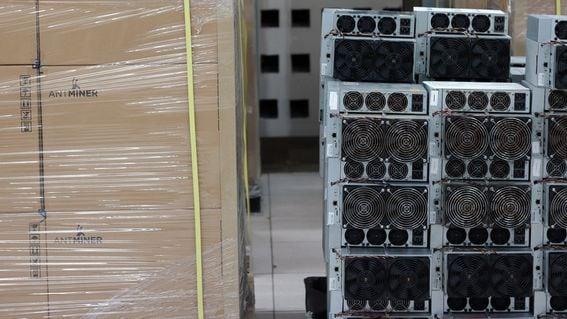
Mining stocks outperformed bitcoin in the first half of the month as investors reacted positively to news of Core Scientific’s AI deal with CoreWeave, the report said. The aggregate market cap of the 14 U.S.-listed bitcoin mining stocks the bank tracks hit a record high in June, the report said. The bank noted that miners outperformed bitcoin on news of Core Scientific’s deal with AI firm CoreWeave. U.S.-listed miners increased their share of the global network hashrate for the second month in a row. The total market cap of the 14 U.S.-listed bitcoin (BTC) miners followed by JPMorgan hit a record high of $22.8 billion on June 15, the Wall Street bank said in a research report on Monday. The bank noted that almost all the companies outperformed bitcoin in the first two weeks of June, with Core Scientific (CORZ) the best performer, adding 117%, and Argo Blockchain (ARBK) the worst, dropping 7%. The world’s largest cryptocurrency fell 3% in the same period. Bitcoin mining stocks gained in the first half of the month as investors reacted positively to news of Core Scientific’s deal with artificial intelligence firm CoreWeave, the report said. Mining difficulty also extended its fall since April's reward halving. “The network hashrate, a proxy for industry competition and mining difficulty, declined ~7 EH/s (1%) since May,” analysts Reginald Smith and Charles Pearce wrote. U.S.-listed miners have increased their share of the network hashrate and, combined, the 14 companies now “accounts for ~23.8% of the global network hashrate,” a gain of almost 1% on the previous month. This was the second month of network hashrate gains for U.S. miners, the bank noted, and an encouraging sign that “inefficient private operators scaled back operations post-halving.” https://www.coindesk.com/markets/2024/06/17/us-listed-bitcoin-miners-reached-record-total-market-cap-of-228b-in-june-jpmorgan/
2024-06-17 08:55
Members of the global financial stability body discussed areas that "warrant further attention" in the crypto sector during a meeting in Toronto last week. The FSB will undertake more work on the risks posed by stablecoin arrangements in emerging and developing economies. It will also consider the challenges emerging from higher levels of stablecoin adoption in the crypto sector. The Financial Stability Board (FSB), which monitors the global financial system for systemic risk, said it will undertake further work on the challenges posed by stablecoins in emerging and developing economies. The decision was taken during a meeting in Toronto of the FSB's plenary, the sole decision-making body of the standard-setting and advisory organization, according to a Friday statement. A stablecoin is a cryptocurrency whose value is pegged to another asset, such as the dollar or gold. The FSB has been one of the main architects of global crypto policy. Last year, along with the International Monetary Fund, it framed a joint policy paper on crypto, warning against implementing blanket bans to mitigate risks associated with the sector. At last week's meeting, FSB members discussed areas that "warrant further attention" in the crypto sector. "In emerging market and developing economies (EMDEs), crypto-assets pose particular challenges for monetary policy and capital flow management," the FSB said. "Members discussed the challenges posed by the relatively higher levels of adoption and risks of global stablecoin arrangements in EMDEs. The FSB will undertake further work to consider how these challenges can be addressed." Stablecoin regulation has been a sticking point between the Group of 7 (G7) biggest industrialized nations and the larger G20. Those differences appear unresolved even as a G7 summit in Italy concluded last week. Read More: Stablecoin Regulation Is a Sticking Point Between the G7 and G20 https://www.coindesk.com/policy/2024/06/17/financial-stability-board-to-extend-its-work-on-stablecoin-risks-in-emerging-and-developing-economies/

2024-06-14 17:15
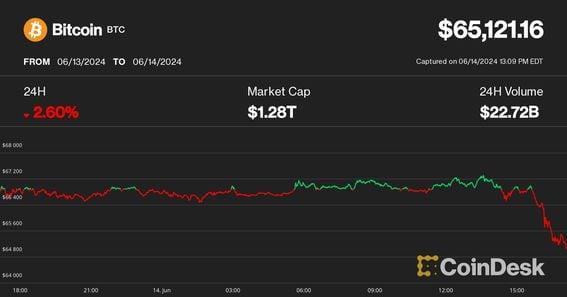
Some $180 million of leveraged derivatives positions were liquidated across all crypto assets during the shake-out, CoinGlass data shows. What looked like prime time for crypto assets on softening inflation data has turned into an ugly week with bitcoin (BTC) tumbling to its weakest price in four weeks on Friday. BTC tumbled more than 2% in an hour to $65,100 during the U.S. trading session from around the $67,000 area. The leading crypto was down 7.5% over the past seven days. Smaller cryptocurrencies saw even steeper declines, with the broad-market benchmark CoinDesk 20 Index shedding almost 12% week-over-week. Ether (ETH) dropped to $3,400, losing over 10% during this period, while native tokens of rival layer-1 networks Solana (SOL), Avalanche (AVAX), Cardano (ADA) and Near (NEAR) sported 15%-20% declines, CoinGecko data shows. The swift tumble liquidated nearly $180 million of leveraged derivatives trading positions across all crypto assets over the past 24 hours, most of them longs betting on higher prices, CoinGlass data shows. This week's shake-out saw a total of over $870 million in liquidations, flushing excess leverage from markets. Analysts and many market participants just a few days ago anticipated an imminent breakout for bitcoin to new record highs, supported by a slower pace of inflation and softer economic data, but attempts for rallies were quickly sold off, leaving BTC stuck in its sideways range. The Federal Reserve this Wednesday projected only one rate cut for this year, less than the central bank's previous forecast, dashing investor hope for looser monetary policy coming this summer. Political uncertainty in Europe with a snap election being called in France also pushed the U.S. dollar index (DXY) higher against other major currencies to its strongest level in more than a month, putting pressure on bitcoin. Bitcoin also struggled with increased selling from miners and profit-taking from long-time holders near the $70,000 area, 10X Research noted, weighing on the broader crypto market. https://www.coindesk.com/markets/2024/06/14/bitcoin-plunges-to-65k-altcoins-bleed-10-20-as-week-turns-ugly/