2024-09-18 06:49
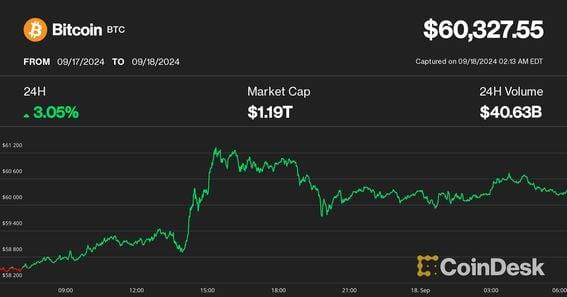
Traders betting on Fed fund contracts are pricing in a 65% implied probability of rates cut to a 4.5-5% range. PLUS: Circle announces partnership with Polymarket Bitcoin is trading above $60,000 as traders await announcements from the FOMC The CoinDesk 20 (CD20), a measure of market performance, is up 1.1% Bitcoin (BTC) held above $60,000 early Wednesday, after a brief tumble below the level in late U.S. hours, as traders around the globe await a U.S. Federal Open Market Committee (FOMC) meeting where chair Jerome Powell is widely expected to announce rate cuts. BTC traded just over $60,300 at press time, up nearly 4% in the past 24 hours to extend weekly gains over 7%. Major tokens showed mixed movements, with ether (ETH), BNB Chain’s BNB and dogecoin (DOGE) rising under 1% and xrp (XRP), Cardano’s ADA and Toncoin (TON) showing slight losses. The broad-based CoinDesk 20 (CD20), an index tracking the largest tokens, rose 1.1%. The FOMC is expected to release its statement and interest rate decision at 2 p.m. Eastern Time later Wednesday. A pivot to lower borrowing costs has historically buoyed bullish sentiment among traders as cheap access to money spurts growth in riskier sectors. Fed funds data shows traders pricing in a 67% chance of a cut that will bring rates in the 4.5%-5% range from the current two-decade high between 5.25% and 5.5%. A larger cut would see rates drop by half a percentage point, instead of the traditional quarter-point cut. Traders on Polymarket are split between the possibility of a 100 basis points (bps) and 125 bps cut, giving both scenarios a 31% chance of happening. However, some say a 50 bps cut could trigger a sell-off as it signals a worrying sign for the economy. “The size of the rate cut matters because it could lead to different market reactions. While a 25 bps cut would likely boost markets, a 50 bps cut might signal recession concerns, potentially triggering a deeper correction in risk assets,” said Alice Liu, research lead at CoinMarketCap, in an email to CoinDesk. "If the rate cut is seen as a response to weakening economic conditions, it could raise concerns about future earnings growth, potentially leading to a short-term pullback in BTC and other crypto assets,” Liu said, adding that Q4 could bring a shift toward more stability after the U.S. elections. “Historically, Q4 has often been a strong period for Bitcoin, and on average BTC has yielded 90.33% price increase in Q4 for the past 10 years,” she noted. Speaking to Bloomberg at the Token 2049 conference in Singapore, SkyBridge Capital founder Anthony Scaramucci predicts bitcoin will hit a record high on rate cuts and more clear rules in the U.S. around crypto. Scaramucci foresees the possibility of a 150 bps rate cut at the next Fed meeting. Elsewhere in crypto, Sui is up over 7% based on continued positive market sentiment from USDC being launched on the platform as well as Circle enabling its Cross-Chain Transfer Protocol (CCTP), which allows for cross-chain flows on Sui. Meanwhile, at Token 2049, Circle announced it had entered into an agreement with Polymarket to collaborate to further integrate Circle’s infrastructure into the prediction market platform, including CCTP. https://www.coindesk.com/markets/2024/09/18/bitcoin-holds-above-60k-as-traders-warn-of-sell-off-on-50-basis-point-fed-rate-cut/
2024-09-18 05:22
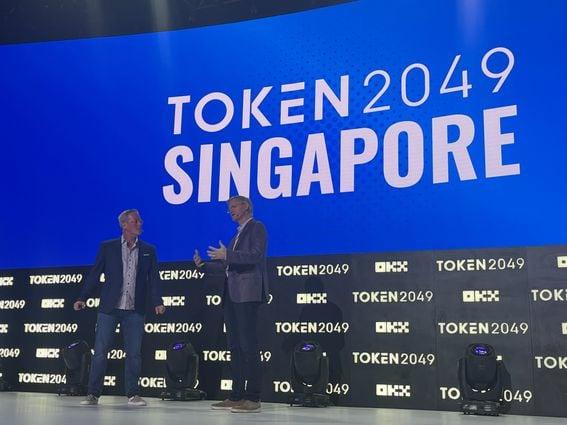
BitGo says USDS is an "open participation" stablecoin that provides rewards to institutions for providing liquidity to the ecosystem. BitGo says it is launching a stablecoin in January 2025 Called USDS this stablecoin will provide rewards to the institutions which power its liquidity. SINGAPORE — BitGo plans to introduce a dollar-backed stablecoin next year, differentiating itself in a crowded market by offering rewards to institutions that provide liquidity to the network, the crypto custody firm announced at Token2049 in Singapore. The stablecoin, dubbed USDS, will be backed by short-duration Treasury bills, overnight repos, and cash, like others on the market. It will be what BitGo calls the first open-participation stablecoin. "The main reason for launching USDS is that, while existing stablecoins serve a good function, we see an opportunity to create a more open and fair system that promotes innovation and, most importantly, rewards those who build the network,” CEO Mike Belshe said in an interview with CoinDesk before his keynote at Token2049. “A stablecoin’s true value comes from the people using it, the liquidity they provide, and the access points for interchange." A stablecoin is a type of cryptocurrency whose value is pegged to another asset class, such as a fiat currency or gold, to stabilize its price. They are used widely in crypto trading and provide most of the liquidity in decentralized finance (DeFi). The biggest are tied to the U.S. dollar, a market that's dominated by Tether's USDT, with a market cap of about $119 billion. The No. 2, Circle's USDC, is about a third of the size. BitGo's offering will differ from its rivals with its rewards-based approach, which incentivizes institutions that are providing liquidity to the USDS network by distributing a portion of the returns generated from its reserves. “At the end of each month, we generate some return from the cash being held in the underlying fund, and we will pass it back to the participants on a pro-rata basis, based on their custody of the asset," Belshe said. While this might sound like it is treading dangerously close to being a dividend and thus classifying the whole operation as an investment contract, Belshe says the difference lies in that it's not distributing the proceeds to the end user, but rather to the institutions providing the liquidity. Other stablecoins have tried creating yield-bearing stablecoins and rewarding end users. But as a compromise, they've needed to exclude the U.S. from the available markets. "You end up with either the folks that opt into only the U.S. market, and then the folks that opt into only the non-U.S. market, like Mountain Protocol or Lift Dollar out of Dubai. They can't sell in the United States because they are a security,” he said. BitGo plans to list USDS on all major exchanges and is targeting $10 billion in assets held within the stablecoin by this time next year. https://www.coindesk.com/markets/2024/09/18/bitgo-to-enter-stablecoin-market-with-reward-bearing-usds-coin/
2024-09-18 03:26
“We are midway through the audit which is a critical piece of the IPO puzzle,” Siu told CoinDesk. Animoca Brands' plans to go public would "depend on the market's status" in the next few years, its Chairman Yat Siu told CoinDesk. Animoca has been looking at Hong Kong or the Middle East for the IPO but Hong Kong is where Animoca is headquartered. Singapore – Animoca Brands is hoping to go public soon, but the final decision on the timeline is dependent on a key component, the "market’s status, amongst other" aspects, the Web3 giant’s chairman Yat Siu told CoinDesk in Singapore on Monday. A major investor in the Web3 space, Animoca's plan to go public became known earlier this year but Siu said we had always wanted to do so. A report in June said the location would be either Hong Kong or the Middle East. Siu also appeared to lean toward Hong Kong as a “strong contender” because the company is headquartered in the city, Bloomberg reported. "It takes time," Siu told CoinDesk, indicating that settling in on a specific timeline was difficult owing to the number of factors involved. “We are midway through the audit, which is a critical piece of the IPO (initial public offering) puzzle,” Siu told CoinDesk. Australia’s DFK Collins is Animoca's auditor, Siu confirmed, as he stated the need for an audit is one of many confidence-building measures the market and institutions look for when a firm signals a desire to go public. Animoca was once a public company in Australia but de-listed in 2020 because of regulatory concerns around crypto. “It’s maybe not a surprise that our growth grew explosively at the time we were delisted because we were able to do many things that, frankly, we couldn’t do because there were things at the time that the ASX was not comfortable with and didn’t understand,” Siu told the Australian Financial Review in 2022. Read More: Animoca Looks to Go Public in Hong Kong or Middle East in 2025: Report https://www.coindesk.com/policy/2024/09/18/animocas-timeline-to-go-public-would-depend-on-the-markets-status-yat-siu/

2024-09-18 00:00
Eight founding member projects include Morpheus and Filecoin Foundation, with Michael Casey, CoinDesk's former chief content officer, as chairman of the new industry group. Eight founding members have started what they call the Decentralized AI Society (DAIS) to fight the possibility of tech giants holding an AI monopoly. The chairman of DAIS is Michael Casey who was formerly CoinDesk’s chief content officer SINGAPORE — Industry leaders have launched a non-profit organization called the Decentralized AI Society (DAIS), dedicated to tackling the probability of the monopolization of the artificial intelligence (AI) industry. The group is headed by Michael Casey, formerly CoinDesk’s chief content officer and chair of Consensus, the crypto media company's annual conference. "The decentralized AI society is acknowledging the fact that centralized platforms in the AI era have a massive head start," Casey told CoinDesk in an interview on the sidelines of the Token2049 blockchain conference in Singapore on Tuesday. "They own all the data, they own all the compute, and I would say they own the regulators." The eight founding members of DAIS include CETI AI, Filecoin Foundation, Bloq, Hypercycle, Morpheus, Hemi, Odyssey and Lumerin. According to the new organization, DAIS aims to tackle four problems: Bringing capital to the decentralized AI world in what has already become an arms race for resources like graphical processing units (GPUs) and the data centers that compute together. Shaping policy to craft AI regulations. Education and promotion of decentralized AI. Engineering to create new algorithms for learning models in a distributed way. "What choice do we have," Casey said, but to fight for a decentralized form of AI, given the power of tech giants like OpenAI, Google, Microsoft and Apple? "I never accept the idea that this is too difficult," he said. "Somebody has to resolve the challenge." Read More: The Future of AI Is Decentralized https://www.coindesk.com/policy/2024/09/18/decentralized-ai-society-launched-to-fight-tech-giants-who-own-the-regulators/

2024-09-17 16:55
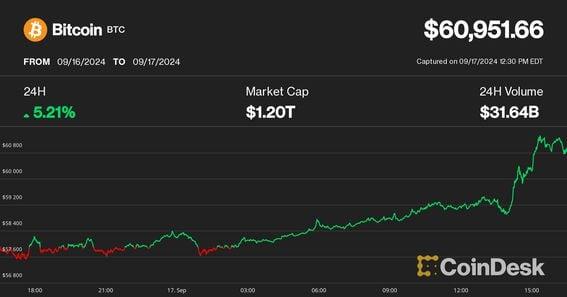
Wednesday's FOMC meeting carries uncertainty for the market, with investors still divided on the magnitude of rate cut. Bitcoin led the crypto rally, hitting its highest price in September, while ETH, SOL, XRP, ADA and AVAX advanced 2%-4%. Significant BTC sell orders between $61,000 and $62,500 may cap further rally, Binance order book shows. "A lot of the focus will be around positioning into tomorrow’s highly anticipated Fed event risk," LMAX Group's Joel Kruger said. Bitcoin (BTC) surged to $61,000 Tuesday during the early hours of the U.S session as cryptocurrencies rose ahead of tomorrow's key Federal Reserve meeting, at which the central bank is universally expected to cut its benchmark fed funds rate for the first time in four years. The largest and oldest cryptocurrency led the digital asset market higher, hitting its highest price since in three weeks at $61,330 before giving up some of the gains. It recently changed hands slightly below the $61,000 level, still up more than 5% over the past 24 hours. The broad-market crypto benchmark CoinDesk 20 Index, meanwhile, advanced 3% to 1,880, as most altcoin majors including ether (ETH), solana (SOL), Ripple's XRP (XRP), Cardano's ADA (ADA) and Avalanche's AVAX (AVAX) underperformed BTC with more modest 2%-4% gains. Despite the rally, bitcoin continues to trade in a fairly tight range and seems unlikely to break out before Wednesday's meeting of the Fed's Federal Open Market Committee (FOMC). The BTC-USDT order book data on Binance, the most liquid trading pair on the largest spot crypto exchange by volume, shows significant sell orders between $61,000 and $62,500, pushing against the idea of a further price increase in the short term. "Looking ahead, a lot of the focus will be around positioning into tomorrow’s highly anticipated Fed event risk," said Joel Kruger, market strategist at LMAX Group in a Tuesday market update. The market is still uncertain on whether the Fed will cut 25 basis points or opt for a larger 50 basis point move. A bit more than 24 hours prior to the central bank's decision, investors have priced in a 63% probability for the more sizable cut, according to the CME FedWatch Tool. "Investors are welcoming the prospect of a larger, more investor friendly Fed rate cut at tomorrow’s meeting, and yield differentials have moved out of the U.S. dollar’s favor as a consequence, added Kruger. The dynamics are not necessarily that straightforward, as the prospect of larger cuts could cause a panicky reaction for risk asset prices, K33 Research analysts noted. "Similar large cuts occurred during the 2001 and 2007 recessions, often signaling heightened recession risks in the U.S," K33 Research said in a Tuesday report. However, those historical comparisons could be misleading, as real rates are at their peak with inflation coming down over the past months allowing a speedier pace of cuts, the report added. Market participants currently see the fed funds rate as 125 basis points lower by the end of the year. "With inflation cooling and unemployment rising, the FED may opt for swift cuts to reach a neutral rate," K33 analysts said. https://www.coindesk.com/markets/2024/09/17/bitcoin-gains-5-to-61k-ahead-of-fed-but-order-books-suggest-rally-could-be-capped/
2024-09-17 14:33
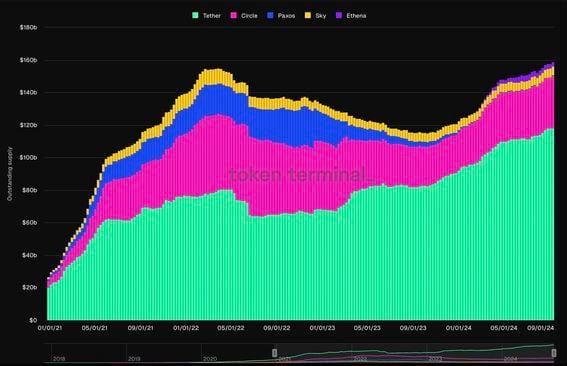
The largest stablecoin's market cap has almost doubled in two years, while key rivals declined and new entrants have yet to pose a challenge. USDT's market share grew to 75% from 55% in the past two years, according to Token Terminal. The Tether-issued stablecoin's supply rose to $118 billion from $65 billion while main rivals struggled. Tether's USDT, the largest stablecoin, is not only growing larger, it's also cementing its dominant position and now accounts for almost 75% of stablecoin market value, up from 55% two years ago, data by blockchain data analytics platform Token Terminal shows. USDT supply nearly doubled in the period, growing to $118.6 billion of the $160 billion stablecoin market from around $65 billion, according to Token Terminal. It's the third-largest cryptocurrency overall, trailing just bitcoin (BTC) and ether (ETH). The No. 2 stablecoin, Circle's USDC, is less than a third of its size. Stablecoins, cryptocurrencies whose price is meant to be pegged to a real-world asset such as a national currency or gold, are key pieces of plumbing for the crypto market, serving as a bridge between fiat money and digital assets. They are increasingly popular for non-crypto activities in emerging regions like Latin America and Southeast Asia, with uses ranging from saving in dollars, payments and cross-border transactions, a fresh report by venture capital firm Castle Island and hedge fund Brevan Howard Digital said. Tether holds over $97 billion of U.S. Treasuries and repurchase agreements in its reserves as of second-quarter 2024, managed by New York-based global financial services firm Cantor Fitzgerald. Tether earns roughly $400 million a month in revenue from yields on those assets, Token Terminal estimated. USDT users said they use the token due to its network effects, user trust, liquidity and its track record relative to other stablecoins, a survey in the report pointed out. It's also been helped by competitors' woes. USDC was hit by the failure of one of its reserve partners, Silicon Valley Bank, during the U.S. regional banking crisis of March 2023. While the token quickly regained its price peg, the event drove investors to rivals, mostly USDT. The token's market cap has dwindled to $35 billion from $50 billion in two years. BUSD, issued by U.S. fintech firm Paxos under the brand of crypto exchange giant Binance, was ordered to shut down by New York state regulators in early 2023. At the time, it was the third-largest stablecoin and boasted a market cap over $20 billion at its peak in late 2022. New entrants have emerged recently, such as payments giant PayPal's PYUSD token and decentralized alternatives from blockchain applications Aave and Curve, but has yet to challenge the leadership of centralized issuers Tether and Circle. https://www.coindesk.com/markets/2024/09/17/tether-issued-stablecoin-usdts-market-share-grows-to-75-as-market-cap-tops-118b/