2024-05-06 13:00
Justine Bone, a cybersecurity firebrand whose research led to recalls of half a million faulty pacemakers, leads the information-sharing and analysis center (ISAC) for crypto firms. The cryptocurrency industry, for years plagued by hacks and other malfeasance, has a new group dedicated to cleaning things up, headed by cybersecurity veteran Justine Bone. Bone is the executive director of Crypto ISAC, the industry's first information-sharing and analysis center, essentially a hub for cybersecurity analysis. A leader in cybersecurity and cryptography for more than 25 years, she was the CEO of medical security research firm MedSec, where her work (in partnership with a short-selling hedge fund) led directly to the U.S. Food and Drug Administration recalling half a million pacemakers that were susceptible to hacking. The devices' manufacturer, Abbott (formerly St. Jude Medical), later issued a firmware update to patch the security holes. The full roster of Crypto ISAC's founding members, who are providing financial support for the organization, will be revealed on-stage May 29 at CoinDesk's Consensus 2024 in Austin, Texas. Included in the list are two of the biggest exchanges, a major stablecoin issuer, one of the best-known custody firms in the field as well as many other household names in crypto. “Up until now, there has not been a crypto ISAC and some people are surprised when they learn that,” Bone said in an interview with CoinDesk. “So a few years ago, some cybersecurity companies who were then joined by some other heavy hitters in the crypto industry, recognized this gap and started organizing." About $1.7 billion was lost to hackers of crypto platforms in 2023, according to blockchain-sleuthing firm Chainalysis. Bringing legitimacy ISACs were introduced as non-profit organizations in the late 1990s to facilitate and legitimize information sharing around cybersecurity vulnerabilities and incidents between public sector and private sector organizations. They are often compared to neighborhood watch programs. The unveiling of Crypto ISAC, which has been several years in the making, is something of a badge of honor, as it joins the crypto industry with many other established verticals that use information sharing to protect critical infrastructure, such as healthcare, retail, the financial sector, the automotive industry and many more. Bone describes an ISAC as “a trusted intermediary that sort of sits in the middle of the conversation around security issues.” Typically these issues could be a heads-up about a new vulnerability in a type of technology, or an active incident underway, where practitioners need to hustle and collaborate to fix the problem, she said. Bone served for years as a member of the Blackhat Review Board, the internationally recognized cybersecurity event series and provider of security research. She also worked as an information security lead at Dow Jones and Bloomberg, has advised several Fortune 50 companies and continues to serve on tech giant HP's advisory board. Diverse membership The organizers of Crypto ISAC run the gamut "from crypto-native companies through to investors ... and cybersecurity solutions providers who specialize in crypto and Web3," Bone said. The team has met with and briefed government officials, she said. The information-sharing protocol underpinning the platform is thoroughly vetted and already adopted by most other ISACs, she said. As well as having the necessary cybersecurity certificates, she said the Crypto ISAC will be "FedRAMP-ready," an important designation that qualifies an organization to deliver services to the U.S. government. “We’re going to be setting up this platform in the next couple of weeks, so when we launch at Consensus, our members will actually have a platform they can log into and see this threat intelligence,” Bone said. https://www.coindesk.com/business/2024/05/06/crypto-now-has-a-neighborhood-watch-to-guard-against-hacks/

2024-05-06 12:34
Also: Trump faces likely conviction, per Polymarket punters; CFTC hearing to discuss political betting ban. This week in prediction markets All eyes on Musk’s tweets – and his future as Tesla CEO Trump’s chance of a conviction are higher than his polling numbers CFTC meeting to discuss potential ban on political betting Tesla was the first company to scale electric vehicles and bring them to the mainstream. There have been challenges along the way, and Tesla’s critics say its founder Elon Musk is an impediment to its success with his erraticism and obsession with posting on his social media platform X, formerly Twitter. Now, Tesla faces an existential threat. Sales and profits are falling, competition is increasing, particularly from China, and drastic cost-cutting measures include staff reductions and simplified car builds. As Tesla struggles with market pressures, leadership and strategic challenges persist, raising concerns about the company's direction and stability. Nevertheless, the market thinks Musk will likely stay on. On Kalshi, the regulated U.S. prediction market platform, "yes" shares in "Elon Musk out as Tesla CEO this year?" are trading at 12 cents, meaning bettors are giving a 12% chance of a change in leadership by Dec. 31. Each share pays out $1 if the prediction comes true, and zero if not. At the same time, Tesla deliveries look to be stable, the market believes, and there’s a 52% chance the company will ship over 400,000 vehicles this quarter, an increase over the “disaster," per analysts, of the last quarter when it only shipped around 386,000. Meanwhile, nothing is going to get between Musk and his X account. On Polymarket, the crypto-based prediction market that operates everywhere except the U.S., bettors are predicting that he’ll tweet (excuse us, post) 75 to 104 times from May 3 to May 10, with outlier money predicting it’ll go all the way to 120. If only there were a way to correlate Musk tweets to the performance of his companies the same way his tweets send memecoins to the moon. Trump Faces Likely Conviction Former U.S. President Donald Trump faces four legal battles as he runs for re-election, and the market thinks he will almost certainly be convicted before election day – but likely not spend any time in prison. Currently, Trump is on trial for 34 felony counts of falsifying business records to conceal a hush-money payment made to the adult film actress Stormy Daniels during the 2016 election, allegedly to protect his presidential campaign from scandal. Aside from that, Trump faces court cases involving allegations he conspired to overturn the 2020 election results related to the Jan. 6 riot on Capitol Hill, mishandling of classified documents, and a racketeering case in Georgia involving a phone call to the state's top election official to "find 11,780 votes." For anyone else, this would be an extraordinarily serious situation that would certainly result in jail time, but this is Teflon Don we are talking about. Currently, Polymarket bettors give a 76% chance that Trump will be convicted before election day. This is up from 57% in late March when the contract was initiated, and Trump’s hush money trial kicked off. But will he spend any time behind bars? Probably not – which puts the market in alignment with legal experts – though bettors have slowly changed their position on this, ever so slightly. Right now, there’s a 17% chance the former President will spend any time incarcerated prior to Election Day. The outcome of the various charges Trump faces range from fines, probation, to the possibility of significant jail time specifically for the mishandling of classified documents and the RICO charges brought in Georgia. Prison time, legal experts have written, is going to be a last resort considering the logistical challenges and the implications of incarcerating a former president who might also be an election candidate. But will any of this benefit incumbent president Joe Biden? Probably not. On Polymarket’s general election contract – which currently has over $120 million bet – Trump’s chances have edged up over the last week to 47% from 44% while Biden’s have remained flat. CFTC Meeting to Discuss Political Betting The Commodity Futures Trading Commission is set to meet on May 10 to discuss a potential rulemaking forbidding political bets. The U.S. regulator is in the midst of a lawsuit involving Kalshi, which is suing the CFTC for rejecting its proposal to list derivatives that allow betting on elections. This legal battle follows a precedent set by Clarke v. CFTC, where the Fifth Circuit Court ruled against the CFTC's revocation of U.S. election betting site PredictIt's no-action letter, potentially influencing the outcome for Kalshi and its efforts to establish large-scale political betting markets in the U.S. Given that the U.S. is about to enter into a hotly contested and acrimonious election, Kalshi and other platforms have a big interest in being able to operate prediction markets legally stateside. Looking at the massive amount of money parked in Polymarket’s election contracts – which has crossed the $120 million mark – it is clear this is something the market wants. Pollsters were critically wrong about the 2016 election and 2020 elections, when they significantly undercounted the Trump vote. They also got the 2022 red wave wrong. Given the size of the Polymarket pot – perhaps larger than the revenue a polling firm brings in every year – one would think there will be a degree of accuracy not yet seen in prior elections. But presumably this money is not American, because Polymarket is not allowed to serve U.S. persons under a settlement with the CFTC. Would the numbers look different if it were a Kalshi contract? The CFTC hearing starts Friday at 10 a.m. EDT, and will be streamed on cftc.gov and the agency's YouTube channel. https://www.coindesk.com/markets/2024/05/06/elon-musk-will-likely-remain-tesla-ceo-and-tweet-non-stop-prediction-markets/

2024-05-06 12:07
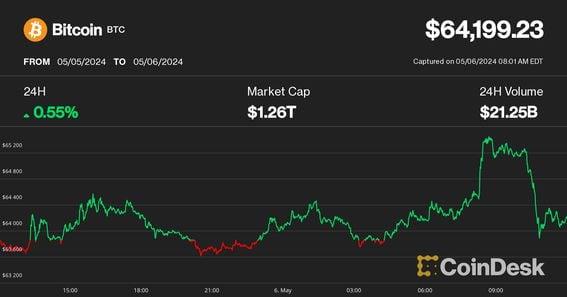
The latest price moves in crypto markets in context for May 6, 2024. Latest Prices Top Stories Bitcoin trades around $64,000 early Monday as the crypto market erased last week's losses. BTC surged to $65,400 during Asia trading hours Monday, its highest price in almost two weeks, and now is up almost 15% from last week's corrective bottom. Bitcoin's swift recovery to a bullish weekly close "sets up the possibility the next higher low is already in place ahead of the next major upside extension to a fresh record high," LMAX Group market strategist Joel Kruger said in a Monday report Alternative cryptocurrencies (altcoins) followed suit, with SOL, AVAX and NEAR advancing 4%-5% over the past 24 hours. The broader crypto market is up 3.2% in the past 24 hours as measured by the CoinDesk 20 Index (CD20). Grayscale's bitcoin ETF saw its first daily inflow after bleeding billions of assets. The Grayscale Bitcoin Trust (GBTC), the largest bitcoin ETF by assets, saw a $63 million of fresh funds from investors on Friday, ending an almost 4-month streak of daily outflows since its conversion to a spot ETF structure in January, data compiled by Farside Investors shows. U.S.-listed spot ETFs also had their best day in more than a week, attracting $368 million of inflows, showcasing a positive sentiment turnaround with bitcoin's rebound. Bitfinex security breach dismissed by CTO Paolo Ardoino as "fake." Controversy arose over the weekend after a hacker group leaked a database of alleged usernames and passwords of over 22,000 Bitfinex exchange users. However, Ardoino refuted the claims and pointed out discrepancies, saying that the company does not store 2-factor authentication data as "clear texts" and the information was likely recycled from previous data thefts unrelated to Bitfinex. Trending Posts Australian Court Hands Win to Market Regulator in Case Against Qoin Blockchain, But There is a Catch BTC-e Operator Alexander Vinnik Pleads Guilty to Money Laundering Conspiracy Charge Former Cred Executives Indicted on Wire Fraud, Other Charges https://www.coindesk.com/markets/2024/05/06/first-mover-americas-bitcoin-nears-65000-amid-strong-crypto-rebound/
2024-05-06 10:56
Part of this case was ASIC's allegation that the Qoin Blockchain and the Qoin Wallets constituted one single scheme but the court disagreed. A court in Australia mostly ruled in favor of Australia’s markets regulator in its case against BPS Financial Pty Ltd (BPS) over its Qoin scheme. The court clarified that blockchain was not part of the financial product. An Australian Federal Court mostly ruled in favor of Australia’s markets regulator in its case against BPS Financial Pty Ltd (BPS) over its Qoin scheme, on Friday, court documents and the regulator’s announcement show. Judge J Downes ruled that the Australian Securities and Investments Commission (ASIC) “succeeded on its Unlicensed Conduct Case, other than in relation to the period during which BPS was an authorized representative of PNI Financial Services Pty Ltd,” who hold a non-cash payments license. That period was 10 months long, ASIC said. In 2022, ASIC sued BPS, asking the court to rule that the entire Qoin project, the token, blockchain, and wallet, was a financial product that required a license. In Australia, ASIC has seen both victories and losses as it ramps up regulatory oversight through legal processes. Part of this case was ASIC's allegation that the Qoin Blockchain and the Qoin Wallets constituted one single scheme, but the court disagreed. "Contrary to ASIC’s submissions, the Qoin Blockchain, a means of acquiring Qoin and a means whereby business operators who hold Qoin Wallets can register as Qoin Merchants are not components of, and are not themselves, the mechanism which allows the user to make the non-cash payment," the order said. Experts said the court made an important rejection of ASIC’s attempts to have an entire blockchain found to be part of a "financial product" under Australian law. “This is an important judicial recognition of blockchains as foundational technology where the use of the technology if it breaches the law, can (and should) be prosecuted, but the technology itself stands separate," said Blockchain Australia Chair and Digital Assets Lawyer Michael Bacina. The order asked ASIC and BPS to confer and agree on a form of an order that would resolve the remaining questions, including penalties for later this month. Read More: Australian Court Dismisses Lawsuit by Market Regulator Against Finder in 'Landmark' Ruling for Crypto Industry https://www.coindesk.com/policy/2024/05/06/australian-court-hands-win-to-market-regulator-in-case-against-qoin-blockchain-but-there-is-a-catch/

2024-05-06 06:48
The stablecoin market supply currently stands at about $150 billion. More than 90% of stablecoin transaction volumes aren’t coming from genuine users, analysis co-developed by Visa finds, according to a Bloomberg report. Out of about $2.2 trillion in total transactions in April, just $149 billion originated from “organic payments activity." Less than 10% of stablecoin transaction volumes are organic or come from real people, according to new findings by Visa and data platform Allium Labs, Bloomberg reported. Out of about $2.2 trillion in total transactions in April, just $149 billion originated from “organic payments activity,” the report said. The analysis removed transactions done by bots and large-scale traders to “isolate those made by real people.” The stablecoin market supply currently stands at about $150 billion, with tether (USDT) and USD Coin (USDC) dominating the market with shares of 75% and 22%, respectively, broker Bernstein has said. Stablecoins are a cryptocurrency tied to another asset class, usually the U.S. dollar, to keep a stable, steady value. They’ve come into sharp focus after PayPal and some others announced they were issuing their stablecoins. Legislation to regulate stablecoins is also seen to be the most likely to make it through the U.S. Congress. "There is also a lot of noise in this data given that blockchains are general purpose networks where stablecoins can be used across a range of use cases with transactions that can be initiated manually by an end user or programmatically through bots," said a note last month about the findings by Cuy Sheffield, Visa’s Head of Crypto. Despite the discrepancy between total transfer volume and bot-adjusted transfer volume, the analysis found a steady growth of monthly active stablecoin users, with 27.5 million monthly active users across all chains. Read More: Stablecoin Bill Unlikely to Get Pinned to FAA Reauthorization, Putting Effort On Hold Again https://www.coindesk.com/policy/2024/05/06/less-than-10-of-stablecoin-transaction-volume-coming-from-real-users-report/

2024-05-04 00:04
GBTC, the biggest spot bitcoin ETF, has seen its assets under management lead over BlackRock's IBIT shrink. The Grayscale Bitcoin Trust (GBTC), the largest bitcoin ETF by assets, saw a net inflow of new money from investors, according to Farside Investors, the first daily increase since the product debuted in January. A net $63 million was added on Friday, according to Farside's tally. The Grayscale product had been the dominant conventional investment vehicle for those looking to invest in bitcoin (BTC) without directly purchasing the cryptocurrency. But it got competition in January when it was converted into an easier-to-trade ETF at the same time nine rival spot bitcoin ETFs began trading. GBTC has much higher fees, and investors yanked billions of dollars from it. Its bitcoin holdings have dropped from more than 600,000 bitcoin to around 290,000 bitcoin, according to fund data compiled by CoinDesk. While the Friday inflow ends the streak of net GBTC withdrawals, BlackRock's iShares Bitcoin Trust (IBIT) is challenging the fund for the title of biggest bitcoin ETF. GBTC now has $18.1 billion in assets, versus IBIT's $16.9 billion. IBIT, now in second place, started at zero in January, while GBTC had more than $26 billion. https://www.coindesk.com/business/2024/05/04/grayscales-bitcoin-etf-sees-inflow-for-first-time-since-january-debut/