2024-05-03 19:38
MoonPay co-founder and CEO Ivan Soto-Wright joins CoinDesk's Jennifer Sanasie in CDTV's "First Mover" to discuss MoonPay's recent partnership with PayPal. CoinDesk's Jennifer Sanasie interviewed MoonPay co-founder and CEO Ivan Soto-Wright for CoinDesk TV's "First Mover" on May 3, to discuss MoonPay's recent partnership with PayPal. Here is the full transcript of the interview. Jennifer Sanasie: MoonPay users can now buy crypto via PayPal (PYPL). The new partnership means that users in the US can seamlessly purchase crypto with PayPal through wallet transfers, bank transfers and debit card transactions. Now the cryptocurrency buying app is the first company to do this with PayPal. CEO and co founder Ivan Soto Wright says that the partnership will help the company reach more customers. So how is this going to enable mainstream adoption? We explore that now. Ivan Soto-Wright, welcome to First Mover. Ivan Soto-Wright: Awesome, thanks for having me. Jennifer Sanasie: Thanks for being here. Now this partnership was announced this week. Let's start at the basics, lay a foundation for me. How's this gonna work? Ivan Soto-Wright: Yeah, so at MoonPay, we're trying to onboard the world to crypto. And so for us, we're constantly looking at new payment methods, new geographies we can expand into. And for us, PayPal was a natural fit. 426 million customers that are inside of PayPal can now use their balances, their debit cards that are saved on the platform, and frictionlessly use PayPal inside of MoonPay to top up their favorite wallet. Jennifer Sanasie: Now, I gotta ask you, I gotta play the devil's advocate here and I'm doing it because people ask me this all the time. Does the world wanna be onboarded onto crypto? Talk to me about some of your user stories and the future that you envision. Ivan Soto-Wright: Yeah, well, I think the future of money is definitely cryptocurrency. I think that eventually we're going to see a place very similar to what we've seen with the Internet. So the Internet really brought down the cost of communication. We're now using voiceover to intero and a protocol to communicate. The same thing will happen for money instead of, you know, all these legacy infrastructure systems that don't communicate on the same language. We can now move to a system built on Internet built by blockchain where transaction costs, I think, will eventually tend towards zero. We're in the early phases of that. It's kind of like the dial-up days. We're constantly getting faster. We're getting speedier. We're going to reduce those cost of transactions. But our job is really just to lower the barriers to enable people to participate. Jennifer Sanasie: How many years do you think it's gonna be until we hit that adoption, until we go from dial-up days to 5G? Ivan Soto-Wright: I mean, it's already really impressive some of the innovation that you've seen on some of these Ethereum blockchains, these layer two solutions. We've already gotten to a place of optimism where transaction costs and gas fees are near zero. And we also have new layer one blockchains that are coming to the market. You know, we don't take a particular take on one blockchain that's going to succeed. We have a view that there's going to be multiple blockchains. And really it's around what are the use cases and the performance that we see as a result of the technology. Jennifer Sanasie: So you're not gonna give me any years, no predictions, no looking into the crystal ball. Ivan Soto-Wright: I think it's followed a very similar trend to the internet. I would never have imagined that MoonPay now has 20 million customers on the platform. It's only been five years since we started the business. I still think we're early days in terms of the overall cycle. I look at market cap somewhat as a proxy. If we look at the Bitcoin market cap today, gold at 12 trillion, Bitcoin around a trillion, we still have a long way to go in terms of adoption of this asset class. Jennifer Sanasie: Let's talk about those 20 million customers. I know that there's a story on coindesk.com. You spoke to us for the launch of this yesterday and you outlined some challenges that customers had, particularly when they were trying to get fiat onto the platform via things like bank cards. Tell me a little bit more about those issues. Ivan Soto-Wright: Yeah, unfortunately, you know, it really pains me as the co -founder of the service. One of our biggest complaints that we receive is sometimes people try to use their card and they have that card rejected by their bank. Now we can't really do much about that. Some banks will decide to decline transactions related to crypto. You know, I think what we see is we want to get to a place where we have the same user experience that we have in traditional fintech. So how do we get there? We partner with traditional fintech and PayPal. Used by over 426 million people. It's a seamless way that people have used to pay. We're now forming a partnership with legacy, some of the bigger fintech platforms to enable that same user experience inside this cryptic ecosystem. Jennifer Sanasie: Have you attempted to form partnerships with any of the banks or have conversations with the banks about this? I know it's not just a MoonPay problem, it's a problem for almost every platform that allows people to buy and trade crypto in the United States and Canada where I'm from, but have you had any conversations with the banks? Ivan Soto-Wright: Yeah, I mean, we're in constant contact with pretty much everyone in this industry. We're always thinking on behalf of our users, how do we provide a better experience? Some banks have updated their policies, some banks haven't. So it just comes down to their appetite. Kind of similar to what you're seeing in the ETF world. There's obviously some players that have decided to not participate full stop. There's others that are really leaning into it like BlackRock. So I think a very similar thing has taken place with banks and their...willingness to work inside this industry. I think for them, the challenge is there are some risks when it comes to cryptocurrency. When you deliver cryptocurrency over a blockchain, it's final. So there's no way to reverse that transaction. And so you do have a potential increased risk for fraud. A lot of the work that we do at MoonPay is to really build the best fraud models to determine should we accept or reject this particular customer and try to de -risk that as much as possible. So we try to do our part. Because we do think this technology is the future and we think that over time that appetite will change. We think that more banks will recognize that this is an important industry to be part of and we'll need tooling like MoonPay. Jennifer Sanasie: You mentioned 20 million customers. Talk to me about how active they are these days. And the reason I ask you that is because it felt like we were going to have an epic year in crypto in January when the ETFs were approved. And now it's feeling a little bit weird if we look at some of what's going on from a macro perspective. The price of Bitcoin is down. There are net outflows with the ETFs now. Talk to me about your user base. Are you seeing an influx of new users? How active are they? Ivan Soto-Wright: Yeah, we actually saw a 43% increase in activity over the last quarter. So we had our best quarter in our five -year history in Q1 this year. And that's given the backdrop of very high interest rates. Most people thought that if interest rates were going to persist at these levels, crypto was not going to be a thing. We've actually kind of seen the opposite. I think a lot of our work is still just trying to improve the user experience. We really believe that if we get the user experience right, people will start to opt into these products similar to how people start to opt in to zoom and you know All these amazing applications that are built on voice over the internet protocol We think the same thing will take place for money and all these new crypto applications, but we're looking at a long period of time. So if you look at the general trend, I try not to look at trends within a year or six months. I really look at zooming out, look at the long term. It's up and to the right. There's more developers coming into the ecosystem. There's new applications that are being built. It just takes time for this ecosystem to flourish. Jennifer Sanasie: You know, I spoke to tech journalist Kara Swisher recently, and I asked her if she thought that we were in a similar phase to the beginning of the internet. You know, she's been around, she's reported quite deeply on the beginning of the internet, and she told me no, she thinks that this sector is a sector that will be around, but maybe not as grand as us who work in the industry like to say it is. Would you agree with that sentiment, or what do you think? Ivan Soto-Wright: I think with any new technology, there's obviously a lot of hype. You go through a hype cycle where everyone is extremely excited about all the promise and then reality sets in. And when it comes down to the reality, the reality for crypto today is the user experience is not where it needs to be. And so that's where we're very committed to our mission of making crypto more like your experience with your fintech than, you know, I think traditional crypto companies that, you know, when I started, there wasn't even graphical user interfaces for some of these wallets. Like you had to use your terminal. It's gotten markedly better and I think the experiences will continue to improve. Jennifer Sanasie: Talk to me a little bit more about that user experience because I think everyone agrees that the user experience needs to get better and we have great web two apps with great user experiences. Where are the challenges? What are the issues facing developers when it comes to creating a good user experience? Because we know what a good user experience looks like. It just feels like we can't really get it right. Ivan Soto-Wright: Yeah, well, I think from our side, it's just constant. We have this word inside of MoonPay called Kaizen, which is continuous improvement. It's these 1 % incremental improvements that you make every single day. You do that over a year, and that's a 3 ,000 % improvement. So we're constantly learning from our users. The reality is it just takes time. You have to adapt that product. You have to get that feedback. You need to listen to your customers. And obviously, trying to solve some of the biggest pain points for them. Like, it's not acceptable if you have a high decline rate because you're getting rejected by your bank. We do things like we prompt the customer based on the six digits of the card number. We could tell them, hey, you could try another payment method. Now we can tell them to try PayPal. Jennifer Sanasie: Talk to me a little bit about the partnership with PayPal. What was that journey like? Was PayPal on board from the get -go? Did it take a little bit of convincing? What was that, I don't wanna call it the dating phase like? Ivan Soto-Wright: Well, we've always had huge admiration for PayPal. They're a phenomenal company. They've always been an innovator. Even since the early days, I remember using PayPal on eBay. I would sell things in my garage online. That was the first time I received money. It was actually through my PayPal account. I see us as kind of building the next frontier. In the same way that you use PayPal to interact with the world of e -commerce, you can use MoonPay to interact the world of crypto and all these new applications. And so I thought it was a natural partnership. I thought that if we could improve the conversion rates for our customers, it was a no brainer. And so we've been spending a lot of time with that team and we're really impressed. They've actually really leaned into crypto. They've been proactive in trying to support more assets on their platform. They've invested heavily in their stable coin initiative, which I think has huge promise. I think we're in the early days of stable coins, but really now you can move frictionlessly money across many different geographies, cross border. They just announced a partnership with zoom. I definitely see the use case for stablecoins being quite strong. We're in the early days. We're obviously still getting to regulatory clarity in the United States around how these things should be backed. But I think ultimately they're going to be an important part of our financial system. Jennifer Sanasie: I know you spoke to a CoinDesk reporter and said it took some time to get PayPal comfortable with the relationship. What did you mean there? Ivan Soto-Wright: It just took time in terms of any major integration. You just have to go through a process. So it's obviously not as fast. As CEO, I want everything to happen yesterday. And so it just takes time to get these things done. But eventually, we get them done. Jennifer Sanasie: Now you are known at MoonPay for the big mainstream partnerships, the big flashy celebrity partnerships. I know late last year there was a MasterCard partnership announced. Any progress there? Ivan Soto-Wright: Yeah, so the MasterCard partnership is one of our most exciting ones. We actually did something very cool at the Arnold Palmer Golf Invitational very recently, where they're starting to look at how do they bring priceless experiences to their customers. Priceless has always been their tagline at MasterCard. And so what they did is they did a bunch of really cool activations at the event. If you scanned, you know, there was a bunch of different QR codes and NFC chips inside the actual event. And if you scan them or you interact with these NFC chips, you would gain collectibles. And some of those collectibles offered you tickets. So if you won't manage to find all these collectibles inside the actual tournament, you would get offered tickets the next day. So it's thinking, how do we provide better experiences to our customers? It's not necessarily, oh, I'm getting an asset because I believe it's going to go up in value. It's an asset that actually has utility. Jennifer Sanasie: Any other big partnerships you can let us know about? Ivan Soto-Wright: We'll have more very soon, but I think this PayPal one is the one that we're super concentrated at the moment. We want to make this a roaring success. We want as many of our users to take it up and actually see success with being able to onboard. It's great for us. Also, for people that have bank payment methods that they'd like to use, they can now use them through PayPal. Jennifer Sanasie: Now, I gotta ask you, everyone who works in this industry has one sector of it that they're very excited about, one that they watch very closely, and it's not always the one that we focus on in our everyday job. Is there a sector in this industry that you're really excited about if you look beyond MoonPay and what MoonPay is doing? Ivan Soto-Wright: I still think we're really early days around the use cases for NFTs. I'm still quite excited about the promise of NFTs. I think we're still early days in terms of how we think about programming content on the blockchain. And so I think things like tickets make a lot of sense to me. I think the ticketing industry today has a lot of inefficiencies. I think a lot of them could be solved by having a robust system that I think will be built on blockchain. I also think gaming assets, I think inside of games, a lot of people collect these digital assets, but they're constrained to the environments. They're in the same way that your money, in a lot of cases, is being held by all these third parties, your data, your property that you have inside of these games is held by third parties, you can now own and control them yourself. And I think that will be the future. Jennifer Sanasie: You and I are excited about the same things in this industry, so great minds. I've been, yeah, of course. Thank you very much for joining me today. Ivan Soto-Wright: Appreciate that. Ivan Soto-Wright: Awesome. Thanks, Jen. https://www.coindesk.com/business/2024/05/03/full-transcript-why-moonpay-and-paypal-partnered-to-expand-crypto-adoption-in-the-us/

2024-05-03 16:55
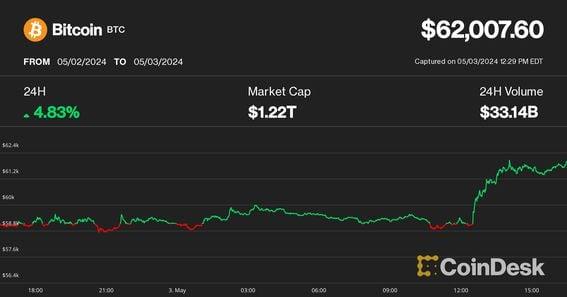
Bitcoin will likely trade in a range between $60,000 and $70,000 through the next few months, the former BitMEX CEO said. Bitcoin jumped nearly 5% following soft U.S. jobs data. The dovish Fed meeting results mean the U.S. dollar's surge likely topped, helping cryptocurrencies, Coinbase analysts said. Cryptocurrencies bounced on Friday led by bitcoin's (BTC) gain, sparking hopes that the worst of the drawdown might be over. BTC surged almost 5% to briefly above $62,000 during U.S. morning hours following a cooler-than-expected U.S. April jobs report that eased concerns about higher interest rates. At press time bitcoin was changing hands at $61,600, up 4.4% and outperforming the broad-market CoinDesk 20 Index's (CD20) 3% advance over the past 24 hours. Ether (ETH) reclaimed the $3,000 level and was up 3% during the same period, while altcoin majors dogecoin (DOGE), shiba inu (SHIB) and Near Protocol's NEAR jumped 5%-10%. The rally happened as the U.S. economy added 175,000 jobs in April, less than the analyst consensus of 245,000 and the previous month's 315,000, according to the government's Nonfarm Payrolls report. It also showed the unemployment rate inching higher to 3.9% from 3.8% in March. Following the report, market participants saw a 68% odds for at least one rate cut by September, up from 57% a week ago, CME FedWatch data indicated. Bitcoin's correction since mid-March coincided with mounting concerns of the Federal Reserve policymakers adopting a more hawkish stance in face of sticky inflation in recent months, with some traders even dismissing chances of any rate cut this year. That's helped the U.S. dollar index to its highest level since November, often a bearish signal for risk assets like crypto. In addition to the soft jobs data, Coinbase analysts David Han and David Duong took note of this week's FOMC meeting at which policymakers indicated no interest in cutting rates, but did taper the pace of the central bank's balance sheet runoff – often referred to as quantitative tightening (QT) campaign – as a dovish sign. "We believe that the FOMC’s more dovish-than-expected statement has signaled the peak in the USD’s upward momentum against both FX [foreign currencies] and crypto pairs," Han and Duong wrote. Arthur Hayes, former CEO of crypto exchange BitMEX, said in his latest essay early Friday that bitcoin has likely bottomed at this week's lows of $56,000, but warned investors to expect a gradual climb instead of a swift recovery to the March highs as markets will cool for the next few months. "Did bitcoin hit a local low [...] earlier this week," asked Hayes. "Yes," he concluded. "I expect prices to bottom, chop, and begin a slow grind higher." Speaking about what's next, he forecasted "a rally to above $60,000 and then range-bound price action between $60,000 and $70,000 until August." https://www.coindesk.com/markets/2024/05/03/bitcoin-hits-62k-as-cryptos-bounce-correction-likely-over-but-expect-a-slow-grind-higher-arthur-hayes-says/
2024-05-03 14:52
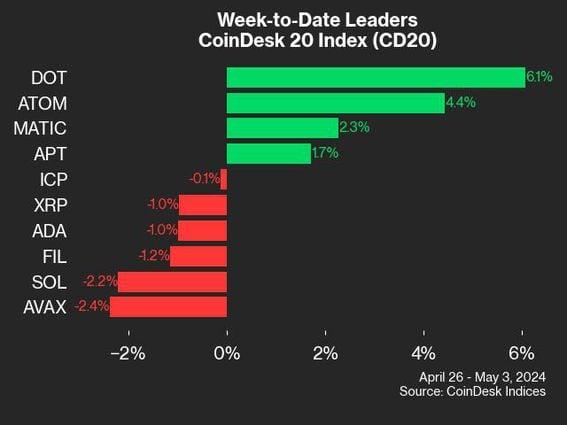
All but four cryptos in the CoinDesk 20 posted losses over the last week, led by declines in NEAR, BCH, and DOGE. CoinDesk Indices (CDI) presents its bi-weekly market update, highlighting the performance of leaders and laggards in the benchmark CoinDesk 20 Index (CD20) and the broad CoinDesk Market Index (CMI). Only four assets in the CoinDesk 20 gained week-to-date. Polkadot (DOT) and Cosmos (ATOM) led the gains, both of which are multi-chain protocols that operate as networks of connected blockchains. Three assets in the index fell more than 10% this week – (NEAR), dogecoin (DOGE), and bitcoin cash (BCH). The CoinDesk 20 is down 15% month-on-month, but has a one-year return of 87%. CoinDesk 20 tracks top digital assets and is investible on multiple platforms. The broader CMI comprises approximately 180 tokens and seven crypto sectors: currency, smart contract platforms, DeFi, culture & entertainment, computing, and digitization. https://www.coindesk.com/markets/2024/05/03/polkadot-and-cosmos-gain-in-a-rocky-week-for-crypto-coindesk-indices-market-update/
2024-05-03 14:30
Both equities and gold have been trading lower since reaching highs in mid-April, the report noted. Both equities and gold have fallen along with bitcoin, the report noted. Coinbase said bitcoin’s recent pullback was below its historical range. The cryptocurrency’s price discovery still remains rooted in global demand trends, the note said. Bitcoin’s (BTC) recent weakness has not been isolated to crypto markets and therefore is not indicative of sector-specific capitulation, Coinbase (COIN) said in a research report Friday. Coinbase notes that both equities and gold have been trading lower since reaching highs in mid-April, against the backdrop of a strengthening dollar. The world’s largest cryptocurrency fell 16% in April, in the biggest monthly decline since June 2022. “What leaves us optimistic in this pullback is that BTC’s maximum drawdown from peak is at 23%, below its historical range,” analysts David Han and David Duong wrote. “We believe that this trend of overall reduced drawdowns will persist, in part because of the legitimization of BTC as a macro asset,” the authors wrote. This has been reinforced by spot exchange-traded funds (ETFs) in the U.S., Canada and Europe and also by the recently launched ETFs in Hong Kong and new applications in Australia. While inflows of overseas ETFs may not be as large as those seen in the U.S., “we think they represent an important signal for regulatory engagement with the asset class globally,” the report said. Blackrock’s iShares Bitcoin Trust (IBIT), the largest spot bitcoin ETF, ended its 70-day inflow streak on Wednesday and saw its first-ever outflow, the report noted. “While this indicates a slowdown of capital inflows to the asset class via the ETF product, we think that ETF flows only drive a portion of BTC price discovery given the global and deeply liquid markets on centralized exchanges (CEXs).” “The average weekday spot volume on CEXs during 1Q24 was $18.8 billion, more than eight-fold the $2.3 billion daily volume of U.S. spot ETFs over the same period,” the note said. “This discrepancy in activity leads us to believe that bitcoin’s price discovery still remains rooted in global demand trends.” The problem with looking at U.S. ETF inflows as a proxy for global price discovery is most obvious with gold, Coinbase said. The largest gold ETF in the U.S., SPDR Gold Shares, has had a net outflow of $3 billion in 2024 even as the precious metal has risen 12% year-to-date. https://www.coindesk.com/markets/2024/05/03/bitcoins-recent-weakness-is-more-tied-to-global-markets-than-to-anything-crypto-specific-coinbase-says/

2024-05-03 12:36
Interest rates and the dollar have both risen strongly in 2024 as expectations of a slowing in the economy and inflation have failed to pan out, but today's report suggests a possible change in trend. The U.S. economy added 175,000 jobs in April, according to the government's Nonfarm Payrolls report released Friday morning. That number stands against economist forecasts for 243,000 jobs and March's 315,000 (which was revised from a previously reported 303,000). The unemployment rate for April was 3.9% versus forecasts for 3.8% and March's 3.8%. The price of bitcoin (BTC) jumped more than 1% to $60,100 in the minutes following the news. Interest rates and the U.S. dollar have both risen strongly in 2024, particularly over the past few weeks, as market expectations of a slowing in economic growth and inflation have failed to pan out. Four months ago, a series of five or six 2024 interest rate cuts by the U.S. Federal Reserve had been priced into forward markets, but, prior today, that was whittled down to one or two, according to the CME FedWatch Tool. In fact, interest rate hikes have begun to enter the chat. At his post-FOMC press conference Wednesday afternoon, Fed Chair Jerome Powell was asked more than once if the central bank was mulling the idea that rates needed to be ratcheted higher. Powell poured cold water over the idea, but continued strong job growth and perky inflation might force the Fed's hand at some point. That tighter than anticipated monetary policy is surely among the array of factors have led bitcoin to tumble roughly 20% from its all-time high reached in mid-March, but this morning's report suggests a change a possible change in trend and prices are bouncing. Traditional markets are also taking the news well. U.S. stock index futures are now all higher by more than 1% and the 10-year Treasury yield has tumbled 11 basis points to 4.47%. The dollar index has fallen 0.8% and the price of gold has risen 0.8% to $2,329 per ounce. A check of other report details shows some weakness as well, with average hourly earnings in April up 0.2% against forecasts for 0.3% and March's 0.3%. On a year-over-year basis, average hourly earnings rose 3.9% versus forecasts for 4% and March's 4.1%. https://www.coindesk.com/business/2024/05/03/us-april-job-additions-of-175k-miss-forecasts-for-243k/
2024-05-03 11:42
The government, which has adopted a pro-crypto stance, must hold a general election by end-January. With results in from about a third of the local councils holding votes, the Labour Party has gained 62 seats, while the governing Conservatives have lost 147. The local election results show how sentiment has changed in the run-up to a general election that must be held by the end of January. Early results from yesterday's U.K. local elections show a swing away from the governing Conservative Party, which has staked out a pro-crypto stance, toward the Labour Party that, while it's expressed support for tokenization, has yet to say where it stands on cryptocurrencies in general. About a third of the country's local councils went to the polls on Thursday, with more than 2,600 seats up for grabs. With results in from 40 of the 107 councils, Labour had won 360 council positions, a gain of 62, while the Conservatives lost 147 for a total of 129, falling behind the Liberal Democrats, BBC data shows. Many of the other results, including the London mayoral election, may not be known until tomorrow or even Sunday. The Conservatives, led by Prime Minister Rishi Sunak, have said that they want the country to be a crypto hub and have ushered in legislation enabling crypto to be treated like a regulated financial activity while shutting down calls for it to be treated like gambling. Labour, meanwhile, has said it will support the Bank of England's digital pound plans and wants to make the country a hub for tokenization, or the representation of real-world assets on a blockchain. These results so far suggest that the Conservatives are unlikely to hold on to power after a general election, which is likely to be held later this year and must be held by Jan. 28, 2025. https://www.coindesk.com/policy/2024/05/03/uk-local-elections-show-swing-to-labour-with-general-election-pending/