2024-04-25 15:26
Co-founders Keonne Rodriguez and William Lonergan Hill are charged with money laundering related to the privacy-protecting wallet. The U.S. government has put to rest any doubts that any involvement in or profiting from privacy tools beyond authoring code for crypto mixers is off limits. Call it an assault on privacy or attack on free speech, but the reality on the ground is that any money that flows into an application designed to mix funds to shield user addresses is being treated as laundered funds, no matter the purpose or destination. Bitcoin Fog. Tornado Cash. Now Samourai Wallet. Samourai Wallet was (its servers have been seized) a bitcoin wallet that promised to "keep your transactions private and your identity masked” through a privacy-preserving service called "Whirlpool." Authorities say the wallet processed over $2 billion in unlawful transactions, including at least $100 million via illegal dark web marketplaces like the Silk Road and Hydra Market. Similar arguments were made about Tornado Cash, when it was sanctioned by the U.S. Treasury, which essentially counted every dollar that flowed through it as criminal in nature. “Together with our law enforcement partners, we will continue to relentlessly pursue and dismantle criminal organizations that use cryptocurrency to hide illicit conduct," U.S. Attorney Damian Williams said in a statement on Wednesday. Op-sec There is much to say about Samourai Wallet’s co-founders Keonne Rodriguez, 35, and William Lonergan Hill’s, 65, op-sec (i.e. “operational security), or apparent lack thereof. Rodriguez was arrested in Pennsylvania and will be arraigned this week, while the U.S. is still working to extradite Hill from Portugal. “I don’t know how they thought they wouldn’t get arrested and prosecuted for this. It sounds like the DOJ has direct evidence of them saying they knew they were helping people conceal illegal transactions and charging for the service,” University of Kentucky law professor Brian Frye told CoinDesk in an interview. The DOJ alleges that Rodriguez and Hill actively solicited criminal customers in their marketing and social media posts. Hill, for instance, reportedly said "At Samourai we are entirely focused on the censorship resistance and black/grey circular economy. This implies no foreseeable mass adoption,” in an intercepted internal message. “Ultimately if you’re knowingly facilitating illicit finance and profiting from it, which is alleged in the complaint, the outlook is bleak,” venture capitalist Nic Carter said in a direct message. “Nevertheless it’s disturbing the extent to which the Biden Admin[istration] is attempting to criminalize privacy.” The Biden Administration has seemingly ramped up efforts to knock down mixing services. That includes arresting Russian-Swedish national, and Bitcoin Fog operator, Roman Sterlingov in April 2021 and participating in the arrest of the co-founders of Tornado Cash in 2023. However, crypto mixers have long been in the sights of criminal prosecutors. In Sterlingov’s case, investigators worked to establish evidence over a period of years. As far back as May 2019, the U.S. Treasury Department’s Financial Crimes Enforcement Network (FinCEN) has been concerned about cryptocurrency “tumblers,” finding that that “persons who accept and transmit value in a way ostensibly designed to protect the privacy of the transmittor [sic] are providers of secure money transmission services and are not eligible for the integral exemption.” In other words, mixers are money transmitters, even though a person is generally only transmitting funds between two addresses they control to anonymize their funds. And if you’re deemed a money transmitter, FinCEN noted, you’re expected to comply with the Bank Secrecy Act. “My opinion is that the crypto industry should treat regulation as 'de force majeure' and adjust to it,” Tal Be’ery, co-founder and chief technology officer of the ZenGo wallet, said. [Force majeure is a common legal clause absolving parties from liability.] “The U.S. government made it very clear that operating a mixer is unacceptable with the prosecution of Tornado Cash operators and therefore going after other mixers could be very much expected.” Privacy dragnet? Others are concerned that it isn’t just mixing services being targeted, but all privacy-preserving blockchain tech. “From the cases against Tornado Cash to the IRS 'broker rule' to the arrest of Samourai Wallet's founders, it's clear that the U.S. government is moving aggressively against privacy tools in crypto,” Galaxy Digital head of research Alex Thorn told CoinDesk. It’s worth noting that, while Rodriguez and Hill remained active in overseeing the protocol since it launched over a decade ago, the Samourai wallet was non-custodial and open-source. The code was "self-hosted” on the company’s open source GitLab repository, although the provided link no longer appears to be working. The Samourai apps have also been removed from the Google and Apple app stores, though theoretically the software can be built, run and hosted by anyone. Some experts contacted by CoinDesk, including Frye, believe that crypto mixers could theoretically be legal to code, but likely not to market or maintain. Releasing software is generally protected by the First Amendment in the United States, because code is a language and language is speech. “While crypto mixers might in theory be legal, if used only for protecting the privacy of legal transactions, using them to conceal illegal transactions is definitely illegal,” Frye said. “It's clear that if developers maintain any involvement in privacy tools beyond authoring code – whether that be operating front-ends, facilitating any kind of money movement or taking fees – they will be targeted. For on-chain privacy to succeed in the future, tools must be completely decentralized,” Thorn echoed. Others, like TradeLayer founder Patrick Dugan, noted that it also matters whether authors of crypto mixer code profit from their inventions. Samourai allegedly earned at least $4.5 million in fees from its wallet and mixer services, according to the indictment. “The case will ultimately come down to any revenue mechanism the developers may have used that might constitute an operating enterprise in the eyes of prosecutors, making them culpable for money laundering done by proxy,” Dugan said, mentioning that, unlike Tornado Cash, Samourai did not have a token. Fighting for privacy Despite the realpolitik of the situation, many in the crypto community see the targeting of crypto mixers as an infringement of the basic human right to privacy. “The government's seizure of Samurai and the arrest of the folks running it is troubling. It feels more like what an authoritarian regime would do rather than a free country. I think people have a fundamental right to privacy in their financial transactions, whether digital or physical,” crypto sleuth Ogle told CoinDesk in an interview. “I'm a big fan of privacy services so I have no moral concerns about what was happening,” said one Bitcoin Lightning developer, who asked to remain anonymous in order to discuss the situation more candidly. “But it seems a bit silly on their part. If I understand the situation correctly these are two American citizens who didn't even do that great a job of covering their tracks. So an arrest is pretty unsurprising.” Others noted that despite the increased heat on privacy services, there will always be demand for these protocols – from legitimate and criminal users. “Given how easy it is to spin up or use another mixer, this doesn't solve the problem of illicit funds being washed," Ogle said. "It just pushes it to another service.” Dugan noted that there are also privacy coins already in circulation for "for those seeking pure Exit via cryptocurrency privacy," though "it ain't easy." He added, "use monero, it's been delisted almost everywhere, so you know it's legit." Zooko WIlcox, founder of privacy coin Zcash, told CoinDesk: “It’s legal to create privacy technology in the USA, and we’re going to keep doing it, because privacy and freedom are core parts of American civilization.” Additional reporting contributed by Cheyenne Ligon and Nikhilesh De. https://www.coindesk.com/consensus-magazine/2024/04/25/samourai-wallet-charges-raise-existential-questions-for-privacy-tech/

2024-04-25 12:21
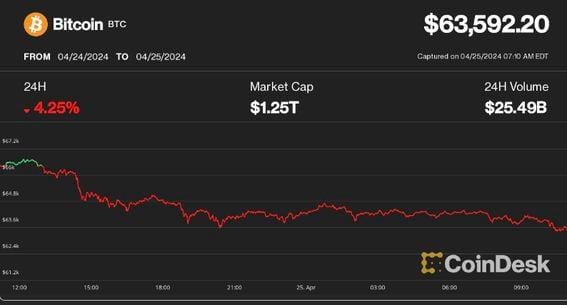
The latest price moves in crypto markets in context for April 25, 2024. Latest Prices Top Stories Bitcoin, the world’s largest cryptocurrency by market value, has dropped 4% over the last 24 hours to less than $64,000. Ether also saw a significant downside, losing 6%, and the CoinDesk 20 Index, a measure of the broader crypto market, lost 6% as well. Reuters reported that U.S. issuers expect the Securities and Exchange Commission to deny their applications to launch spot ether exchange-traded funds (ETFs) after discouraging meetings with the agency in recent weeks. In traditional markets, tech stocks declined after Meta failed to live up to high expectations for its first-quarter earnings report. BlackRock’s spot bitcoin exchange-traded fund (ETF), which trades under the ticker IBIT on Nasdaq, fell out of favor on Wednesday, preliminary data published by Farside Investors showed. For the first time since going live on Jan. 11, the fund did not draw any investor money, snapping a 71-day inflows streak. Seven of the other 10 funds followed IBIT’s lead. Fidelity’s FBTC and the ARK 21Shares Bitcoin ETF (ARKB) registered inflows of $5.6 million and $4.2 million, respectively, while Grayscale’s GBTC bled $130.4 million, leading to a net cumulative outflow of $120.6 million, the highest since April 17. U.S. House Representative Maxine Waters (D-California) indicated that the final version of a stablecoin bill could be ready soon. "We are on our way to getting a stablecoin bill in the short run,” the top Democrat on the House Financial Services Committee told Bloomberg on Wednesday. Waters has previously called a version of the stablecoin bill “deeply problematic and bad for America." “It’s about making sure investors and that the people are protected,” Waters told Bloomberg. “We have to ensure that they have those assets to back up stablecoins,” she said. The latest development strengthens hopes that the U.S. can get a new stablecoin law before the elections this year, which was considered a longshot at the start of the year. Chart of the Day The chart shows CryptoQuant's Coinbase premium index, which tracks the spread between bitcoin’s prices on the Nasdaq-listed Coinbase (COIN) exchange and the offshore giant Binance. The indicator shows bitcoin is again trading at a discount on Coinbase, reflecting a weaker net buying pressure from U.S. investors. Source: CryptoQuant. Trending Posts EigenLayer-Powered Aligned Layer Raises $20M to Make ZK Proofs Faster, Cheaper on Ethereum 'Buy Bitcoin' Sign Sold for Over $1M at Auction Spot Bitcoin, Ether ETFs Get Official Approval in Hong Kong; 'Potential Fee War' Unfolding, Says Analyst https://www.coindesk.com/markets/2024/04/25/first-mover-americas-bitcoin-drops-below-64k-ether-falls/
2024-04-25 07:31
Waters has previously called a version of the stablecoin bill “deeply problematic and bad for America." The top Democrat on the U.S. House Financial Services Committee has told Bloomberg that a stablecoin bill could be ready soon. The latest development strengthens hopes that the U.S. can get a new stablecoin law this year, before the elections, considered a longshot at the start of the year. U.S. House Representative Maxine Waters (D-California) indicated that the final version of the stablecoin bill could be ready soon. "We are on our way to getting a stablecoin bill in the short run,” the top Democrat on the House Financial Services Committee told Bloomberg on Wednesday. Waters has previously called a version of the stablecoin bill “deeply problematic and bad for America." “It’s about making sure investors and that the people are protected,” Waters told Bloomberg. “We have to ensure that they have those assets to back up stablecoins,” she said. The latest development strengthens hopes that the U.S. can get a new stablecoin law before the elections this year, which was considered a longshot at the start of the year. Congressional movement, both in the Senate and the House, on stablecoin legislation picked up pace in the past few weeks. Waters said that the U.S. Federal Reserve, the Treasury Department and the White House have all had input in crafting the bill, the report said. Waters and House Financial Services Committee Chairman Patrick McHenry (R-N.C.), who have been negotiating for 22 months, reportedly met with Senate Majority Leader Chuck Schumer to get the legislation moving by tying it to a must-pass Federal Aviation Administration reauthorization due next month. Last week, in the Senate, U.S. Senators Cynthia Lummis (R-Wyo.) and Kirsten Gillibrand (D-N.Y.) introduced a new stablecoin bill, which proposed a ban on algorithmic stablecoins and required tokens of issuers to be fully backed by reserve assets. Waters also told Bloomberg that she has discussed stablecoins with the Senate Banking Chairman Sherrod Brown. Earlier this month, Brown told Bloomberg he was open to advancing the stablecoins legislation. A marijuana banking bill could also be paired with the stablecoin legislation. Brown’s committee has advanced the marijuana legislation but it could face opposition from Republican leader Mitch McConnell. However, Waters said she was hopeful of overcoming that resistance if it were to come. In March, McHenry said the stablecoin bill is largely worked out in the Republican-controlled House and just needs a scheduled floor vote. Read More: U.S. Senators Lummis, Gillibrand Take on Stablecoin Legislation With New Bill https://www.coindesk.com/policy/2024/04/25/stablecoin-bill-could-be-ready-for-the-us-house-soon-says-top-democrat-maxine-waters-bloomberg/

2024-04-25 07:07
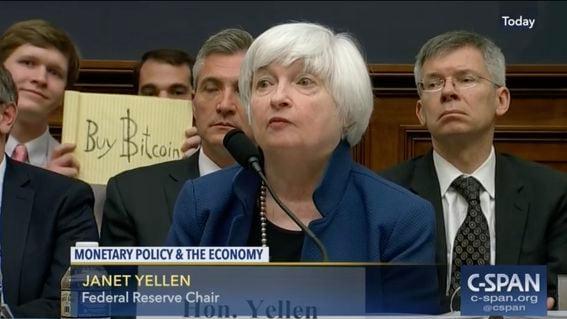
Proceeds will go to fund the development of Bitcoin layer-2 lightning startup Tirrel Corp. The iconic 'Buy Bitcoin' sign that was held up behind Janet Yellen was sold at an auction for 16 BTC. Proceeds from the auction will go to fund a Bitcoin layer-2 startup called Tirrel Corp. The iconic 'Buy Bitcoin' sign held behind Janet Yellen during her televised Congressional testimony in July 2017 has been auctioned off for 16 BTC, or just over $1 million. Scarce.City, the auction house that facilitated the deal, said it was a record amount for the auction platform. The auction itself was held at PubKey, a Bitcoin-themed bar in New York City. The sign’s new owner is someone who goes by the handle of Squirrekkywrath, according to a tweet from PubKey. Not much is known about its new owner. The head of research at Galaxy, Alex Thorn, said he’s a “bitcoin OG that no one has ever heard of.” In a prior interview with CoinDesk, Christian Langalis, who held up the sign, said the proceeds would go to fund his startup, Tirrel Corp, which is developing a Bitcoin Lightning network wallet on Urbit. After holding up the sign during a 2017 House Financial Services hearing, Langalis was escorted out of the building for violating committee rules – all the while, the image was going viral on the web. https://www.coindesk.com/business/2024/04/25/buy-bitcoin-sign-sold-for-over-1m-at-auction/
2024-04-25 07:03
The move may bring fresh energy and capital into the spot ETFs. The bank has allowed ETF buying since the start, but only if the customer approaches them directly. Morgan Stanley could become the first among its peers to allow bitcoin ETF solicitation. The move could push substantial inflow into the ETFs. Morgan Stanley (MS) is looking to allow its 15,000 brokers to recommend bitcoin (BTC) exchange-traded funds (ETF) to their customers, according to a report from AdvisorHub. The Wall Street giant opened up bitcoin ETF purchases after they had been approved earlier this year. However, this was done only on an unsolicited basis. The bank is now looking to let its brokers pitch bitcoin ETFs directly to its customers, the report added. The move is a testament to the demand for the spot ETFs and could bring additional inflows into the funds. The ETFs allow the customers to reap the benefits of investing in the oldest cryptocurrency without direct exposure. “We’re going to make sure that we’re very careful about it...we are going to make sure everybody has access to it. We just want to do it in a controlled way,” AdvisorHub reported, citing a Morgan Stanley executive. The Securities and Exchange Commission (SEC) approved 11 spot bitcoin ETFs in January. The firms that got the approval include investment behemoths BlackRock (BK), Fidelity, Invesco (IVZ) and others. The approval brought massive inflows into the funds and, subsequently, bitcoin. However, the inflows have been dwindling for some time, with BlackRock registering zero daily inflow for its ETF for the first time ever on Wednesday, according to Farside. Morgan Stanley allowing its brokers to recommend bitcoin ETFs could bring back momentum into the funds. Morgan Stanley declined to comment on the report. https://www.coindesk.com/business/2024/04/25/morgan-stanley-may-soon-allow-brokers-to-pitch-bitcoin-etfs-to-customers-report/
2024-04-25 06:53
Inflows have slowed this month, taking the wind out of the bitcoin bull run. BlackRock's spot bitcoin ETF did not draw any investor money on Wednesday, the first such instance since the fund's inception three months ago. Inflows have slowed this month, taking the wind out of the bitcoin bull run. BlackRock’s spot bitcoin exchange-traded fund (ETF), which trades under the ticker IBIT on Nasdaq, fell out of favor on Wednesday, preliminary data published by Farside Investors showed. For the first time since going live on January 11, the fund did not draw any investor money, snapping a 71-day inflows streak. Seven out of the other ten funds followed IBIT’s lead. Fidelity’s FBTC and the ARK 21Shares Bitcoin ETF (ARKB) registered inflows of $5.6 million and $4,2 million, respectively, while Grayscale’s GBTC bled $130.4 million, leading to a new cumulative outflow of $120.6 million, the highest since April 17. Spot ETFs debuted in the U.S. on January 11 with much fanfare, promising to pull billions of dollars in institutional money. To date, BlackRock’s IBIT has alone amassed more than $15 billion, while the 11 funds taken together have registered a net inflow of over $12 billion. However, most inflows happened in the first quarter, and the uptake has slowed this month, taking the wind out of the bitcoin bull run. Bitcoin (BTC), the leading cryptocurrency by market value, has traded primarily between $60,000 and $70,000 this month, CoinDesk data show, marking a weak follow-through to the first quarter’s near 70% rally to record highs above $73,500. https://www.coindesk.com/markets/2024/04/25/blackrocks-bitcoin-etf-snaps-71-day-inflows-streak-data-show/