2024-04-23 15:32
The bank reiterated its year-end bitcoin and ether targets of $150,000 and $8,000, respectively. ETFs that hold Ethereum's ether (ETH) are unlikely to be approved in May, Standard Chartered said in a report. Rising macro risks have led to a slowdown in spot bitcoin (BTC) ETF inflows. The bank reiterated its end-of-year bitcoin price target of $150,00 and its ether target of $8,000. U.S. regulators probably won't approve ETFs that give investors access to Ethereum's ether (ETH) in May, according to investment bank Standard Chartered, which had previously expected the Securities and Exchange Commission to give its blessing then. Approval of spot bitcoin (BTC) exchange-traded funds in January helped fuel a rally in the biggest cryptocurrency. But Standard Chartered is not bearish amid its changing view on prospects for an ether ETF. Digital assets have endured a perfect storm of negative headwinds in recent weeks, yet the worst is over and the market is well-positioned to recover, Standard Chartered said in a research report on Tuesday. "Bitcoin exchange-traded fund (ETF) inflows have stalled, and ether ETFs now look unlikely to be approved in May as expected," analyst Geoff Kendrick wrote. The analyst had previously said that ether spot ETFs would likely gain approval on May 23, according to a March 18 report. The "U.S. Securities and Exchange Commission (SEC) has targeted decentralized finance (DeFi) by suing Uniswap, U.S. Treasury yields have jumped, Federal Reserve rate cuts have been pushed back, and BTC and ETH – as risky assets – have been pulled lower by the escalation of the conflict in the Middle East," Kendrick said. Still, the bank says that the bad news is already priced in for bitcoin and ether, and "positive structural drivers" are expected to take over again. The company reiterated its end-of-year bitcoin price target of $150,000 and its ether forecast of $8,000. Bitcoin was trading around $66,800 and ether was near $3,237 at publication time. Market positioning is now much cleaner than before, as $261 million of leveraged long positions were removed from the bitcoin futures market on April 13 in response to Iran's attack on Israel, the report noted. This was the largest daily liquidation since October 2023. Bitcoin spot ETF inflows have likely slowed due to macro reasons, the report said. These include higher U.S. Treasury yields and geopolitical tension in the Middle East. Furthermore, the first wave of ETF buying may be largely complete, which means a strong positive driver of the market has stalled for now, the bank said. The next wave of buying will be the inclusion of these ETFs in wider macro funds, but this could take some time. https://www.coindesk.com/markets/2024/04/23/ether-etfs-are-unlikely-to-be-approved-in-may-standard-chartered/
2024-04-23 12:05
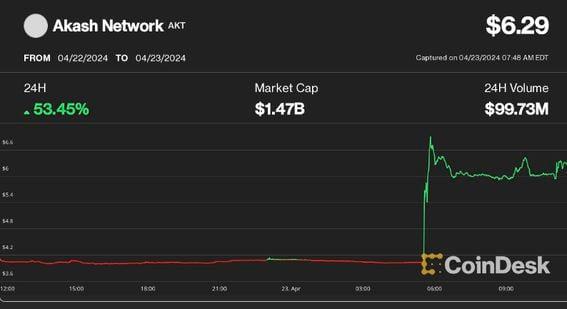
The decentralized cloud computing company also announced its ‘Akash summit.' The AKT token is up more than 50% over the past 24 hours. Cloud computing platform Akash was built using the Cosmos software development kit (SDK) and implemented on the Cosmos blockchain. The AKT token has a market capitalization of over $1 billion. Akash Network, a decentralized cloud computing platform, saw its token AKT rally to almost $7 on Tuesday as the token was listed on South Korean exchange Upbit. AKT jumped over 50% over the past 24 hours after trading steadily at $4 over the past week. Upbit is the largest cryptocurrency exchange in South Korea by trading volume. AKT currently has a market capitalization of $1.45 billion, according to data from Messari. Akash was built using the Cosmos software development kit (SDK) and implemented on the Cosmos blockchain. It’s an open network that offers users a way to buy and sell computing resources via its own marketplace. It connects server owners who need computing power to host applications with cloud computing resources. The company also announced its ‘Akash summit’ on Monday, which will take place in May. The summit will have a focus on the decentralized artificial intelligence (AI) space. Akash Network fits into the wider ‘DePIN’ narrative, which has had substantial interest from venture capitalists recently. Anand Iyer, founder of Canonical Crypto, an early stage VC, told CoinDesk it is seeing the true utility of decentralized hardware come to life as the computing needs for AI surge. "Companies and protocols like Akash Network and Ritual are leading the way here and we expect to see more players leveraging decentralized networks for non-crypto use cases," Iyer said. https://www.coindesk.com/markets/2024/04/23/akash-networks-token-surges-50-on-upbit-listing/
2024-04-23 11:09
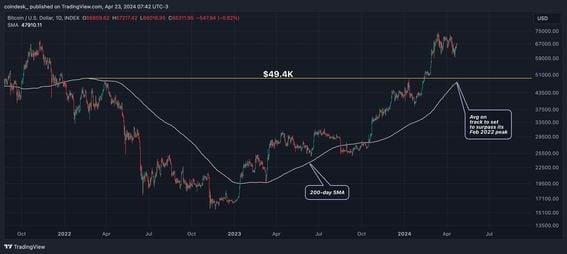
The 200-day simple moving average is one of the most widely tracked indicators of bitcoin's long-term trend. Bitcoin's 200-day average is on track to challenge its previous peak of $49,452 from February 2022. Past data show the most intense phase of the bull cycle unfolds after this average surpasses its previous peak. Bitcoin's (BTC) price moved into bullish territory above the 200-day simple moving average (SMA) in October, setting record highs above $73,000 last month. Now, the average, a crucial barometer of long-term trends, is also rising fast in a sign of strong bullish momentum and appears set to surpass its previous peak of $49,452 in February 2022. At press time, bitcoin traded at $66,200, with the 200-day average at $47,909. That's noteworthy for traders as past data show the most intense phase of the bullish cycle unfolds after the average surpasses its previous peak to new lifetime highs. In early November 2020, six months after the third halving, bitcoin's 200-day SMA rose to its then-highest above $10,320. By mid-April 2021, bitcoin had rallied 4.5 times to $63,800. The cryptocurrency surged over 2000% to nearly $20,000 in 12 months after the average set new highs in December 2016, or five months after the second halving. A similar meteoric rally unfolded after the average rose to a new peak in November 2012, around the time of the first halving. As always, past data is no guarantee of future results. That said, some features of the past cycles have been repeated to a T. For instance, BTC's bear market climaxed in November 2022, and prices rose in subsequent months, which aligns with the historical pattern of bottoming out to start a new rally 15 months ahead of the halving. Bitcoin blockchain implemented the fourth mining reward halving on Saturday, reducing the per-block coin emission to 3.125 BTC from 6.25 BTC. Most analysts are of the view that rising government debt concerns will eventually force the U.S. Federal Reserve (Fed) to cut interest rates rapidly, keeping risk assets, including cryptocurrencies, in an uptrend. In the short term, however, prices may drop due to profit-taking and volatility in bond markets. https://www.coindesk.com/markets/2024/04/23/bitcoins-200-day-average-is-approaching-a-record-high-heres-why-it-matters/
2024-04-23 10:00
DYDX also has a large release of tokens scheduled but is not experiencing the same pricing pressure. OP, YGG, and DYDX have scheduled unlocks this week, where previously unavailable tokens will be released into the market. While OP and YGG are down against the CD20, DYDX seems to be less affected. Ethereum Layer 2 solution Optimism's native token OP and Yield Guild Games' YGG token were both in the red during the Asia afternoon trading day, as both tokens have unlocks scheduled for later this week. In the digital assets world, unlocks refer to the scheduled release of a specified amount of the project's tokens that were previously locked to prevent team members from dumping on retail investors once they get listed on an exchange. These unlocks increase liquidity and are generally viewed as a bearish signal, although some analysts argue that they merely amplify the current market trend. OP is down 3.5% while YGG is down 3% in the last 24 hours, according to market data. In comparison, the CoinDesk 20 (CD20), a measure of the most liquid digital assets, is flat. According to market data from Token Unlocks, Optimism is scheduled to unlock 2.3% of its OP token (worth $24.16 million) in the coming days, while YGG's next unlock will push an additional 5.3% of its circulating supply onto the market, worth $16.7 million. In the last 14 days, OP is down 24%, while YGG is down approximatley 32%. Meanwhile, DYDX is scheduled to unlock 10.7% of its circulating supply on May 1, worth around $78 million, according to Token Unlocks. Its token doesn't appear to be feeling pressure from the upcoming unlock as it's only down 1.2%. https://www.coindesk.com/markets/2024/04/23/op-ygg-feeling-sell-side-pressure-as-unlocks-loom/

2024-04-23 07:32
The court had found Ripple violated federal securities laws by making institutional sales of XRP but dismissed other allegations brought by the SEC. Ripple Labs has opposed the SEC’s proposal seeking a nearly $2 billion fine against the company. Ripple Labs said the Court should impose a civil penalty of no more than $10 million. Ripple Labs filed its opposition on Monday against the U.S. Securities and Exchange Commission’s (SEC) proposal to ask a New York judge to impose a nearly $2 billion fine against the company behind the XRP Ledger blockchain. “The Court should deny the SEC’s requests for an injunction, for disgorgement, and for pre-judgment interest, and should impose a civil penalty of no more than $10 million,” the filing said. The SEC’s proposal asked the court to order Ripple Labs to pay $876 million in disgorgement, $198 million in prejudgment interest, and a $876 million civil penalty, amounting to a total of $1.95 billion. The court had found Ripple violated federal securities laws by making institutional sales of XRP but dismissed similar allegations by the SEC that the sale of XRP on exchanges and through algorithms also violated the law. “The SEC’s remedial requests are more evidence of the administrative overreach that has beset this case," Ripple’s lawyers wrote. “The agency acts as though it had prevailed entirely and had proved reckless conduct. It has done neither. The agency also seeks disgorgement barred by controlling Supreme Court and Circuit precedent and a separate penalty that exceeds by more than 20 times what it has obtained from any other defendant or respondent in a digital-asset case.” Additionally, in a paragraph that redacted Ripple’s revenue from institutional sales, income taxes it paid, and it’s losses, the entity argued it had no gains to disgorge. Read More: SEC Seeks $1.95B Fine in Final Judgment Against Ripple https://www.coindesk.com/policy/2024/04/23/ripple-says-10m-penalty-enough-rejects-secs-ask-of-195b-fine-in-final-judgment/
2024-04-23 07:22
The new BTC supply added to the market could drop to $30 million per day, according to Bitfinex. Analysts at Bitfinex estimate that the new BTC supply added to the market could drop to $30 million per day, amounting to less than five times the average daily inflows into the spot-based ETFs. Investor are increasingly taking direct custody of their coins, Bitfinex added. Bitcoin's (BTC) recent mining reward halving has altered the market in such a way that it could potentially lead to cryptocurrency's demand being five times greater than that of supply, according to the latest projection by analysts at the crypto exchange Bitfinex. On Saturday, the per-block reward paid to miners was cut in half to 3.125 BTC from 6.25 BTC. Per Bitfinex, the halving of rewards means the notional value of the total number of new coins added to the supply daily could drop to $30 million. That's a significant decrease, equating to five times less than the average daily demand for the U.S. spot ETFs. "With the daily issuance rate declining post-halving, we estimate that the new supply added to the market (new BTC mined) would amount to approximately $40-$50 million in USD-notional terms based on issuance trends. It is expected that this could possibly drop over time to $30 million per day, including active and dormant supply as well as miner selling, especially as smaller miner operations are forced to shut down shop," analysts at Bitfinex said in a report shared with CoinDesk. "The average daily net inflows from spot Bitcoin ETFs dwarf that number at over $150 million, even though flows have moderated and even turned net negative over recent weeks," analysts added. The supply squeeze has already begun. Since halving, the total number of new coins added to the supply daily has dropped to 450 BTC (nearly $30 million) from the pre-halving four-year average of around 900 BTC, data from Glassnode show. Nearly a dozen spot-based ETFs began trading in the U.S. on Jan. 11, allowing investors to take exposure to cryptocurrency without owning it. Bitfinex is assuming that the average daily inflows into ETFs since inception will remain constant in the coming months. While it remains to be seen if they do, miner selling could slow. Miners or entities responsible for minting coins ran down their coin inventory in months leading up to the halving to fund equipment upgrades to ensure post-halving sustainability of operations. Data tracked by Glassnode show that in six months leading up to the halving, the number of coins held in wallets tied to miners fell by over 18,000 BTC to 1.82 million BTC. Lastly, according to Bitfinex, investors are again increasingly taking direct custody of their coins, weakening the market's supply side. "Current on-chain data indicates that Bitcoin exchange outflows are reaching peaks not seen since January 2023, suggesting that many investors are moving their holdings to cold storage in anticipation of price increases," analysts at Bitfinex said. "Meanwhile, the active selling by long-term holders has not precipitated the typical pre-halving price drop yet, indicating a robust absorption of this selling pressure by new market entrants," analysts added. Bitcoin changed hands at $66,660 at press time, up over 5% since halving, defying expectations of a price correction. The CoinDesk 20 Index, a broader market gauge, has risen nearly 7%, CoinDesk data show. https://www.coindesk.com/markets/2024/04/23/bitcoins-post-halving-demand-to-be-5x-greater-than-supply-bitfinex-estimates/