2024-04-22 11:51
The spike in network fees was driven by speculative activity to mint new meme tokens following the launch of the Runes protocol, the report said. Total miner revenue is currently about triple the pre-halving level, the report noted. The spike in network fees indicates the level of developer interest in Bitcoin, and the fee revenue potential for miners, Bernstein said. The broker expects 15% of miner revenues to be network transaction fees on a sustainable basis. Since the reward halving of bitcoin (BTC), miners have earned about 19 BTC per block on average, which is over and above the standard block rewards as a spike in network fees led to a tripling of revenue, broker Bernstein said in a research report on Monday. The quadrennial halving, which slows the rate of growth in bitcoin supply, occurred on Friday evening. “This is driven by speculative activity to mint new tokens (mostly meme tokens) by retail traders,” analysts Gautam Chhugani and Mahika Sapra wrote. The Runes protocol allows people to etch and mint tokens on the chain. The launch of the protocol over the weekend triggered a spike in network fees on the Bitcoin blockchain. The report said that the total miner revenue is currently about triple the pre-halving level, at around 22 bitcoins versus 7 bitcoins before. Bernstein noted that daily revenues exceeded $100 million, with more than about $80 million coming from transaction fees, which is clearly abnormal, it said. “Investors should not extrapolate these fees into the future, but it indicates the level of developer interest on the Bitcoin blockchain, and the fee revenue potential for miners,” the authors wrote. The broker notes that Runes token launches have been speculative meme tokens so far, and such speculative activity may be short-lived. Still, the fungible token market is largely untapped on the Bitcoin network, the report noted, and decentralized tokens and other utility tokens on the Ethereum network exceed more than $200 billion. “We expect 15% of miner revenues to be network transaction fees, on a sustainable basis,” the note said, adding that seen as “speculative fervor” on blockchains can last for 6-18 months, the miners may continue to enjoy the above normal windfall for now. https://www.coindesk.com/markets/2024/04/22/bitcoin-miners-have-raked-in-abnormal-transaction-fees-since-halving-bernstein/

2024-04-22 10:37
Bitcoin's implied or expected volatility remains positively correlated with its price as traditional market fear gauges spike amid broad-based risk aversion. BTC's implied volatility index, DVOL, has recently declined, maintaining a positive correlation with the cryptocurrency's price. Stock and bond market volatility indices, VIX and MOVE, have ticked higher amid risk aversion. A continued rise in MOVE may weigh over bitcoin, one analyst said. Bitcoin's (BTC) price has recently corrected after weeks of unstoppable rally, tracking weakness in U.S. stocks and bonds. BTC's pullback again stands out, exhibiting little fear or panic compared to stocks and bond markets, where expected or implied volatility indices, often called fear gauges, witnessed notable spikes. Bitcoin's price has declined by 7% this month. Still, crypto exchange Deribit's BTC DVOL index, an options-based measure of expected price volatility over the next 30 days, has decreased from 75% to 70% on an annualized basis. That's an extension of the pullback from March highs at around 80%, according to data from TradingView. In other words, despite the price drop, there has been little panic buying of put options or derivatives offering downside protection, which is usually the case in traditional markets. Implied volatility is influenced by demand for options. Meanwhile, the Chicago Board Options Exchange's CBOE Volatility Index (VIX), a measure of expected price turbulence over four weeks, has significantly increased from an annualized 13% to 19%. The index is based on options tied to the S&P 500 index, which has experienced a 5.4% decline this month. The MOVE index, which measures expected volatility in U.S. Treasury notes, has increased from 94% to 111% alongside a decline in bond prices (and an uptick in yields). The diverging trend in the BTC DVOL does not necessarily mean bitcoin is seen as a relatively safe asset and is a bull market feature. BTC's implied volatility has been positively correlated with its price since 2023. "Bitcoin, in this bull market is still very much in a positive spot/vol correlation regime. With the potential parabolic moves to the upside, BTC vol picks up as price starts to rally and softens as we sell off," David Brickell, head of international distribution at Toronto-based crypto platform FRNT Financial, said. "Tradfi risk skew is still very much to the downside as the sell offs are typically sharper than the slower grinding rallies," Brickell added. BTC's unusual implied volatility profile means traders may be better off taking bullish implied volatility bets during price rallies than during market swoons. MOVE spike matters Bitcoin bulls anticipating a resumption of the uptrend might want to watch out for a continued rise in the MOVE index. That's because heightened volatility in U.S. Treasury notes, which dominate global collateral and securities and finance, often leads to tighter financial conditions and investor risk aversion. "Treasuries are often the collateral that are used by markets to borrow and gain leverage to trade in stocks and other riskier investments," the founders of newsletter service LondonCryptoClub said in Monday's edition. "When bond volatility spikes, then a greater haircut is applied to that collateral, meaning less leverage is able to be taken against it, which means reduced liquidity in the system. Alongside the strengthening dollar, this has been a squeeze on stocks and also on bitcoin," the founders added. 11:46 UTC: Updated VIX value. The previous version erroneously mentioned VVIX value. https://www.coindesk.com/markets/2024/04/22/bitcoins-unique-volatility-profile-in-focus-as-vix-and-move-spike/
2024-04-22 09:53
Nadeem Anjarwalla, who escaped Nigerian custody in March, could be extradited back to the country within the week, one local media outlet reported citing government sources. Nigeria wants the Binance executive who custody and fled to Kenya to be extradited. Local media outlets have reported that Nigerian government officials are expecting Nadeem Anjarwalla to be returned to the country within the week. Nadeem Anjarwalla, an executive at crypto exchange Binance who recently escaped Nigerian custody, has been located in Kenya and faces extradition, multiple local media outlets have reported. Nigerian authorities have found Anjarwalla in Kenya and are working with Kenyan authorities to bring the executive back to the country, Nigeria’s Daily Post reported last week, citing government sources. Nigerian newspaper The Punch reported on Monday, citing unnamed government sources, that Anjarwalla could be returned to Nigeria within the week via the international criminal police organization (INTERPOL). CoinDesk has reached out to INTERPOL, Kenya’s foreign ministry and Nigeria’s police force for comment. Anjarwalla was detained alongside another Binance executive, Tigran Gambaryan, in February, as Nigerian authorities accused the crypto exchange of manipulating the local exchange rate, tax evasion and money laundering. Anjarwalla, a British-Kenyan dual national, reportedly fled the country in March using a concealed Kenyan passport. Gambaryan, still in Nigeria, pleaded not guilty to money laundering charges during an April court appearance. https://www.coindesk.com/policy/2024/04/22/binance-exec-who-escaped-from-nigeria-has-been-found-in-kenya-faces-extradition-reports/

2024-04-22 08:03
The Thai SEC cited earlier decisions by nations like India and the Philippines in blocking unauthorized platforms. Thai authorities have decided to block “unauthorized” crypto platforms. The authorities have not named the entities they see as unauthorized, but have asked users to quickly withdraw their assets. Authorities in Thailand have decided to block “unauthorized” crypto platforms to increase the efficiency of law enforcement in solving the problem of online crime, according to an announcement on Friday. After a meeting of the Technology Crime Prevention and Suppression Committee, Thailand’s Securities and Exchange Commission or SEC was ordered to submit information on unauthorized digital asset service providers to the Ministry of Digital Economy and Society to block access to the platforms. The SEC has considered the impact on users, and will give them time to manage their accounts before being unable to use the service, the announcement said. “Therefore, the SEC requests users of the said platform to quickly withdraw their assets from the platform,” the announcement said. The Thai SEC also cited earlier decisions by nations like India and the Philippines in blocking unauthorized platforms. Thailand’s regulators have been attempting to find the balance between supporting the crypto ecosystem and preventing fraud. On the one hand, it has allowed institutional investors and very high-net-worth individuals to invest in crypto exchange-traded funds (ETFs) and allowed retail investors to invest without limits in digital tokens backed by real estate or infrastructure, but on the other hand, it has said custodians need to have a contingency plan if something goes wrong. Read More: Thailand’s SEC Breaks New Ground in 2024 With Crypto-Friendly Rules https://www.coindesk.com/policy/2024/04/22/thailand-to-block-access-to-unauthorized-crypto-platforms/

2024-04-22 07:54
Miners will be faced with substantial cost increases as a result of the halving, with electricity and bitcoin production costs almost doubling, the report said. Bitcoin miners may shift towards AI due to the potential for higher revenue, CoinShares said. The average bitcoin production cost post-halving is about $53,000. Some miners are actively managing financial liabilities and are using excess cash to pay down debt, the report said. Crypto miners may shift towards artificial intelligence (AI) in energy-secure locations following the bitcoin (BTC) halving due to the potential for higher revenue, CoinShares (CS) said in a report on Friday. The quadrennial halving, which slows the rate of growth in bitcoin supply by 50%, occurred on Friday evening. Coinshares notes that mining companies like BitDigital (BTBT), Hive (HIVE) and Hut 8 (HUT) are already generating income from AI. At the same time, TeraWulf (WULF) and Core Scientific (CORZ) have existing AI operations or plans to grow in the space. “This trend suggests that bitcoin mining may increasingly move to stranded energy sites while investment in AI grows at more stable locations, authors led by James Butterfill wrote. The miners will be faced with substantial cost increases as a result of the halving, with electricity and overall production costs almost doubling, the report said. Mining companies can try to mitigate these higher costs by optimizing energy costs, increasing mining efficiency and buying better-priced hardware. “The weighted average cash cost of production in Q4 was approximately $29,500; post-halving, it is projected to be about $53,000,” the authors wrote. The average electricity cost of production in the fourth quarter was about $16,300 per bitcoin, which is expected to increase to around $34,900 post the halving. The hashrate could rise to 700 exahash by 2025, according to the asset manager’s forecasts, but may drop by 10% after the halving as miners turn off unprofitable machines. Hash prices are expected to fall after the event to $53/ph/day. Hashrate refers to the total combined computational power that is used to mine and process transactions on a proof-of-work blockchain. CoinShares notes that the miners are actively managing financial liabilities, and some are using excess cash to pay down debt. https://www.coindesk.com/business/2024/04/22/bitcoin-miners-may-shift-focus-to-ai-after-halving-coinshares-says/

2024-04-22 06:27
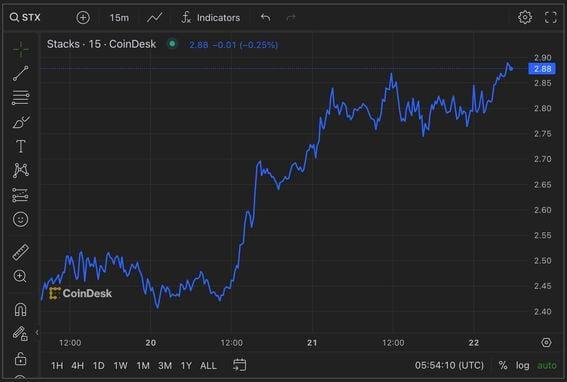
Top Bitcoin Layer 2 coins have risen 5% to 20% since halving, leaving BTC behind, according to data source CoinGecko. Top Bitcoin layer 2 coins have risen 5% to 20% since halving, leaving BTC behind. The BTC-beating rise comes amid Runes-led spike in transaction fees on the Bitcoin blockchain. Tokens associated with Bitcoin layer 2 solutions have outperformed bitcoin (BTC) since the Bitcoin blockchain's highly-anticipated mining reward halving took effect early Saturday. STX, the native token of leading Bitcoin layer 2 network Stacks, has risen nearly 20% to $2.87 since quadrennial halving reduced the per block coin emission to 3.125 BTC from 6.25 BTC, according to data source CoinGecko. Bitcoin, meanwhile, has gained just over 4.7% to $66,300. STX is one of the best-performing top 25 cryptocurrencies of the past 24 hours, per Velo Data. Other layer 2 coins, like Elastos’ ELA token and SatoshiVM’s SAVM, have risen 11% and 5%, respectively, since halving. Bitcoin layer 2 solutions are projects that address scalability and transaction speed limitations on the Bitcoin blockchain. They are built on top of the Bitcoin blockchain and bring scalability by processing transactions off the main chain. While Ethereum layer 2 solutions mainly focus on scaling the Ethereum smart contract blockchain, Bitcoin Layer 2 projects aim to scale and introduce programmability features to the main blockchain, which doesn't operate an Ethereum-like virtual machine. The market-beating move of Bitcoin layer 2 coins comes amid the post-halving surge in transaction fees on the Bitcoin blockchain. Data tracked by Glassnode show the mean transaction fee soared to nearly 0.0020 BTC after halving, reaching the highest since early 2018. The spike in fees could be explained by the launch of a new protocol called Runes that allows users to “etch” and mint tokens on the Bitcoin blockchain. Runes' debut saw speculators rush to mint tokens and trade meme coins, catalyzing increased transaction activity and higher transaction costs. According to data source Ord.io, the total number of Runes inscriptions on the Bitcoin blockchain was 3,700 at press time. https://www.coindesk.com/markets/2024/04/22/bitcoin-layer-2-coins-stx-ela-savm-outperform-btc-after-halving/