2024-04-22 06:10
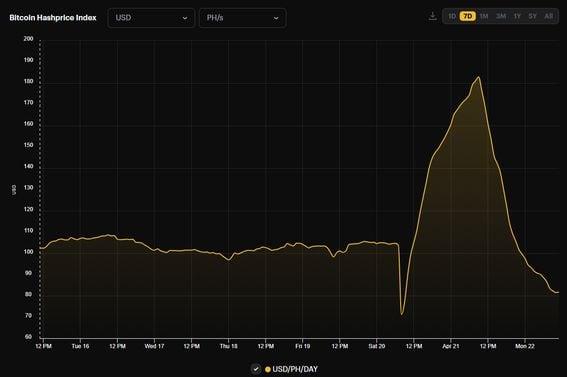
After the halving, fees spiked to $146 for a medium-priority transaction and $170 for a high-priority transaction. Bitcoin transaction fees have significantly come down post-halving The floor price for the Runes NFT collection has also come down. Runes was supposed to be the tool that maintained fee revenue post-halving Bitcoin (BTC) started the week stable, changing hands above $65,800, as transaction fees have significantly lowered following the halving. On-chain data from Mempool.space shows that medium-priority transactions are now costing $8.48 while high-priority transactions cost $9.32. In the initial aftermath of the halving, these fees spiked to over $146 for a medium-priority transaction and $170 for a high-priority transaction. The hashprice index, a metric created by Luxor to quantify how much a miner can expect to earn from a specific quantity of hashrate, has also dropped from $182.98 per hash/day to $81, a level below where it was at pre-halving. While bitcoin miners anticipated that the halving would significantly cut revenue, the introduction of Casey Rodarmor’s Runes protocol – designed to create fungible tokens on Bitcoin – which went live at the halving, was supposed to be the antidote to this, given the level of activity it would create on-chain. Instead, in the initial days after the event, floor prices for the runestone NFT collection have dropped by almost 50% in the last 24 hours with a floor price of nearly 0.037 BTC, according to Magic Eden, while ordinal collections like Bitcoin Puppets and NodeMonkes are up 11% and 8% respectively according to CoinGecko data. It should be noted that these ordinal collections also generate considerable transaction fees but don’t appear to be the same revenue source as many hoped Runes would be. CORRECTION (April 22, 2024, 17:40 UTC): Fixes misspelling of Bitcoin Puppets. https://www.coindesk.com/markets/2024/04/22/bitcoin-transaction-fees-come-crashing-down-post-halving/
2024-04-21 20:18
The Bitcoin "halving" was supposed to dramatically chop revenue of bitcoin mining companies. Instead, the simultaneous launch of Casey Rodarmor's Runes protocol has ignited a flurry activity on the oldest and largest blockchain, driving up fees. Bitcoin's once-every-four-years "halving," which took place late last week, was supposed to bring a steep cut in revenue for crypto miners, since their rewards for new data blocks would drop by 50%. Instead, the simultaneous launch of Casey Rodarmor's new Runes protocol – for minting digital tokens on top of the oldest and largest blockchain – has proven so popular that it's caused massive network congestion, sending transaction fees to record levels and showering Bitcoin miners with a windfall like never before. Bitcoin transaction fees averaged a record $127.97 on April 20, when the halving took place and Runes launched, based on coordinated universal time. That's more than seven times the average fee rate on the day before, and roughly double the previous record set three years ago. Total revenue for bitcoin miners, which includes the block rewards as well as transaction fees, soared to a record $107.8 million for the single day, according to YCharts. The development could be bullish for big bitcoin mining firms including Marathon Digital Holdings ($MARA), Riot Blockchain ($RIOT), Hut 8 Mining (HUT) and Core Scientific (CORZ). (Marathon announced separately on Friday that it was rebranding to "MARA," which happens to be its stock ticker.) The quadrennial halvings were part of Bitcoin creator Satoshi Nakamoto's original design when it was launched in 2009, an effort to harden the original cryptocurrency's resistance to inflation with an ever-decreasing pace of new issuance. But with the rewards shrinking for miners, the question has been whether they would see adequate incentives to continue mining on the blockchain – crucial since their efforts are essential to the blockchain network's security. "We expect the particular frenzy pushing fees to these levels to die down in the relatively near term, but this episode is the latest indication that concerns about bitcoin’s long-term 'security budget' are misplaced," the Bitcoin-focused investment firm Ten31 wrote in a newsletter on Saturday. Ordinals sequel Rodarmor's new Runes protocol can be used to spin up new digital tokens like those common on the Ethereum blockchain but thus far mostly absent from the Bitcoin ecosystem. The launch was highly anticipated because Rodarmor was the primary developer behind Ordinals, which became extremely popular after it debuted last year as a novel way to mint NFTs on Bitcoin, previously unthinkable. Rodarmor himself worried aloud on a recent episode of his Hell Money podcast whether Runes might be a flop; if the main use of Runes was to spin up "meme coins" for fickle traders whose speculative interests can shift quickly, why would these traders instinctively gravitate toward a blockchain optimized for security rather than for speed or low costs? Come, they did, however, and Runes may have outstripped even some of the most ambitious expectations. According to the website RuneAlpha, as of April 21 some 4,923 runes had already been etched, with 801,124 runes transactions and 68,548 holders. "The overall Runes ecosystem will likely be worth many billions of dollars," the blockchain researcher Saurabh Deshpande wrote in a post on Decentralised.co. Several crypto exchanges, including OKX and Gate.io, have already listed some of the newly minted runes, such as SATOSHI•NAKAMOTO, for trading. Jimmy Song, an independent Bitcoin developer and commentator, wrote in a blog post on Saturday that the Runes frenzy has made it nearly possible to get a transaction included into certain fees without paying an exorbitantly high transaction fee. "The Runes asset issuance has overridden almost every other use case at the moment," Song wrote. The Bitcoin Layer substack wrote that Runes appears to be a "game of greater fools in which essentially everybody loses," but it does take up block space and may "accentuate the need for hastening the development of and further expansion of liquidity on layer-2 scaling solutions like the Lightning Network." Transaction fees as a percentage of the total miner revenue per block jumped to their highest level ever of 75%, according to the authors Joe Consorti and Nik Bhatia. 'Preview of what's to come' It's "a preview of what’s to come in Bitcoin mining economics decades from now, as Bitcoin monetizes into a $10 trillion+ asset, demand for the network is orders of magnitude larger than today, and we’ve had a few more halvings," they wrote. Grayscale, the money manager behind the Grayscale Bitcoin Trust (GBTC), remarked on the potentially dramatic change in outlook for miners in an emailed newsletter on Saturday. "If transaction fees normalize at a level higher than in the past, the impact of the halving on miner revenue will be dampened," Grayscale wrote. https://www.coindesk.com/tech/2024/04/21/bitcoin-miners-reap-windfall-as-runes-debut-sends-transaction-fees-to-record-highs/

2024-04-20 14:03
Grayscale said it will contribute 10% of Grayscale Bitcoin Trust (GBTC) assets to the Bitcoin Mini Trust. Grayscale’s new ETF product, the Bitcoin Mini Trust, has set fees at 0.15%. Grayscale said it will contribute 10% of Grayscale Bitcoin Trust (GBTC) assets to the Bitcoin Mini Trust (BTC). Grayscale, which currently offers the highest-cost spot bitcoin ETF, revealed that a planned spinoff version of the fund will have a 0.15% fee, which would be the lowest of them all, according to pro forma financials in its latest filing. The existing Grayscale Bitcoin Trust (GBTC) has a 1.5% fee. When Grayscale's Bitcoin Mini Trust (BTC) is introduced, the filing says the company will contribute 10% of the assets in GBTC to the BTC Trust. Shares of the BTC trust are to be issued and distributed automatically to holders of GBTC shares. (The pro forma financial statements are projections of future expenses and revenues, based on a company's past experience and future plans.) Grayscale’s Bitcoin Mini Trust was conceived to offer GBTC investors a lower fee option that’s more competitively in line with other bitcoin ETFs approved back in January. Currently, the Franklin Bitcoin ETF (EZBC) at 0.19% is the lowest-cost spot bitcoin ETF. The Grayscale spinoff is also considered a non-taxable event for GBTC’s existing shareholders, so those investors will not be expected to pay capital-gains tax to automatically transfer into the new fund. Some early stage GBTC investors with gains in the thousands of percentages would face a significant taxable event to switch to a competitor product with a lower fee. Grayscale’s GBTC appeared over a decade ago, originally offered through a private placement. In mid-2015, the shares began trading publicly on an over-the-counter basis. This continued until January 2024 when GBTC uplisted to NYSE Arca as a spot bitcoin ETF, along with competition products from other companies including BlackRock and Fidelity. Grayscale’s current assets under management stands at around $19.6 billion; its nearest rival, which is BlackRock’s IBIT fund, has grown to just over $17.5 billion. CORRECTION (April 20, 2024, 20:44 UTC): Removes reference to the number of bitcoin that would be moved from GBTC to the new fund. https://www.coindesk.com/business/2024/04/20/grayscale-reveals-015-fees-for-its-bitcoin-mini-trust-etf/

2024-04-20 01:35
Though finding value in meme coins isn't always easy. Despite this being the most anticipated Bitcoin halving yet (at least according to Google search history), it was the launch of the high-profile Bitcoin builder Casey Rodamor’s latest creation – Runes – that turned heads, even among long-time blockchain developers who despise the digital tokens that can be minted on the platform. Rodamor is known for the release of Ordinals, a protocol that allows people to “inscribe” data on the smallest units of bitcoin (i.e. satoshis) to create highly valued assets on Bitcoin. Ordinals is largely credited for inspiring a renewed developer ecosystem on Bitcoin. Runes is similar to Ordinals, in that it allows people to “etch” and mint tokens on-chain – the main difference is that ordinals are “non-fungible” (i.e. one-of-a-kind) while Runes will function more like meme coins, which have recently taken crypto markets by storm. The first Runes project to mint was Rodamor’s own UNCOMMON•GOODS project, which was announced well in advance of the halving, as were many of the projects looking to etch themselves on these highly coveted satoshis. Impossible to know in advance, however, is what other projects would be able to find space on these scarce satoshis. There are already quite literally hundreds of Runes projects that are currently being minted and looking for prospective buyers. About nine blocks after the halving, Runes minters had already paid 78.6 BTC in fees (~$4.95 million) in order to buy the rarest of the rare. This suggests that, like Ordinals, the Runes protocol could be a boon to Bitcoin’s burgeoning fee economy. What makes a Runes project potentially viable is something of a subjective measure: being an early project to list — like DOG•GO•TO•THE•MOON, which has the honor of being “Rune Number 3” — is one measure. But buyers are also judging projects based on the “quality” of its ticker. A number of Runes projects were already starting to mint before the halving happened, including DOG•DOG•DOG•DOG•DOG, MEME•ECONOMICS, SHORT•THE•WORLD and PEPE•WIT•HONKERS, including dozens others, according to runebtc.xyz. Prior to the halving block being mined, prospective buyers in an X Space hosted by Leonidas, a well-regarded Ordinals collector, users and speculators alike were discussing which Runes to mint and trading ticker names. Among the names dropped were Taproot Wizards, the Ordinals project co-created by Bitcoin OG influencers Eric Wall and Udi Wertheimer, and a project called Satoshi Nakamoto, named after Bitcoin’s creator, which at press time had over 5,000 holders who minted about 19,000 tokens. Which projects will actually prove to have long term value is hard to judge. “Yeah, I don't see any good memes, like, I mean, I'm just trying to figure it out,” one trader said. “To be quite frank, I haven’t minted anything yet.” “I’m trying to understand the space in general right now,” someone else responded. “These projects are like early Runes. Do you guys think that these are actually going to be the most valuable ones?” “I think it depends what happens with them,” someone responded. Another aspect to consider: how many of the tokens were “pre-mined,” or held in reserve for project creators to potentially release on the market later. Prior to the halving, Leonidas shared guidelines that suggested projects that pre-mine more than 10% of the token supply were “greedy.” “I think the pre-mines are going to be the ones that win,” one trader said. “Because like, it's so hard to come up with a good meme with a 13 character limit,” he said, referring to the hardcoded naming system Rodamor added to Runes to try to prevent “ticker squatters.” In time, Runes tickers will be able to list with shorter names. Within three years, there could be Runes projects with three-letter tickers, for instance. Though it’s unclear how well this strategy will play out. According to data source Ordiscan, one forethinking developer has already blocked off a series of tickers, including ZZZZ (which will be the “first four letter Rune” to mint in two years), ZZ and Z (the first two letter and one letter Runes to mint in three years) and A (the last single character Rune to mint in four years). In other words, with something so new, it’s hard to determine what to value. “As everybody is scrambling to figure out what the hell's going on, I want to just take a moment to say it's awesome being here with all of you,” Leonidas told his audience. “This is essentially the start of a new protocol that kicked off about 30 minutes ago. So let's see what happens. I think it's going to be very chaotic.” https://www.coindesk.com/markets/2024/04/20/runes-protocol-launches-on-bitcoin-sending-fees-soaring-as-users-rush-to-mint-tokens/

2024-04-20 00:23
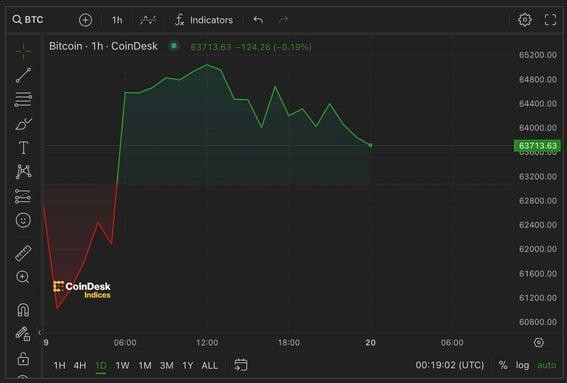
Bitcoin had slumped to as low as $59,685 on Friday morning, then rebounded heading into the event. Bitcoin (BTC) held steady around $63,700 in the aftermath of the cryptocurrency's fourth halving, an event that upends the economics for the miners who power the Bitcoin ecosystem. BTC recently barely moved from its level right before the 840,000th Bitcoin block was mined just as Saturday began in UTC time. Bitcoin had slumped as low as $59,685 on Friday before rebounding above $65,000. The halving has historically been a precursor to a rally in the price of bitcoin, with the last one, in May 2020, giving way to a run up from $9,500 to $65,000 during the subsequent year. But this time, bitcoin has already embarked on a momentous rally to record highs, rising from $15,500 in late 2022 to $73,680, helped by optimism around the approval of spot bitcoin ETFs in the U.S. and then then the ensuing enthusiasm after they began trading in January. On Thursday, JPMorgan said that it expected bitcoin to drop following the halving as it remained in "overbought conditions" based on the high level of open interest in bitcoin futures. Goldman Sachs added that in order for bitcoin to emulate the success of previous cycles following halving events, macro conditions need to be supportive of risk-taking. Bitcoin has traded between $59,600 and $73,860 since Feb. 28 with the upside of the range being protected this week alongside the backdrop of rising conflict in Israel, which has had a knock-on effect across all capital markets. A sell-off on April 12 from $71,000 to $60,000 wiped out $4 billion in open interest from the bitcoin market, according to Coinalyze. The figure across all exchanges excluding CME is $16.1 billion. https://www.coindesk.com/markets/2024/04/20/bitcoin-rally-holds-around-63700-following-4th-block-reward-halving/
2024-04-20 00:16
The launch of Casey Rodarmor's new Runes protocol sent fees surging as users rushed to etch new digital tokens that can be launched atop the Bitcoin blockchain. The Bitcoin halving took place early Saturday, upending the economics of running the pioneering blockchain. Fees soared in the aftermath as a new Bitcoin-based system called Runes launched. Bitcoin completed the fourth halving in its 15-year history, a milestone venerated and anticipated in the blockchain community just like the World Cup and Olympics are in sports. The once-every-four-years event, which cuts in half the amount miners get rewarded for creating new bitcoin, took place at 00:09 UTC on Saturday when the 840,000th block was added to the Bitcoin blockchain. While bitcoin's price held mostly steady above $63,000 in the aftermath, something else stole the show: Transaction fees spiked on Bitcoin as the launch of a new protocol called Runes led to a flurry of transactions as speculators rushed to mint digital tokens atop the blockchain. The halving block – block 840,000 – saw a record-high 37.6 BTC fee (worth more than $2.4 million) attached to it, and fees remained far higher than normal in the hour after the halving. The winning mining pool for that block was ViaBTC, entitling it to the bitcoin rewards at the new, just-lowered rate of 3.125 BTC per block, worth about $200,000 at the current price. But crypto miners had been competing actively for the block since it contains the first "sat" – the smallest denomination of bitcoin – following the halving. These "epic sats" that follow halvings are seen as collector's items, and some mining executives have suggested that this individual fragment of a bitcoin could be worth millions of dollars, or many multiples of the current price of an entire bitcoin. The Runes protocol for fungible tokens, from Casey Rodarmor, the developer behind the Ordinals platform that launched last year to enable NFTs on Bitcoin, also launched at block 840,000. Less than an hour after the launch, 853 of the runes had already been etched, according to the website runealpha.xyz. A quick glance at the fees paid by users to get transactions included in blocks might reflect the intense competition by users to mint the new runes: the $2.4 million fees for the halving block compared with $40,000 to $60,000 for a more typical block before the halving. Several of the ensuing blocks also came with more than $1 million of fees. "We've not had anything like this in the history of Bitcoin," the prominent Bitcoin developer Jimmy Song said during a livestreamed watch party hosted by Tone Vays. "We're stressing the network in a different way, in ways we've never stressed it before." On-chain data shows that the median satoshis per byte (sats/vByte) fee has exploded post-halving to 1,805 sats/vByte. Pre-halving on April 19, this most recent median fee was closer to 100 sats/vByte. (Sats/vbyte (satoshis per byte) is a measurement of the fee rate used to conduct a Bitcoin transaction, indicating how many satoshis (the smallest unit of Bitcoin) you are willing to pay for each byte of data in your transaction.) In layman's terms, this means that transaction fees have surged, with medium-priority transactions costing $146 and high-priority transactions costing around $170. Miners are expected to rely more on higher transaction fees and a potential increase in bitcoin's price to offset the expected decline in revenue due to the reduced mining subsidy, especially in the short term. For CoinDesk's complete coverage, please see our Bitcoin Halving landing page. The mining reward – which dropped to 3.125 BTC from 6.25 BTC during this halving – is an incentive for entities who contribute computing power to secure Bitcoin. The miner that wins the race to add each new block to the network takes away the mining reward, the amount of which is fixed until it's cut again at the next halving, as programmed by the cryptocurrency's elusive creator, Satoshi Nakamoto. Soaring fees, though, in the aftermath of the halving suggest miners could have a lucrative new revenue stream in the Runes era – though several people speaking on the Tone Vays livestream expressed the belief that the fee spike will end up being temporary. The quadrennial halving is seen as a momentous occasion in the crypto community because it symbolizes Bitcoin's original concept as an autonomous, decentralized financial network whose monetary policy is set by code, as opposed to human organizations like governments and central bankers. Unlike traditional, or fiat, currencies, whose value has historically been eroded by inflation and government printing, bitcoin is designed to be non-inflationary with a maximum total supply of 21 million BTC in circulation. With the halvings every four years, the pace of new issuance of bitcoins reduces over time until the last one is mined, likely sometime in 2140. Read More: Bitcoin Halving, Explained Historically, halvings have been followed by surges in bitcoin's price. The thinking is that the fewer new BTC are being produced, the more valuable those already in existence become. This time, the outlook is murky. Some market commentators say the halving is already priced into BTC and, therefore, the immediate effects may be muted. Others see the bitcoin price falling, while yet others have suggested a rally is in store. The potential effects of this present halving may be impossible to predict due to the profound differences in the Bitcoin landscape compared with the three previous events. Notably, January's long-awaited approval of spot bitcoin exchange-traded funds (ETFs) in the U.S. means greater institutional investment is coming to BTC by orders of magnitude. Also, following the launch of the Ordinals protocol early last year, there is now much greater activity going on under the hood of Bitcoin, with developments and upgrades to the network potentially bringing far more utility to the notoriously conservative ecosystem. https://www.coindesk.com/tech/2024/04/20/bitcoin-blockchain-has-fourth-halving-in-15-year-history-in-show-of-monetary-policy-set-by-code/