2024-04-18 08:19
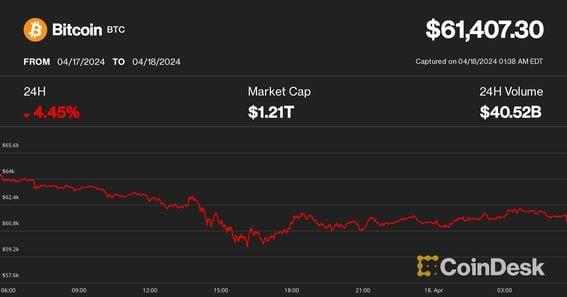
Analytics firm Santiment's social-media metrics suggest the crypto crowd is beginning to lean bearish. Social media metrics suggest crypto followers are beginning to adopt a bearish attitude on bitcoin's price trajectory. Historically, bearish crowd sentiment has been observed at market bottoms. "The masses are always wrong. Wisdom is doing everything the crowd does not do," American poet and novelist Charles Bukowski said. That holds true for crypto too, and the crypto crowd is beginning to lean bearish on bitcoin (BTC) – a sign the current BTC price sell-off may soon run out of steam. "Historically, prices move in the opposite direction of mass traders' expectations," blockchain analytics platform Santiment said in a market insights post, adding the market could bottom out right before the halving – expected in the next two days – or shortly after. Data tracked by Santiment shows that the number of "bull market" or "bull cycle" mentions on crypto social media has been declining since late March. At the same time, the number of "bear market" or "bear cycle" mentions steadily increased. Santiment's Social Trends indicator tracks chatter across Telegram, Reddit, X and 4Chan to identify keywords or topics that have sparked interest. "According to the crypto crowd, the #bullmarket has essentially come to an end after #Bitcoin's -16% market value drop since the #AllTimeHigh of $73,600 hit back on March 14th. At the same time, #bearmarket mentions are increasing," Santiment said. The number of mentions for other keywords like "buy the dip" also indicates that "hopium ” – crypto slang for hopes of a quick recovery and a continued bull run – among retail investors has faded. Historically, a decline in the "buy the dip" mentions has marked the end of downtrends. The dwindling probability of Federal Reserve interest-rate cuts, heightened geopolitical tensions and timing for U.S. tax payments have weighed on bitcoin this month, leading to a 14% price slide. The leading cryptocurrency by market value hit lows under $60,000 yesterday before recovering to trade near $61,200 at press time. The CoinDesk 20 Index, which measures the performance of the top 20 digital assets by market capitalization, has declined by 24% this month. Bitcoin's blockchain will implement its fourth mining reward halving on Friday or early Saturday, cutting the per-block BTC emission by 50% to 3.125 BTC. Several analysts, including JPMorgan, have warned of a deeper price slide following the quadrennial event, although the consensus is bullish over the long term. https://www.coindesk.com/markets/2024/04/18/bearish-flip-in-crypto-crowd-sentiment-hints-at-coming-bitcoin-price-bounce/

2024-04-18 06:39
The exchange could return as a FIU-registered firm after paying the fine, the report added. Binance and nine other exchanges were sent show cause notice by the Indian government some months ago. Earlier this year, the exchange was removed from the Apple Store in India. Binance, the cryptocurrency exchange that was removed from India some months ago, is looking to re-enter India by paying a $2 million fine, the Economic Times reported on Thursday. Earlier this year, Binance and some other exchanges were removed from the Apple Store in India after India’s Financial Intelligence Unit (FIU) sent them compliance show cause notices. OKX, KuCoin, Huobi, Kraken, Gate.io, Bittrex, Bitstamp, MEXC Global and Bitfinex were the other firms that were sent notices at the time. After paying the fine, Binance will return to the country as an FIU-registered firm, the ET report added, citing people aware of the developments. It is “unfortunate that it took (Binance) more than two years to realize there is no room for negotiations, and (that) no global powerhouse can command special treatment, especially at the cost of exposing the country’s financial system to vulnerabilities,” the report said, citing a source. Binance did not respond to CoinDesk’s earlier request for comment, while the FIU was not immediately available for comment. https://www.coindesk.com/business/2024/04/18/binance-could-come-back-to-india-by-paying-2m-fine-report/

2024-04-18 06:14
BTC dominance is creeping upwards as Layer-1s and Artificial Intelligence tokens had a rough week, while Google search interest in the halving skyrockets. BTC and other digital assets continue to be challenged by the market. Layer-1s and AI tokens have fared worse than bitcoin, leading to an increase in BTC's market dominance Bitcoin (BTC) has become more dominant in the crypto market thanks to impending halving and broader market risk aversion, despite the price correction The largest cryptocurrency by market value was trading below $61,400 during Asian trading hours on Thursday, according to CoinDesk Indices data, as the sell-off in risk assets, fueled by difficult macroeconomic conditions, rages. The CoinDesk 20, a measure of the world’s most liquid digital assets, is down 3.3%, trading at 2,125. While bitcoin might be having a challenging moment, layer-1s and altcoins are doing worse. Top layer-1 tokens like Solana’s (SOL) are down over 20% in the past week. Avalanche's (AVAX) is down 26%, Cardano's (ADA) is down 23%, and Filecoin (FIL) is down 30%. The bloodbath in Artificial Intelligence tokens, once the darling of the market, continued with some of the largest AI tokens down double digits during the last week. Render's RNDR is down 13%, and Fetch.AI’s FET token is down 24%. All this has led to bitcoin dominance moving up. Bitcoin dominance helps traders gauge the market mood and the token's influence on altcoin trends. Bitcoin dominance is currently at 55.19%, up around 1.35% in the last week or 2.5% in the last month. Meanwhile, in the run-up to the halving, Google search interest in the halving is hitting all-time highs, far surpassing search interest in the 2020 halving. According to Google search trends data, there has been more search interest in the halving than in Ethereum, solana, or dogecoin. https://www.coindesk.com/markets/2024/04/18/bitcoin-dominance-increases-as-halving-nears-and-btc-price-lingers-near-61k/
2024-04-17 20:06
Avi Eisenberg faces up to 20 years in prison if he’s convicted on all three counts against him. NEW YORK — Crypto trader Avi Eisenberg’s fate now rests in the hands of 12 New York jurors, who have been tasked with deciding whether his October 2022 trades on Mango Markets – which netted him $110 million – were fair game or fraud. On Wednesday, the jury heard closing arguments in the government’s case against Eisenberg, who was arrested in Puerto Rico in December 2022 and charged with commodities fraud, commodities manipulation and wire fraud in connection with his Mango Markets exploit two months earlier. Eisenberg, 28, was clad in a dark gray suit. His mother and two other family members were in the gallery during the proceedings. Though his attorneys suggested he may testify earlier in the trial, his defense ultimately rested without calling him to the stand. The defense’s case on Monday and Tuesday largely hinged on a single expert witness, former Secret Service agent-turned crypto investigations consultant Jeremy Sheridan. Over two days of testimony he spoke to the mechanisms that enabled Eisenberg’s trades and the difficulty of understanding whether his borrows were, according to Mango Markets’ codebase, actually borrows at all. But much of his testimony got thrown out by the judge after the court determined his knowledge of Mango Markets’ codebase was itself insufficient. Prosecutors have argued that Eisenberg engaged in market manipulation, trading large sums of MNGO perpetual futures contracts between himself to pump the price over 1000%, then using his newly-created collateral to fool the platform into allowing him drain $110 million in various cryptocurrencies via the platform’s “borrow” function. But Eisenberg wasn’t borrowing, prosecutors told the jury on Wednesday – he was stealing. Hours after the exploit, he issued an “extortionate” anonymous proposal to the Mango Markets decentralized autonomous organization (DAO) offering to return $67 million of his haul in exchange for promises not to pursue criminal charges or freeze the rest of the stolen funds. The facts of the case were largely undisputed by Eisenberg’s defense team when they took the stand. Instead, Eisenberg’s lead attorney, Brian Klein, attempted to frame Eisenberg’s massive trades as a “successful and legal trading strategy” that “fully complied” with the Mango Markets protocol. Klein pointed to Mango Markets’ lack of Terms of Use – only a checkbox that told visitors to use the site “at your own risk” – at the time of Eisenberg’s exploit, arguing that he simply used the platform as intended and made a lot of money doing it. “This is how people do things in this world of crypto,” Klein told the jury. Klein is a well-known defense attorney in the crypto sphere, whose past clients include Erik Voorhees, Charlie Shrem and Virgil Griffith. Klein is also currently representing Tornado Cash developer Roman Storm. Prosecutors told the jury a different version of the story. Eisenberg, they said, knew what he was doing was illegal. Before his exploit, Eisenberg had sued someone else in federal court for manipulating the price of WAVES. He’d also made internet searches for things like “statute of limitations market manipulation” and “elements of fraud” before his October 2022 trades. After the trades – and once his identity as the exploiter had been exposed – Eisenberg bought a ticket for a flight to Israel and searched for “FBI surveillance,” “list of Israel extraditions” and “Otisville prison,” a white-collar federal penitentiary. “That’s what you do when you think you’ve committed a crime,” the prosecutor told the jury. Klein told the jury Eisenberg didn’t go to Israel to escape charges, but instead because angry Mango Markets’ users were threatening his safety. Klein also said that the fact that Eisenberg sued both Circle and AscendX, a nominally Romanian exchange, to get his money back once it was frozen – as well as his willing return to the U.S. – was further evidence that he did not believe he had committed a crime. In their rebuttal, prosecutors said that Eisenberg’s legal attempts to get his money were made after his identity as the exploiter had been exposed. He thought that his proposal to Mango Markets’ DAO, and its subsequent “waiver of liability,” meant he was off the hook, emboldening him to come back to the U.S., they said. “Manipulation, lies, deceit – it’s criminal, whether it happens on Wall Street or on a computer program,” the prosecutor said. Eisenberg faces up to 20 years in prison if convicted on all three counts. https://www.coindesk.com/policy/2024/04/17/jury-begins-deliberations-in-110m-mango-markets-fraud-trial/

2024-04-17 15:42
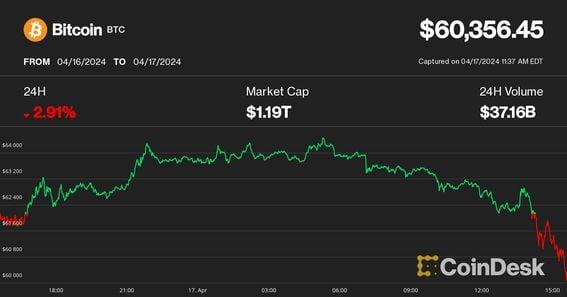
Large bitcoin investors haven't started to buy the dip yet, suggesting that the correction may continue for a while, an LMAX Group strategist noted. Bitcoin dipped to $59,900 for the first time since early March as cryptocurrencies slipped Wednesday. Order book data on key spot exchanges shows demand below $60,000, which could halt the decline. The crucial support level for BTC to watch is $59,000, LMAX's Kruger said. Bitcoin (BTC) has given up the entirety of its bounce from Saturday's panicky selloff, plunging to under the $60,000 level in the morning hours of the U.S. trading session Wednesday. After earlier Wednesday recovering above $64,000, bitcoin slipped to as low as $59,900, down more than 3% over the past 24 hours and its weakest price since early March. At press time, it was trading at $60,200. Ether (ETH), the second-largest crypto asset by market capitalization, tumbled below $3,000 declining 2.5% over the same period. The weakness echoed through most crypto markets, with all CoinDesk Market Index (CMI) sectors being in the red, while the broad-market CoinDesk 20 Index lost 1.8%. The spot market order book for BTC-USDT on crypto exchange Binance, the most liquid trading pair, shows bids clustered below $60,000, outweighing sale orders. This indicates strong demand below that level that could halt further price decline at least in the short term. Today's decline affirmed that cryptocurrencies are going through a cool-off phase after a multi-month rally that peaked last month. Bitcoin since has lost more than 15% from its latest all-time high, while some altcoins pulled back 40%-50% from their recent tops, which isn't out of ordinary of previous crypto bull market pullbacks, Glassnode data showed. Bitcoin investor behavior suggests that the market weakness could continue for a while as large investors haven't started to buy the dip yet at current prices, Joel Kruger, market strategist at LMAX Group, said in a Wednesday market update. "The latest blockchain data shows large holders of bitcoin holding off on increasing exposure into the current dip, which suggests we could still see some more weakness or consolidation before bitcoin is ready to turn back up," Kruger said. The crucial technical level to watch for BTC is $59,000, referring to a significant support zone where prices rebounded twice through March, he added. "If bitcoin can hold above this level, it keeps the direct focus on that next push to a fresh record high and towards $100,000," Kruger said. "If on the other hand we see more downside pressure that translates to a breakdown below $59,000, this will delay the short-term bullish outlook and open the door for a more meaningful correction into the $45,0000-50,000 area." https://www.coindesk.com/markets/2024/04/17/bitcoin-tumbles-to-60k-ether-under-3k-correction-not-over-says-strategist/
2024-04-17 15:00
According to a blog post shared with CoinDesk, the new Kraken Wallet will be the first from a major exchange to be open-sourced. Kraken, the second-biggest U.S.-based crypto exchange, has developed its own wallet, catching up to its rival Coinbase in the product arena and joining a saturated field that also includes major players like MetaMask, Ledger and Trezor. The new self-custodial “Kraken Wallet" is being releasing Wednesday and will be available to both Kraken users and non-users, CoinDesk is first to report. The wallet will initially support eight blockchains including Bitcoin, Ethereum, Solana, Optimism, Base, Arbitrum, Polygon and Dogecoin. According to a blog post shared with CoinDesk, the Kraken Wallet will be the first from a major exchange to be open-sourced. This means that developers can access and contribute to the code. Kraken will also pay developers that find vulnerabilities through their open-source grant program, so that they can improve the wallets in the event that there are bugs. The wallet will collect the “absolute minimum amount of data to function as a wallet,” according to Kraken, ticking off a privacy principle that is valued by many crypto users. “User activity is proxied through Kraken’s own infrastructure, shielding IP addresses and preventing users’ identity and location information from potential external exposure.” Coinbase's Coinbase Wallet is extremely popular, and at least two other big crypto exchanges, Binance and OKX, offer wallets for users to plug into their ecosystems. “Kraken has been telling people for more than ten years to self-custody their assets. We built Kraken Wallet on the principles central to the crypto space, such as user privacy and open source code,” said Eric Kuhn, the Product Director for Kraken Wallet to CoinDesk. “There’s a lot of interesting things that are happening on-chain and we wanted a wallet that enables people to go and access these ecosystems.” Kraken has been building out its suite of products over the last few months. In November, Kraken was reportedly talking with multiple layer 2 teams about building their own layer 2 blockchain – shortly after Coinbase came out with its own rollup chain, Base, in August. The collapse of Sam Bankman-Fried's FTX crypto exchange in 2022 underscored the risks of leaving crypto on centralized exchanges – possibly helping to explain why the likes of Kraken and Coinbase have been nosing into business opportunities involving on-blockchain products. "Kraken Wallet is how we invest in the “your keys, your crypto” ecosystem which is vital for the existence of permissionless financial access. We welcome other wallets but we are going to focus on building the best all in one crypto wallet that is open source, secure and private," Kuhn said. https://www.coindesk.com/tech/2024/04/17/kraken-releases-own-crypto-wallet-joining-competition-with-coinbase-metamask/


