2024-04-16 05:15
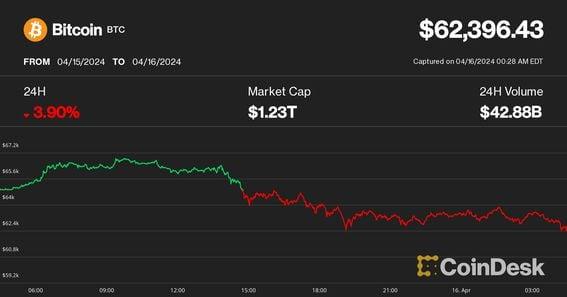
CoinDesk Indices' Bitcoin Trend Indicator has been indicating a strong uptrend since last fall. Crypto prices continue to decline, with the Bitcoin Trend Indicator dropping into neutral. Trading volume for BTC remains resilient, however. Bitcoin (BTC) was down nearly 4%, trading below $62,500 in the early hours of the Asia business day, while Ether (ETH) is trading above $3000. The CoinDesk 20, a measure of the world's largest and most liquid digital assets, is trading at 2,139, down 4%. CoinDesk's Indices Bitcoin Trend Indicator (BTI) has flipped to neutral from bullish, signaling a weakening of upside momentum. The BTI is a daily signal communicating the direction and strength of bitcoin's price trends through a purpose-built algorithm. The Bitcoin BTI has been in an uptrend or significant uptrend zone since October 2023, when there were initial reports that major fund managers were in the final phase of discussions with the Securities and Exchange Commission (SEC) about the launch of spot bitcoin exchange-traded funds (ETF). Ether's trend indicator has also hit neutral as well. Market data shows that on April 15, there were no outflows from any of the other bitcoin ETFs, aside from GBTC. Last week's total flow hit negative $82.5 million, most of which came from GBTC outflow. "Despite the downturn, trading volumes remained robust, with BTC Spot ETFs recording a weekly trading volume of approximately $16.2 billion, averaging $3.2 billion per day," Matteo Greco, Research Analyst at Fineqia said in a note shared with CoinDesk. "The cumulative trading volume since inception now stands at around $212 billion, with an average daily trading volume of approximately $3.3 billion." Meanwhile, the prices of luxury watches continue to decline, according to a new report from Watchcharts.com and Morgan Stanley. "Despite record performance in equity and crypto markets that may have helped to temporarily alleviate downward pressure on prices, second hand prices [for watches] continued to contract sequentially in 1Q," the report reads. We think it is premature to conclude that the secondary watch market is headed towards imminent recovery." The report cites high inventory levels as a reason for the continued decline in market prices. https://www.coindesk.com/markets/2024/04/16/bitcoin-dips-below-625k-as-coindesks-btc-trend-indicator-turns-neutral/
2024-04-16 02:00
OKX's comes as other major cryptocurrency exchanges, like Coinbase and Kraken, have also pursued their own layer 2 networks over the last year. OKX, the fourth-largest crypto exchange, said its new layer-2 blockchain, called X Layer, has gone live on its public mainnet, a continuation in the era of major crypto companies starting their own distributed networks. X Layer, previously known as X1, makes use of Polygon's Chain Development Kit (CDK), a customizable toolkit that lets developers build their own chains by making use of zero-knowledge technology. The news comes as other major cryptocurrency exchanges have pursued their own layer-2 networks over the past year. In August, Coinbase launched its “Base” blockchain, which is built with Optimism’s OP Stack. Kraken is reportedly also interested in creating its own layer-2 blockchain. In a press release, OKX said its developers will be contributing to CDK’s codebase, and that X Layer will connect to Polygon’s wider ecosystem via the AggLayer. AggLayer is a Polygon offering that aims to unify liquidity across various chains spun up using the project's technology. “OKX’s 50 million users now have an easy path to onboarding to X Layer and all the other chains connected to the AggLayer,” Polygon Labs Chief Executive Officer Mark Boiron said in the release. X Layer, which launched on testnet in November, will allow users to access over 170 decentralized applications (dapps), with more slated to launch soon. “We envision X Layer and other layer-2 chains as the highway infrastructure of the Web3 world, with dApps as the marketplaces and self-hosted wallets as the vehicles that take you there,” OKX Chief Marketing Officer Haider Rafique said in the press release. https://www.coindesk.com/tech/2024/04/16/crypto-exchange-okxs-new-layer-2-chain-x-layer-built-on-polygon-tech-hits-public-mainnet/

2024-04-15 19:40
At a recent gathering of investors in Miami, skepticism remained high even after finance titan BlackRock's shift toward touting the original cryptocurrency. Many mid-sized asset managers in traditional finance are still skeptical about bitcoin, even after some of the biggest names in the industry have started to endorse the cryptocurrency. Some call bitcoin a "bubble" while others don't see demand from clients and therefore, have no reason to participate in the alternative asset class. Around the time it turned 15 and following years of scoffing by others on Wall Street, Bitcoin in 2023 won acceptance from one of the most powerful investors in the world, BlackRock. Other traditional finance firms had endorsed the original cryptocurrency, to be sure, but BlackRock's blessing – in the form of filing to create a spot bitcoin ETF and vocal praise from CEO Larry Fink – was widely viewed as a surprising and significant turn of events. The tone around bitcoin (BTC) seemed to shift among finance professionals – at least some of them – in the aftermath, with more players voicing support. And, yet, earlier this month at an event in Miami for investment pros, it was clear that a significant swath of the industry continues to have serious doubts about bitcoin. "Bitcoin is just an extractive bubble," Mike Green, portfolio manager at Simplify Asset Management, said at the recent Miami Investment Masters Symposium. "It's effectively a mechanism to transfer wealth from one group of individuals to another." That skepticism doesn't translate into Simplify completely ignoring bitcoin, however. It offers customers two funds that are exposed to BTC: the Simplify Bitcoin Strategy PLUS Income ETF and the Simplify US Equity PLUS GBTC ETF, which invests 10% of its assets in the Grayscale Bitcoin Trust (GBTC). There is demand for bitcoin, so Simplify is meeting that desire, Green said. But this doesn't change his overall view that bitcoin is simply a mechanism to transfer wealth. "No value has been created and nothing has been done per se." Bitcoin skepticism remains common There are signs of broader reluctance. For spot bitcoin ETFs, even though they have seen unprecedented demand for a newly released product, they are not being offered to clients of some wealth management firms, including Vanguard and State Street. Only about half a dozen prominent firms have disclosed that they let their customers invest in the funds and experts believe that most of the volume for the bitcoin ETFs comes from retail investors. Banking giant Goldman Sachs, though it plays a key role for BlackRock's iShares Bitcoin Trust (IBIT) as a so-called authorized participant, earlier this month reiterated that it doesn’t believe bitcoin belongs in investment portfolios and that its clients are not interested in the cryptocurrency. Stone X Group's chief strategist, Kathryn Vera, gave a presentation at the Miami conference, stating that bitcoin won't be a reserve currency – economics jargon for a currency like the dollar, euro or yuan held by central banks to support global trade and finance – "in her lifetime." A key reason why the largest conventional currencies are cornerstones of finance is this reserve currency status. Gold fan and economist Peter Schiff called bitcoin gambling money that has no use in the present or the future. "This whole thing is a big bubble," he said at the event, as bitcoin was trading around a new record high above $73,000. "It's going to collapse." While some asset managers have picked their side and stand firm on their opinions, others simply aren't at the point yet where they are forced to consider the asset class as an investment – despite the recent creation in the U.S. of 11 bitcoin ETFs from BlackRock, Fidelity, Grayscale and others designed to make it easier for investors to buy bitcoin. Green said his firm isn't seeing much interest in bitcoin from its clients – though he concedes that might partly be the firm's fault as it doesn’t actively market the cryptocurrency or advise clients to invest in it. Another asset manager, who asked not to be named, said that the firm is making its clients so much money that it simply doesn't need bitcoin, especially because the crypto asset requires a level of forecasting that all of the other trades that the firm makes don't. "Business is booming with the focus we have," the manager said. According to Green, a lot of his peers aren't willing to put in the work to really understand the technologies behind bitcoin and other crypto assets, especially when there is no pressure from clients to do so and because speaking negatively about the cryptocurrency or expressing skepticism or speculation in the space doesn't seem to have any negative impact, he said. As a result, there is a tremendous amount of disinformation circulating in the industry. "There is a lack of interest in really understanding it because it's really hard to pursue something like bitcoin whole-cloth," he said. https://www.coindesk.com/business/2024/04/15/there-are-many-bitcoin-critics-left-in-finance-despite-blackrocks-newfound-love/

2024-04-15 19:33
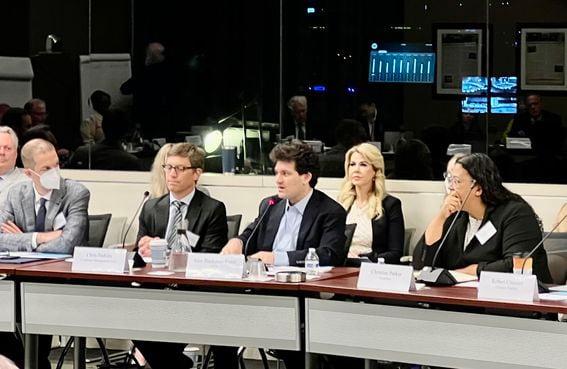
CFTC chief Rostin Behnam previously disclosed there were meetings and messages with FTX's Sam Bankman-Fried, but he hasn't granted another senator's call to see all the records. The head of the U.S. Commodity Futures Trading Commission (CFTC), Rostin Behnam, had a lot of contact with Sam Bankman-Friend, the disgraced former CEO of FTX, but lawmakers suggest he hasn't been fully forthcoming about those interactions. So, Sens. Elizabeth Warren (D-Mass.) and Chuck Grassley (R-Iowa) are demanding more. Warren and Grassley sent Behnam a letter calling for "an accounting of all meetings and correspondence between you and Sam Bankman-Fried during your tenure." Over a 14-month period, CFTC officials had met with Bankman-Fried and his team as many as 10 times at the agency, and Behnam told lawmakers in 2022 that he'd also exchanged "a number of messages" with the FTX founder, who was recently sentenced to 25 years in prison for the massive fraud perpetrated there. For his part, Behnam and his agency have at least one significant reason for communicating so often with the FTX CEO: He was trying to push a part of his company – the LedgerX division that was spun off again after the collapse to return to its original name – into a unique position to directly handle margined derivatives trading for customers without a go-between firm. The failed effort had even been the topic of an in-house roundtable discussion at the CFTC in which SBF starred on a big panel otherwise filled with industry opponents. In a Senate hearing in 2022 just after the meltdown of FTX, Grassley and another senator asked Behnam for information on his and his staff's meetings and text conversations with Bankman-Fried. Afterwards, Sen. Josh Hawley (R-Mo.) asked for records of correspondence between FTX, the CFTC, other government agencies and the White House. The new letter from Warren and Grassley, dated April 12, again asks for such correspondence, detailing that they want copies of all written communications, plus minutes and timelines of interactions. "We just received these letters, so we will work with the office to get them the information they need," said Steven Adamske, a spokesman for the CFTC. The chief of the other U.S. markets regulator, Securities and Exchange Commission Chair Gary Gensler, has similarly drawn scrutiny for his agency's interactions with SBF in the months before the company's dramatic collapse. Read More: U.S. CFTC Warns About Clearing Derivatives Tied to Digital Assets https://www.coindesk.com/policy/2024/04/15/elizabeth-warren-demands-us-cftc-chair-explain-his-chats-with-sbf/
2024-04-15 17:23
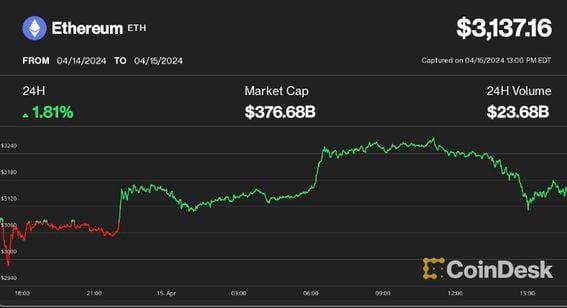
Bitcoin has also given up some of its early Monday bounce, returning down to the $64,000 level. Ether (ETH), the second largest cryptocurrency by market value, hovered just above the $3,100 mark in early afternoon U.S. hours on Monday, struggling to retain gains made since the crypto market's panicky selloff on Saturday. While ahead 4% over the past 24 hours, ETH is lower by about 4% since rising to nearly $3,300 earlier Monday on word (as yet still unconfirmed) that multiple Hong Kong-based spot bitcoin and ether ETFs had been approved. Downside pressure in bitcoin (BTC) has resumed as well, with that crypto now modestly lower over the past 24 hours to $64,200 after earlier Monday nearly reaching $67,000. The broader CoinDesk 20 Index is ahead 0.68% over the past 24 hours. Alongside, Solana's (SOL), gave up a large proportion of its overnight gains, dropping to around $140 from as high as $155 early Monday morning. That's also down from $175 reached on Friday. Bitcoin, ether and the rest of crypto plunged on Saturday – with bitcoin dropping to the $61,000 area and ether below $3,000 – as Iran launched a bombing campaign on Israel, but the sector had regained some footing later in the weekend. Singapore-based digital assets trading house QCP Capital said in a note to investors that historically, buying the dip on the outbreak of major geopolitical conflicts has been a profitable trade. Ed Goh, head of trading at liquidity provider B2C2, said the firm has seen consistent buying in BTC, especially on the dip over the weekend. “57% of our flow has been to the buy side,” said Goh. He also added that altcoin activity remains high and they have seen a bias towards buying for alts. Bitcoin’s halving event is fast approaching on April 19, which some traders are predicting could trigger a short-term “sell the news” reaction before and after the event. Despite the setbacks, some altcoins continued with significant gains on Monday, with Ondo Finance (ONDO) up 15% over the past 24 hours while Render’s RNDR was aheadp 12% and The Graph (GRT) rose 9%. https://www.coindesk.com/markets/2024/04/15/ether-altcoins-remain-under-pressure-following-volatile-weekend/
2024-04-15 13:44
Betting against an invasion on the prediction market may yield almost 7x as much as Taiwan government bonds. Plus: Mideast turmoil barely changes U.S. presidential odds. Which pays more: a two-year Taiwanese government bond, or a prediction market contract about the potential invasion of Taiwan by China? Turns out it's the prediction market contract. "No" shares on crypto-based platform Polymarket are trading at 92 cents, which means that should China not invade Taiwan by the end of the year, holders get an 8.7% return on their money. In comparison, a two-year bond from its central bank is paying just over 1.26%. Government bonds have historically been a bet on the future prospects of a country. Political instability, economic turmoil, and the possibility of war are hallmark characteristics of a developing nation. Investors demand to be rewarded for the risk, hence the higher yield on these bonds. El Salvador's bonds have historically traded at a higher premium than a developed nation like Canada because the likelihood that catastrophe would strike the nation is considered to be much higher, but that trend is changing as its President's bitcoin bet and war on organized crime appears to be paying off. Taiwan's government is fairly stable, and the country has a high degree of economic development, while also running a surplus. The market knows the government is regularly paying its debt, so there's not much of a premium that can be commanded on the bond market. Of course, an invasion would throw this into complete disarray. But such an event isn't likely, based on how the bond market is pricing things. One might say that the prediction market is overpricing the potential for such an event, hence free money that yields more than the country's own government bonds. A word of caution and caveat: sometimes competitive Polymarket contracts get settled by how its oracle, Uma, interprets the fine print. The name Taiwan is often used as a synecdoche for the government of the Republic of China (ROC), which administers Taiwan, and roughly a dozen outlying islands, some of which, like Kinmen, are less than three kilometers away from the coast of the People's Republic of China. An invasion of Kinmen is an invasion of the ROC, but not an invasion of Taiwan—though for bettors playing the market, that'll be up to Uma to decide. Cooler heads The flight of missiles and drones from Iran to Israel meant a panicked flight to safety for the crypto market this past weekend, as bitcoin dipped while tokenized versions of gold rallied. This uptick in geopolitical tensions in the region didn't appear to be long-term for the market, as crypto prices began their recovery as soon as rumors of the imminent approval of spot crypto ETFs in Hong Kong filtered through the market's collective psyche. Nor did it really shift the political landscape in a meaningful way for bettors on Polymarket. A contract asking users to bet on the outcome of the 2024 Presidential election—which has over $110.8 million staked, easily a record for crypto-based prediction markets—saw "yes" shares for Biden winning rise 1 cent, to 45 cents, and "yes" shares for Trump dip by a penny to 45 cents. A share pays out $1 if the prediction turns out correct, so the market is signaling each candidate now has a 45% chance of winning. While these aren't really material moves, they're at odds with some of the rhetoric on X (formerly Twitter), which, in its perpetually panicked state, thought a broader regional war was about to kick off. In this regard, the market is reflecting some sober second thoughts. A contract predicting if Israel would retaliate against Iran with a counter-attack points to a 14% chance of it happening. CORRECTION (15:16 UTC): Corrects figures in headline, subhead and third paragraph. https://www.coindesk.com/markets/2024/04/15/free-money-polymarket-bet-pays-8-if-china-doesnt-invade-taiwan/


