2024-09-13 06:39
Binance and Coinbase also face similar allegations by the SEC of violating federal securities laws for failing to register as a broker, clearinghouse or exchange. Kraken has requested a U.S. court for a jury trial in its fight against the U.S. SEC. A California Judge ruled last month that the SEC's lawsuit against Kraken will proceed to trial. Kraken suggested action had been taken against it for exercising its first amendment. Crypto exchange Kraken has demanded a jury trial in the case brought against it by the U.S. Securities and Exchange Commission (SEC), a court filing Thursday showed. A California Judge ruled last month that the SEC's lawsuit against Kraken will proceed to trial. The verdict came after similar rulings in cases brought on by the agency against Binance and Coinbase (COIN), which also face allegations of violating federal securities laws by not registering as a broker, clearinghouse or exchange with the SEC. The SEC sued Kraken in the Northern District of California last November asking the court to permanently enjoin the exchange from further securities violations, seeking disgorgement of its “ill-gotten gains” and other civil penalties. The regulator listed ADA, ALGO, ATOM, FIL, FLOW, ICP, MANA, MATIC, NEAR, OMG, and the SOL tokens as the 11 unregistered securities. In Thursday's court filing, Kraken reiterated its position denying that it has engaged in illegal conduct, responding to each allegation in the SEC's lawsuit and presenting 18 other defenses. Kraken's legal argument appeared to be based on its interpretation of the Securities Act and the Exchange Act because neither includes digital assets. The exchange said it never registered with the SEC because it was never required to do so, and that it was not an exchange, a broker dealer or a clearing agent within the meaning of the Exchange Act. The firm further argued that the SEC failed to state "a claim upon which relief may be granted because it did not have the authority to regulate Kraken." "The digital assets themselves cannot be the investment contracts because they carry none of the rights and obligations of a share of stock, a bond, or any other financial asset that Congress has said is subject to SEC regulation," the filing said. Kraken admitted to listing more than 220 crypto assets globally, permitting margin trading, over-the-counter trading desk, instant buy features, and customer applications, but denied that these services transform its platform into a securities exchange, clearing agency, or broker-dealer. Specifically, Kraken accused the SEC of acting without due process and fair notice, suggesting action had been taken against it for exercising its first amendment. Read More: SEC’s Case Against Kraken Will Proceed to Trial, California Judge Rules https://www.coindesk.com/policy/2024/09/13/kraken-seeks-jury-trial-in-sec-lawsuit-presents-defense-arguments/

2024-09-13 05:58
World Liberty Finance is helmed by Trump’s sons, Eric Trump and Donald Trump Jr, and the 18-year-old Barron Trump is the project's "DeFi visionary.” Donald Trump announced that his family's cryptocurrency project, World Liberty Financial, will launch on September 16. The project aims to move away from traditional banking by embracing cryptocurrencies. Republican candidate Donald Trump said on a podcast Thursday that his family-helmed decentralized finance (DeFi) project World Liberty Financial will be released on September 16. “Embracing the future with crypto and leaving slow and outdated big banks behind,” Trump said in a video posted on his X account. “Join me live at 8 P.M.” World Liberty Finance is helmed by Trump’s sons, Eric Trump and Donald Trump Jr, and the 18-year-old Barron Trump is the project's "DeFi visionary.” A draft of the World Liberty Financial whitepaper received by CoinDesk shows the project will include a "credit account system" built on DeFi platform Aave and the Ethereum blockchain – to facilitate decentralized borrowing and lending. Broadcast messages on the World Liberty Finance Telegram channel show plans for stablecoins pegged to the U.S. dollar - stating the project wants to “spread U.S.-pegged stablecoins around the world” to “ensure that the U.S. dollar’s dominance continues.” https://www.coindesk.com/business/2024/09/13/world-liberty-crypto-project-helmed-by-donald-trumps-family-will-release-on-sept-16/

2024-09-13 04:14
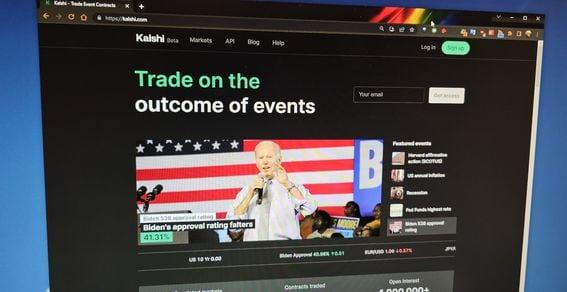
Contracts offered to U.S. customers on who will control Congress only traded a few hours before being halted pending the appeal. A U.S. federal appeals court halted Kalshi's brand-new political prediction markets, heeding the Commodity Futures Trading Commission's request for an emergency stay after the regulator lost a similar motion to a lower-level judge. Judge Jia Cobb of the District of Columbia court ruled last week that the CFTC exceeded its authority by banning Kalshi from listing U.S. political prediction markets, basically bets on which party might control the House of Representatives or win the White House in any given term. Kalshi, the plaintiff in the case, sued the CFTC, arguing the agency was behaving arbitrarily in banning these markets. The CFTC initially asked Judge Cobb, who's overseeing the case, to still prevent Kalshi from listing any contracts while it waited for her full opinion, which she published Thursday morning. The judge denied the CFTC's request, and Kalshi listed its first U.S. political prediction markets in the afternoon. The CFTC filed an emergency motion to stay the markets to the appeals court while it considers whether to appeal the full ruling, court records showed Thursday. Trading on Kalshi's two new contracts, asking which party will win the House and Senate, was paused as of 11:30 p.m. ET Thurday (03:30 UTC Friday), with a notice on Kalshi's website citing a "pending court process." "Appellee KalshiEx LLC ('LLC'), knowing that this Court’s review was imminent, has raced to launch its election gambling contracts on the same day the District Court issued a memorandum opinion, before Appellant the Commodity Futures Trading Commission ('Commission' or 'CFTC') has had the opportunity to file this motion for stay pending appeal about the serious legal issues and public interests at stake," the CFTC said in its filing. Kalshi wouldn't be harmed much if the appeals court temporarily halted its contracts, while the public interest may be harmed more if the contracts continued, the CFTC argued. Kalshi's attorneys pushed back, saying "no administrative stay is necessary or appropriate." "Kalshi will promptly oppose the CFTC’s renewed stay motion on the merits in this Court. But in the meantime, no administrative stay is necessary or appropriate. Judge Cobb’s decision on the merits was clearly correct because the statute empowers the CFTC to block event contracts only if they involve (as relevant here) 'gaming' or 'unlawful activity,'" the company's letter said. "As Judge Cobb observed, elections are neither." The appeals court ordered Kalshi to halt its contracts while it considers the motion, and ordered Kalshi to file a response by Friday evening. The CFTC can file a reply by Saturday evening. The CFTC is also in the middle of a rulemaking process to ban political prediction markets in general from the U.S., citing concerns about policing fraud in the underlying market – namely, elections. Judge Cobb, in her Thursday opinion, said she was sympathetic to that reasoning but it was irrelevant to her assessment of the agency's case against Kalshi specifically. https://www.coindesk.com/policy/2024/09/13/kalshis-new-political-prediction-markets-halted-as-cftc-appeals-loss/
2024-09-12 23:43
The action could impact $200 million of DeFi loans in the Sky ecosystem should the proposal pass. Sky, the decentralized finance lender formerly known as MakerDAO, will vote on fully ditching wrapped bitcoin (wBTC) from its ecosystem, according to a Thursday governance post, potentially a major development in DeFi since the platform has $200 million of loans collateralized by the token. WBTC is a token that allows investors to use bitcoin (BTC) on other blockchains, and plays a key role in lending DeFi as collateral, with a $9 billion market capitalization. DeFi risk management firm BA Labs, an influential voice in the Sky protocol's governance, previously had proposed to reduce exposure to wBTC, due to perceived risks from Tron founder Justin Sun's involvement with the custodian for the underlying assets. Sky is one of the biggest DeFi projects and issuer of the $5 billion decentralized stablecoin DAI, so the development had been closely tracked by crypto analysts and blockchain industry watchers. On Thursday, BA Labs proposed to gradually offboard all wBTC exposure from collateral assets in five steps, with the first one starting on Sep. 26. Each step will be voted on. "We find that legal due diligence would not provide an adequate level of assurance," BA Labs said in its proposal. BA Labs recommended onboarding alternative products to the platform should the proposal pass. A spokesperson for Tron did not immediately return a request for comment. Competitors energized Currently, there are some $73 million worth of loans collateralized with wBTC on Sky-affiliated lending platform SparkLend, and some $127 million debt against wBTC in Sky's legacy vaults, according to the BA Labs post. Tensions flared up around wBTC following crypto custody firm BitGo's announcement earlier this month that it planned to transition control of the asset to a joint operation with a custody platform called BiT Global. The deal, which distributed control over the project's custody to three entities globally instead of just one, was cast as a way of helping to decentralize the operation. According to an Aug. 9 press release, BiT Global is a global custody platform with regulated operations based in Hong Kong, registered as a Trust and Company Service Provider (TCSP), and is a "a strategic partnership between BitGo, Justin Sun, and the Tron ecosystem." BitGo CEO Mike Belshe earlier this month defended the joint firm's autonomy from Sun and Tron. BitGo CEO Says Wrapped Bitcoin’s Critics Aren’t Being ‘Intellectually Honest’ About Their Concerns The drama around wrapped bitcoin has energized competitors offering alternative versions of the token, including dlcBTC, Threshold's tBTC and FBTC, which has the support of Mantle Network. Notably, crypto exchange and custody giant Coinbase debuted its own wrapped bitcoin competitor earlier Thursday. https://www.coindesk.com/business/2024/09/12/defi-lending-giant-sky-sets-vote-to-offload-wrapped-bitcoin-as-justin-sun-concerns-linger/

2024-09-12 18:29
Under the agreement, the platform can list only BTC, BCH and ETH in the U.S. Is that a hint of which digital assets the SEC thinks are not securities? Trading platform eToro agreed Thursday to settle charges with the U.S. Securities and Exchange Commission that it operated as an unregistered broker and clearing agency and that it facilitated trading in some crypto assets that are securities. The agreement sees eToro paying a $1.5 million fine and means the company will be limited to trading just three digital assets: bitcoin (BTC), bitcoin cash (BCH) and ether (ETH). Etoro, which is based in Israel, is not a big player in the U.S. crypto market. It has only 240,000 customer accounts compared to Coinbase's 100 million. But the SEC agreement is significant for the clues it offers about how the regulator views the key legal question of which digital assets are not securities, and therefore outside its supervision, lawyers contacted by CoinDesk said. Below is a sampling of reactions from leading digital asset-focused attorneys: Joseph Tully, securities litigation lawyer at Tully & Weiss: “It appears that the SEC has officially sanctioned BTC, BCH, and ETH so we know that the SEC considers at least those three to be commodities and not securities. The key words here [are] at ‘at least.’ There may be others, but there is no legal guidance based upon this settlement.” Lowell Ness, partner at Perkins Coie: “It’s interesting to see parties agreeing to this kind of drastic settlement when viewed against federal court rulings holding that programmatic trades are not securities transactions. This settlement highlights the huge gap that may be developing between regulators and some of the early court decisions.” Drew Hinkes, Partner with K&L Gates: Joshua Ashley Klayman, U.S. Head of Fintech and Head of Blockchain and Digital Assets at Linklaters: “What we know from the face of the Cease and Desist Order is that eToro submitted an Offer of Settlement that the SEC accepted. eToro does not admit or deny the findings set forth in the Cease and Desist Letter, except with respect to the SEC’s jurisdiction. "It is important to remember that, unlike in a court case, where allegations must be proven, parties have freedom of contract to agree to settlements. Here, we have very little information about which digital asset or assets the SEC may have alleged were the subject of securities transactions. We also do not have visibility into eToro’s motivations for settling, nor its business plans or strategy generally. "For those reasons, in my view, one should exercise caution and should not assume that the existence of the Cease and Desist Order will have an impact on any enforcement action that may be before the courts, now or in the future. Put differently, no allegations were proven in connection with this Cease and Desist Order, and it appears that no allegations were even made by the Commission as to which specific digital assets the Commission thought to be securities or to form part of a securities transaction.” Bill Hughes, lawyer at Consensys: Former SEC lawyer Alexandra Damsker: “What a disappointment to take the settlement. "These people are chickens - we have an opening post [the Supreme Court decision] Loper: they should go to the courts and get a determination. The SEC actually DOESN’T have the final say here. "But they are just cutting off the business and running off, tail between their legs. Oh well.” We’ll update this article with more reactions as we receive them. Note: The views expressed in this column are those of the author and do not necessarily reflect those of CoinDesk, Inc. or its owners and affiliates. https://www.coindesk.com/opinion/2024/09/12/etoro-settles-with-the-sec-industry-lawyers-react/
2024-09-12 16:59
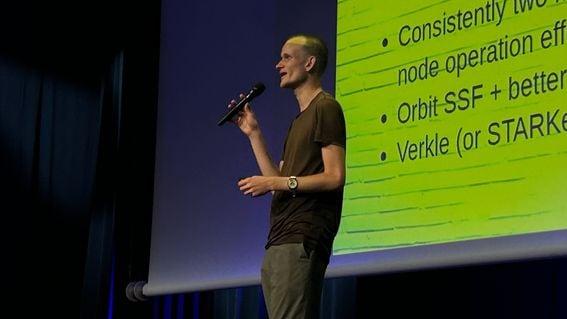
In 2022, Buterin proposed a set of stages for rollups, to classify them in their pursuit of decentralization. The criteria is meant to showcase that rollups tend to rely on “training wheels” and deploy their protocols to users before it's ready to fully decentralize. There's the bully pulpit. And then the silent treatment. Ethereum co-founder Vitalik Buterin wrote on X that he will be weighing in on layer 2 networks differently in his public posts from now on – omitting mentions of those projects that aren't decentralized enough. To merit any ink, they have to at least meet a decentralization threshold known as "Stage 1," under a hierarchy he laid out years ago in a blog post. “Starting next year, I plan to only publicly mention (in blogs, talks, etc) L2s that are stage 1+,” Buterin wrote. “It doesn't matter if I invested, or if you're my friend; stage 1 or bust.” In 2022, Buterin proposed a set of stages for rollups, to classify them in their pursuit of decentralization. The criteria is meant to showcase that rollups tend to rely on “training wheels” and deploy their protocols to users before it's ready to fully decentralize. “While a project’s tech is still immature, the project launches early anyway to allow the ecosystem to start forming, but instead of relying fully on its fraud proofs or ZK proofs, there is some kind of multisig that has the ability to force a particular outcome in case there are bugs in the code,” Buterin wrote in a blog post in 2022. In blockchain terms, multisig is short for a key that can be controlled by combining multiple signatures – often representing a small group of people who could make changes under emergency conditions, essentially bypassing the typical consensus process used to validate the network. Taking off the 'training wheels' Buterin has categorized the projects in three different stages, ranging from 0 to 2. Stage 0 is when a layer 2 network relies on full training wheels. Stage 1 is when it has limited training wheels, but is running with fraud proofs – an important cryptographic process that avoids the need for a single centralized entity to settle any layer-2 transactions to the base Ethereum blockchain. Stage 2 means a project is fully decentralized. L2Beat, a layer-2 dashboard, tracks how the different layer-2 protocols rank in terms of those different stages. Currently, none of the leading rollups has reached Stage 2. At Stage 1, only Arbitrum One, OP Mainnet, and zkSync lite have reached this stage. “The era of rollups being glorified multisigs is coming to an end," Buterin wrote on X. "The era of cryptographic trust is upon us.” https://www.coindesk.com/tech/2024/09/12/ethereums-vitalik-buterin-amps-up-pressure-on-layer-2-networks-to-decentralize-further/