2024-04-12 07:21
Singapore-based Matrixport expects mainland Chinese investors to move billions into potential Hong Kong-listed spot BTC ETFs through the Stock Connect program. Mainland Chinese investors could pour $25 billion in potential Hong Kong-listed spot bitcoin exchange-traded funds (ETFs) through the Southbound Stock Connect program, according to Matrixport. One Hong Kong-based observer said mainland Chinese funds have been applying to issue spot ETFs through their Hong Kong subsidiaries. Hong Kong, one of the world’s leading financial centers and a gateway for outbound Chinese investments, is set to approve a spot bitcoin exchange-traded fund tied to bitcoin (BTC). The investment vehicle could unlock up to $25 billion in demand from Chinese investors via the Southbound Stock Connect program, according to Singapore-based crypto services provider Matrixport. The Southbound Stock Connect allows qualified mainland Chinese investors to access eligible shares listed in Hong Kong. “A likely approval of Hong Kong-listed Bitcoin Spot ETFs could attract several billion dollars of capital as mainland investors take advantage of the Southbound Connect program, which facilitates up to 500 billion RMB (HK$540 billion and $70 billion] per year in transactions," Matrixport said in a report Friday. “Based on the (potential) available capacity, this might result in up to 200 billion Hong Kong dollars of available capacity for those HK Bitcoin ETFs—or US$25 billion," Matrixport added. The estimate is based on a blue sky assumption that the average amount of the unused annual Southbound connect quota over the past three years would be channeled into the spot ETFs. The Stock Connect program allows mainland Chinese investors to snap up HK$540 billion worth of Chinese stocks annually. However, flows in the past three years have been HK$450 billion, HK$400 billion and HK$320 billion, falling short of the limit by HK$100 to HK$200 billion ($15 billion to $25 billion), according to data source 360MarketIQ. "Hence there is potentially HK$100 billion to HK$200 billion in quota left for bitcoin ETF investment flows – if the approval occurs without any restrictions. HK$200 is the equivalent of $25 billion," Matrixport explained. As of this writing, it's unclear whether the impending spot ETFs will be open for mainland Chinese investors. That said, mainland China seems interested in diversifying into alternative assets, as evidenced by the recent surge in gold prices in Shanghai. The tightly controlled Chinese renminbi (or yuan) has declined nearly 2% against the U.S. dollar, extending the two-year losing streak on the back of an economic slowdown and shrinking trade surplus. "China’s RMB is at a 17-year low vs. the USD. Indeed, there is a demand for diversification," Matrixport said, noting the Chinese central bank's continued gold purchases. Nick Ruck, COO of ContentFi Labs, said mainland funds are interested in issuing ETFs in Hong Kong. "Mainland-based funds have been applying to issue spot bitcoin ETFs through their Hong Kong subsidiaries. If approved, this could allow qualified mainland investors greater access to bitcoin," Ruck, who is based on Hong Kong, told CoinDesk. According to Nikkei Asia, top Chinese fund manager Bosera Asset Management's Hong Kong arm, Harvest Global Investments, and Chinese brokerage GF Holdings-owned Value Partners have applied for ETFs in Hong Kong. In December, a report by Hong Kong Exchanges and Clearing Limited (HKEX) said the Stock Connect program was expanded to include Hong Kong-listed ETFs in July 2022. As of mid-2023, the program included six Hong Kong-listed ETFs, and their average daily turnover grew to HK$2.9 billion by September. The U.S. greenlighted nearly a dozen spot ETFs four months ago. Since then, these funds have amassed $12 billion in investor funds, pushing bitcoin to new record highs above $73,000. https://www.coindesk.com/markets/2024/04/12/hong-kong-listed-bitcoin-etfs-could-unlock-upto-25b-in-demand-crypto-firm-says/

2024-04-12 06:12
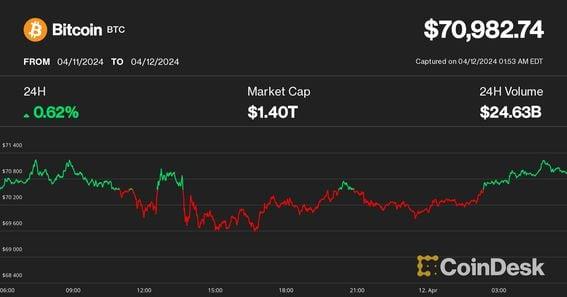
The Thursday total ETF flow was negative, with GBTC leading the pack GBTC outflows are once again negative, with $124.9 million flowing out of the trust-turned-ETF. However, the price of bitcoin remains stable, challenging the thesis that outflows push down prices (BTC) is stable, trading above $70,900, as outflows from the Grayscale Bitcoin Trust (GBTC) pick up once again. Overall, $124.9 million flowed out of GBTC, according to on-chain data. In comparison, $4.6 million flowed into Fidelity's FBTC, and $11.1 million went into Bitwise's BITB. Up to Thursday, all the bitcoin ETFs have reported a weekly outflow of $227.9 million. There's currently a belief within the market that continued outflows from GBTC put selling pressure on BTC and drive down prices. However, that belief is not universal, and some market participants have a wait-and-see approach, highlighting that outflows are expected from GBTC, given its higher fee structure. Traders are pricing in some price stability for bitcoin in the remaining weeks of April, with bettors on Polymarket putting the chance of BTC hitting $75,000 at 60% by month's end and the chance of it hitting $80,000 at 32%. https://www.coindesk.com/markets/2024/04/12/bitcoin-stable-near-71k-as-gbtc-outflows-pick-back-up/
2024-04-12 04:00
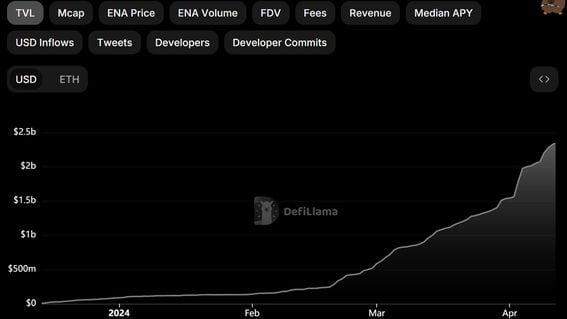
"A lot of things can go wrong," in Ethena's yield-generation strategy, said Folkvang CEO Mike van Rossum. Ethena Labs' USDe stablecoin provides a yield through a tokenized cash-and-carry trade. Counterparty risk and a funding-rates reversal are two of the protocol's main challenges. Ethena founder Guy Young labeled comparisons with Terra's failed UST as a "weak, surface-level argument." Ethena Labs, a decentralized protocol centered on the yield-bearing USDe stablecoin, has polarized crypto traders in the weeks since introducing the token to the public in February over similarities to the Terra ecosystem, which imploded in 2021. People who stake USDe for a minimum of seven days currently earn an annualized yield of about 37%, high enough to spur total value locked (TVL) on the protocol to $2.3 billion from $178 million – a 12-fold increase in just 60 days. High yield, however, is a double-edged sword and usually reflects high risk: Terra's UST paid out nearly 20% to stakers before its demise. Unlike asset-backed stablecoins like tether (USDT) and USDC, whose value is secured against dollars or dollar-equivalents such as U.S. government debt, USDe calls itself a synthetic stablecoin with its $1 value maintained through a financial technique known as the cash-and-carry trade. The trade, which involves buying an asset and simultaneously shorting a derivative of the asset to collect the funding rate, or the difference between the two prices, is well known in traditional finance and doesn't carry directional, or delta, risk. "The trade itself is very safe and well understood, many folks (including Folkvang) have been running trades like this for years," Folkvang founder Mike van Rossum said in a post on X. "But keep in mind it’s only risk free when talking about delta. There are a lot of things that can go wrong here. Such as any issue with any of the exchanges these positions (and collateral) are managed on. As well as issues around trying to execute hundreds of millions (or billions) in very volatile markets." How does Ethena work? Ethena users mint USDe tokens by depositing stablecoins like USDT, dai (DAI) and USDC on the protocol. They can then stake the minted USDe, which has a market cap of $21.3 billion, in return for the yield. To generate that yield, Ethena has deployed several strategies that hinge around the cash-and-carry trade. Funding rates on bitcoin (BTC) and ether (ETH) perpetuals are currently positive, which means long positions pay short positions, generating a return for those shorting the market. Funding rates typically flip negative in falling markets, which means Ethena's yield source might dry up if cryptocurrency enters another bearish cycle. Crypto whales seem unperturbed. Earlier this week 10 wallets withdrew a total of $51 million of Ethena's native governance token (ENA) from exchanges and locked that on Ethena for a minimum of seven days, according to Lookonchain. "The risks to Ethena is that the yield goes away due to natural market forces, or that they have a counterparty blow up, not the collateral itself," Jeff Dorman, chief investment officer at Arca, said in an interview. "What Ethena is trying to do with basis trades is fairly easy, and has been done in traditional markets for decades," he said. "Anyone can do the same thing on their own, if they have enough capital for collateral, and trusted counterparties. All Ethena is doing is increasing the risk while decreasing the time it takes for you to do it on your own." Long-lasting scars Terra's traumatic demise led to the bankruptcy of several other crypto firms, and left long-lasting scars across the industry. It blew up because UST, an algorithmic stablecoin, entered a death spiral following aggressive selling and a slump in the value of LUNA, which acted as collateral. "It is a really weak, surface-level argument to compare what Ethena is doing to Luna," Ethena Labs founder Guy Young said in an interview with Laura Shin on the Unchained podcast. "The core difference here is thinking about what's backing the stable asset. So UST was backed by the LUNA token, which mooned up 100% and dumped 50% in a week. Ethena's USD is fully backed and fully collateralized." As for its reliance on a bull market, Young said: "I think it's a valid concern around this. What we did see even in 2022 when you had staked ETH together with basis you could still sustain rates above U.S. Treasuries, but I do imagine that in a bear market you do see a reasonable unwind of USDe supply." "This is something that we're okay with," Young said. "It's just something that is responding to market dynamics, and if there is less leverage demand to be long as the interest rate is lower, we're going to adjust to a smaller size." Young didn't rule out changing Ethena's yield-generation strategy to something that "makes sense in a bear market" if necessary. https://www.coindesk.com/business/2024/04/11/ethena-labs-divides-opinion-as-high-yield-stirs-memories-of-terra/
2024-04-11 21:55
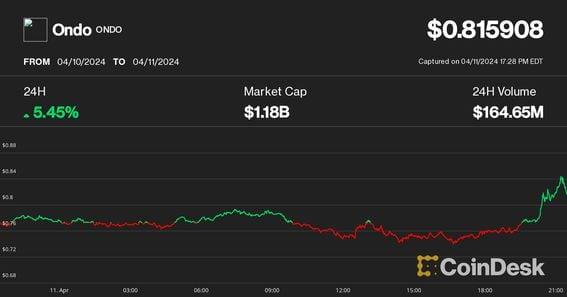
Stablecoin issuer Circle introduced a new smart contract function earlier Thursday to allow near-instant, around-the-clock redemptions from BlackRock's BUIDL fund for USDC stablecoins. Ondo Finance's governance token (ONDO) jumped Thursday after the tokenized asset platform tested out the newly introduced ability to do near-instant conversions between Circle's USDC stablecoin and BlackRock's new BUIDL token. An Ondo wallet on Ethereum redeemed $250,000 worth of BUIDL tokens in exchange for USDC, Etherscan data shows. That was an attempt to try out the USDC-to-BUIDL feature announced Thursday by Circle, Ondo Finance CEO Nathan Allman said in a Telegram message to CoinDesk. "We are using it to power instant 24/7/365 redemptions of OUSG into USDC," Allman added. OUSG refers to the Ondo Short-Term U.S. Government Treasuries token backed by securities sold by the U.S. government. ONDO gained as much as 8% as news about the transaction started circulating on social media crypto circles before paring some of its advance. BlackRock, one of the world's most powerful financial institutions, made headlines last month by entering the asset tokenization race, a red-hot sector in the crypto industry to place traditional financial instruments such as bonds, credit or commodities to blockchain rails. The BlackRock USD Institutional Digital Liquidity Fund, created with tokenization firm Securitize, holds cash, U.S. Treasury bills and repurchase agreements. Investment in the fund is represented by the Ethereum-based BUIDL token, which provides yield paid out via blockchain rails every day to token holders. Ondo Finance was one of the early adopters of the fund, using it as a backing asset for its OUSG token. https://www.coindesk.com/markets/2024/04/11/ondo-spikes-8-as-ondo-finance-tests-instant-conversion-from-blackrocks-tokenized-fund-to-usdc/
2024-04-11 20:21
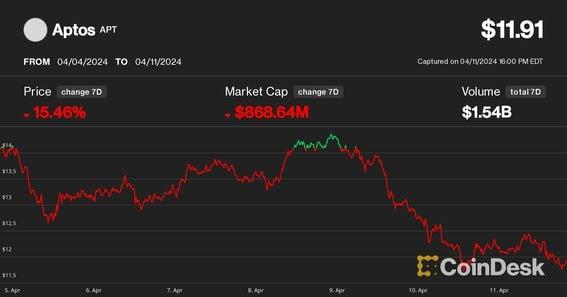
Unlocks are scheduled releases of previously locked-up cryptos to prevent early investors and insiders from selling tokens in large numbers. Nearly 25 million of locked-up APT tokens will be released Friday including to early investors, TokenUnlocks data shows. Prices historically decline around such events as the supply increase outpaces investor demand for the asset, according to research. The native cryptocurrency of layer-1 blockchain Aptos (APT) underperformed the crypto market ahead of an almost $300 million supply event due this week that will increase the number of circulating tokens. APT declined more than 16% over the past week while major crypto assets bitcoin (BTC) and ether (ETH) gained 3% and 5%, respectively. It was the second-worst performing constituent of the broad-market CoinDesk 20 Index, beating only the token of decentralized exchange Uniswap (UNI) which tumbled on regulatory actions in the U.S. The difficult week occurred ahead of 24.84 million of previously locked-up APT tokens that are scheduled to be released on April 12, TokenUnlocks data shows. The actual time when assets can be moved after the release could be around 1-2 days after the event, the website adds. Some $141 million worth of tokens will be distributed to core contributors, $100 million to investors, $38 million among community members. $16 million in tokens are earmarked for the ecosystem development foundation. Token unlocks happen because the supply of many cryptocurrencies are locked up in vesting to prevent insiders – early investors, team members – from dumping tokens en masse. Prices historically decline around such events, as the supply increase outpaces investor demand for the asset, according to research by crypto analytics firm The Tie. The APT tokens to be released represent just 6% of the current circulating supply, but is nearly double the daily trading volume on exchanges, per CoinGecko data. https://www.coindesk.com/markets/2024/04/11/aptos-falls-16-over-past-week-lagging-ahead-of-300m-token-unlocking-event/
2024-04-11 18:35
Wright’s decision to drop his appeal comes a month after a U.K. court ruled that he was not Satoshi Nakamoto. Craig Wright has dropped his appeal against Hodlonaut in Norway. The decision to drop the case comes a month after a U.K. judge definitively ruled that Wright is not the inventor of Bitcoin. Craig Wright has dropped his appeal against Norwegian bitcoiner Hodlonaut, ending a nearly five-year-long legal battle over a series of social media posts in which Hodlonaut called Wright a “scammer” and a “fraud” for claiming to be the inventor of Bitcoin. A Norwegian judge sided with Hodlonaut after a 2022 trial in Oslo, concluding that he had “sufficient factual grounds to claim that Wright had lied and cheated in his attempt to prove that he is Satoshi Nakamoto.” Hodlonaut brought the case against Wright to preempt him from moving forward with a defamation case about the same social media posts in the U.K., where laws are heavily tipped in favor of the plaintiff, and monetary damages can be enormous. The infamously litigious Wright appealed the court’s decision. But, according to Hodlonaut, Wright has now dropped that appeal. “Just got off the phone with my Norwegian lawyer. CRAIG WRIGHT DROPPED THE APPEAL IN NORWAY!,” Hodlonaut wrote in a social media post, adding, “I’m very happy!” Wright’s decision to back down comes just a month after he lost a separate court case in the U.K. that severely hobbled his ability to claim Satoshi’s throne. The Crypto Open Patent Alliance (COPA) sued Wright in 2021 in order to prove that he was not, in fact, the inventor of Bitcoin and to stop him from being able to claim copyright of the Bitcoin whitepaper or sue Bitcoin developers or others under the guise of being Satoshi. In March, U.K. Judge James Mellor found in favor of COPA, stating that Wright “is not the author of the Bitcoin white paper…is not the person who adopted or operated under the pseudonym Satoshi Nakamoto….is not the person who created the Bitcoin System…[and] is not the author of the initial versions of the Bitcoin software.” The famously bellicose Wright has been largely quiet in the wake of Judge Mellor’s decision, as has his billionaire benefactor Calvin Ayre. The day after the COPA trial ended, Ayre posted a farewell message on X, saying that the message would be his “last” before taking off on “an adventure I have planned for the last year.” Despite the conclusion of Wright’s appeal in Norway, other litigation involving Wright – including another defamation case against Hodlonaut in the U.K. – remains pending. Representatives for Wright did not respond to CoinDesk’s request for comment. https://www.coindesk.com/policy/2024/04/11/craig-wright-drops-appeal-against-hodlonaut-in-norway/