2024-09-12 12:03
The next difficulty adjustment is expected to decrease mining difficulty, potentially relieving some pressure on miners. The difficulty of mining bitcoin has reached an all-time high of 92.6 terahashes, increasing by over 10% since early July, which could strain miners' profitability due to higher operational costs. Increased mining difficulty might pressure miners financially, potentially leading to more bitcoin being sold to cover costs. However, some say there's no direct correlation between mining difficulty and bitcoin price. The next bitcoin difficulty adjustment is estimated to occur on Sept. 27, decreasing the bitcoin mining difficulty to 77.12 T, as per Coinwarz. The computational power required to bring new bitcoin (BTC) into existence has surged to a fresh lifetime high in a move that could spell trouble for miners and impact prices. Mining difficulty hit 92.6 terahashes late on Wednesday, Coinwarz data shows, rising by four units in a month and more than 10% since early July. Difficulty (denoted by terahashes) measures the computation power used to process blocks on a proof-of-work blockchain, such as bitcoin, broadly referring to how and time-consuming it is to find the right hash for each block. Entities, often referred to as miners, use extensive computing systems to mine blocks and are rewarded with bitcoin - which is sold on the open market to cover costs and turn a profit. The network automatically adjusts the difficulty of mining new blocks to the blockchain every 2,016 blocks, or roughly every two weeks. This is based on the number of miners and their combined hashpower - which measures how much computing power a network uses. The next bitcoin difficulty adjustment is estimated to occur on Sept. 27, decreasing the bitcoin mining difficulty from 92.67 T to 77.12 T, as per Coinwarz. A bump in mining difficulty can dampen profits for bitcoin mining companies as costs required to keep operations going significantly increase - straining an already difficult environment for such firms. “Revenue has been under pressure for many mining firms post-halving,” Augustine Fan, head of insights at SOFA, told CoinDesk in a Telegram message Thursday. “We believe, however, that the recent selling pressure is primarily from trading stopouts and ETF outflows.” Some traders, meanwhile, say bitcoin price action could be impacted based on general market conditions and how miners deal with the difficulty increase. “There is no clear cause-and-effect relation between mining difficulty and BTC price. Higher mining difficulty will indeed cause stress on the miners' but how they react to such stress is up to individual miners,” Peter Chung, head of research at Presto, told CoinDesk in a Telegram message. “Over the long-run, miners deal with rising difficulty levels by upgrading the equipment and/or pursuing other cost rationalization measures (e.g. seeking cheaper electricity cost, etc). Historically, when you average it out, BTC price showed no meaningful correlation with this particular variable,” Chung said. Presto research analyst Min Jung, however, said that selling pressure could be on the cards based on overall market sentiment. “If equities weaken and the overall financial markets show signs of weakness, it could lead to selling pressure, driven by the belief that it is better to take a loss now than later,” Jung said in a message. https://www.coindesk.com/markets/2024/09/12/mining-new-bitcoin-is-more-difficult-than-ever-heres-how-it-could-impact-btc-prices/

2024-09-12 11:55
The central bank wants to promote the widespread use of the digital ruble. Russia's largest banks must support a digital version of the ruble for customers starting July next year. Smaller banks will follow suit over the coming years. The Bank of Russia wants the country's largest banks to support a digital ruble for retail and commercial use by July next year. The banks will need to enable their customers to "open and top up digital ruble accounts, make transfers, and accept digital rubles in their infrastructure," the central bank said Thursday. After that, "it is planned to launch the widespread use of the digital national currency. It is important that it is available to citizens and businesses and, if desired, they can freely use it on an equal basis with cash and non-cash funds." The digital ruble is a central-bank issued digital currency, or CBDC. Banks worldwide have been exploring use of CBDCs either for retail or institutional, or wholesale, use. Some nations like the Bahamas and Nigeria have already introduced CBDCs. Russia has been testing its CBDC with 12 banks. At the beginning of the month, the trials expanded to 9,000 people from 600. https://www.coindesk.com/policy/2024/09/12/russian-central-bank-targets-july-2025-for-widespread-digital-ruble-use/

2024-09-12 11:36
Bitcoin is expected to end the year at new all-time highs regardless of who wins the U.S. election, the report said. Bitcoin is going to break out to new highs by year-end irrespective of who wins the U.S. election, the report said. The bank said bitcoin could reach $125,000 if Trump wins and $75,000 if Harris triumphs. Standard Chartered said positive catalysts such as regulatory reform are expected to dominate the crypto market, regardless of the election outcome. Bitcoin (BTC), the world's largest cryptocurrency, is expected to hit a new high by year-end, regardless of who wins the U.S. election in November, investment bank Standard Chartered (STAN) said in a report on Thursday resuming coverage of the sector. The outcome of the U.S. presidential election is important for digital assets, but it matters less than when Biden was the Democratic candidate, and less than markets think, the bank said. Bitcoin is expected to hit new all-time highs by year-end irrespective of who wins the election, the report said, and could reach about $125,000 if Trump wins or around $75,000 if Kamala Harris triumphs. The bank sees positive drivers dominating the crypto market. "Progress on relaxing regulations - particularly the repeal of SAB 121, which imposes stringent accounting rules on banks' digital asset holdings - will continue in 2025 no matter who is in the White House," wrote Geoff Kendrick, global head of digital assets research at Standard Chartered, adding that progress would just take longer under a Harris presidency. A re-steepening of the U.S. Treasury curve is also "building positive momentum" for bitcoin, the report noted. Bitcoin is likely to sell-off initially if Harris wins, but Kendrick expects any dip to be bought as investors recognise that regulatory progress will still happen, albeit at a slower pace, and as other positive catalysts take over. https://www.coindesk.com/markets/2024/09/12/bitcoin-could-hit-125k-by-year-end-if-trump-becomes-president-75k-if-harris-triumphs-standard-chartered/

2024-09-12 10:46
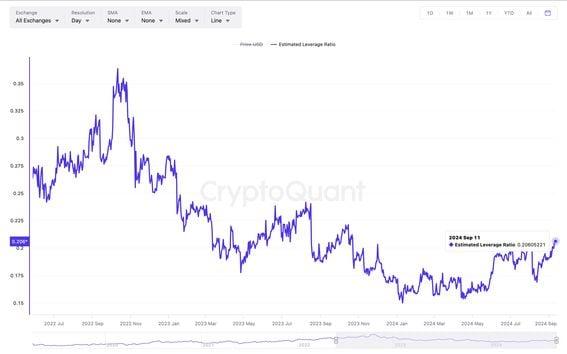
High-leverage liquidity in bitcoin is concentrated at around $58,500, according to Hyblock Capital. Renewed bias for leverage points to increased investor risk appetite. High-leverage liquidity in bitcoin is concentrated at around $58,500. Increased leverage indicates traders taking on more risk and a possible jump in price volatility. Leverage in the bitcoin (BTC) market is growing again, a sign traders are looking to take on more risk, potentially injecting volatility into the market. The so-called estimated leverage ratio, which divides global futures open interest by the number of coins held on exchanges, has jumped to 0.2060, the highest since October 2023, according to data tracked by analytics firm CryptoQuant. The increase follows a months-long consolidation below 0.20, pointing to traders increasingly using borrowed funds to amplify their futures positions and a risk-on environment. A low ratio suggests a cautious approach. The estimated leverage ratio peaked following the collapse of Sam Bankman Fried's FTX exchange, formerly the third-largest futures trading platform in late 2022 and trended lower till December 2023. Leverage allows traders to control larger positions with relatively little capital, magnifying both profits and losses. It's a double-edged sword that exposes traders to margin shortages and forced liquidations when the market moves against their positions, which, in turn, adds to price volatility. "The recent increase in the Bitcoin Estimated Leverage Ratio suggests a growing trend among investors toward higher leverage in the derivatives market," CryptoQuant said in a blog post. $58,500 is the key level According to Hyblock Capital, high-leverage liquidity is stacked at around $58,500. So, once prices approach that level, volatility could pick up, especially because overall market liquidity remains low. That means a buy/sell order can have an outsized impact on the going market rate. "High-leverage liquidity zones around $58,500 could drive increased volatility and create opportunities for traders as Bitcoin gravitates toward these levels," Hyblock said in an email to CoinDesk. "Combined order book liquidity remains low, suggesting bullish potential, while the global bid-ask ratio remains positive, indicating robust underlying demand," Hyblock added. At press time, bitcoin changed hands at around $58,000, representing a 2.5% over 24 hours, according to CoinDesk data. Ether (ETH), the second largest cryptocurrency by market value, traded 1% higher at $2,350, with an estimated leverage ratio of 0.35. https://www.coindesk.com/markets/2024/09/12/leverage-in-the-bitcoin-market-is-increasing-again/
2024-09-12 10:31
Sentiment is somewhat bearish about the near-term outlook for bitcoin, the bank's consumer survey showed. Fewer than 1% of U.S. consumers called crypto a fad, according to a Deutsche Bank survey. Only 18% of respondents said they expected stablecoins to thrive; 42% expected them to fade. Sentiment about bitcoin's outlook was not so positive, the survey said. U.S. consumers are warming up to crypto, with less than 1% calling it a "fad," a dramatic decline from previous years, Deutsche Bank (DB) said in a report on Wednesday. Just over half of the people surveyed viewed crypto as an important asset class and method of payment, and 65% said they could see it replacing cash. The bank surveyed over 3,600 consumers in the U.S., U.K. and Europe in March and July. "We expect cryptocurrency democratisation to advance further over the next 2-3 years driven by exchange-traded funds (ETFs), Federal Reserve policy, and regulation," analysts Marion Laboure and Sai Ravindran wrote. It's not all good news, with bitcoin (BTC), the world's largest cryptocurrency, garnering a gloomy outlook for the rest of the year and stablecoins, the backbone of decentralized finance (DeFi), facing an uncertain future in respondents' eyes. A third of consumers said they thought the BTC price would be below $60,000 by year-end, and only 12%-14% thought it would cross $70,000. Bitcoin was trading around $58,200 at publication time. For the longer term, perceptions were mixed: 40% of respondents said they thought BTC would thrive in the coming years, while 38% said they expected it to disappear. The outlook for stablecoins, a type of cryptocurrency that's designed to hold a steady value, was also viewed with circumspection. Just 18% of those surveyed said they expected stablecoins to thrive, whereas 42% expected them to fade. Those backed by a fiat currency such as the dollar or a traditional commodity like gold were most likely to keep their value, the survey said. More than 50% of consumers said they were concerned about a cryptocurrency collapsing in the next two years. Crypto adoption has remained steady in the U.S. and the U.K. in recent years, and the retail market now looks ready for a rebound, according to crypto platform Gemini's '2024 Global State of Crypto' report, published earlier this week. https://www.coindesk.com/markets/2024/09/12/us-consumers-say-crypto-is-here-to-stay-stablecoins-maybe-not-deutsche-bank/
2024-09-12 09:13
The floating yields on the bitcoin-based LBTC token are from pools that went live on Wednesday. There's also a fixed-yield option of an annualized 10%. DeFi platform Pendle's new pools allows users to earn floating yields up to 45% and fixed yields of 10% on a bitcoin-based token. The yields are achieved through staking service Lombard's LBTC token in collaboration with Ethereum layer-2 network Corn. Pendle splits investments into principal tokens and yield tokens that can be traded separately, facilitating high-yield strategies by allowing users to trade future returns. DeFi platform Pendle on Wednesday started offering pools with variable yields of as high as 45% on a bitcoin (BTC)-backed token in a move that expands the product’s fundamentals. The offering, which can also provide fixed yields of an annualized 10%, allows users to deposit LBTC, a liquid-staking token issued by restaking startup Lombard, in a Pendle pool made by Ethereum layer-2 network Corn. Data shows the pool has attracted over $13 million in user deposits since going live. It matures on Dec. 26. “We’ve seen major use cases with fixed yield for ETH, and we’re aiming to replicate the same success with BTC as well,” CEO TN Lee told CoinDesk in a Telegram message. “It’s going to be a busy few weeks for us as we roll out new pools and launches.” Pendle's approach is to divide investments into a decentralized finance (DeFi) protocol, such as Compound or Aave, into two: the principle put up by the investor and the yield expected to be earned on that position in the form of token rewards. The split into a principal token (PT) and a yield token (YT) that can traded on the open market creates the high yields possible on Pendle’s pools. Users can buy YT with LBTC, giving them increased exposure to the underlying yield and points from LBTC and Corn until maturity, at which point the YT will be worth zero. If they forego those rewards, they can elect to receive either the fixed yield or the floating yield, which comprises the points that can be monetized and future tokens that will be airdropped to LBTC holders. Lombard is a restaking service that converts wrapped bitcoin (WBTC) to a Lombard Bitcoin (LBTC) token that can be used in DeFi applications to capture yield. Corn, another startup, is a network that uses bitcoin as the main token to pay usage fees. Unwrapping the jargon: Liquid staking is a service that allows users to stake their crypto assets and receive a new token in exchange. Layer 2s are blockchains focusing on a specific use case atop a broader service blockchain. DeFi refers to using automated smart contracts to provide financial services, such as lending and borrowing to users. A pool can be considered a digital locker to store assets and earn returns, similar to bank accounts. Pendle’s PENDLE tokens are up 11% in the past 24 hours, CoinGecko data shows, beating a 2% rise in bitcoin. https://www.coindesk.com/markets/2024/09/12/bitcoin-yields-as-high-as-45-on-offer-in-pendles-new-pools/