2024-03-20 05:28
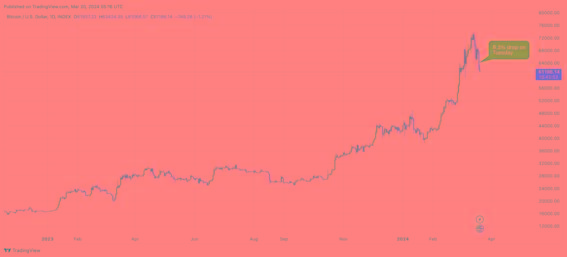
Spot BTC ETFs witnessed record outflows on Tuesday, provisional data from Farside show. BTC fell over 8% on Tuesday, its biggest single-day (UTC) percentage slide since November 2022. ETF outflows likely catalyzed the drop. Bitcoin’s (BTC) price correction gathered pace Tuesday as the U.S.-listed spot exchange-traded funds (ETFs) fell out of favor. The leading cryptocurrency by market value fell over 8% to under $62,000, data from charting platform TradingView show. That’s the biggest single-day percentage (UTC) decline since Nov. 9, 2022. That day, prices tanked over 14% as Sam Bankman Fried’s FTX exchange, formerly the third largest, went bankrupt. The daily performance mentioned here represents the percentage gain or loss in a day, beginning at midnight UTC and concluding at 23:59:59, UTC. Prices have pulled back 15% from record highs of over $73,500 reached last week. The CoinDesk 20 Index has pulled back 16% over the same time frame. Bitcoin’s latest price slide has been catalyzed by several factors, including outflows from the spot ETFs, according to trader and economist Alex Kruger. Provisional data published by investment firm Farside show that on Tuesday, there was a net outflow of $326 million from the spot ETFs, the largest on record. On Monday, Grayscale’s ETF witnessed a record outflow of $643 million. “Reasons for the crash, in order of importance: #1 Too much leverage (funding matters). #2 ETH driving market south (market decided ETF was not passing). #3 Negative BTC ETF inflows (careful, data is T+1). #4 Solana shitcoin mania (it went too far),” Kruger said on X. Ether (ETH), the second-largest cryptocurrency by market value, peaked at around $4,000 following last week’s Dencun upgrade and has since declined to $3,130. One reason for the slide has been the dwindling probability of the U.S. SEC greenlighting an ether spot ETF by May. Besides, the crypto market looked overheated early this month, with long traders paying annualized funding of over 100% to keep their bullish perpetual futures bets open. Such a one-sided buildup of leverage on the bullish side often presages price corrections. Investors will now closely watch Wednesday’s Federal Reserve rate decision, which Chairman Jerome Powell’s press conference will follow. “This upcoming week, we will have the Fed rate decision followed by Powell’s press conference. This will give us more insight into whether the Fed is still seeing rate cuts on the horizon this year. The strong economy and higher than anticipated inflation continue to be reasons for the Fed to remain hawkish without much push-back," Greg Magadini, director of derivatives at Amberdata, said. Both the dollar index and the U.S. Treasury yields have recently moved higher on the back of sticky consumer price and producer price indices, denting the appeal of risk assets, including emerging technologies like cryptocurrencies. https://www.coindesk.com/markets/2024/03/20/bitcoin-registers-biggest-single-day-loss-since-ftxs-collapse/
2024-03-20 02:30
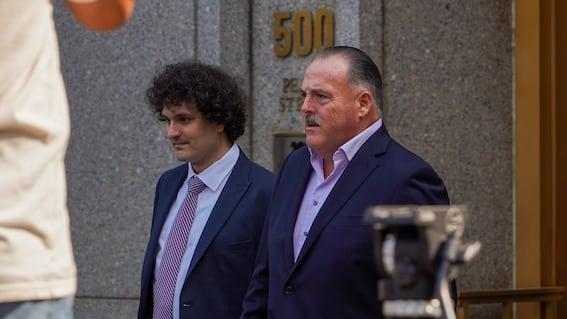
SBF's former customers have weighed in. The stage is set for a federal judge to determine how long Sam Bankman-Fried may spend in prison. The U.S. Department of Justice and defense attorneys have now both filed their arguments, as well as statements from FTX creditors (from the prosecution) and Bankman-Fried's family and friends (from the defense). 'Emotional toll' The narrative Attorneys with both the defense and the prosecution have now filed their sentencing memos with the judge overseeing Sam Bankman-Fried's case, arguing for their respective sentences. Alongside the briefs, the attorneys have also filed supporting letters from the people around FTX and Bankman-Fried, presenting emotional arguments on top of their legal reasoning. Why it matters Bankman-Fried will return to court next week for sentencing. The U.S. Department of Justice wants him in prison for at least four decades; the defense thinks a handful of years is a sufficient punishment (and that the DOJ's recommendation is bonkers). Without trying to guess how a federal judge might approach this, the questions he might look at include Bankman-Fried's conduct, how FTX's customers fared and – of course – the evidence presented during the trial itself. Breaking it down District Judge Lewis Kaplan now has letters from Bankman-Fried's family, former FTX employees, former FTX customers and various other parties when he rules on sentencing next week. The defense and DOJ published various comments to try and convince the judge to support either a relatively light 6.5-year or lengthy 50-year sentence. Both are miles away from the 100-year sentence that the Presentence Investigation Report apparently suggested. I wrote about the defense's submissions a few weeks ago; the short version is Bankman-Fried's attorneys argue he is remorseful and that his life is forever changed by FTX's demise. He won't be able to get a job again without the exchange hovering over him, the defense said. Tough, the DOJ said last Friday. In its response (which the defense later called a "disturbing" recommendation), the DOJ lambasted the 32 year old, saying he deliberately broke the law and his efforts to try and fix the situation may even have made things worse. On Monday, the DOJ filed victim impact statements from former FTX customers describing the effect the exchange's 2022 collapse had on their finances, health, relationships and lives. These letters, mostly addressed to a DOJ officer, the judge or attorneys with a law firm working on a class action suit against the company, detailed how people felt about the exchange's bankruptcy and their expected bankruptcy recoveries. "The emotional toll of this ordeal has been overwhelming," one writer, whose name was redacted, said. Many of these statements took aim at one argument presented by the defense: that FTX customers would be made whole after the exchange wrapped up its bankruptcy process. That's technically true, but only to the extent that these customers will receive the dollar value of their crypto holdings as of November 2022, and not the value they might otherwise have if they had been able to hold onto their funds through the crypto market's huge recent price rise, many of the creditors said. Even there, some of the letters said, receiving the funds back won't make up for the year and a half the customers didn't have access to their money. Contrast these arguments with the defense's submissions, which were mostly character references from Bankman-Fried's family, former colleagues, friends and others tied to him either through donations or the Effective Altruism movement. Some of these letters addressed Bankman-Fried's conduct during and immediately after the collapse of FTX, while others focused solely on the Bankman-Fried that the writers knew. The letters – both the defense and the prosecution submissions – are likely to be taken into account by the judge. Other factors will likely include Bankman-Fried's own testimony during his trial, as well as the testimony of everyone else. The DOJ alleged perjury in its submission, on top of everything else. There's also the fact that the case seemed so clear-cut to the jury that the 12 members only took a few hours to agree to convict on all seven charges. Other questions that may play a role: will Bankman-Fried commit fraud again if he re-enters society? How will he comport himself outside of prison? "At age 32, the government wants to break Sam Bankman-Fried. They ignore completely his condition and vulnerabilities. Instead, they urge, menacingly, that the sentence imposed must 'disable' him even from 'being in a position' where he theoretically 'could' perpetrate a fraud," a Tuesday filing from the defense said. "That is a horrifying interpretation of specific deterrence." Bankman-Fried is scheduled to be sentenced on March 28. Stories you may have missed Nigeria's SEC Proposes 400% Increase to Crypto Firm Registration Fees: Nigeria's Securities and Exchange Commission has proposed a 400% increase in registration fees for crypto companies. This is as the country's government continues to hold two Binance executives without charge while it tries to get user information from the exchange. Craig Wright Is Not Satoshi, Didn't Author Bitcoin Whitepaper, Judge Rules: A U.K. judge ruled that Craig Wright is not Bitcoin creator Satoshi Nakamoto moments after a month-long court case concluded. EU Lawmakers Vote for Three Major Texts in Anti-Money Laundering Package That Also Targets Crypto: The European Parliament has voted in favor of three texts tied to an anti-money laundering package, including regulations around crypto. FinCEN Is Analyzing $165M in Transactions That May Tie Crypto and Hamas, Senior Official Says: The Financial Crimes Enforcement Network is looking at data filed by financial institutions reporting potentially suspicious activity tied to Hamas. FinCEN is reviewing $165 million in transactions, though a letter by Deputy Treasury Secretary Wally Adeyemo hedged the extent to which these transactions might involve crypto – or, for that matter, Hamas. Election 2024 Earlier this month was Super Tuesday in the U.S., bringing the country one step closer to the general election this November. At stake are roles at every level of the government: Voters will decide if U.S. President Joe Biden, a Democrat, deserves a second term or if his predecessor, Republican Donald Trump, should return; whether Democrats keep the Senate; whether Republicans keep the House. And that's just at the federal level. Despite efforts by political action committees, companies and people in the crypto industry, it so far seems unlikely that crypto issues will, on their own, be a major factor for voters the same way the economy, for example, might be. And yet, as always, whoever wins the elections could define the policies that shape the crypto industry's role in the U.S. And this is, of course, true everywhere: The U.S., European Union, U.K., India – there's a lot of elections happening this year. As CoinDesk ramps up its coverage of this year's elections, we want to hear from you: What do you want to know about the candidates running for office? Just their position on crypto? Their views on crypto-adjacent issues like digital privacy or personal freedoms? Reply to this email and let us know! This week Monday 14:00 UTC (10:00 a.m. ET) There was a bankruptcy hearing for Genesis, where a judge signed off on its proposed $21 million SEC settlement over charges tied to its role with the Gemini Earn product. Wednesday 18:00 UTC (2:00 p.m. ET) The Fed will announce its latest rate decision. Thursday 12:00 UTC (12:00 GMT) The Bank of England will announce its latest rate decision. Elsewhere: (The Washington Post) The Post published an in-depth look at the increasing demands for data centers which require large amounts of electricity – and the strain these facilities are putting on local grids. (Gizmodo) A Montana resident created hybrid, giant sheep using DNA from Kyrgyzstan-based Marco Polo sheep that he cloned and implanted into his own ewes. (Washingtonian) The Washingtonian interviewed Amtrak CEO Stephen Gardner, about being a longtime railfan. If you’ve got thoughts or questions on what I should discuss next week or any other feedback you’d like to share, feel free to email me at [email protected] or find me on Twitter @nikhileshde. You can also join the group conversation on Telegram. See ya’ll next week! https://www.coindesk.com/policy/2024/03/20/does-sam-bankman-fried-deserve-50-years-in-prison/
2024-03-19 21:16
James Seyffart says the U.S. Securities and Exchange Commission really hasn't engaged with potential issuers, unlike the extensive talks in the run-up to bitcoin ETF approvals. Bloomberg analyst James Seyffart believes a spot ether exchange-traded fund won't get approved in May. Seyffart and his colleague had previously seen a 35% chance that one or more of the issuers will receive a green light. Odds that spot ether ETFs will get approved in May have gotten slimmer, according to a Bloomberg ETF analyst who cited U.S. regulators' seeming lack of engagement with potential issuers over the products. “We now believe these will ultimately be denied on May 23rd for this round,” Bloomberg Intelligence ETF analyst James Seyffart wrote in a post on X on Tuesday. Seyffart and his colleague Eric Balchunas had previously given 35% odds for approval in May. The Securities and Exchange Commission postponed a decision on a spot ether exchange-traded fund previously, but it will have to make one by May 23, as that is the final deadline for one of the applicants. Currently, seven issuers are hoping to launch an ether fund: BlackRock, Fidelity, Invesco with Galaxy, Grayscale, VanEck, 21Shares with Ark, and Hashdex. Seyffart noted that the SEC hasn't gone back and forth with issuers over the spot ether ETF, a contrast to the extensive discussions that took place before spot bitcoin ETFs were approved in January. https://www.coindesk.com/markets/2024/03/19/ether-etfs-likely-wont-get-approved-in-may-bloomberg-analyst-predicts/

2024-03-19 19:39
BlackRock CEO Larry Fink said in an interview earlier that the company's filings for spot bitcoin and ether ETFs were "stepping stones towards tokenization." Investment management giant BlackRock (BLK) has created a fund called the BlackRock USD Institutional Digital Liquidity Fund, according to a document filed with the U.S. Securities and Exchange Commission (SEC). The fund, incorporated in the British Virgin Islands, will be launched in partnership with asset tokenization firm Securitize. The filing does not reveal what assets the fund will hold, but Securitize's presence potentially suggests the product has something to do with the tokenization of real-world assets, or RWA – industry jargon for representing ownership of a wide range of assets through a token on a blockchain. After BlackRock's filing came out, Ondo Finance's native token ONDO jumped as much as 20%, and is up 12% over the past 24 hours outperforming the broad-market CoinDesk 20 Index (CD20) and bitcoin (BTC). Ondo runs a RWA platform. Observers pointed to blockchain data showing $100 million of Circle's USDC stablecoin on the Ethereum network was moved to an address related to a Securitize deployer, which could potentially be a seed investment into the fund – though that's not certain. The move follows BlackRock's foray into digital asset funds, listing a spot-based bitcoin (BTC) exchange-traded fund (ETF) in January, which amassed over $15 billion of assets under management. The company also filed for a spot ether (ETH) ETF last year. BlackRock CEO Larry Fink said in a January interview with CNBC that BTC and ETH ETFs "are just stepping stones towards tokenization and I really do believe this is where we're going to be going." Tokenization of real-world assets is a growing sector in the intersection of digital assets and traditional finance that involves placing traditional assets on blockchain rails in pursuit of faster settlements and increased efficiency. https://www.coindesk.com/policy/2024/03/19/blackrock-creates-tokenized-asset-fund-sec-filing-shows/

2024-03-19 18:47
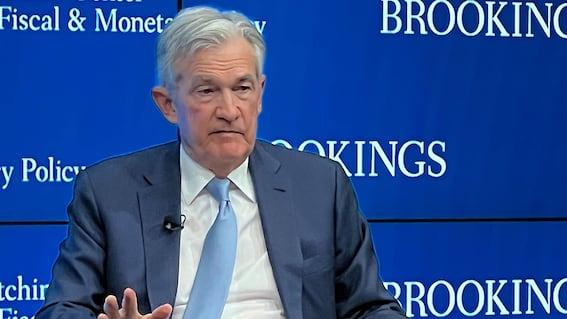
Disappointing flows into bitcoin ETFs over the past days partly resulted from investors trimming risks ahead of Wednesday's FOMC meeting, one market observer said. Bitcoin slightly rebounded after dipping over 15% from last week's record as investors trimmed risks. Wednesday's Fed decision poses a risk for crypto asset prices, with concerns over a less investor-friendly stance due to strong U.S. economic data and sticky inflation, LMAX Group market strategist said. Bitcoin (BTC) price rebounded to near $65,000 from its overnight lows on Tuesday, but the upcoming Federal Reserve meeting concluding on Wednesday is looming large over the crypto market to decide whether the correction is over. After notching a series of fresh all-time highs over the past weeks, the largest crypto by market capitalization turned sharply lower from just shy of $74,000 on Thursday. It tumbled over 15% to below $63,000 by earlier Tuesday, dragging other digital assets lower. The correction followed hotter-than-expected inflation readings in the U.S. last week, which could curb the central bank's willingness to ease their monetary policy, further delaying interest rate cuts. "The market unanimously expects rates to stay unchanged but will pay close attention to adjustments to the dot plot, as cuts may be delayed on the backdrop of persistently high inflation," said Vetle Lunde, senior analyst at digital asset analytics firm K33 Research. The dot plot is the Fed committee members' outlook on interest rates over the next year and offers investors a glimpse into policymakers' expectations. Bitcoin's price decline was coupled with disappointing flows into the U.S.-listed bitcoin ETFs in the last few days, which was partly due to investors' being wary of taking risks before the conclusion of the Federal Open Market Committee (FOMC) meeting, Lunde added. A more hawkish message from the Fed could curb investors' appetite for risk assets such as cryptocurrencies, weighing on prices and possibly elongating the correction. "The Fed decision this week poses a risk, with concerns over a less investor-friendly policy stance due to strong U.S. economic data and inflation," Joel Kruger, market strategist at LMAX Group, said in an emailed note. "While correlations between crypto and traditional assets have been low, a risk-off sentiment from the Fed decision could spill over into crypto." Recently, BTC was changing hands at $64,500, rebounding from below $63,000 but still down 3.5% over the past 24 hours. The broad-market CoinDesk 20 Index (CD20) declined almost 5% during the same time. https://www.coindesk.com/markets/2024/03/19/bitcoin-rebounds-to-65k-as-investors-weigh-looming-fed-decision-risk/
2024-03-19 17:54
The blockchain developer gave the coffee giant a $4 million grant as part of their 2022 deal to build an NFT-powered loyalty program that is now being shuttered. Polygon Labs paid $4 million to host Starbucks Odyssey, the NFT-powered loyalty program that made headlines as a crypto biz-dev coup. The deal was a hallmark of a "big and flashy" business development strategy that Polygon has since abandoned, people familiar with the matter said. Companies usually pay their tech vendors for services rendered. For Starbucks' soon-to-be-defunct foray into crypto on the Polygon network, it was the other way around. Polygon Labs paid $4 million to the coffee giant in 2022 as part of their deal to build and host a blockchain-based loyalty program, Starbucks Odyssey, on the Polygon network, according to two people familiar with the matter. The payout ended a competitive hunt by proponents of at least three blockchain ecosystems who wanted to partner with Starbucks, a third person said. The previously unreported figure adds context to the origins of one of crypto's flashiest crossovers into American consumer culture (and subsequent flops). Last week, Starbucks pulled the plug on Odyssey, its 18-month experiment in using collectible non-fungible tokens as the anchor of a loyalty program. The figure speaks to the cost of doing business development in crypto. In 2022 Polygon Labs pursued headline-grabbing partnerships with the likes of Nike and Starbucks, the kind of companies that might elevate Polygon's name recognition. If big brands were using Polygon as their launchpad for crypto, then perhaps their massive customer bases would follow suit. They did not. "These types of big flashy deals are a remnant of the past and the previous leadership’s strategy," said a person familiar with Polygon Labs' current thinking. The company, the main developer of the Polygon blockchain, is now more focused on building innovative tech than inking partnerships, the person said. Origins of Odyssey The deal with Polygon likely wasn't only a money play. Starbucks appears to have been genuinely interested in finding a Web3 partner that would host Odyssey. Its search was being led by Forum3, a marketing consulting shop whose co-CEO Adam Brotman was once Starbucks' chief digital officer. Brotman had conversations with representatives from Polygon as well as Solana in early 2022, two people privy to the discussions said. Samson Mow, a longtime bitcoin booster, told CoinDesk he lobbied Starbucks to choose Liquid Network, a bitcoin layer-2. Forum3 chose Polygon for its tech, one former Polygon employee said. But the deal also came with the grant as well as extensive technical and marketing support to help Forum3 set up the Starbucks loyalty program, that person said. The Voyage Begins Starbucks Odyssey sought to reimagine the coffee company's popular loyalty program with a crypto tint, according to a case study published by Forum3 in January. Members would get "stamps" (collectible NFTs) for completing tasks. They could use those stamps to qualify for rewards like invitations to coffee-themed experiences or exclusive branded swag. The loyalty program promised to be a moneymaker for Starbucks. It sold these stamps for as much as $100 apiece. It likely made over a quarter of a million dollars by taxing secondary sales of the stamps, according to on-chain data. But Odyssey also had upside for its members, the stamp buyers. They could resell the stamps to others via a digital storefront set up by Starbucks and Nifty Gateway, an NFT marketplace. Forum3's case study hailed the "measurable monetary value" Odyssey could create for Starbucks and its fans. The first monetized Odyssey NFT series (the Siren Collection) sold out in 18 minutes and quickly traded at a 4x premium, according to Forum3. As happens with many NFTs, Odyssey found a collector community that believed in its value potential and bet big. One such collector was Dan Elitzer, co-founder of the venture capital firm Nascent. "We've not invested a huge amount compared to what we typically do," Elitzer said in a January interview. Even so, Nascent believed that Odyssey NFTs could have long-term value if Starbucks Odyssey endured as the first big NFT loyalty program, he said. Even before Starbucks said it would shutter Odyssey, its NFTs value proposition was under stress. The last Siren NFT to sell before Starbucks' March 15 announcement was priced at $215. On Tuesday prospective buyers were offering a maximum of $86 per Siren NFT, while sellers wanted no less than $165. Representatives for Forum3, which once billed itself as a Web3 company but has since pivoted to AI, according to its website, did not respond to a request for comment. The Odyssey Ends Starbucks Odyssey succeeded in fostering a niche following during its 18-month run as an invite-only "beta" program. Along with a vibrant Discord server, it inspired a cult following whose proponents traded the NFTs, boosted the program on social media and even created a "Tips" website to help people strategize their points-earning. That community was in a sense of shock last week when Starbucks abruptly announced the Odyssey was ending. Members traded messages of grief, anger, sadness and wistful memories in its private Discord server, according to screenshots of messages reviewed by CoinDesk. "It’s definitely a little upsetting as someone who has put some time and $$ in but overall I understand the pivots of big business and I’m happy that Starbucks tested the concept," Bryan Kayne, a crypto consultant and Odyssey member, said in a Telegram message to CoinDesk. In an email to CoinDesk, a representative for Starbucks said: "We’re looking forward to applying our learnings to the future of this program." She would not detail what that future holds, nor whether it will continue working in Web3. "We value our relationship with Polygon and the contributions it has made to Starbucks Odyssey," the representative said. She would not discuss the financials of its business partnership with Polygon. Old Polygon, New Polygon The Starbucks deal was an exemplar of the high-flying, big-name-forward dealmaking style Polygon pursued under the leadership of Ryan Wyatt. The former online gaming executive was Polygon Labs' president from early 2022 until mid-2023, when, according to two people familiar with Polygon, he was ousted. "If you look at Polygon Labs now, over the last nine months they’ve shifted their focus to become a tech powerhouse focused on ZK tech and deals that have more of an immediate impact on-chain rather than marketing value," one source said. The switch also reflects the challenges of building crossover Web3 products for a non-crypto audience, paid deal or no. Multiple users and proponents of Odyssey told CoinDesk the feature was built to accommodate those who didn't have a crypto wallet or an understanding of blockchains – in other words, most human beings (and by extension most Starbucks customers). A former Polygon employee who worked on the Starbucks deal said it was no surprise Odyssey is shutting down. "Chasing Web2 is a fool's errand, in my opinion," the person said, referring to established tech giants. "The crypto native narrative is big enough if you play it right." Wyatt, who declined to comment through a spokesperson at his current employer, Optimism Unlimited, highlighted his emphasis on the marketing value of dealmaking in recorded talks he gave after leaving Polygon. "We were in a really good position where people were looking for positive stories and so a lot of the efforts were amplified," Wyatt said in an interview with crypto investing firm Variant in September 2023, months after leaving Polygon. Partnerships with "household brand names" helped Polygon "establish credibility," he said. It was common for Polygon to pair grants with their partnerships, a former employee said, calling the practice commonplace across crypto. Wyatt said the same in an appearance on CoinDesk TV in December 2022. "All the protocols are doing paid deals," he said at the time. https://www.coindesk.com/business/2024/03/19/polygon-labs-paid-4m-to-host-starbucks-doomed-foray-into-crypto/