2024-03-19 16:53
With April’s “halving” set to cut mining rewards by half, Bitcoin miners are upgrading to more efficient mining machines, cutting costs, finding cheaper sources of power and exploring mergers and acquisition opportunities. “Show me the money.” The notorious phrase from 1996’s “Jerry Maguire” movie is on the lips of investors watching the state of the Bitcoin mining market as it faces its next crunch point: April's Bitcoin Halving. Mining, an integral part of securing the bitcoin network, requires a lot of capital to operate profitably. And now, after a brutal crypto winter and with the upcoming halving next month, many investors have turned sour on what once was an outrageously profitable business, drying up capital for the miners. This feature is part of CoinDesk’s “Future of Bitcoin” package published to coincide with the fourth Bitcoin “halving” in April 2024. To bring investors back and keep them on-board, miners will need to upgrade to more efficient mining machines, cut costs, have a prudent risk management strategy and participate in deal-making that will enhance shareholder value, industry observers say. “I think the next evolution [for mining investors] is there'll be a lot more scrutiny on how you're deploying capital and what the return on that investment is for these companies,” said Asher Genoot, the new CEO of bitcoin mining firm Hut 8. He added that any company “that is not able to execute on that [return on investment] will suffer because shareholders won't trust them with money and you'll have capital flowing to others, that people really trust and are willing to support.” Gaining investors' trust could be tough, but not impossible if a company knows which options to utilize correctly, Genoot said. In the last bull market of 2021, investors poured money into miners who were able to show that they had invested money to grow their business — regardless of the capital cost. This led to miners buying assets at high prices and borrowing more debt than was serviceable. When the bear market hit in the second half of 2022, shares of publicly-traded miners imploded, leading investors to drop the stocks altogether. Even now, as the digital assets market starts another bull run, investors are still shying away from the miners, starving the industry of capital it needs to stay profitable and grow their businesses. The main concern among the investors is the risk the miners will face heading into April’s halving event: competing for the block reward that will be slashed in half. Many investors now hope to gain their bitcoin exposure through spot bitcoin exchange-traded funds (ETFs), which are less uncertain than bitcoin mining stocks. Payback of efficiency One of the first options miners can use to stay profitable when the halving cuts reward by half is to have mining machines that can consume less power but have higher computing ability i.e. more efficient rigs. Buying new generations of miners ahead of a potential post-halving bull market is crucial for miners to stay profitable, bitcoin mining equipment and hosting provider Blockware Solutions said in a research report. “Miners who embrace the halving and capitalize on bear market prices for hardware stand to reap substantial rewards, with shorter ROI [return on investment] periods and enhanced profitability throughout the halving epoch,” the report said. The miners have already started to deploy capital to upgrade their mining fleet, heading into the halving. Most recently, Riot Platforms (RIOT) said it spent nearly $100 million to buy new generations of MicroBT’s mining rigs to increase computing power while raising efficiency. But just buying more efficient machines may not be enough for miners. A machine can be more efficient, but if it costs more, miners will need to evaluate if it is worth maintaining and running the older machines or buying new ones, Hut 8’s Genoot said, noting that miners need to consider “how quickly can you get your dollars deployed” when thinking about investing in new mining rigs. Amanda Fabiano, founder of Fabiano Consulting and former head of mining at Galaxy, agrees with Genoot. It may make sense for some miners to continue to upgrade to newer model mining rigs, but a deeper dive into the cost of mining is needed to make that decision. “If someone is on the mid-curve of the cost curve, they likely will continue to upgrade their fleet. If a miner has a low cost of electricity and can have some energy arbitrage, older gen machines aren’t a terrible idea,” she said. ‘Scarcity value’ of cheap power The cost of powering mining rigs is another key consideration. “By positioning ourselves on that lower end of the operating cost curve, we basically make ourselves in a position where, irregardless of what happens with mining revenues or transaction fees, we're going to be in a position that's going to be profitable for modeling purposes,” Ben Gagnon, chief mining officer of Bitfarms (BITF), said during fourth quarter earnings call. A miner can buy cheap mining rigs that are new and more efficient, but if they aren’t plugged in with a cheap source of power, miners won’t be profitable, failing to gain investors' confidence. “Miners [mining machines] aren’t scarce today. You can buy new ones, buy used ones or take someone else’s order over, but there isn’t a lot of scarcity value. What is scarce is the access to power,” said Greg Beard, Stronghold Digital Mining’s (SDIG) CEO. Stronghold’s solution is its own power plant that turns “coal refuse,” a material left over from coal mining, into power at its wholly-owned Scrubgrass and Panther Creek power plants in Pennsylvania. Power management is one of the key battlegrounds for running a profitable mining company. “It's your ability to manage energy in real-time,” Genoot said. Creative options Aside from managing the cost of power, miners can also deploy other creative solutions to hedge their revenue post-halving. One is “production hedging” — something traditional commodity firms have done to eliminate pricing volatility. Just like an oil and gas producer or a corn farmer, digital asset miners can use derivatives to lock in the price of their mined bitcoin to hedge against any potential downside. Some options are already out there, including Luxor Technologies’ derivatives products that aim to aid miners use hashrate derivatives — a type of financial product tied to the mining of bitcoin — to help with hedging activities. However, these hedges are complex and may pose some challenges for miners, because of their lack of liquidity. “While there are several positive aspects associated with using such derivative products, they also pose a multitude of challenging problems, potentially contributing to the scarcity of sell-side offerings and a simultaneous lack in buy-side activity,” Galaxy's mining analysts, led by Brandon Bailey, wrote in a research note. Miners can mitigate such liquidity concerns by using other risk management strategies such as “options, costless collars, and forwards,” Galaxy said, noting that “these straightforward structures are highly liquid and boast quick execution times.” Additionally, miners can opt-in to diversify their revenue stream by using their data centers to host other customers, including artificial intelligence and cloud computing. During the trenches of crypto winter, some miners have already started to do so to mitigate revenue risks. Valued-added deals One theme that comes up repeatedly when talking about halving and survival of miners is the prospect of more mergers and acquisitions (M&A). As CoinDesk has reported, the halving will lead strong miners to devour smaller, less efficient miners, unleashing a survival of the fittest dynamic. Industry observers and participants agree, calling the strategy one of the crucial levers that miners can pull to stay profitable post-halving. “Operational excellence and SG&A cost will become more important for all miners, but especially the public [listed] mines. I personally think M&A season will continue — consolidation and shifts in strategies leading up to and post the halving,” said Fabiano. Hut 8’s Genoot echoed this. “I think opportunities will come up, smaller operators will realize that they can't get the count forward, they can't compete as much at scale, and larger companies will continue to consolidate,” he said. Miners, including Hut 8, CleanSpark (CLSK), Marathon (MARA), have all started to buy up assets from other miners to stay ahead of the competition. However, given increased investor scrutiny, miners will likely seek buying opportunities that can provide a good return on investment. “I think you will see consolidation this year related to how do you make more money and acquire someone that has the power limit on the overhead [cost]” to create a deal that will add value for the shareholders, said Stronghold’s Beard. Bitfarm’s Gagnon cautioned that consolidation has to make sense for the shareholders. “It needs to be at the right cost and it needs to add strategic value,” he said. “We believe that finding surplus, low-cost electricity, preferably renewable, is the long-term benefit to the company. So if somebody else has developed something that makes sense to us and we can get it at the right price strategically, then we're happy to layer it in,” Gagnon added. https://www.coindesk.com/consensus-magazine/2024/03/19/bitcoin-halving-is-a-show-me-the-money-moment-for-miners/

2024-03-19 16:40
A version of the new proof system, which will help secure withdrawals from Optimism and other networks based on its tech, will be deployed to Ethereum's Sepolia test network on Tuesday. One of the biggest rollup networks on Ethereum is finally gearing up its systems for prime time. Optimism, a "layer-2" blockchain, bundles up user transactions and settles them on Ethereum for cheap. It has played a lead role in expanding accessibility to the second-largest blockchain ecosystem by market capitalization – and serves as the template for the publicly traded crypto exchange Coinbase's own layer-2 network, Base. But there's a catch to using Optimism today: Fault proofs, a component of the setup considered crucial for security, don't even exist. That's soon set to change. On Tuesday, OP Labs, the main development firm behind the Optimism blockchain, will begin testing fault proofs on Ethereum's Sepolia test network. The new deployment comes a few months after Optimism launched an initial version of fault proofs on Goerli, another Ethereum test network, in October. Karl Floersch, co-founder of Optimism and CEO of OP Labs, told CoinDesk he expects the proofs to reach Ethereum's main network later this year, with the Sepolia deployment bringing the team closer than ever to this goal. The tech will help secure withdrawals from the network, and it has been a long time coming – exposing the Optimism ecosystem to embarrassing criticism from advocates of rival blockchains. Rollups and fault proofs The Ethereum network, stifled for the past few years by sky-high transaction fees, has over the past two years turned to layer-2 rollup networks like Optimism to alleviate congestion. Optimism and similar rollups aim to borrow their security from Ethereum, meaning recording transactions should be tantamount to writing transactions directly onto Ethereum. Optimism is currently the third-largest rollup network in terms of transaction volume, with $950 million in total deposits, according to DefiLlama. The chain's technology also powers the second and fourth-largest layer-2 networks, Coinbase's Base network and Blast, a buzzy newcomer to the rollup race. When rollups pass user transactions to Ethereum, they do so by bundling big groups of transactions into large batches. They then "settle" those transactions onto the main chain all at once, which lets them offer transactions to users for a fraction of the cost. In theory, rollups are supposed to secure themselves via "proofs," which are mathematical formulas that Ethereum network observers can reference to check if the data passed down from the rollups reflects real user activity. The proof systems are ultimately supposed to make good on rollups' primary value proposition, which is to provide cheaper access to Ethereum without compromising on the decentralization and trustlessness that separate blockchains from legacy finance and Web2 systems. Today, Optimism lacks fault proofs, meaning users need to trust Optimism's programming – or the "security council" that watches over the protocol – to keep withdrawals secure. The security council is just a group of people – not exactly in keeping with the crypto ethos of decentralized, code-based protocols that aren't vulnerable to human whims, biases and schemes. "Fault proofs allow for permissionless, crypto-economically enforced withdrawals," Floersch explained in an interview with CoinDesk. "Today, on the chain, you must trust the security council to operate honestly in order to keep your withdrawals secured." Optimism's security council includes several well-known members of the crypto industry, including representatives of OP Labs, the Ethereum Foundation and Coinbase. They operate a multi-signature wallet that has certain powers over the protocol and can be used to approve upgrades to its code. In the future, Floersch says, withdrawals will be secured such that "even the worst security council cannot mess with you." Round two Optimism had a version of fraud proofs when it launched in 2020, but the system was deemed insufficient and later scrapped entirely. "We made a fatal error" when launching those first fraud proofs, said Floersch. "This fatal error was that we were so entranced with getting to proofs as quickly as possible that we made a large number of sacrifices in the quality of the system." The biggest sacrifice, according to Floersch, was that the initial proof system was "compatible" rather than "equivalent" to the Ethereum virtual machine (EVM), meaning there were certain elements of its programming that would complicate the process of porting apps to Optimism, and would make it more difficult for the whole system to scale. Optimism deposits have ballooned by almost $1 billion since its fraud proofs went to the wayside, and the OP Labs team has open-sourced elements of its technology under the "OP Stack" – a blockchain-building framework used by some of the biggest layer-2 ecosystems of the day, including Base. The new proof system, which Optimism calls a "fault" proof system rather than a "fraud" proof system, will be EVM equivalent rather than EVM compatible, which should help it support apps more seamlessly than the old setup. Floersch says it's also been designed with a particular eye to modularity, meaning it will come with different components that can be swapped out according to a chain's use case – like if a network plans to use proofs powered by zero-knowledge (ZK) cryptography. Under Optimism's old proof system, "it was like building a shack out of sticks," said Floersch. "We're like, 'Alright, we can get up real quick, but we can't actually build a skyscraper with this thing. So it ended up not being that useful." With the "building blocks" provided by Optimism's new system, "you can start stacking them on top of each other and building a really sturdy structure," said Floersch. "Now we're set to build the Empire State Building." Training wheels When it comes to its still-in-progress inner workings, Optimism isn't an outlier. All rollup networks have resorted to using different types of "training wheels," which are supposed to help the layer-2 networks safely welcome new users even as they're ironing out certain technical elements of their systems. The Ethereum community has gravitated towards identifying rollups in terms of "stages," where stage 0 rollups use training wheels and require trust from users to work, and stage 2 rollups are more-or-less identical to Ethereum in terms of their permissionless and security. Stage 1 systems sit somewhere in between. According to L2Beat, a widely-referenced layer 2 watchdog service, Optimism is considered a "stage 0" rollup whereas Arbitrum, Optimism's biggest competitor, is considered "stage 1" since it already has a working proof system. For either service to reach the final stage, they'll need to further decentralize – which means not just introducing fault/fraud proofs, but deploying the systems such that no security councils or other entities have privileged access over the protocol. Floersch wouldn't predict when Optimism would reach stage 2: "If the fault-proof system is not fully ready," said the Optimism founder, "then there needs to be a way for manual intervention to come in and update the systems." OP the tortoise Optimism's delayed timeline for re-introducing proofs has made it the butt of criticism in some corners of the blockchain industry. "Making sure that folks actually decentralize – actually build out full proofs – is super fair, super healthy and great for the ecosystem," said Floersch. "That time that we took – yes, it costs us on Twitter or whatever, but ultimately what I think is the most important is that this is a long-term game." According to Floersch, Optimism's deliberate pace has ultimately put it on a faster timeline. "What we have been trying to do, and what we are dedicated to, is building out a stage-2 fully decentralized system as quickly as possible," he asserted. https://www.coindesk.com/tech/2024/03/19/optimism-finally-starts-testing-fault-proofs-at-heart-of-design-and-of-criticism/

2024-03-19 13:51
The settlement comes days after a New York judge denied motions by Genesis and crypto exchange Gemini to stop the SEC case. Genesis Global Capital will pay $21 million as a civil penalty in a settlement with the SEC that has now been formalized. The SEC will not receive any "portion of the penalty until after payment of all other allowed claims," the regulator said in a statement. Bankrupt crypto lender Genesis Global Capital has agreed to a final judgment ordering it to pay $21 million to settle charges with the U.S. Securities and Exchange Commission (SEC) for violating securities laws for its role with the now-defunct Gemini Earn program, the SEC announced Tuesday. The settlement comes days after a New York judge denied motions by Genesis and crypto exchange Gemini to stop the SEC case filed in January 2023 from moving forward. Genesis and two affiliates had filed for bankruptcy shortly after the SEC charges. In February 2024, Genesis said in court documents it had agreed with the SEC to settle the charges for $21 million, and it appears the deal has now been finalized. Critically, the SEC will not receive any "portion of the penalty until after payment of all other allowed claims by the bankruptcy court," the announcement said. “Today’s settlement builds on previous actions to make clear to the marketplace and the investing public that crypto lending platforms and other intermediaries need to comply with our time-tested securities laws," said SEC Chair Gary Gensler in a statement. Read More: DCG Calls Out Subsidiary Genesis' Settlement With New York as 'Subversive' https://www.coindesk.com/policy/2024/03/19/genesis-to-pay-sec-21m-penalty-to-settle-charges-over-gemini-earn-product/
2024-03-19 11:23
Some professional traders have termed SLERF a "blue-chip meme” – a nod to blue-chip stocks – for reasons ranging from its fair distribution among holders to perceived future demand. A Solana-based meme coin, Slerf, has surpassed all Ethereum-based exchanges in trading volume within its first day of existence. Slerf's popularity surged after its developer said they accidentally sent all raised funds to a burn address, leading to a frenzied market and a price increase. Slerf is considered a "blue-chip meme" by some professional traders, and efforts are underway to compensate presale participants through donations from the Solana community and trading fees from exchanges. A Solana-based token that’s been live for little more than a day has clocked up more trading volume than all decentralized exchanges on the Ethereum blockchain in a sign of how frenzied the demand is for meme coins. Slerf, a sloth-themed token issued in Asian morning hours on Monday, posted trading volume of more than $2.7 billion in the past 24 hours, data from DEXScreener shows. These volume encompasses 800,000 trades from 130,000 individual traders, additional metrics for the SLERF/USD pair show. More than $1.7 billion in trades were routed through the Solana-based exchange Raydium, CoinGecko data shows. In contrast, exchange applications on Ethereum processed $2.3 billion in cumulative volume, DefiLlama data shows. This is the total count of any transaction settled on the blockchain, such as those from trading, lending, and borrowing applications. SLERF came into existence following a token presale, during which it raised $10 million from users. It quickly went viral on social platform X after its developer said they accidentally sent all the money raised to a burn address, a crypto wallet address that’s not controlled by anyone, thus losing access to the funds. That did nothing to stop a frenzied market from purchasing and trading the tokens. SLERF was eventually floated on Solana-based exchanges including Jupiter and Orca and the price surged to as high as $1.4 within a few hours from an initial value near 3 cents. Some professional traders have termed SLERF a “blue-chip meme” – a nod to blue-chip stocks – for reasons ranging from its fair distribution among holders to perceived future demand. A blue-chip stock is a sign of stability and quality at the corporate level and usually relates to a company that has a long history. Meanwhile, SLERF developers are trying to make their presale participants whole by requesting donations from the Solana community. Crypto exchanges such as HTX and Bitget have already committed to the effort by pledging SLERF trading fees to a donation address. Over $450,000 in donations had been raised as of European morning hours on Tuesday, address trackers show. https://www.coindesk.com/markets/2024/03/19/solana-meme-coin-slerf-clocks-higher-trading-volume-than-all-of-ethereum/

2024-03-19 11:17
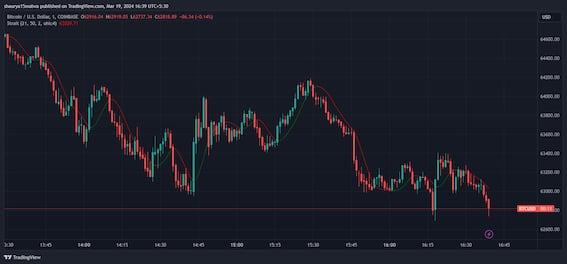
Crypto market capitalization fell more than 8% in the past 24 hours, data shows. Bitcoin short-term holders took profits last week, according to CryptoQuant. Ether, Solana’s SOL, BNB Chain’s BNB and Cardano’s ADA slumped more than 9%. Bitcoin (BTC) slipped under $63,000 in European morning hours Tuesday, causing a marketwide tumble that saw overall capitalization drop 8% in the past 24 hours. The losses came after a day of large outflows from the Grayscale bitcoin ETF and lower-than-usual inflows on other ETF products on Monday. The day ended with net outflows of $154 million, as reported. On-chain analysis firm CryptoQuant said on X bitcoin short-term holders - or users that hold tokens for less than five months - took profits in the past week, which may have contributed to the selling pressure. Major tokens ether (ETH), Solana’s SOL, BNB Chain’s BNB and Cardano’s ADA slumped more than 9%, CoinGecko data shows. The meme coin sector saw losses of over 17% on average, data shows, led by dogwifhat (WIF) and floki (FLOKI) at 18%. The sector has been the strongest by gains so far this year but is infamously volatile. The broad-based CoinDesk 20, an index of major tokens minus stablecoins, slumped nearly 10%. https://www.coindesk.com/markets/2024/03/19/bitcoin-drops-under-63k-leads-to-marketwide-correction/
2024-03-19 10:31
The U.K. has been refining it approach to regulating the crypto sector. The FCA plans to help deliver a market abuse regime for crypto this year. The regime would apply to anyone committing market abuse on a crypto asset that is trading on a U.K. exchange, regardless of where they are based. The U.K.’s Financial Conduct Authority (FCA) intends to deliver a market abuse regime for crypto this year, according to its business strategy on Tuesday. The business plan set out an agenda to protect consumers, ensure market integrity and facilitate international competitiveness. Last year, the government issued a consultation that included plans for a market abuse regime for crypto assets. “The market abuse offenses would apply to all persons committing market abuse on a crypto asset that is admitted (or requested to be admitted) to trading on a U.K. crypto asset trading venue," the government said in its crypto consultation response in October. "This would apply regardless of where the person is based or where the trading takes place." The proposed regime would, for example, require crypto exchanges to detect and disrupt market abuse behaviors. The FCA is the main crypto regulator in the country. So far, the FCA implemented a promotions regime for crypto that includes requirements like adding risk warnings and a 24-hour cooling-off period for first-time buyers. It has also been consulting on a regime for stablecoins. In its strategy for 2024 to 2025, it also said that it intends to recover “GBP 6.2m [$7.9 million] of costs for the new regulation of stablecoins and wider regime and GBP 200,000 for extending the financial promotions perimeter.” But it did not set out how it planned to do so. CoinDesk reached out for further comment. https://www.coindesk.com/policy/2024/03/19/uk-regulator-fca-plans-to-deliver-a-market-abuse-regime-for-crypto-this-year/