2024-03-05 16:08
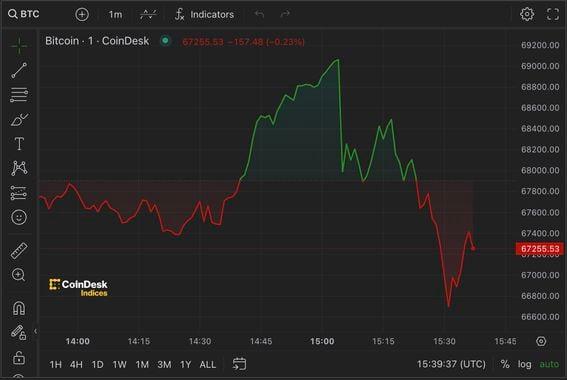
More than $84 million of derivatives have been liquidated in the past four hours, mostly long positions. Bitcoin fell by 3.2% in the 30 minutes after it surged above $69,000. Historical cycles show that a conclusive all-time high breakout is often followed by a sustained period of upside price action. More than $84 million of derivatives have been liquidated in the past four hours, the majority of which have been long positions. Bitcoin (BTC) rose to a record $69,325, topping its previous peak set in November 2021, on a flurry of volatility buoyed by demand from spot exchange-traded funds (ETFs) in the U.S. Unlike the previous cycle, the largest cryptocurrency by market value almost instantly fell back as bearish traders wrangled for control. Bitcoin dropped 3.2% in 30 minutes and at press time was trading at $66,100. The CoinDesk 20 Index, a measure of the broader crypto market, lost 1.8% in the hour after BTC hit its high. Historically, when bitcoin breaks an all-time high, prices tend to rally for the next few days: In 2020, it rose to $24,200 from $20,000 in a 48-hour period. It didn't drop below $20,000 again until June 2022, in the midst of a bear market. In March 2017, bitcoin hit a high of $1,350 before dropping to $897 over the following two weeks. Then it started a run to an eventual high of $20,000. Today's immediate response indicates that bitcoin doesn't have the momentum required to emulate the rise in 2020. Significant sell orders have been added at $70,000 and $71,000 on Binance, contributing to the stalemate. More than $84 million worth of derivatives positions have been liquidated in the past four hours, the majority of those have been long positions. That ties into the overwhelmingly positive funding rates of the past few days. A positive funding rate indicates that perpetuals are trading at a premium to the spot price and requires traders holding long positions to pay a fee to those holding short positions, a cost they may be inclined to bear. Bitcoin appears to suffered a rejection from the $69,000 region, meaning it is likely to gravitate back to a previous level of support such as $64,000 or even $61,000 before making another attempt to conclusively break the $69,000 mark. In 2020, it took bitcoin more than three weeks to finally crack $20,000. It suffered multiple rejections, dropping to as low as $16,250 amid rising volatility before it eventually broke through. It's likely that bitcoin will enter a range-bound period before taking aim at another break-out attempt. https://www.coindesk.com/markets/2024/03/05/bitcoin-hit-a-record-high-heres-what-might-happen-next/
2024-03-05 14:35
Last week's ETHDenver conference drew a significant presence from developers and reps of blockchain ecosystems beyond Ethereum, taken as a sign of just how influential the second-largest distributed network has become. Last week's ETHDenver conference, originally focused on the Ethereum blockchain, drew a presence from developers and teams focused on other ecosystems, including Bitcoin, Solana and Polkadot. The draw reveals Ethereum's influence and reach – as well as the potential competition. Ethereum conferences aren't just for Ethereans anymore. Last week's ETHDenver conference in Colorado, one of the year's largest gatherings for developers and users of the Ethereum blockchain, drew in a cross-section of the blockchain industry. The broad swath of attendees might be a testament to Ethereum's influence on other blockchain ecosystems, attracting onlookers from other crypto tribes. But it also might be a sign of rival systems looking to encroach on Ethereum's success in making blockchains more programmable, with its vibrant ecosystem of software developers looking to create new applications. Bitcoin, which is in the midst of a developer renaissance with the advent of its own NFTs and decentralized finance (DeFi) services, had an impressive turnout of builders at the conference. So did Polkadot, the "hub-and-spoke" blockchain created by Gavin Wood, an Ethereum co-founder who used to market his new project as an improvement over the Ethereum model. Even Solana, the speed-focused network that's long positioned itself as an "ETH Killer," had a well-attended booth at Denver's National Western Complex, the conference's venue. John Paller, the conference's founder and executive steward, told CoinDesk in an interview that there were "probably seven or eight layer 1s that are here, and we have probably 12 layer 2s." The cross-chain camaraderie might have been out of place in past years, when dueling strains of maximalism defined the blockchain industry. But it makes sense that networks might now wish to make inroads with Ethereum's developer community. "Even though there are a lot of issues with Ethereum, it is probably the first virtual machine that a developer will interact with if they're new to this ecosystem," said David Roebuck, co-founder of TRGC, a crypto investment firm focused on early-stage companies. "Ethereum, being here for eight or nine years, really has this compounding network effect, so all the layer 1s trying to stay relevant are integrating and doing things with Ethereum." The Ethereum community seems more than willing to embrace its competitors, with the rise of "layer 2" networks increasing the community's comfort level with working across multiple blockchains. "As users become more fragmented, and as the developer community on Ethereum starts to become a lot more flexible and versatile across different protocols, you are 100% going to see the 'Ethereum ecosystem' grow to encompass other blockchain ecosystems," Christine Kim, vice president of research at Galaxy Digital, told CoinDesk during a conversation in the ETHDenver press office. ETHDenver 2024's Big Tent Ethereum's biggest weakness has always been its transaction fees, which can make something as simple as a token swap cost upwards of $10 in fees alone. "Ethereum is not planning on bringing down fees for its users, and that's a reality that people need to understand," explained Kim. To circumvent its fee problems, Ethereum has gone full-throttle on rollups, the "layer 2" networks that settle transactions on the Ethereum chain but offer lower fees and higher speeds to users. "Ethereum is king," said Paller. "It's how do we build around Ethereum, with layer 2s to ZK-fill-in-the-blanks or whatever." Ethereum co-founder Vitalik Buterin started to advocate for a "rollup-centric" roadmap for the chain in 2020, and over the past year his vision has been realized, with layer-2 rollup networks like Arbitrum, Optimism and the U.S. crypto exchange Coinbase's Base consistently surpassing Ethereum in overall traffic. While Ethereum's rollups ultimately pass data to the base Ethereum chain, they're still separate networks – each with its own programming, app ecosystem and community. "All of this talk around interoperability between rollups naturally leads to conversations of, well, why aren't we having increased interoperability with other execution environments like the Solana VM," or the Cosmos ecosystem, said Kim. The "data availability" problem As the Ethereum umbrella expands to include other blockchains, it must lean into one of its weakest use cases: data availability, or "DA." When blockchains need to store data, they frequently lean on other blockchains: So-called data availability layers, which keep a full record of a chain's transaction data so it can be formally verified. While Ethereum can technically be used as a data availability layer, there are other networks, like Celestia and Filecoin, for which data availability is their bread and butter. "In terms of its reliability and resilience, I think Ethereum as a data availability layer is unmatched," Kim said. "However, you have the problem of high fees and high costs. You have other cheaper data availability solutions." Ethereum's next big upgrade, Dencun, will happen later this month, and is explicitly designed to make the network friendlier for layer-2 services via improved data availability: The key upgrade, "danksharding," re-jiggers the network's programming to make it easier for layer 2s to settle "blobs" of data onto the chain – theoretically, as a way to ramp up Ethereum's capacity to store L2 transaction information. But Dencun might be too little too late. Ethereum is ultimately playing catch-up in the realm of data availability, and it's unlikely that its costs will decrease to get within range of other DA networks anytime soon. The risk for Ethereum As Ethereum continues to shift in the direction of layer 2s and cross-chain interoperability, it risks "ceding its dominance as a general purpose platform for general-purpose compute," Kim said. Ethereum is currently the largest blockchain for "general computation" – both in terms of the size of its developer community, as well as the level of liquidity in its decentralized finance ecosystem. Its expansion to new ecosystems comes amid a wider trend of blockchain "modularity," where apps that would have historically lived on one blockchain are now picking and choosing pieces of different blockchain architectures, and deploying elements of their programs across all of them. "Applications are cross-chain, their architectures are cross-chain," said Sam Friedman, a principal solutions architect at Chainlink Labs, which builds interoperability architecture for blockchains. "It's not independent instances of the app on different chains. It's the same app with different components" on different chains. With the shift towards modularity, Ethereum's lead in the blockchain race might begin to blur, if not erode altogether, given its speed, cost and data storage shortcomings. Meanwhile, builders from the other blockchain ecosystems are waiting in the wings. "If there was some Ethereum killer that showed up and had better tech, and the ability to build a stronger, more vibrant, more durable community than Ethereum, then it should win," said Paller. Margaux Nijkerk contributed reporting. https://www.coindesk.com/tech/2024/03/05/bitcoiners-solana-acolytes-crash-ethereum-conference-in-denver-for-a-reason/

2024-03-05 09:36
The Series A investment round included Ledger, Tezos Foundation, Chiron and British Business Bank. Baanx, a cryptocurrency payments specialist authorized by the U.K.’s Financial Conduct Authority (FCA), has raised a $20 million Series A funding round, the company said on Tuesday. The investment round, which included Ledger, Tezos Foundation, Chiron and British Business Bank, brings the crypto payment enabler’s total funding to over $30 million. London-based Baanx, which runs the Ledger card product, recently signed a three-year partnership with Mastercard for the U.K. and Europe. Large legacy payments companies such as Mastercard and Visa have been quietly exploring things like payments on Ethereum, stablecoins and the Web3 world of non-custodial wallets – areas where Baanx provides seamless connectivity. “Over the past 12 months, we have been building out a series of non-custodial, on-chain products, creating a whole new type of crypto payment,” Chief Commercial Officer Simon Jones said in an interview. “Allowing the user full control of their funds whilst enabling real-world spend, we hope to power the next generation of crypto payments.” Jones said the funding will help the firm introduce its services in the U.S. and Latin America later this year. The company, which has over 150,000 users, also has a native BXX token. CORRECTION (March 5, 12:33 UTC): Corrects name of investor to Tezos Foundation throughout. An earlier version said the investor was Tezos. https://www.coindesk.com/business/2024/03/05/crypto-payments-specialist-baanx-raises-20m-funding-round/

2024-03-05 09:12
The tokens have logged over $1.7 billion in volumes on the regulated exchange in the past 24 hours, the most among counterparts. Shiba Inu fell on Coinbase amid a volatile crypto trading session. Such a drop usually occurs when a sell order exceeds the available market depth. Shiba Inu (SHIB) prices briefly fell 50% on U.S. exchange Coinbase (COIN) in early Asia morning hours on Tuesday before returning to normal in an unusual move. SHIB slipped from $0.000044 to $0.000022 on Coinbase amid a bitcoin (BTC)-led sell-off among major tokens. Prices fell to an average of $0.000036 on other exchanges, such as Bybit and Kraken, marking the Coinbase drop as an anomaly. Such drops usually occur when a sell order exceeds the available market depth – or liquidity at any given point on a certain exchange. As of European morning hours, SHIB has a market depth of $1.2 million on Coinbase. As such, spot SHIB volumes crossed $1.7 billion on Coinbase in the past 24 hours, the most among counterparts. The regulated exchange is one of the only avenues through which U.S.-based retail investors can participate in the crypto markets. Despite the morning sell-off, SHIB prices are up 45% in the past 24 hours. Meanwhile, the broader CoinDesk 20 index (CD20) is up 3%. The meme coin sector has rallied recently, jumping over 100% in the past week, data from CoinGecko shows. https://www.coindesk.com/markets/2024/03/05/shiba-inu-prices-briefly-dropped-50-on-coinbase/

2024-03-05 09:07
Martijn Rozemuller, the CEO of VanEck Europe, sees crypto eventually matching its other product lines in terms of assets under management. VanEck Europe, the European division of the global asset manager, expects half of its assets under management to come from crypto in the future. Martijn Rozemuller, the CEO of VanEck Europe, said crypto will become more important and that he sees more potential for growth in that area than in others. VanEck Europe is the issuer of the VanEck Crypto and Blockchain Innovators UCITS ETF which holds Coinbase, Block, and MicroStrategy, among others. VanEck, a 69-year-old asset manager with a history of bringing newfangled investments to customers, has high hopes for the role crypto will play in its European division. Today, roughly 10% of the business' assets under management come from crypto products and 90% derive from conventional investing through ETFs, Martijn Rozemuller, the CEO of VanEck Europe, said in an interview. “I think that balance will shift,” he said. “Crypto will become more important … and it will be closer to 50/50.” It's a big growth goal from an emerging asset class, one that optimists see enticing a broader collection of investors, especially now that spot bitcoin ETFs have been approved in the U.S. That is familiar turf for VanEck, though, a U.S.-based company that was a pioneer in letting Americans buy international assets in the 1950s and then created a gold fund in the 1960s. Rozemuller’s interest in crypto was something that he shared with VanEck CEO Jan Van Eck, and that potentially bolstered the acquisition and formation of the company’s Europe division. In 2018, VanEck acquired a Dutch ETF provider called Think ETF Asset Management, founded by Rozemuller. “As soon as we got together with Jan, even probably before the acquisition, bitcoin was definitely a topic,” Rozemuller said. “Jan mentioned that he was already looking at ways to maybe do something in the U.S. We told him, 'Well, we're actually working on something in Europe, too.'” VanEck introduced one of the 10 new U.S.-traded spot bitcoin ETFs that debuted in January, but it's been a participant in crypto its larger rival BlackRock. VanEck first filed to launch an ETF tied to the price of bitcoin in 2017. VanEck Europe, the issuer of roughly 50 ETFs on stock exchanges across the continent, launched the VanEck Crypto and Blockchain Innovators UCITS ETF in 2021; it holds the stock of Coinbase Global, Block, Marathon Digital, Bitfarms and MicroStrategy, among other smaller allocations. The fund is among the 15 top-performing ETFs in VanEck Europe’s portfolio by assets under management, even though it’s been a lot more volatile than most other products. A big reason behind Rozemuller’s passion for crypto is one that isn’t often heard. He believes that people should be investing in a more “sensible way,” he said, not simply to chase performance and make a quick profit but rather to be in it for the long run. A lot of the investors of VanEck Europe’s crypto ETF are just that, he said. “I personally like that a lot.” In the future, VanEck Europe, which describes itself as a firm that brings a “special twist,” wants to be the go-to issuer for all things “non-mainstream,” even though the company is already a leader in the field. “There's some competitors that have really nice ETFs. There's competitors that really focus on exchange-traded notes when it comes to crypto. But there's not many that do both and do both really well and really make a positive difference,” Rozemuller said. https://www.coindesk.com/business/2024/03/05/bitcoin-etf-issuer-vaneck-has-huge-crypto-growth-goals-in-europe/

2024-03-05 08:49
As the protocol evolves, new layers could emerge bringing new use cases and more users, the report said. Miners will need to maintain their existing hashrate, energy and real estate while competing with the rest of the network. The months after halving are the most difficult. The mining sector recovered after previous halvings, demonstrating the resilience of the network and the industry. Bitcoin (BTC) holders have historically welcomed the quadrennial reward halving in the expectation it will drive prices higher, but miners must constantly plan for this event – which cuts their bitcoin earned by 50% – to avoid going bankrupt, Fidelity Digital Assets said in a report Monday. “Not only do miners need to maintain their existing hash rate, energy and real estate, but they are also continuously competing with the entire network that is trying to do the same thing,” analyst Daniel Gray wrote. Hashrate refers to the total combined computational power that is being used to mine and process transactions on a proof-of-work blockchain, such as Bitcoin. Miners need to be proactive and cannot afford to just maintain their position in the network, the report said. “They must constantly push to acquire more hashrate as well as increase the efficiency of their hashrate, acquire lower-cost energy from cheaper sources, and expand their infrastructure to house any new machines,” Gray wrote. At the same time, every other miner is also bidding for the same resources. Fidelity notes that the months after halving are the most difficult, because while bitcoin “plays catch-up to the immediate pay cut,” miners need capital reserves to offset the drop in revenue. Still, as the protocol evolves, new layers could emerge bringing new use cases and more users, the note said. “While the past halvings did see a flush-out of weaker miners, the industry ultimately recovered with more miners and hashrate than ever, demonstrating the resiliency of the network and industry,” the report added. https://www.coindesk.com/business/2024/03/05/bitcoin-miners-need-to-be-proactive-to-hold-their-positions-after-halving-fidelity-digital-assets/