2024-02-12 18:18
The bankrupt exchange's unit, Digital Custody Inc., which FTX bought for $10 million, sold for just $500k to CoinList. FTX will sell Digital Custody Inc. (DCI) to CoinList for 95% less than it bought in 2022. DCI's original CEO will provide financing to CoinList for the purchase. Debtors said that DCI remains a valuable franchise, given it has already acquired a custody license from South Dakota. Sam Bankman-Fried's defunct exchange FTX plans to sell one of its units it bought for $10 million just months before bankruptcy, for a mere $500,000 to the token sale platform CoinList. FTX purchased Digital Custody Inc. (DCI) for a total price of $10 million on Aug. 6, 2022, from Digital Finance Group and DCI's CEO Terrence Culver, according to a court filing. The exchange filed for bankruptcy on Nov. 11 that same year after CoinDesk unveiled that not everything was as it seemed for Bankman-Fried's empire. DCI was initially bought to provide custodial services for FTX.US and U.S.-based LedgerX, but due to the collapse of the FTX empire, it was never integrated into either operation. Following the sale of LedgerX – and after FTX said it wouldn't restart or sell its exchange – DCI had "relatively few operations," according to the court filing. Still, DCI remains a valuable franchise, given it has already acquired a custody license from South Dakota, according to the filing. "The Debtors believe that a prompt sale of the Interests will enable the Debtors to defray or avoid any further and additional operational, carrying or other expenses associated with the Interests," the filing said. "DCI is also no longer useful to the Debtors’ business given the Debtors’ sale of LedgerX and that it is unlikely for the Debtors to sell or restart FTX US," the filing added. The debtors of FTX won't hold an auction for the sale but will be able to consider higher bids from other parties up to three days before the hearing of the sale. FTX debtors have already evaluated bids from other interested buyers and decided that a sale to CoinList and Culver would be the best outcome, given Culver's previous role in DCI getting its license in South Dakota and ability to execute the purchase quickly, according to the filing. Culver will provide financing to CoinList via convertible notes for the purchase. There is a $50,000 break-up fee associated with the deal if it falls apart. FTX said it eventually plans to repay all its creditors and has been trying to offload some of its subsidiaries as part of its bankruptcy process. Most recently, the exchange said it plans to sell a stake in artificial intelligence (AI) startup Anthropic, in which FTX and sister investment firm Alameda invested $500 million in 2021. https://www.coindesk.com/business/2024/02/12/ftx-to-sell-custody-unit-for-500k-after-paying-10m-just-months-before-collapse/

2024-02-12 17:20
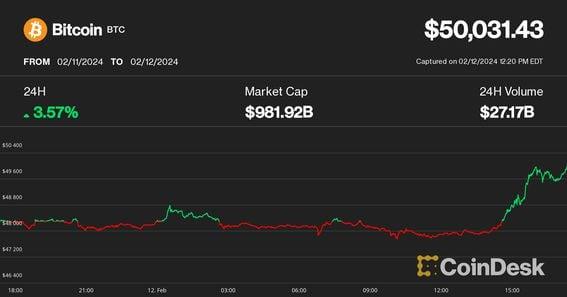
The world's largest crypto has now more than recovered since tumbling below $40,000 in the initial days following the opening of the spot ETFs. After a brief stumble following the Jan. 11 launch of the spot ETFs, the bitcoin (BTC) bull market begun in January 2023 has entered the FOMO stage, with the price breaking out above $50,000 for the first time in more than two years. Even as the new spot ETFs took in billions of dollars in their first weeks of trade, investor attention appeared to be focused on the billions leaving the high-fee Grayscale Bitcoin Trust (GBTC), and the price of bitcoin tumbled to as low as $38,500 just days after the ETFs opened for business. The action of the past couple of weeks though has seen slowing outflows out of GBTC, while sizable inflows have continued into the new products. On Feb. 8, Grayscale shed just 1,850 bitcoin, while the other nine ETFs added nearly 11,000 tokens to their funds. Then on Feb. 9, Grayscale lost 2,252 coins, while the other nine ETFs added more than 13,000. For perspective, just 900 newly mined bitcoin hit the market each day (soon to decline to 450 per day when the Bitcoin halving occurs in April). Crypto winter ends The price of bitcoin peaked at about $69,000 in November 2021; 2022 was a disaster amid the implosion of the Terra ecosystem and the disintegration of crypto exchange FTX and its wunderkind founder Sam Bankman-Fried in November 2022, along with a number of other high-profile crypto industry blowups. Bitcoin closed 2022 at just above $16,000, down about 75% from its all-time high. Many other crypto tokens suffered even larger routs. Alongside the price drops and big-name collapses, layoffs and shop closings were common throughout the industry – a trend that continued throughout 2023. While 2023 will be remembered as a major bull market period for crypto, the price action for bitcoin was rather lame throughout much of the year. On Oct. 1, bitcoin sat at just $27,000, ahead more than 65% for 2023, but a relatively small recovery considering how high bitcoin had been. The year's final quarter, though, was characterized by growing confidence the SEC – after years of delays and outright denials of any and all attempts by asset managers to launch a spot bitcoin ETF – was finally going to green light the vehicles in early 2024. The price of bitcoin rose nearly 60% in the 2023's final three months to close the year above $42,000. https://www.coindesk.com/markets/2024/02/12/bitcoin-hits-50k-on-coinbase-for-first-time-since-late-2021/
2024-02-12 14:52
Fourth quarter EBITDA was $99 million versus a loss of $7 million a year earlier. Digital Currency Group (DCG) in a letter to investors Monday morning reported results for the fourth quarter and fiscal 2023. Full text follows. Dear Shareholders, We are pleased to share our Q4 2023 Investor Report, which includes details regarding DCG’s financial performance and notable business developments. With a rally in crypto asset prices that kicked off this year alongside significant milestones reached, including DCG’s repayment of more than $1 billion of debt, and Grayscale’s GBTC beginning to trade as an ETF on NYSE Arca, we're looking ahead to this next chapter for DCG and the future growth of our industry. As always, we ask that you please keep all contents of this email and Investor Report strictly confidential and do not share with your fund LPs or other unauthorized recipients. Q4 2023 Financial Summary (excluding Genesis’ performance) Crypto asset prices continued to rise and reached annual highs of ~$45K in the fourth quarter, with average BTC price of ~$37K in Q4 up 29% from ~$28K in Q3. DCG Q4 2023 consolidated revenues were $210 million, up 12% quarter-over-quarter primarily due to higher asset prices, which drove $156 million of revenues at Grayscale (up 24% quarterover-quarter) and $38 million of revenues at Foundry (down 22% quarter-over-quarter given lower mining revenues). On a year-over-year basis, DCG Q4 2023 revenues were up ~59% vs. $132 million in Q4 2022. Q4 2023 average BTC price was up ~101% compared to ~$18K in Q4 2022. Q4 2023 EBITDA was $99 million, up 41% quarter-over-quarter, and up from an EBITDA loss of $7 million in Q4 2022. FY 2023 Financial Summary (excluding Genesis’ performance) For the 2023 fiscal year, DCG’s consolidated revenues were $749 million with EBITDA of $275 million. Revenues finished slightly down compared to $813 million in FY 2022, while EBITDA improved from $261 million for the same period as less profitable businesses were sold or wound down, representing a year-over-year margin improvement of 463 basis points. As of December 31, 2023, DCG’s investment portfolio (including tokens, Grayscale trust shares, venture / fund investments, and public equities) was marked at ~$975 million. Annual 409A Independent Valuation At the end of each year, we provide an annual 409A independent valuation of DCG’s stock. Consistent with previous years, DCG engaged Anvil Advisors for this purpose. The resulting valuation of DCG common equity as of December 31, 2023 is $4.4 billion, or a price per share of $55.87. This represents a 102% increase from the $2.2 billion valuation as of December 31, 2022. Key Business Updates Genesis Creditor Negotiations On November 28, 2023, DCG & Genesis filed an amendment to the Partial Repayment Agreement (PRA), which was approved by the bankruptcy court on December 21, 2023. This agreement provided significant operating flexibility and the ability to transfer certain Grayscale trust shares held to pay down debt principal. Further, as disclosed in early January, we made a final payment to complete the payoff of all short-term loans from Genesis. In total, DCG has paid off more than $1 billion of debt to its creditors in just over a year, including nearly $700 million to Genesis, satisfying all obligations currently due. Last week, DCG filed its objection to the amended Genesis bankruptcy plan. For over a year, DCG has worked around the clock to propose a variety of options, including deal structures that would have allowed Genesis creditors to benefit from an increase in equity value at DCG and Genesis, that the creditor committees agreed to and then reneged on. We have stated that DCG would support a plan that pays creditors a 100% recovery; however the proposed plan – developed without input from DCG – violates United States bankruptcy law and favors a small controlling group of creditors over others. DCG cannot support a plan that is unlawful and deprives DCG of its corporate governance rights. New York Attorney General Update Last week, New York Attorney General Letitia James amended her civil lawsuit complaint against Gemini, Genesis, DCG and individuals, originally filed on October 19, 2023, which broadens the lawsuit to include all Genesis creditors as victims and seeks more than $3 billion in restitution. It is important to note that this figure represents the total claims pool in the Genesis bankruptcy and we expect creditors to be paid back in full on the value of their claims. In addition, there is nothing new here. This is the same baseless complaint recirculated to generate another round of press headlines. DCG has always conducted its business lawfully and with integrity. The updated complaint follows Genesis filing a proposed settlement with the NYAG that would effectively give the NYAG all residual value in the Genesis estate after creditors are paid. Similar to the amended bankruptcy plan, Genesis devised this proposed settlement without notice to DCG to circumvent bankruptcy law and allow creditors to get paid more than the legally-allowed value of their claims. We will continue to fight this attempt to undermine the law. Grayscale Spot Bitcoin ETF Approval In a historic moment for our industry, on January 10, 2024, Grayscale received approval from the U.S. Securities and Exchange Commission to uplist GBTC to NYSE Arca as a spot Bitcoin ETF. GBTC commenced trading on NYSE Arca the following day. Since launching in 2013 as the first Bitcoin fund in the United States, GBTC has amassed nearly one million investors and more than $22 billion* in AUM, with hundreds of millions of dollars in daily trading volume. Following Grayscale’s landmark court victory last year, the approval of spot Bitcoin ETFs in the United States represents a monumental shift toward mainstream adoption of digital currencies. CoinDesk Sale On November 20, 2023, we announced the sale of CoinDesk to Bullish, the institutional digital assets exchange led by Tom Farley. DCG acquired CoinDesk in 2016 with the belief that the crypto industry needed a leading independent media company. We are proud to have supported its transformation into an award-winning media and events company and the most trusted information platform for digital assets. Thank you for your ongoing support. Best, DCG Investor Relations https://www.coindesk.com/business/2024/02/12/digital-currency-group-reports-q4-revenue-of-210m-up-59-yy-full-text/

2024-02-12 08:08
Spot bitcoin ETFs have amassed more than 192,000 bitcoin in holdings, as of Friday, since their launch nearly a month ago. Bitcoin could see a steady price increase after its halving event on lower selling pressure and new interest in native Bitcoin-based applications. Ordinals have revitalized Bitcoin on-chain activity and bolstered fundamentals while buying demand from spot bitcoin exchange-traded funds (ETFs), which are likely to support higher prices in the future. Bitcoin’s (BTC) technical fundamentals and use cases have significantly increased in the past year and likely made the asset “stronger” ahead of its historically bullish halving event compared to previous years, crypto asset management Grayscale said in a research note last week. “Despite miner revenue challenges in the short term, fundamental on-chain activity and positive market structure updates make this halving different on a fundamental level,” researcher Michael Zhao said. “While it has long been heralded as digital gold, recent developments suggest that bitcoin is evolving into something even more significant.” Halving is part of the Bitcoin network’s code to reduce inflationary pressure on the cryptocurrency and will cut the rewards in half for successfully mining a bitcoin block. This makes obtaining or mining new bitcoin much harder – and has historically preceded bull runs. Ordinals Bump Fundamentals Zhao stated that the advent of ordinal inscriptions and BRC-20 tokens had revitalized on-chain activity on Bitcoin, generating upwards of $200 million in transaction fees for miners as of February 2024. “This trend is expected to persist, bolstered by renewed developer interest and ongoing innovations on the Bitcoin blockchain,” he said. The BRC-20 standard (BRC stands for Bitcoin Request for Comment) was introduced in April to allow users to issue transferable tokens directly through the network for the first time. The tokens, called inscriptions, function on the Ordinals Protocol. The protocol allows users to embed data on the Bitcoin blockchain by inscribing references to digital art into small Bitcoin-based transactions. During times of network demand, fees derived from Ordinals they consisted of over 20% of monthly revenue for miners – emerging as a new source of income, one of the network’s most important stakeholders. Bitcoin ETFs to Drive Buying Pressure Beyond generally positive onchain fundamentals, bitcoin’s market structure looks beneficial to price post-halving, the report said. Lower rewards are expected to require relatively lower buying pressure to keep prices afloat, which, with increased demand, could translate to higher prices. “Historically, block rewards have introduced potential sell pressure to the market, with the possibility that all newly mined bitcoin could be sold, impacting prices,” Zhao wrote. “Currently, 6.25 bitcoin mined per block equates to approximately $14 billion annually (assuming bitcoin price is $43K).” “In order to maintain current prices, a corresponding buy pressure of $14 billion annually is needed,” he stated, adding that these requirements will decrease “to $7 billion annually” after the halving as rewards fall down to 3.25 bitcoin per block, “effectively easing the selling pressure.” Spot bitcoin ETFs have amassed more than 192,000 bitcoins in holdings as of Friday since their launch nearly a month ago. The funds have only been on the market for less than one month but have already attracted billions of dollars from investors looking to gain exposure to bitcoin without having to buy and store it directly. https://www.coindesk.com/markets/2024/02/12/bitcoin-stronger-ahead-of-halving-grayscale/

2024-02-12 07:40
The validator entry queue has jumped to 7,045, the highest since Oct. 6, according to data source ValidatorQueue. The waitlist for new Ethereum validators is now the longest since early October. The renewed interest in staking is noteworthy as the yield on staked ether remains below 4%. The Ethereum network is witnessing a spike in the number of validators looking to stake their ether (ETH). The so-called validator entry queue has jumped to 7,045, the highest since Oct. 6, according to data source ValidatorQueue. The waitlist, representing over 225,000 ether ($562 million), is expected to be cleared in just over 48 hours. Ethereum limits the number of new validators that can join the network per epoch or the time it takes to process blocks on the blockchain. This results in a backlog. An Ethereum epoch is 6.4 minutes long. Validators are entities that stake a minimum of 32 ether in the network to participate in running Ethereum’s proof-of-stake consensus blockchain. In exchange for staking ether, they receive a steady rate of return analogous to interest income from fixed-income instruments like bonds. “Resurgence in Ethereum staking activity indicates initial signs of renewed vitality,” David Lawant, head of research at institutional crypto exchange FalconX, said in an email on Friday. Lawant added that the renewed uptick in the activation queue is notable, as there has been little to no improvement in the annualized percentage yield on staked ether. CoinDesk’s composite ether staking rate continues to hover between 3.5% and 4% for the fourth straight month, offering barely any premium compared to the yield or the so-called risk-free rate of 4.17% on the 10-year U.S. Treasury note. While the number of stakers looking to join the network has spiked, the tally remains well below the figures over 75,000 seen following Ethereum’s Shapella upgrade in April last year. The Shapella upgrade opened withdrawals of staked ether for the first time, de-risking the process of locking coins in return for rewards. The waitlist for validators looking to exit saw a brief spike in early January after failed crypto lender Celsius revealed plans to unstake its entire ether holdings. Ether lags bitcoin Ether jumped nearly 10% last week, underperforming bitcoin’s (BTC) 14.5% gain and the 11% rise in the CoinDesk 20 Index. The uncertainty about the potential launch of U.S.-based spot ETFs later this year and the need for more clarity in the SEC’s categorization of ether have seemingly kept traders from aggressively buying ether. According to Lawant, everyone is waiting to see whether the potential ETH ETFs will be allowed to stake coins. “Ark/21Shares updated their S-1 form to include a staking component this week. The back and forth on S-1 amendments over the upcoming months ahead of the key date on May 23 will hint at whether that’s a real possibility,” Lawant noted. https://www.coindesk.com/markets/2024/02/12/ethereum-validator-entry-queue-signals-renewed-interest-in-staking/

2024-02-12 06:52
The court will determine the fine Block Earner will have to pay during a scheduled hearing on March 1, 2024. Fintech company Block Earner engaged in unlicensed services by offering its crypto-backed Earner product, ruled an Australian Federal Court. The court though, handed Block Earner a part victory against Australia’s markets regulator by adjudicating that its DeFi “Access" service was not illegal. An Australian court has given a split decision in a case brought by Australia’s markets regulator against Sydney-based crypto start-up Block Earner. Judge Ian McNeil Jackman, who is also the brother of actor Hugh Jackman, ruled on Friday that Block Earner engaged in unlicensed financial services conduct when offering its crypto-backed Earner product. However, Jackman dismissed allegations relating to Block Earner’s DeFi “Access” service. The court will determine the fine Block Earner will have to pay during a scheduled hearing on March 1, 2024. The Australian Securities and Investments Commission (ASIC) sued Block Earner, alleging the fintech company provided a range of unlicensed fixed-yield earning products based on crypto assets in November 2022. In the same month, Block Earner, which has backing from crypto exchange Coinbase, voluntarily withdrew its fixed-yield “Earner” service. ASIC Deputy Chair Sarah Court said, “This important decision provides some clarity as to when crypto-backed products should be considered financial products which require licensing under the law.” “Block Earner can continue offering Access, and the case provides guidance for other crypto businesses highlighting ’a positive step forward’ that 'provides a glimpse into a future where DeFi can thrive,” the company said in an announcement. https://www.coindesk.com/policy/2024/02/12/australian-judge-hands-split-decision-in-markets-regulator-vs-block-earner/