2024-01-10 05:09
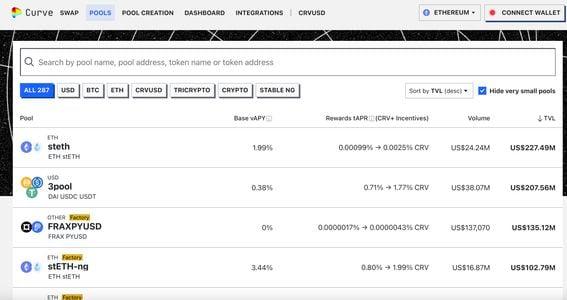
Curve's FRAXPYUSD liquidity pool, which went live on Dec. 27, boasts the third largest TVL of $135 million. Payments services provider PayPal's dollar-backed stablecoin PYUSD's use in decentralized finance (DeFi) seems to be gathering traction. A recently launched liquidity pool comprising PYUSD on the automated market maker (AMM) platform, Curve, boasts $135 million in total value locked (TVL), the third largest behind the popular 3pool. In addition to PYUSD, issued by regulated company Paxos, the so-called FRAXPYUSD pool also consists of Frax Finance's collateralized algorithmic stablecoin FRAX. The pool went live on Dec. 27. A liquidity pool is a reserve of two or more cryptocurrencies locked in a smart contract, facilitating the exchange of assets on a decentralized exchange. Curve is a decentralized exchange used by traders to swap stablecoins. The activity on Curve is considered a proxy for whales looking to convert one stablecoin into another. The FRAXPYUSD pool allows traders holding FRAX to swap them for PYUSD and then use the newly acquired coin on the PayPal app for purchases and remittances. At press time, the pool was imbalanced, with FRAX accounting for over 80% of the total liquidity. "FRAX is kind of like the on-chain liquidity for PYUSD, and the latter is the offchain fiat ramp," Sam Kazemian, founder of Frax Finance, told CoinDesk in an interview. "Since inception, the pool has seen an average daily trading volume of $5.5 million." CoinDesk has reached out to PYUSD's issuer Paxos for insights on PYUSD's growing use case in DeFi. Debuted in August, PayPal's PYUSD is slowly finding its way into decentralized finance, although it still lags behind industry leaders Tether and Circle by a significant margin. Data tracked by Kaiko show PYUSD's daily trading volume hit a high of $9 million in December and recently stood at around $4 million, a far cry from Tether's USDT recording a 24-hour trading volume of over $55 billion. "It is a good sign that liquidity is growing in DeFi. It seems that Paypal is investing resources into expanding the stablecoin's usage for crypto trading activities, beyond just payments and within the Paypal app," Clara Medalie, research director at Kaiko, said in an email. "However, they face a lot of competition from USDT, which today denominates the majority of all crypto transactions and liquidity. Circle's USDC is also a big competitor on DeFi protocols and is by far the most liquid," Medalie added. Kazemian said the FRAXPYUSD will likely grow more, with Frax Finance exploring potential DeFi integration supported by PayPal's payment app. "Imagine if you open your PayPal app and you can save in PYUSD and Frax inside of Curve and earn the yield," Kazemian quipped. https://www.coindesk.com/markets/2024/01/10/paypals-stablecoin-part-of-third-largest-liquidity-pool-on-curve/
2024-01-10 04:32
The revelation raises questions about the investments regulator's security protocols. The Securities and Exchange Commission (SEC) did not employ basic security measures on its X (formerly Twitter) account when it was “compromised” to spread false bitcoin ETF news, according to the social media company. Late Tuesday, X’s Safety team said it had completed its “preliminary investigation” into the SEC’s market-moving, false post on approval of bitcoin ETF applications, which the regulator blamed on its “compromised” account. “The compromise was not due to any breach of X’s systems, but rather due to an unidentified individual obtaining control over a phone number associated with the @SECGov account through a third party,” X’s Safety account posted. The explanation seemingly rules out an “inside job” or “fat finger” theory of the midday post. Bitcoin (BTC) price pumped on the post, but quickly crashed after SEC Chair Gary Gensler clarified that the post was phony. The incident raises new questions about basic security measures being taken by the SEC, the most powerful investment regulator in the U.S. and one whose statements are closely watched and traded on. Gensler himself has previously encouraged investors to take their security seriously. U.S. senators J.D. Vance and Thom Tillis have sent a letter to the SEC demanding an explanation of its lapse in cybersecurity. “It is unacceptable that the agency entrusted with regulating the epicenter of the world’s capital markets would make such a colossal error,” they wrote. “We can also confirm that the account did not have two-factor authentication enabled at the time the account was compromised. We encourage all users to enable this extra layer of security,” X posted. For full coverage of bitcoin ETFs, click here. An SEC spokesperson did not immediately return a request for comment on the statement. https://www.coindesk.com/policy/2024/01/10/hacker-seized-sec-phone-number-to-post-fake-bitcoin-etf-approval-x-says/

2024-01-10 01:22
Lawmakers and crypto boosters are asking questions about how the SEC's X (formerly Twitter) account was compromised, leading to a bogus tweet on Tuesday. Nearly seven years ago, the Securities and Exchange Commission (SEC) denied the first spot bitcoin exchange-traded fund (ETF) application, citing the risk presented to investors by market manipulation. It would become a familiar refrain for the countless rejections that followed. The regulator's got some explaining to do. Tuesday's bogus tweet from the SEC's official X (formerly Twitter) account caused a rapid pump and then plummet in bitcoin's price as traders tried to make sense of the apparent approval. By the looks of it, the powerful regulator had just greenlit every prospective BTC ETF application, delivering bitcoin speculators their long-awaited victory a full day ahead of schedule. Of course, the suspicious post – it was paired with a $BTC cashtag – was a hoax. Within minutes Chair Gary Gensler tweeted from his own account that SEC had not approved anything. Bitcoin markets continued their sell-off in response. The whole charade prompted calls for an investigation by crypto-friendly lawmakers and enraged social media users alike into how the SEC allowed itself to become a disinformation platform. "Fraudulent announcements, like the one that was made on the SEC’s social media, can manipulate markets. We need transparency on what happened," tweeted Senator Cynthia Lummis (R-Wy.) after the SEC confirmed its account has been "compromised." It was an ironic twist in what many expected were the final hours of the SEC's stonewalling of the spot bitcoin ETF. The SEC's own statements primed traders for overreacting to this type of misinformation. In mid-October the regulator tweeted "Careful what you read on the internet. The best source of information about the SEC is the SEC," in response to a retracted CoinTelegraph tweet that stated that BlackRock's bitcoin ETF application had been approved. While the first part of that tweet retained its credibility Tuesday, the second half was reduced to farce. As many commentators pointed out, even the SEC cannot be trusted for what's going on at the SEC. Last week, an SEC spokesperson told CoinDesk that any decisions would first be posted on its own internal EDGAR database. Of course, the general public and even informed observers cast such guidance aside on Tuesday. "Does this mean we can blame more of the @secgov’s horrible rulemaking and so-called regulation by enforcement on a 'compromised account'?, tweeted Rep. Bill Huizenga in response to Gensler. Beyond the gleeful irony of it all, the SEC's apparently hacked account raised uncomfortable questions about how seriously the regulator took its mandate to protect itself in order to protect investors (though it's unclear how exactly the X account was compromised). "The SEC will work with law enforcement and our partners across government to investigate the matter and determine appropriate next steps relating to both the unauthorized access and any related misconduct," the regulator said hours into the episode. https://www.coindesk.com/policy/2024/01/10/crypto-boosters-attack-sec-for-manipulating-btc-market-after-etf-tweet/

2024-01-09 23:04
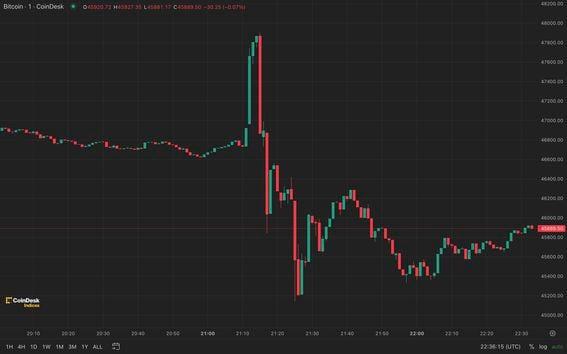
The immediate price reaction showed that bitcoin's price might be capped if a real approval arrives, one analyst noted. Bitcoin (BTC) endured wild swings during Tuesday's trading session as a U.S. Securities and Exchange Commission (SEC) social media post about approving spot bitcoin exchange-traded funds (ETF) turned out to be false, leaving market participants baffled. BTC first rallied 2.5% to a fresh 19-month high of $47,900 immediately following the official SEC account's shared on X (formerly Twitter) about the bitcoin ETF approval, attracting massive attention with crypto observers prematurely celebrating the landmark decision. Then, bitcoin sharply declined nearly 6% to as low as $45,100 when it turned out the SEC's account was compromised, and SEC Chair Gary Gensler denied the news. The wild price action liquidated over $50 million worth of derivatives trading positions on crypto exchanges within an hour, CoinGlass data shows. Liquidations occur when an exchange forcefully closes a trader's open position using borrowed money due to loss of margin. Recently, BTC changed hands slightly below $46,000 at press time, down some 2% over the past 24 hours. This was the second instance during the day when a false social media post triggered massive volatility. Earlier Tuesday, dogecoin (DOGE) jumped as much as 9% on an X post about the death of the token's mascot, then declined as the news turned out to be false. Alex Krüger, co-founder of Asgard Markets, noted that today's events suggested bitcoin might not rally as much as bulls hope when the real news about an approval arrives. "Fake ETF news showed BTC upside is clearly capped until we see actual ETF inflows," Krüger said in an X post. "Time for ETH to take over." https://www.coindesk.com/markets/2024/01/09/bitcoin-jumps-then-dumps-to-45k-as-fake-news-about-spot-bitcoin-approval-liquidates-50m/
2024-01-09 21:31
The X account of the U.S. Securities and Exchange Commission, which is deciding whether to approve bitcoin ETFs, "was compromised," the regulator told CoinDesk. The U.S. Securities and Exchange Commission confirmed it has not approved bitcoin ETF applications – contradicting its X (formerly Twitter) account briefly saying otherwise. "The SEC's @SECGov X/Twitter account has been compromised," a spokesperson said in a statement to CoinDesk. "The unauthorized tweet regarding bitcoin ETFs was not made by the SEC or its staff." In a separate statement shared later, a spokesperson said "there was unauthorized access to and activity on" the account by an "unknown party." The party no longer has that unauthorized access, the statement said. "The SEC will work with law enforcement and our partners across government to investigate the matter and determine appropriate next steps relating to both the unauthorized access and any related misconduct," the statement said. X's Safety team said early Wednesday morning UTC that the SECgov account did not have two-factor authentication enabled, and the attacker was able to gain control over a phone number tied to the account. For full coverage of bitcoin ETFs, click here. SEC Chair Gary Gensler on his own X account said the ETFs have not been authorized. "The SEC has not approved the listing and trading of spot bitcoin exchange-traded products," he said. The regulator is widely expected to approve spot bitcoin ETF applications on Wednesday. An SEC spokesperson told CoinDesk last week that any approval for bitcoin ETFs would appear in the agency's EDGAR database; X was not given as a means of communicating the decision. "Any Commission 19b-4 orders will be posted on our website and then published in the Federal Register," the spokesperson said. The compromised @SECgov X account had tweeted: "Today the SEC grants approval for #Bitcoin ETFs for listing on all registered national securities exchanges. The approved Bitcoin ETFs will be subject to ongoing surveillance and compliance measures to ensure continued investor protection." It included a graphic with a quote purportedly from Gensler. The account also posted a second tweet that just said "$BTC," but this post was almost immediately deleted. Bitcoin (BTC) first jumped to nearly $48,000 immediately after the social media post, then plummeted nearly 6% to $45,100 when the news turned out to be false. The volatile period wiped out over $50 million of leveraged derivatives trading positions within an hour, CoinGlass data shows. https://www.coindesk.com/policy/2024/01/09/sec-twitter-compromised-chair-gensler-says-after-account-said-bitcoin-etfs-approved/
2024-01-09 19:08
The volatile episode came at a time when the crypto industry anxiously awaits a spot bitcoin ETF approval, a landmark for the asset class' maturation. Dogecoin jumped 9% on a later-recanted social media rumor about the death of the token's mascot. The volatile episode irked crypto market observers as liquidations soared on the fake news. Dogecoin (DOGE) swung wildly on Tuesday as a social media rumor about the death of the popular meme coin's mascot turned out to be fake, riling up crypto observers. DOGE price jumped as much as 9% to 8.3 cents after pseudonymous X (formerly Twitter) user TraderAguila posted a screenshot of a Telegram conversation in Japanese that alleged that Kabuso, the token dog for the cryptocurrency, passed away. Soon after, the author deleted the X post and went private, saying the screenshot turned out to be fake. Later they deleted the account altogether. DOGE pared most of its gains and retraced to around 8 cents, but still higher than the 7.7 cents it changed hands before the fake news. The episode riled up crypto observers as it added fuel to the asset class' bad reputation of alleged market manipulation and speculative nature. "The charts people are painting while speculating over the death of an animal make me think we're either all going to hell or we're already there," widely-followed crypto market observer Tree of Alpha opined. The volatile period also irked some DOGE traders as the swift price swing wiped out leveraged trading positions. CoinGlass data shows that over $674,000 worth of leveraged derivatives trades got liquidated within an hour, topping all other crypto asset liquidations including bitcoin. Dogecoin started off as a joke cryptocurrency in 2013 but amassed a huge global following, including Elon Musk, and now has a market capitalization exceeding $11 billion. The events came at a time when the crypto market is attracting outsized attention, awaiting regulatory approval of a sought-after spot bitcoin exchange-traded fund (ETF) in the U.S., which is considered a landmark win for the industry's maturation. For full coverage of bitcoin ETFs, click here. Notably, bitcoin (BTC) price briefly spiked in October, when crypto-focused news outlet CoinTelegraph falsely tweeted that asset manager BlackRock's application was approved by regulators. https://www.coindesk.com/markets/2024/01/09/dogecoins-9-swing-amid-fake-rumor-of-mascots-death-riles-up-crypto-enthusiasts/