2024-01-09 03:49
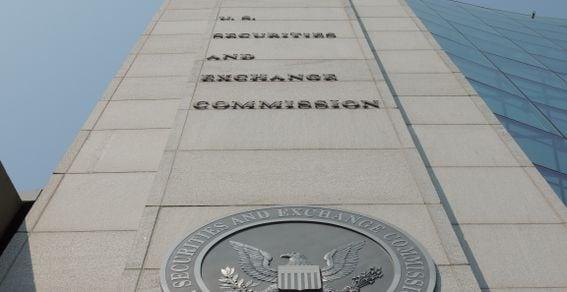
With a Wednesday deadline looming, the regulator sent comments just hours after would-be issuers filed documents detailing their fees. U.S. Securities and Exchange Commission officials sent comments to a set of prospective issuers of bitcoin exchange-traded funds (ETFs) just hours after the companies filed documents detailing fees for their proposed products, an individual familiar with the comments said. The issuers should file updated documents on Tuesday, the individual said. The comments addressed minor details in the amended S-1 forms rather than significant changes, and should not affect the timeline for a potential approval by the regulator. Issuers hoping to launch spot bitcoin ETFs in the U.S., including BlackRock, Grayscale and Fidelity, announced their expected fees in filings earlier Monday. Bloomberg Intelligence analyst James Seyffart, who's been closely tracking the bitcoin ETF applications, tweeted that it was "borderline unheard of" for applicants to hear back from the SEC within the same day for amended filings. Monday's comments show SEC officials are still engaged in dialogues with the would-be ETF issuers, most of whom proposed creating spot bitcoin ETFs last summer. The agency faces a Jan. 10, 2024 deadline – i.e. this Wednesday – for one of the applications, by Ark and 21 Shares. A flurry of amended filings by issuers reflecting their conversations with SEC officials has raised hopes in recent weeks that the agency will approve spot bitcoin ETFs to trade in the U.S. These hopes were bolstered when exchanges including Nasdaq, NYSE Arca and Cboe BZX filed amended 19b-4 documents on Friday, which another individual told CoinDesk last week were intended to match the S-1 filings. Both 19b-4 and S-1 filings need to be deemed effective by the SEC before an ETF can begin trading. Bitcoin ETF advocates hope a regulated financial product will let traditional financial institutions and everyday retail investors gain exposure to the world's oldest cryptocurrency's price without having to set up wallets or otherwise deal with new financial structures. The SEC has so far rejected every application for a spot bitcoin ETF, dating back to 2013. While the agency has not yet signaled publicly how it might rule on the latest slate of applications, the amount of feedback it's provided and the amended filings – not to mention the speed with which it's responding – suggest the nearly-a-dozen applications will be cleared for takeoff. https://www.coindesk.com/policy/2024/01/09/sec-hustles-to-answer-latest-bitcoin-etf-filings-source/
2024-01-08 19:26
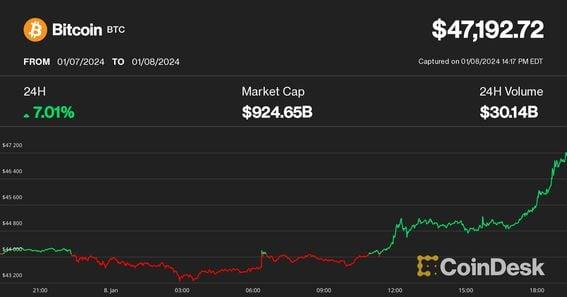
Bitcoin could rally 10%-15% more in case the SEC approves spot bitcoin ETFs, LMAX strategist Joel Kruger noted. Bitcoin (BTC) on Monday topped $47,000 for the first time since April 2022 as anticipation for a landmark spot-based BTC exchange-traded fund (ETF) approval in the U.S. is reaching a fever pitch. The largest and original cryptocurrency rose sharply from $43,200 during Asia morning hours to a fresh 19-month high of $47,192 during the U.S. trading session, CoinDesk Indices data shows. BTC gained almost 7% over the past 24 hours. For full coverage of bitcoin ETFs, click here. The rally happened as investors are anxiously awaiting a regulatory decision for the first spot-based bitcoin exchange-traded-funds in the U.S., expected sometime this week. Most market observers expect an approval, with bulls forecasting that these vehicles would dramatically expand the investor base for the asset and attract large inflows. Applicants including asset management giants BlackRock, Fidelity and Grayscale earlier today submitted updated S-1 filings to the U.S. Securities and Exchange Commission (SEC) and multiple issuers revealed the fees they would charge investors. In case an SEC approval truly arrives, the announcement could push bitcoin's price even higher, LMAX Group market strategist Joel Kruger noted in an email. "An approval could trigger a 10-15% rally, fueled by sidelined capital," Kruger said. "If there's no approval, projections hint at a possible correction, but strong support above $30,000 is expected." https://www.coindesk.com/markets/2024/01/08/btc-blasts-past-47k-as-bitcoin-etf-excitement-gets-feverish/
2024-01-08 17:01
Just one potential spot bitcoin ETF issuer has set a management fee above 1% as many of the others are asking for less than 0.5%. Two days before the Securities and Exchanges Commission (SEC) is expected to approve one or more U.S. spot bitcoin exchange-traded funds (ETFs), all potential issuers have disclosed an important – if not the most important – detail about their product: the fee. And they differ greatly. Some 13 proposed ETFs are awaiting SEC approval, or rejection, and the fee they charge is one way they can differentiate themselves from the others. Lower fees, charged as a percentage of the fund's assets, leave more for investors. Crypto native fund manager Bitwise is charging the least – 0.24% after a 6-month period of no fees – though some of its rivals aren't far off. Ark and 21Shares plan to charge 0.25%, VanEck also lists at 0.25% and Franklin at 0.29%. BlackRock, the world's largest asset manager, set its fee at 0.30%, lower than some experts had expected given its size and reputation could have allowed it to charge more and still strongly compete in popularity. “Life just got a lot tougher for everyone else,” Bloomberg Intelligence’s ETF senior analyst Eric Balchunas wrote on X, referring to BlackRock's pricing decision. Fidelity set its fee at 0.39% and Invesco and Galaxy at 0.59%, while Valkyrie and Hashdex chose 0.80% and 0.90%, respectively. Like Bitwise, most of the issuers plan to offer reduced fees for a fixed period after their introduction. One stand out is Grayscale, which wants to convert its Grayscale Bitcoin Trust (GBTC) into an ETF. It plans to charge at the high end of range, 1.5%. While this is lower than the trust's management fee of 2% and there is a potential to waive the fee, it might not be enough to compete with the other applicants, according to some observers. “Hard to imagine advisors picking a 1.5% ETF” Balchunas said on X. Grayscale’s fee, “simply isn’t going to cut it," posted Nate Geraci, another ETF expert. For context, the average fee on ETFs in 2022 was 0.37% according to research from Morningstar. Grayscale, however, has heft in another category that matters greatly in the ETF world: size. It already has more than $27 billion of assets under management, which gives it a huge advantage compared to the others, which have zero. https://www.coindesk.com/business/2024/01/08/bitwise-tops-bitcoin-etf-low-fee-table-while-grayscale-bets-on-size/

2024-01-08 16:36
While the industry eagerly awaits the U.S. regulator's decision on spot bitcoin ETFs, Gary Gensler is on X warning investors that crypto is rife with scams. The entire crypto world and much of the U.S. financial sector is anxiously awaiting word from the U.S. Securities and Exchange Commission (SEC) on whether it will approve a spot bitcoin exchange-traded fund (ETF). SEC Chair Gary Gensler has chosen this moment to issue a broad warning about the hazards to investors of getting into digital assets. Gensler – as he's done many times – posted on X to warn people that the crypto sector is beset by scams and fraud, and that many companies in the space aren't following securities laws. For full coverage of bitcoin ETFs, click here. "Those offering crypto asset investments/services may not be complying w/ applicable law, including federal securities laws," Gensler posted, advising his followers that there are a number of things to keep in mind about cryptocurrencies. "Fraudsters continue to exploit the rising popularity of crypto assets to lure retail investors into scams," he added in another post. Read More: Solana Meme Coins See 80% Price Drop After December Frenzy It's unclear whether Gensler's words represent a final dig before the agency – as many expect – approves ETF applications that are approaching key deadlines. That moment is widely seen as a major turning point, because fully regulated spot ETFs would allow much easier trading of digital assets for even the most casual investor, and some estimates suggest that could mean tens of billions of dollars flowing into the industry. Of course, whether or not cryptocurrency businesses are properly approaching securities law is a matter still being worked out in a long list of court cases. Gensler's agency has been found by some judges to be on the wrong side of the argument, though the SEC has also chalked up a few wins, including a recent ruling in the Terraform Labs case that the regulator was right about the company improperly pushing unregistered crypto securities. Read More: SEC Chair Gary Gensler: 'Far Too Many Frauds and Bankruptcies' https://www.coindesk.com/policy/2024/01/08/as-crypto-world-watches-sec-chair-gensler-says-again-that-sector-is-dangerous/

2024-01-08 15:24
The Grayscale Bitcoin Trust's (GBTC) $27 billion of bitcoin and $350 million of daily volume gives Grayscale an advantage versus BlackRock and other wannabe rivals, according to Bloomberg's Eric Balchunas. In the universe of exchange-traded funds, size matters. And in the world of spot bitcoin ETFs, the giant is Grayscale Investments, which, if approved by the U.S. Securities and Exchange Commission, would come out of the gate with more than $27 billion of assets under management (AUM) while other potential issuers are starting from scratch. For those who have not been following the bitcoin (BTC) ETF proposal process in detail, a dozen or so issuers appear to be on the verge of being simultaneously approved by the SEC. Grayscale stands out from the crowd with its trove of over 619,000 BTC, having started back in 2013 as an easy way for institutional investors to gain exposure to bitcoin without holding the asset directly. For full coverage of bitcoin ETFs, click here. There are other determining factors, such as the fees these products will charge. But judging by Grayscale's proposed 1.5% fees for its proposed ETF uplift, which is about 100 basis points, or one percentage point, higher than the competition, the firm is banking on its volume and liquidity. "We have a massive differentiator from any other product that is going to come on the market because we have over a million investors and hundreds of millions of dollars in trading volume on a daily basis, and that will continue when it is approved to be uplisted to the New York Stock Exchange," David LaValle, global head of ETFs at Grayscale Investments, said in an interview. On the subject of fees, it's not necessarily the case that investors will switch products to maintain the same exposure solely based on fees, choosing BlackRock or Fidelity's lower fee structures for a spot bitcoin ETF, for instance. Such a move is particularly unlikely when tax considerations are factored in. For example, a Grayscale investor with long-term capital gains in the 15% to 20% range would be looking at a long time horizon to make up that tax bill based on a saving in basis points. Eric Balchunas, an analyst at Bloomberg Intelligence focused on ETFs, agrees that tax is going to be a big consideration for many when it comes to Grayscale. "The tax issue is benefiting Grayscale, in my opinion," Balchunas said in an interview. "A lot of times with mutual funds, there are people who don't want to be in a certain active mutual fund that overcharges and underperforms, but the tax hit is so great after all these years in the bull market they just stay in there." That said, most market watchers believe Grayscale will see some degree of outflows, especially given that its Grayscale Bitcoin Trust (GBTC) traded at a large discount to the underlying value of bitcoin in recent times. "There have been a number of people who have bought GBTC units betting that it will become an ETF," Sui Chung, CEO of crypto index provider CF Benchmarks, said in an interview. "So they buy the discount, betting that once it becomes an ETF they can redeem at NAV net asset value and just hoover up that profit. It's hard to say how much AUM that will be, but it's likely to be a decent chunk." Certain esoteric factors can be added to this. Although it isn't Grayscale's fault, Chung said, one unknown factor is how much goodwill Grayscale has lost with investors through the years of big NAV discounts. Then there's the unfortunate circumstance of Grayscale's owner, Digital Currency Group, having legal woes. "Although, in reality, GBTC is bankruptcy-remote, not every investor understands that. Some may just feel better going to BlackRock or Invesco," Chung said. (Another DCG division, Genesis, is restructuring in bankruptcy court.) But the ETF industry is complex, and even if Grayscale were to quickly drop a few billion in assets, the fund would still have a huge upper hand, Bloomberg's Balchunas points out. "GBTC opening on day one with over $20 billion and $350 million of daily volume is like bringing a gun to a knife fight," he said. "Any of these products would kill to have that much money in like three years, let alone the first week. If Grayscale is able to convert on the first day, outside of BlackRock and Fidelity, it's gonna make it really exceptionally hard for the others." Although all the signs suggest Grayscale will be given a green light along with the other ETF hopefuls, the SEC could conceivably still try and prevent or delay them based on the regulator's stated goal of setting out a level playing field, Balchunas said. "You have to remember that Grayscale embarrassed the SEC when they won their case," Balchunas said. "I'm not saying the SEC is petty, but if they did want to get revenge, my guess is they could probably find some kind of a parking ticket reason to mess with them. But then they could get sued again. So it's complicated." https://www.coindesk.com/business/2024/01/08/in-bitcoin-etf-battle-grayscale-is-bringing-a-gun-to-a-knife-fight/

2024-01-08 15:08
Lazarus Group, said to have been behind some $3 billion worth of cryptocurrency hacks and exploits over the past three years, appears to be moving around some of its bitcoin hoard. The group holds $79 million in wallets tagged by the blockchain analysis firm Arkham. North Korean hackers Lazarus Group have moved $1.2 million worth of their ill-gotten gains from a coin mixer to a holding wallet, marking their largest transaction in over a month. Data from the blockchain analysis firm Arkham shows that Lazarus Group's wallet received 27.371 bitcoin (BTC) in two transactions before sending out 3.34 BTC to a previously used wallet. The coin mixer wasn't identified. Generally speaking, a coin mixer, sometimes referred to as a tumbler, is a blockchain-based protocol that can be used to obscure the ownership of cryptocurrencies by mixing them with coins from other users before redistributing them – so no one can tell who got what. Typically, the transparency of blockchains makes it a straightforward exercise to track the crypto's provenance and transfers. Lazarus Group is said to have been behind $3 billion worth of cryptocurrency hacks and exploits over the past three years, according to a report by cybersecurity firm Recorded Future. The U.S. Treasury Department has tied Lazarus Group to a $600 million theft of cryptocurrency from the Axie Infinity-linked Ronin bridge. According to a report last week from TRM Labs, North Korea-affiliated hackers were involved in a third of all crypto exploits and thefts in 2023, making off with some $600 million in funds. Read More: North Korea Was Responsible for Over $600M in Crypto Thefts Last Year: TRM Labs The Lazarus Group wallet now holds $79 million in wallets tagged by Arkham, including $73 million worth of bitcoin and $3.4 million worth of ether (ETH). Metamask developer Taylor Monahan said the recent Orbit attack, which resulted in the loss of $81 million, followed patterns similar to previous attacks committed by Lazarus Group. https://www.coindesk.com/business/2024/01/08/north-korean-hacking-group-lazarus-withdraws-12m-of-bitcoin-from-coin-mixer/