2024-01-04 09:08
Renewed rate cuts by the Fed have historically presaged recessions and triggered rotation of money out of risk assets. The Fed minutes released Wednesday show policymakers could cut rates this year. Past data show an economic recession tends to follow as the Fed begins cutting rates. The minutes of the Federal Reserve's (Fed) December meeting released Wednesday showed interest rate cuts are likely in 2024. The long-awaited liquidity easing has been widely touted as a critical bullish tailwind for bitcoin (BTC) alongside the impending spot ETF launch and Bitcoin blockchain's quadrennial mining reward halving. There is a catch. Past data sourced from MacroMicro shows that the early stages of the supposedly stimulatory Fed rate cut cycle are often characterized by the economy on the brink of a recession and brief but notable rally in the U.S. dollar, a global reserve currency backed by the world's largest and most liquid government bond market. In other words, if history is a guide, bitcoin may see a brief and intense bout of risk aversion later this year after the Fed begins cutting the benchmark Federal Funds rate. A recession is a prolonged period of declining economic output and a rise in unemployment. Left to market forces, a recession can lead to sharp decline in investors' risk taking ability and asset price deflation. Thus, central banks often combat the same with monetary stimulus. The dollar is a global reserve currency, with an outsized role in global trade, international debt, and non-bank borrowing. When the greenback rallies, those with dollar borrowings face higher debt servicing costs. That leads to tighter financial conditions, leading to investors reducing exposure to risk assets like bitcoin. The dollar index, which gauges the USD's exchange rate against major fiat currencies, initially strengthened after the Fed kicked off the rate-cut cycle in mid-2000, September 2007, and August 2019. The S&P 500, a proxy for worldwide investor risk appetite, saw bouts of risk aversion during the early stages of the rate-cut cycle. The shaded area shows recessions followed the Fed pivot to rate cuts. Recession follows rate cuts? Historically, the Fed has resorted to rate cuts only with recession at the doorstep. That has led to forward-looking markets treating rate cuts as a harbinger of bad news and seeking safety in the U.S. dollar. Recessions have consistently followed the onset of easing cycles over the past 60 years, according to data tracked by investment banking firm Piper Sandler. "This sequence often occurs because the Fed tends to overshoot by raising and maintaining high-interest rates for longer than necessary, inadvertently stifling economic growth. Rate cuts usually come into play only when the economy is visibly declining and unemployment is on the rise. By that point, a recession is typically inevitable," Piper Sandler said in a note to clients on Jan. 2. "This time around, it's likely that the same pattern will repeat, with the Fed maintaining a hawkish stance longer than required," Piper Sandler added. Per some observers, markets are currently overestimating the U.S. economy's ability to avoid a recession in the wake of the steep Fed rate hike cycle that saw borrowing costs surge 525 basis points to 5.25% in 16 months to July 2022. That leaves the door open for negative market reaction on potential recession. https://www.coindesk.com/markets/2024/01/04/expected-fed-rate-cuts-support-bull-case-in-bitcoin-but-there-is-a-catch/
2024-01-04 08:52
The popular Polymarket market bet “Bitcoin ETF approved by Jan 15?” has attracted almost $1 million in volume from hundreds of users. Bitcoin (BTC) fell 7% on Wednesday, with reports of an analyst’s opinion on the expected U.S. spot bitcoin exchange-traded fund (ETF) approval later this month contributing to a flush of highly-levered futures tracking the largest cryptocurrency. While professional analysts remain mixed on the market impact of the approval, expected by Jan. 15, they largely forecast a positive decision from the Securities and Exchange Commission (SEC), as does the crypto community, which is betting on it using prediction market Polymarket. “ETF deniers are crypto’s flat earthers,” wrote one user on the platform who had seemingly purchased 2,800 “yes” bets on a positive decision. Polymarket allows users to bet on topics including sports, politics, and pop culture. Prices represent the current probability of an event taking place and range from $0 to 99 cents – resolving to $1 when any bet is ended. One popular market is the “Bitcoin ETF approved by Jan 15?” bet, which has attracted almost $1 million in volume from hundreds of users. "This market will resolve to 'Yes' if any spot Bitcoin ETF receives approval from the SEC by January 15, 2024, 11:59:59 PM ET. Otherwise, this market will resolve to 'No,'" conditions of the bet say. "The primary resolution source for this market will be information from the SEC, however, a consensus of credible reporting may also be used." Over 83% of bets are in favor, similar to a “90% probability” of the approval given by ETF analysts. Polymarket user comments suggest that even those betting against the decision expect an ETF to be approved at some point, but not by the wager's deadline. Billions in directional bitcoin trades are resting on the ETF decision, making it one of the most influential in recent years. Data shows funding rates for bullish bets on bitcoin reached a record high earlier this week, indicating a heightened appetite for gaining exposure to the asset regardless of associated costs. https://www.coindesk.com/markets/2024/01/04/deniers-are-cryptos-flat-earthers-as-markets-flash-83-odds-of-bitcoin-etf-approval/

2024-01-03 17:48
Goldman Sachs is in talks to play the key role of being an "authorized participant" for BlackRock and Grayscale's bitcoin ETFs, if the SEC approves them, according to people familiar with the situation. Goldman Sachs, the high-profile Wall Street investment bank, looks likely to play a key role for the bitcoin ETFs that BlackRock and Grayscale want to introduce in the U.S., according to two people familiar with the situation. The company is in talks to be an authorized participant, or AP, for the exchange-traded funds, according to the people, who requested anonymity. That's one of the most important jobs in the multi-trillion-dollar ETF industry, a role that involves creating and redeeming ETF shares to ensure the products trade in lockstep with their underlying assets. Goldman Sachs would join other finance giants in taking on that role. Last week, it was announced that JPMorgan Chase, Jane Street and Cantor Fitzgerald would take on the AP job for some of the dozen or so companies seeking the Securities and Exchange Commission's permission to offer bitcoin ETFs in the U.S. And many more names are likely to emerge – though the ones that have come out so far are among the biggest firms in U.S. finance. A source at a major trading firm said they expected each bitcoin ETF to ultimately have five to 10 APs. Big U.S. banks, who have traditionally avoided dealing with cryptocurrencies directly, have been invited to join the hotly anticipated bitcoin ETF party thanks to the adoption of a cash-based mechanism for handling the bitcoin backing the shares, which is seen as a necessary part of winning SEC approval. The firms Goldman Sachs is seeking to partner with are major players. BlackRock is the biggest asset manager in the world, while Grayscale runs the $26 billion Grayscale Bitcoin Trust, the biggest bitcoin investment vehicle. The Grayscale product is structured as a trust, though, and the company wants to convert it into an easier-to-trade ETF. Grayscale, which won a landmark court battle against the SEC that cleared the way for upgrading its bitcoin trust into an ETF, last year named market-makers Jane Street and Virtu Financial as proposed APs when the time came to make the transition. Goldman Sachs did not respond to requests for comment by press time. BlackRock and Grayscale declined to comment. https://www.coindesk.com/business/2024/01/03/goldman-sachs-eyeing-bitcoin-etf-role-via-blackrock-and-grayscale-sources/
2024-01-03 16:45
We see a 98% chance of approval in the next couple of weeks and the high likelihood of a Bitcoin rally to follow. Let's address the topic the crypto industry is obsessed with: I believe there is a 98% chance that a spot bitcoin ETF will be approved in the U.S. by Jan. 10. Recent developments support that. The Securities and Exchange Commission has been meeting with potential issuers of these ETFs, even during the busy holiday season, to straighten up the final details, structure the creation and redemption procedure and guide issuers to incorporate the latest changes into their revised S-1 filings. BlackRock just filed its fourth amendment to its application with the SEC on Dec. 23 and is expecting to seed its bitcoin ETF with $10 million on Jan. 3. Of course, seeding the ETF shell does not necessarily mean launch. But Fox Business reported that final amendments to all spot bitcoin ETF applications must be done by Dec. 29: “The applications that are fully furnished and filed by Friday will be considered in the first wave.” The following indicates the SEC timetable of 13 prospective issuers: Source: Bloomberg The SEC has requested that issuers have their authorized participant agreement – describing who will play the key role of creating and redeeming ETF shares – available in the coming days. Authorized participants are a central part of the ETF business, but this job will be a particularly tough one, with bitcoin ETF APs needing basic knowledge of digital assets and the ability to provide safekeeping and custody, conduct due diligence for anti-money-laundering and know-your-customer purposes, ensure compliance with sanctions regulations, deal and place crypto asset orders on behalf of clients, and so on. Not many traditional brokerages are well-equipped to do this. No authorized participants yet. Source: Bloomberg It is obvious that the SEC wanted the ETF issuers to have at least conducted the preliminary chat with the market participants and sort things out – e.g. the assigned roles, operation flows, AP agreements – before formally granting the green light. For a brand new and groundbreaking ETF like this, it takes more than one mega-fund issuer to succeed; it is about the whole digital asset ecosystem and reciprocal teamwork. Wall Street is lucky to have Coinbase, which already white labeled a significant portion of their crypto user database from 2013 and its KYCed wallet addresses. Meanwhile, in Hong Kong, the Securities & Futures Commission on the other hand is progressing with spot bitcoin ETFs in a more logical and conventional order. First, the SFC issued virtual asset management licenses, allowing fund managers with crypto experience to launch long-only private funds for high-net-worth individuals and institutions. Second, they issued a virtual asset exchange license on crypto trading platforms, letting retail clients to buy or sell bitcoin and ether. Then, they offered traditional brokerage firms with qualified crypto backgrounds to upgrade the business scope to virtual assets as well, meaning those brokers can also provide crypto-related dealing and placing orders on behalf of their clients. This proper sequence of licensing provides the ground rules and makes a spot bitcoin ETF likely in 2024. Bitcoin’s strength in 2024 should be well supported by themes like spot ETFs, the halving and a fall in real rates, according to Coinbase Institutional. The three combined factors will establish the basic fundamentals of 2024 and will push bitcoin and the crypto industry's entire market capitalization to all-time highs. https://www.coindesk.com/markets/2024/01/03/bitcoin-etf-looks-very-likely-given-these-bureaucratic-sec-steps/

2024-01-03 12:53
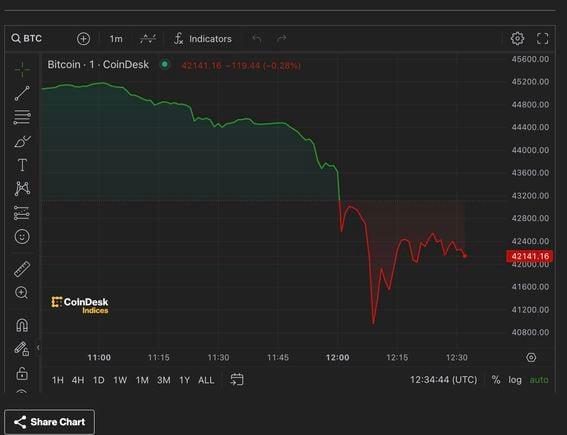
"SEC Chair Gensler is not embracing crypto in the U.S., and it might even be a very long shot to expect that he would vote to approve bitcoin spot ETFs," Matrixport said Crypto investment services provider Matrixport expects the U.S. Securities and Exchange Commission (SEC) to reject all applications to list a spot bitcoin exchange-traded fund (ETF) this month. "The current five-person voting Commissioners leadership critical for the ETF approval of the SEC is dominated by Democrats," wrote the firm in a note on Wednesday. "SEC Chair Gensler is not embracing crypto in the U.S., and it might even be a very long shot to expect that he would vote to approve bitcoin spot ETFs." "An ETF would certainly enable crypto overall to take off, and based on Gensler’s comments in December 2023, he still sees this industry in need of more stringent compliance," Matrixport continued. "From a political perspective, there is no reason to approve a bitcoin spot ETF that would legitimize Bitcoin as an alternative store of value." The widely-anticipated approval of a spot BTC ETF in the U.S. helped drive bitcoin to prices not seen since April 2022 as it closed 2023 up nearly 160% on the year. Matrixport estimates that of the extra $14 billion of fiat and leverage deployed into crypto since September, $10 billion might be related to ETF expectation. BTC is currently down nearly 7% on the day at $42.445, with the entirely of that decline coming in the space of a few minutes around 12:00 UTC. Galaxy Digital Head of Research Alex Thorn took serious issue with the Matrixport report, calling it "bewildering" and "nonsensical." Galaxy, in partnership with Invesco, is among the more than dozen firms who have applications with the SEC for a spot bitcoin ETF. Read More: Matrixport's $45K End of Year Target for Bitcoin Looks to Be Accurate Updated at 17:00 UTC: Includes reaction from Galaxy's Thorn. https://www.coindesk.com/policy/2024/01/03/bitcoin-spot-etf-proposals-to-be-rejected-by-sec-matrixport/

2024-01-03 12:41
Financial services company Matrixport said it expects the SEC to reject all ETFs applications this month. Bitcoin slid 8% on Wednesday as jitters around the anticipated approval of a spot bitcon (BTC) ETF began to enter the market. The slump retraced the entire upside move that occurred on Jan. 1, spurring the liquidation of $500 million worth of positions across derivatives exchanges. "The likelihood of the ETF's passage became less and less likely, and the market saw a stalemate," options analyst GreeksLive wrote on X. "Weakness in crypto mining stocks, and the sell-off in several crypto-related U.S. stocks, also reinforced the market's skepticism." Last week, Retuers reported that a bitcoin ETF could be approved as soon as "Tuesday or Wednesday," citing sources. Financial services firm Matrixport rebuffed optimistic expectations, saying: "We believe all applications fall short of a critical requirement that must be met before the SEC approves. This might be fulfilled by Q2 2024, but we expect the SEC to reject all proposals in January." Following a morning high of $45,500, bitcoin dropped to as low as $40,550 before bouncing back to $42,200. Open interest fell by $2 billion due to liquidations, the dwindling value of BTC and traders reducing exposure on both the long and short side. https://www.coindesk.com/markets/2024/01/03/bitcoin-slumps-as-400m-liquidated-in-two-hours/