2024-09-04 09:41
As the former Mt. Gox CEO launches his new exchange and ‘Ungox’ venture, he reflects on what he wishes he could have done differently a decade ago. SEOUL, SOUTH KOREA – As Mt. Gox wrapped up its bankruptcy redemption payments, it ended a nearly decade-long legacy, and the book is closed on what might be the greatest hack in all of crypto. Mark Karpeles, the failed exchange’s CEO, was once a hated man in the crypto community, and Japanese prosecutors wanted to send him away for a decade. But now, Karpeles belongs to an exclusive club of the 1% which have fought the law in Japan and won – something nearly unheard of in a country with a 99% conviction rate where the justice system prefers to coerce confessions rather than contest a case. Now, with all this behind him, Karpeles is off on a new adventure: launching a new crypto exchange called EllipX, which takes the best modern practices of exchanges and lessons learned from Mt. Gox as well as continuing work on a crypto ratings agency called Ungox. “I can say very confidently that Mt. Gox hack wouldn't have happened if we had even some of the tools we have today,” Karpeles said in an interview with CoinDesk at Korea Blockchain Week. Better crypto wallets One thing that Karpeles wishes he had during the heyday of Mt. Gox was hierarchical deterministic, or HD, wallets. HD is a type of wallet that securely manages and generates multiple public and private key pairs from a single master seed. Karpeles’ exchange was hacked because of stolen private, encrypted private keys and a transaction malleability exploit, which led to the loss of around 850,000 bitcoin (BTC) from the exchange's vulnerable hot wallets. "In retrospect, if we had tools like custodians and HD wallets, we wouldn’t have stored private keys on the servers,” he said. “We could have provided public seed access to an accountant for real-time monitoring of transactions, which would not only have prevented the Mt. Gox hack but also allowed us to detect suspicious activity much earlier." EllipX, Karpeles’s new exchange, will be set up like the New York Stock Exchange, with separate segmented groups handling trading, brokering and storing assets. Japanese crypto regulation The necessity of this sort of structure come from lessons learned in blood. Karpeles pointed out that Japan now has strict custodian rules for exchanges, hence why Japan was the safest place to be an FTX customer. "Before Mt. Gox, nobody in Japan knew what bitcoin was, but when the Mt. Gox bankruptcy happened, it was covered all over national TV. Despite having only 10,000 to 20,000 customers in Japan, the event was streamed live on every TV station and widely reported,” he said. “Along with the Coincheck hack four years later, these incidents led Japan to implement much stricter security rules and regulations for cryptocurrency exchanges," he continued. The final chapter of the Mt. Gox legacy was closed a few months ago as bankruptcy creditors were paid back. And while some thought this would lead to significant selling pressure on BTC and push down the price, the reality was the market digested everything calmly and quietly. “I think you're seeing a lot of OG buyers of bitcoin,” he said. “While some may have sold when they got their holdings back, most still believe in crypto and want to see where it’s going." So what does Karpeles think of the blockchain industry today? Too much centralization risk, and too many “bad projects”. "There are too many, I'm going to use the word 'bad' in a very large sense, because it could be either a scam project or just projects that don't bring anything new that stand out too much," he said. Karpeles said he wants to see a safer crypto world, where you can see a project, find it interesting, and buy into it without having to worry if it's a scam or not. “When people read about crypto, they see whatever thing was a scam, people lost money, and so on," he said. "It's always the same story.” https://www.coindesk.com/business/2024/09/04/mt-gox-wouldnt-have-happened-with-modern-tools-mark-karpeles/

2024-09-04 08:31
Miners earned an average of $43,600 per exahash a second in daily block rewards last month, the lowest rate on record, the report said. Bitcoin mining profitability is at a record low, the report said. The aggregate market cap of the U.S.-listed bitcoin miners tracked by the bank fell 15% last month, JPMorgan said. The bank noted that mining difficulty rose 9% from the previous month. Bitcoin (BTC) mining profitability is stuck at record lows, JPMorgan (JPM) said in a research report on Tuesday. "We estimate bitcoin miners earned an average of $43,600 per EH/s in daily block reward revenue in August, the lowest point on record," analysts Reginald Smith and Charles Pearce wrote. That compares with a peak value of $342,000 in November 2021, when the BTC price was $60,000 and the network hashrate was 161 EH/s. Mining stocks declined as the average price of the world's largest cryptocurrency fell for the third consecutive month and the network hashrate rose. Hashrate refers to the total combined computational power used to mine and process transactions on a proof-of-work blockchain. The total market cap of the 14 U.S.-listed miners tracked by the bank shrank 15% month-on-month to $20 billion, with only three of the miners outperforming bitcoin in the period, the report said. The network hashrate, a proxy for competition in the industry and mining difficulty, increased for the second straight month, the bank noted. "The network hashrate averaged 631 EH/s in August, up 16 EH/s from last month, and about 20 EH/s below prehalving levels," the authors wrote. JPMorgan noted that mining difficulty rose 9% last month, and is 4% higher than before the halving. There was a brief spike in transaction fees in August, to as much as 120% of the block reward, which is an "incremental positive" for the miners, the report added. The bank noted that bitcoin's annualized volatility rose to 62% in August, from 45% in July. https://www.coindesk.com/markets/2024/09/04/bitcoin-mining-profitability-is-stuck-at-record-lows-jpmorgan-says/

2024-09-04 08:29
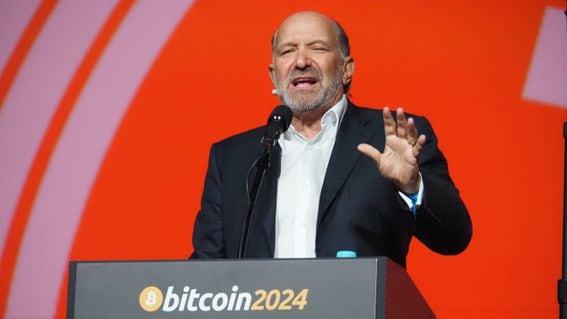
Howard Lutnick was picked by Donald Trump to chair his presidential transition team last month Howard Lutnick says banks want to transact in BTC as a new asset class but are being held back the existing requirements of U.S. regulators. "That's why they don't hold it. But if the regulatory environment was good, you will see all the traditional financial companies go head first into bitcoin," he said. Cantor Fitzgerald CEO Howard Lutnick has said traditional financial (TradFi) companies "want to transact in bitcoin" as a new asset class but are being held back by the existing requirements of U.S. regulators. Lutnick said in an X post on Tuesday that bitcoin (BTC) was an "outsider to the TradFi community [that's] only now dipping its toe into global finance." "If a bank were to hold your bitcoin, they would have to set aside their own money equal to that amount, sort of 'in jail'. That's why they don't hold it. But if the regulatory environment was good, you will see all the traditional financial companies go head first into bitcoin," Lutnick said. As well as being CEO of Cantor Fitzgerald, which unveiled its plans to open a bitcoin financing business in June, Lutnick was also picked by the pro-crypto Republican candidate Donald Trump to chair his presidential transition team. Cantor Fitzgerald, which owns a "s***load" of bitcoin, according to Lutnick, plans to launch its bitcoin financing business with $2 billion in lending, providing leverage to BTC holders. It already handles U.S. Treasury trading with stablecoin issuer Tether. Read More: Trump's New Crypto Business to Offer Access to 'High-Yield' Investments, Website Says https://www.coindesk.com/policy/2024/09/04/tradfi-companies-want-to-transact-in-bitcoin-says-cantor-fitzgerald-ceo/
2024-09-04 08:12
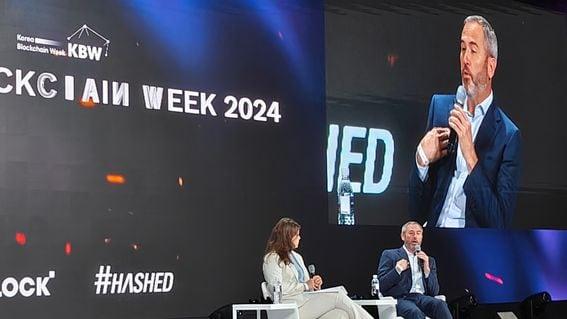
The RLUSD will be fully backed by U.S. dollar assets, tested with enterprise partners, and will operate on the XRP Ledger and Ethereum blockchain. Ripple is close to launching its U.S.-dollar pegged stablecoin, Ripple USD (RLUSD), with CEO Brad Garlinghouse indicating a launch timeline of “weeks.” RLUSD will be fully backed by U.S. dollar assets, tested with enterprise partners, and will operate on the XRP Ledger and Ethereum blockchain. SEOUL- Ripple Labs chief executive Brad Garlinghouse, at the ongoing Korea Blockchain Week on Wednesday, said that the company’s U.S.-dollar pegged stablecoin is close to issuance. “We will certainly launch soon. Weeks, not months,” Garlinghouse said at the event. “It’s called Ripple USD. RLUSD has been minted in that framework.” He stated that plans for the token were made after USD Coin (USDC), the second-largest stablecoin by market capitalization of $34 billion, lost its dollar peg in March, 2023. “We felt like there was an opportunity for a credible player already working with lots of financial institutions to lean into that market,” he said. Ripple first revealed its stablecoin plans in April, stating that the token would be "100% backed by U.S. dollar deposits, short-term U.S. government Treasuries and other cash equivalents.” It began testing the token in early August with enterprise partners. The stablecoin is scheduled to be deployed onto Ripple's institution-focused XRP Ledger and the Ethereum blockchain to start and will be based on Ethereum's ERC-20 token standard. Plans for the stablecoin come amid further boosts to the XRP Ledger network in the form of Ethereum-compatible smart contracts, which will let users build out on-chain exchanges and issue tokens, among other financial services, as they do on Ethereum. https://www.coindesk.com/business/2024/09/04/ripple-usd-stablecoin-could-be-issued-in-weeks-not-months-garlinghouse/
2024-09-04 07:36
The new index will help traders guage expected SOL price turbulence over two weeks. Volmex announces 14-day implied volatility index tied to SOL. More indices to be debuted in months ahead, Volmex said. Crypto derivatives protocol Volmex Finance unveiled a new implied volatility index for programmable blockchain Solana's SOL token on Tuesday. The index is a way to measure expected price swings in the world's fifth-largest cryptocurrency by market value. The SVIV index measures forward-looking 14-day expected volatility in SOL, Volmex said in an email to CoinDesk, adding traders can track the same to see the degree of potential SOL price swings (in either direction) over the following two weeks. Volmex said it would eventually debut longer-duration SOL implied volatility indices, including the widely-tracked 30-day gauge and derivatives linked to the same, allowing market participants to place bets on volatility. The so-called "vol trading" involves profiting from the degree of price fluctuations rather than the price direction. Traders use tools like options tied to the underlying asset and futures tied to volatility indices to bet on or hedge against volatility. Perpetual futures tied to Volmex's bitcoin implied volatility index (BVIV) and the ether index (EVIV) have been trading on Bitfinex since early April. Both indices gauge the 30-day expected volatility and have been adopted by institutions. Early this year, principal trading firm Arbelos Ltd and B2C2, an institutional liquidity provider for digital assets, completed the first bilateral option transaction on the BVIV index. https://www.coindesk.com/markets/2024/09/04/solanas-sol-gets-first-implied-volatility-index-on-volmex/

2024-09-04 05:21
BTC traded lower as weak U.S. manufacturing data revived growth concerns. The 11 U.S.-listed spot ETFs saw $287.8 million worth of outflows on Tuesday, according to Farside Investors. BTC traded lower as weak U.S. manufacturing data revived growth concerns. The U.S.-listed spot bitcoin (BTC) exchange-traded funds (ETFs) had a rough day on Tuesday as growth concerns and a sell-off in Nvidia (NVDA) dented market sentiment. The 11 ETFs registered a cumulative net outflow of $287.8 million, the largest single-day tally since May 1, when the funds bled over $500 million, according to data tracked by Farside Investors. Fidelity's FBTC led the outflows, registering $162.3 million in withdrawals. Grayscale's GBTC registered an outflow of $50.4 million and BITB and ARK lost $25 million and $33.6 million, respectively, with others accounting for the rest of the cumulative outflow. BlackRock's IBIT drew zero for the second straight trading day. Bitcoin's price fell over 2.7% to $57,500 on Tuesday, reversing Monday's bounce. The losses came after the U.S. ISM manufacturing PMI printed below 50, indicating a continued contraction in the activity in August. The data revived growth fears, weighing over risk assets, including cryptocurrencies. "A miss in the manufacturing PMI rehashed fears of an economic slowdown, with Nvidia leading the sell-off, losing 9.54%," crypto OTC liquidity network Paradigm said in a Telegram broadcast. At press time, BTC changed hands at $56,500, extending overnight losses and the futures tied to the S&P 500 traded 0.4% lower. https://www.coindesk.com/markets/2024/09/04/bitcoin-etfs-bleed-287m-largest-daily-outflow-in-four-months/