2024-09-04 01:52
U.S. stocks tracked by Nasdaq 100 and S&P 500 fell as much as 3.5% lower on Tuesday to kick off a historically bearish September month. BTC briefly fell to $55,500, its lowest since August 8, to reverse nearly all gains in the past month. The August reading of the Institute for Supply Management’s manufacturing index slumped for a fifth straight month with a rebound from July but remaining below the 50 threshold. Bitcoin (BTC) fell to its lowest level since early August in Asian morning hours Wednesday after steep losses in U.S. and Asian equity markets saw some major stocks tumble nearly 10%. BTC briefly fell to $55,500, its lowest since August 8, to reverse nearly all gains in the past month. The broader market tracked by CoinDesk 20 (CD20), a liquid index tracking the largest tokens by market capitalization, fell nearly 6%. Major tokens solana's SOL and ether (ETH) dropped over 7%, leading losses. U.S. stocks tracked by Nasdaq 100 and S&P 500 fell as much as 3.5% lower on Tuesday to kick off a historically bearish September month as weak manufacturing data reignited concerns over an economic slowdown. The move spread over to Asian markets as Japan's Nikkei slid more than 4% in the hours after opening - exacerbating tremors from last month's Yen carry trade unwinding. The August reading of the Institute for Supply Management’s manufacturing index slumped for a fifth straight month with a rebound from July but remaining below the 50 threshold. The index is a monthly gauge on the level of economic activity in the U.S. manufacturing sector and is considered to be a sign of the broader economy. https://www.coindesk.com/markets/2024/09/04/bitcoin-dives-under-56k-amid-us-japan-stock-market-rout/

2024-09-04 01:45
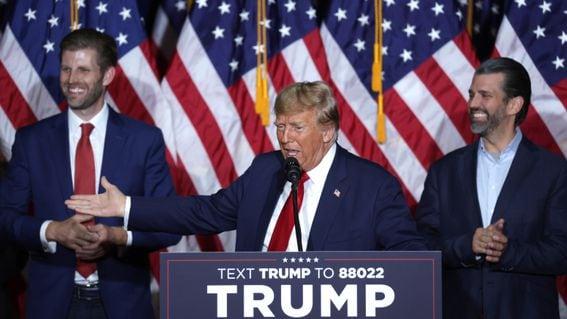
The incident comes hours after CoinDesk revealed details of the crypto project the Trump family has recently touted. The X accounts of Donald Trump's daughter-in-law and daughter were apparently hacked Tuesday evening to promote a token purportedly tied to World Liberty Financial, the upcoming crypto project touted by family members in recent days. Lara and Tiffany Trump, the wife of Eric Trump and daughter of Donald Trump, respectively, tweeted what they described as "the only official" blockchain addresses for World Liberty Financial. Lara Trump tweeted: Our goal at World Liberty ... is to utilize our governance token on Solana, $WL, to support our DeFi lending protocol." Not long after, Eric, the middle son of former President Trump, posted on X that the two profiles had been compromised and the addresses were a "scam." World Liberty Financial also tweeted: "ALERT: Lara's and Tiffany Trump's X accounts have been hacked. Do NOT click on any links or purchase any tokens shared from their profiles. We're actively working to fix this, but please stay vigilant and avoid scams!" This is at least the third time a token allegedly but apparently not really tied to Trump – who's curried the crypto industry's favor and votes over the past few months – has been launched. There was a DJT token, which convicted fraudster Martin Shkreli said was launched with Barron Trump, Trump's youngest child, and other developers. No one from the Trump family confirmed whether they had any ties to that project. Another, Restore the Republic, or RTR, also briefly hit a $155 million valuation before crashing. The hacks came hours after CoinDesk revealed details of World Liberty's plans, including the fact that it's a borrowing-and-lending DeFi platform that plans to issue a token called WLFI. The project does not have an official launch date, but the white paper indicated that Donald Trump, who is running for president a third time, will be the "chief crypto advocate." Eric, Donald Jr. and Barron Trump all have roles as well. https://www.coindesk.com/business/2024/09/04/trump-family-members-hacked-to-promote-apparent-crypto-scam/

2024-09-03 21:08
The migration to POL from MATIC will also bring in some tokenomics changes with a new emission rate of 2% annually. Polygon, a layer-2 network atop the Ethereum blockchain, will activate an upgrade on Wednesday that swaps out its longstanding MATIC token for a new POL token, allowing for more flexibility on issuance of new supply. While the planned switchover has been well-telegraphed, the changeover could be closely monitored, since the token is widely held across crypto investor portfolios; it's the 13th biggest by market capitalization in the CoinDesk 20 index of large digital assets, at about $3.8 billion. For many users, the swap will take place automatically. The migration comes as a part of the project's planned revamp laid out last year in its “Polygon 2.0” roadmap, to make POL the native token of its main chain, the Polygon PoS chain, as well as eventually other chains in its ecosystem. According to Polygon, in the initial phase of the migration, “POL replaces MATIC as the native gas and staking token for the Polygon PoS network. In subsequent phases, POL will serve a crucial role in the AggLayer.” The AggLayer is another staple in the roadmap, essentially a system for aggregating affiliated blockchains built using Polygon technology. Furthermore, the Polygon community has proposed that “POL will support broader roles in the Polygon staking hub (to be released in 2025), including block generation, zero-knowledge proof generation and participation in Data Availability Committees (DACs).” POL migration The migration from POL to MATIC will also bring in some tokenomics changes. Polygon shared that the token will have a new emission rate of 2% annually, where part of the supply goes to validators on Polygon PoS for rewards, and the other part to the community treasury, “a self-sustainable ecosystem fund that can support the above activities.” “The biggest reason why the upgrade was needed from a technical perspective, is that the MATIC upgrade keys were burned very intentionally years ago. Which basically means that we can't make changes to that token,” said Marc Boiron, CEO of Polygon Labs, in an interview with CoinDesk. “So one of the things that we wanted was to introduce emissions that way. We could use it for the community, we could use it for growth. It was literally impossible to do that otherwise.” Boiron reiterated that introducing emissions is supposed to help the Polygon community ecosystem by introducing a grants program as part of the community treasury, allowing them “some form of control by the community over the funds so that you can grow the ecosystem.” “And then the second one is a means for, effectively, validators to receive emissions,” Boiron added. “Effectively, if you think of these new chains that pop up, what's going to happen is that with time, they're going to want to decentralize. And so instead of just having a centralized sequencer, they're going to need to incentivize people to actually run a decentralized group or a decentralized prover. And if they don't have a token, or if they don't want to launch a token yet, how do they do that? Well, effectively, what this does is that a portion of that POL emissions can actually be used to decentralize their network, and then POL holders will then receive fees from that network.” https://www.coindesk.com/tech/2024/09/03/polygon-to-start-much-awaited-swap-of-pol-token-for-longstanding-matic/

2024-09-03 20:52
Four team members listed in World Liberty Financial's white paper previously worked on Dough Finance, which was drained of $2 million in July. One also founded Date Hotter Girls LLC. Donald Trump and his sons have for weeks teased an upcoming cryptocurrency project, but they've been light on details in public. Privately, though, the former U.S. president's inner circle has been quietly shopping around a white paper for World Liberty Financial – and CoinDesk has obtained excerpts. The document and other reporting describe a borrowing and lending service strikingly similar to Dough Finance, a recently hacked blockchain app built by four people listed as World Liberty Financial team members. Other participants include all three of Trump's sons (including 18-year-old Barron, who is identified as the project's "DeFi visionary"), financiers and e-commerce influencers. According to a person familiar with the plans, the project will also include a new cryptocurrency: WLFI, a non-transferable governance token. A transfer restriction could make the asset difficult for speculators to trade. World Liberty Financial "highlights the power of blockchain in an accessible way," according to the white paper. Though the app isn't ready for prime time, a review of a since-deleted codebase on GitHub shows that the project – at least in its early stages – appears to have lifted code directly from Dough Finance, which lost $2 million in July's hack. It has not been confirmed whether later iterations of the app contain such earlier code, and there is no indication that any vulnerabilities in the Dough Finance code appear in the new project's code. Zachary Folkman and Chase Herro – listed in the white paper as World Liberty Financial's head of operations and its data and strategies lead, respectively – built Dough Finance, a person familiar with the matter said. (Herro used to link to Dough Finance's Telegram group in his bio on the messaging app, according to a screenshot reviewed by CoinDesk.) Octavian Lojnita, the project's smart contracts lead, also previously worked on Dough Finance, according to his online resume. Boga, World Liberty Financial's pseudonymous front-end developer, is listed as an author (under 0xboga) in Dough Finance's source code. A limited liability corporation for World Liberty Financial is registered to Folkman, who, along with Herro, is the co-creator of Subify, which bills itself as a censorship-free competitor to both Patreon and OnlyFans – both services that let customers pay content creators, with the latter skewing toward explicit content. Folkman previously registered a company called Date Hotter Girls LLC and posted seminars on YouTube on how to pick up women. Herro, Folkman, World Liberty Financial and the Trump campaign did not respond to requests for comment. Details about Trump's foray into decentralized finance have been scarce up until now. Members of the Trump family teased that it was coming on social media, but they revealed little beyond the project's name. When it was first announced last month, it was called The DeFiant Ones. According to the white paper for the rebranded World Liberty Financial, the project will include a "credit account system" – built on decentralized finance (DeFi) platform Aave and the Ethereum blockchain – to facilitate decentralized borrowing and lending. Governance tokens like WLFI generally allow their owners to participate in the management of the crypto project. In this case, the platform's users "can suggest and vote on adding new DeFi lending markets or integrating new blockchains," according to the white paper. The white paper also says the product will feature an "easy-to-use interface for accessing WLFI as a 'smart account' or a brokerage." Previous efforts to create crypto brokerage services have seen mixed results. Companies like Voyager Digital, which offered brokerage services, fell into bankruptcy in 2022, costing customers significant chunks of money. More traditional financial firms have also made moves toward offering brokerage services to crypto clients, though they've so far refrained from getting deep into DeFi specifically. The team behind World Liberty Financial The project's figurehead is Donald J. Trump, who has taken the title of "Chief Crypto Advocate." His sons, Eric Trump and Donald Trump Jr. – who seem to be the driving force behind the project – are also involved as "Web3 Ambassadors." The project's leadership team also includes people who aren't in Trump's family. In addition to Folkman, Herro, Lojnita and Boga, the project's leadership includes long-time Trump friend and well-known property developer Steve Witkoff ("Institutional Investment") and his son Zach Witkoff ("Intelligence") and Alex Golubitsky ("Legal Counsel"). Golubitsky and his legal partner, Gabriel Shapiro, run the crypto governance advisory MetaleX Pro. The firm has disclosed it is receiving 1.3% of World Financial Liberty's upcoming token $WLFI. Folkman and Herro, who also goes by "Chase Hero," are longtime friends and business partners. In addition to their work with Subify, Herro and Folkman have operated so-called "mastermind groups" – essentially, private networking clubs with a steep price of entry – and sold online e-commerce courses. Herro has appeared as a guest on popular podcasts including YouTuber Logan Paul's podcast "Impaulsive," where he has discussed his past stints in prison for drug-related charges, and how he got rich as a "self-made businessman." Paul is currently being sued in a class action lawsuit accusing him of orchestrating a rug-pull with his failed CryptoZoo project. Court records show Herro owns a 34-foot boat called "Clickbait." According to data from Open Corporates, Folkman, under the alias Zack Bauer, formerly operated the pick-up artist advice platform "Date Hotter Girls" with another individual, Rob Judge. During his work with Date Hotter Girls, Folkman taught "masterclasses," including one on how to "Become the Ultimate Alpha Male." Beginning in 2015, Herro and Folkman started "The Watchers," a Facebook page and YouTube channel with 2,280 subscribers dedicated to providing information about cryptocurrency and advice about entrepreneurship. The last video was uploaded four years ago. Herro formerly operated a crypto trading firm called "Pacer Capital," which appears to no longer exist. Courting crypto voters The initiative is part of a significant shift for Trump, who during his presidency expressed skepticism toward digital assets and derided Bitcoin (BTC) as "based on thin air." Now, with a campaign promise to make the United States the "crypto capital of the planet," the former president is aiming to solidify his appeal with an industry that has accounted for more than half of all corporate campaign spending in this election cycle. It comes after the former president sold multiple waves of Trump-themed non-fungible tokens (NFTs), some of which gave purchasers raffle tickets to attend a dinner with him or similar rewards. He just released the fourth batch. Cryptocurrency companies have dumped $119 million into the 2024 election cycle, outspent only by the fossil fuel industry. Two of the top-10 corporate spenders in this election are Coinbase and Ripple, with Coinbase securing the No. 1 spot. The crypto industry has also made itself felt through targeted funding spent by Fairshake, a super political action committee, and its affiliated PACs, claiming 26 wins in the 2024 primaries. Trump and other Republicans have sought to argue that they will nurture the crypto industry, replacing unpopular regulators and allowing entrepreneurs to launch products without fear of lawsuits or subpoenas from agencies like the Securities and Exchange Commission. Democrats have been more split on the issue, with some prominent lawmakers like Sen. Chuck Schumer promising legislation to clarify the rules of the road but others remain hostile to digital assets. Vice President Kamala Harris, the Democratic nominee, has not said anything publicly about crypto or how she views the issue. Nikhilesh De contributed reporting to this story. https://www.coindesk.com/business/2024/09/03/inside-the-trump-crypto-project-linked-to-a-2m-defi-hack-and-former-pick-up-artist/
2024-09-03 16:22
Bitfinex suggested bitcoin could fall to as low as $40,000 in a bearish scenario. A 25 basis point Federal Reserve cut would be positive for markets, but a higher 50 point move would signal growing concerns of a recession and a deeper correction for risk assets, Bitfinex said in a report. A September price drop would present a buying opportunity with a seasonally strong period ahead, K33 said. Worn down by months of lackluster price action, crypto investors were looking forward to the Federal Reserve cutting interest rates in September as a catalyst for a bull move, but escalating recession fears could bring a deeper correction, according to analysts at Bitfinex. Bitcoin (BTC) could drop as much as 15%-20% following a September rate cut if the easing cycle is paired with a recession, wrote the team. That would translate to a bottom somewhere in the $40,000-$50,000 range. "Typically, rate cuts are perceived as bullish catalysts for risk assets," they wrote. "A 25 basis point rate cut would likely mark the beginning of a standard rate-cutting cycle, which could lead to long-term price appreciation for BTC as recession fears ease. Such a move would signal the Fedʼs confidence in the economyʼs resilience, reducing the likelihood of a severe downturn." Alternatively, a larger 50 basis point cut might result in a short-lived 5%-8% spike for BTC only to be erased by growing concerns of an oncoming recession and more pain for asset prices, Bitfinex added. "This would mirror past instances where aggressive rate cuts initially boosted asset prices, only for the gains to be tempered by rising economic uncertainties," the authors said. Seasonal effects aren't in bitcoin's favor either, they said, noting September is one of the weakest months of the year in crypto. Brighter months after September All the doom and gloom for the month ahead could present an attractive buying opportunity for investors with more favorable months coming after, crypto analytics firm K33 Research argued in a report. "Buying blood in September to build exposure for Q4 has historically been the best spot strategy," said Vetle Lunde, senior research analyst at K33. The period from October to April has been historically the strongest time for bitcoin. "An investor opting to buy the October open and sell the April close would have seen 1,449% returns since 2019, while a trader opting for the opposite strategy would have seen net negative returns," Lunde said There are also some positive catalysts for a strong year-end, the report added. The large selling pressure from various government entities and Mt. Gox have mostly abated, while about $14.5 billion of funds will be redistributed to FTX creditors later this year, with bulls hoping a part of that money will be reinvested in the crypto market. https://www.coindesk.com/markets/2024/09/03/bitcoin-could-drop-20-after-fed-rate-cuts-in-bearish-case-but-weak-september-presents-buying-opportunity-analysts/

2024-09-03 15:18
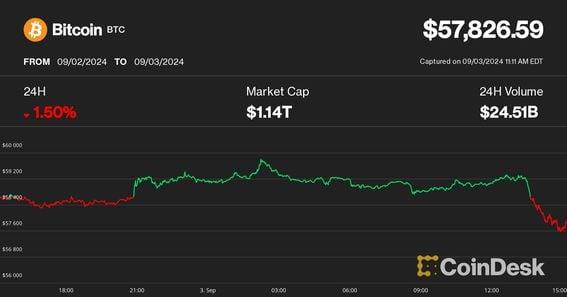
Seasonality suggests a hoped-for bounce after a rough August may not materialize. Bitcoin and ether fell sharply as U.S. stocks posted large losses in early Tuesday trade It's a big week for U.S. economic data and the first report showed weakness alongside an uptick in inflation pressure September has often proven to be a poor month for bitcoin prices Continuing what's become a firmly established pattern over the past few weeks, cryptocurrencies slid sharply lower early in the U.S. trading day. Ninety minutes after U.S. stock markets opened for trade following Monday's Labor Day Holiday, bitcoin (BTC) was down 1.5% to $57,800 while ether (ETH) was lower by 3% to $2,442, its weakest level since early February. The broad market gauge CoinDesk 20 Index was down only 1% as a handful of constituents were posting modest session gains, led by lumens {{XLMX}} and litecoin (LTC). The selling in crypto took place alongside a sizable slide in stocks, led by a 2.4% decline in the Nasdaq and a 1.5% fall for the S&P 500. U.S. August economic data begins to roll in This morning's ISM Manufacturing PMI report for August showed continued contraction, coming in at 47.2 versus 47.5 expected and July's 46.8. The guts of the report, however, had a stagflationish feel, with New Orders dipping to 44.6 from July's 47.4 while Prices Paid rose to 54.0 from 52.9. Following the soft numbers, traders have upped the odds of a 50 basis point Federal Reserve rate cut in September to 39% from 30% one day ago, according to CME FedWatch. The betting favorite, though, remains 25 basis points at 61%. The main event for U.S. macro news – and possibly the final arbiter on whether the Fed goes 25 or 50 – remains Friday's August employment report, and economists are forecasting job gains rebounding to 160,000 from July's soft 114,000 print. The unemployment rate is anticipated to have dipped to 4.2% from 4.3%. Seasonality suggests selling might continue After bitcoin's roughly 10% decline for the month of August, at least some were hoping for a September bounce, but that could prove wishful thinking. According to Galaxy Research chief Alex Thorn, bitcoin fell during seven of the last 10 Septembers. However, that data set contains some good news, said Thorn, as October has typically been bitcoin's best month of the year and the rest of the Fall has usually brought positive returns as well. https://www.coindesk.com/markets/2024/09/03/crypto-crumble-sends-bitcoin-below-58k-ether-to-7-month-low/