2023-12-13 19:10
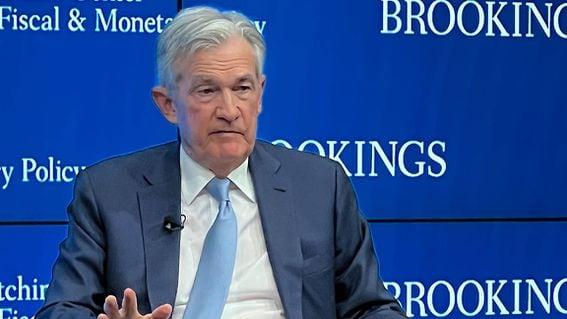
Market participants will look to Fed Chair Jerome Powell's post-meeting press conference for additional signs about the direction of future policy. The U.S. Federal Reserve as expected on Wednesday held its benchmark fed funds rate range steady at 5.25%-5.50%, but at the same time trimmed its rate outlook for year-end 2024 to 4.6% from 5.1%. "Tighter financial and credit conditions for households and businesses are likely to weigh on economic activity, hiring, and inflation," said the central bank's accompanying statement. "The extent of these effects remains uncertain." Alongside the interest rate announcement, the Fed also released its quarterly update of economic projections. The central bank now expects 2023 to end with a core inflation rate of 3.2% versus 3.7% expected three months earlier. The end rate for 2024 is now seen at 2.4% versus 2.6% previously. Real GDP growth for 2024 has been trimmed to 1.4% from 1.5%. The Fed now sees its fed funds rate ending 2024 at just 4.6% against 5.1% expected three months earlier, suggesting 75 basis points of rate cuts next year. The price of bitcoin (BTC) added just less than 1% to previous Wednesday gains, now higher by 2.2% to $42,370. A check of traditional markets finds rates tumbling, with the 10-year Treasury yield down 12 basis points to 4.08%, its lowest level since August. U.S. stock market averages have moved to session highs, the S&P 500 now up 0.6%. The price of gold is higher by just less than 1% to $2,013 per ounce and the dollar index is lower by about 0.5%. Fed Chair Jerome Powell will hold a post-meeting press conference at 2:30 pm ET at which market watchers will look for additional clues about the future path of monetary policy. Prior to today, markets overwhelmingly didn't expect any moves at the Fed's late January meeting, but nearly 50% anticipated a rate cut at the following meeting in March, according to the CME FedWatch tool. https://www.coindesk.com/markets/2023/12/13/federal-reserve-holds-policy-steady-but-indicates-more-dovish-2024/
2023-12-13 16:25
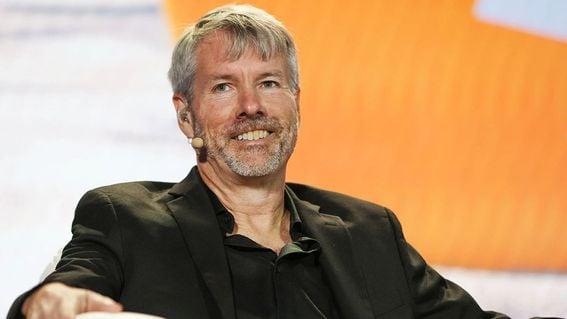
The new rules by the U.S. accounting standards setter would go into effect in December 2024. The Financial Accounting Standards Board (FASB), a U.S. entity that details how companies should report assets on their balance sheet, published a standards update on Wednesday that will let corporations recognize "fair value" changes in crypto holdings. The move will benefit companies with crypto on their balance sheets, like MicroStrategy (MSTR). Under the existing rulebook, companies have to report a loss if the crypto they hold is worth less than the purchase price, even if they haven't sold the assets. Under the new rules, companies will have to report the fair value, cost-basis and types of assets they're holding. Stakeholders providing feedback to FASB said the existing guidance did not provide useful information for investors or other parties, the update document said. "Accounting for only the decreases, but not the increases, in the value of crypto assets in the financial statements until they are sold does not provide relevant information that reflects (1) the underlying economics of those assets and (2) an entity’s financial position," the document said. The new rules were adopted unanimously by the board and will take effect after Dec. 15, 2024, the document said. A section explaining how FASB got to the point of adopting new guidance said it received a vast amount of feedback supporting a new approach to digital assets. "Stakeholders’ feedback, including respondents to the 2021 FASB Invitation to Comment (ITC), Agenda Consultation, indicated that improving the accounting for and disclosure of crypto assets should be a top priority for the Board," the document said. "Nearly 500 respondents to the 2021 ITC requested that the Board add to its agenda a project related to crypto assets." FASB has been working on updating accounting rules for crypto holdings over the past several months, with FASB indicating in September it would adopt the new guidance. Michael Saylor, MicroStrategy's founder and former CEO, previously tweeted that the move would make it easier for corporations to adopt bitcoin as a treasury asset, an argument he repeated Wednesday morning after the FASB guidance was released. Bitcoin's (BTC) price rose more than 1% after the guidance was released, trading around $42,150 as of press time. https://www.coindesk.com/policy/2023/12/13/fasb-confirms-fair-value-approach-for-corporate-crypto-holdings/
2023-12-13 15:58
USDT was assigned a low score of four, meaning the largest stablecoin is constrained in its ability to maintain its peg to fiat, the rating agency says. Credit rating agency S&P reveals new stablecoin ranking system that gives the biggest one, Tether's $90 billion USDT, a poor score. The system is designed to "evaluate a stablecoin's ability to maintain a stable value relative to a fiat currency," which is the core job of a stablecoin. Tether's $90 billion USDT, the world's largest stablecoin, was critiqued by S&P Global Ratings for being worse than rivals at doing its core task: being valued at $1. S&P, famous for its long history in bond and credit ratings, just introduced a system for evaluating stablecoins, which serve as a key piece of the cryptocurrency ecosystem by acting as a bridge between crypto and the conventional financial system. They serve as a stand-in for traditional currencies like the U.S. dollar or euro, and are linked to a fiat currency. (USDT is pegged to $1, others are pegged to 1 euro, etc.) When investors cash out of crypto investments, they can receive that in the form of stablecoins, rather than fiat currencies, and stablecoins are also used as a form of digital payment. The ratings agency's new Stablecoin Stability Assessment rates stablecoins on a 1 to 5 scale, aiming to "evaluate a stablecoin's ability to maintain a stable value relative to a fiat currency," according to S&P. A score of 1 means a given stablecoin is "very strong," while 5 means "weak." Tether's USDT, the most popular stablecoin, got a score of 4 (meaning "constrained"). The second-largest stablecoin, Circle Internet Financial's $24 billion USDC, got a 2 ("strong") – the best rating any stablecoin got, an assessment it shared with Gemini dollar (GUSD) and Pax Dollar (USDP). Stablecoin asset quality "The quality of the assets backing the stablecoin is a critical driver of the final assessment," S&P said in a statement introducing the system. "Weaknesses in other areas, including regulation and supervision, governance, transparency, liquidity and redeemability, and track record, contributed to those stablecoins with lower assessments." Whether this assessment from a stalwart of traditional finance will steer investment decisions is an open question. For highly regulated TradFi firms, a group accustomed to listening to the likes of S&P, USDC is already a more transparent option than USDT, as it provides more information about the makeup of its reserves and published more frequent reports on its holdings. On the other hand, users of USDT – and there are many – have already shown they don't really care by sticking with that stablecoin in the face of years of questions about the quality of the assets it holds to back USDT. If there are $90 billion of USDT in circulation, then there should be the same amount of assets stashed in something – preferably a safe, stable asset like cash or the equivalent. It has never published an official audit, but does release quarterly "attestations" that describe the assets it holds. Tether said that at the end of the third quarter, it had $86 billion of assets ($72.6 billion of which were U.S. Treasuries, widely considered among the safest investments in the world) backed $83 billion worth of USDT. Concerns were intensified when Tether and Bitfinex, its corporate sibling, agreed to pay $18.5 million in 2021 to settle allegations from New York state, which said: "Tether's claims that its virtual currency was fully backed by U.S. dollars at all times was a lie." 'Lack of regulation' Of Tether and USDT, S&P wrote: "Unlike some other issuers of stablecoins, Tether Ltd., which is incorporated in Hong Kong and wholly owned by British Virgin Islands-registered Tether Holdings Ltd., is not subject to regulation or supervision of an authoritative body. This contrasts with some stablecoin issuers that are subject to regulatory oversight by an authority, such as the New York State Department of Financial Services (NYDFS), and are required to follow rules set by the NYDFS' stablecoin guidance. We see the lack of regulation and/or supervision of USDT as a weakness." None of the eight stablecoins that S&P evaluated scored a 1. In addition to USDT, Dai (DAI) and First Digital USD (FDUSD) also got 4s. The lowest rank of 5 was assigned to TrueUSD (TUSD) and Frax (FRAX). "As we look to the future, we see stablecoins becoming further embedded into the fabric of financial markets, acting as an important bridge between digital and real-world assets," Lapo Guadagnuolo, a senior analyst at S&P, said in a statement. "Nonetheless, it's important to acknowledge that stablecoins are not immune to factors such as asset quality, governance, and liquidity." USDT is the third-biggest crypto after bitcoin (BTC) and ether (ETH), according to CoinGecko. Several stablecoins depegged from their intended value in March, when a banking crisis gripped the U.S. Circle's USDC sank to 87 cents, a harrowing moment for the crypto industry. Tether's USDT depegged, too, but not in the scary way S&P's report might imply was likely: It surged to $1.06 or so. Last month, the Bank for International Settlements – the global organization of central banks – said that most stablecoins have not managed to stay stable. To serve as a medium of exchange, stability is essential, the bank said. The BIS cited concerns over "transparency regarding the availability and quality of these reserves," an issue echoed by S&P. Tether had not responded to a request for comment by publication time. Nikhilesh De and Krisztian Sandor contributed reporting. https://www.coindesk.com/policy/2023/12/13/tether-scores-second-lowest-rank-in-sp-global-stablecoin-stability-assessment/

2023-12-13 15:39
The government's official rate is now 800 pesos to the dollar versus roughly 400 previously. Argentina's recently elected president devalued the nation's currency by more than 50% and announced spending cuts, but, possibly to the dismay of cryptocurrency enthusiasts, Javier Milei did not – yet, at least – turn his enthusiasm for bitcoin (BTC) into an official government policy. In slashing the peso's value to 800 per U.S. dollar from less than 400, Milei is mostly bringing the government's official valuation in line with that of private markets, where the peso lately has often traded at more than 1,000 to the dollar. Notably, though, the Milei administration has done nothing to lift the capital controls imposed by the previous government that allowed it to cap the official rate at about 400. Among the moves to lower government spending, the administration announced that contracts of less than a year will not be renewed, reduced subsidies for public transportation, electricity, gas and water, and canceled government advertising for one year. The moves drew praise from the International Monetary Fund (IMF), with Managing Director Kristalina Georgieva saying she welcomed the "decisive measures," calling them "an important step toward restoring stability and rebuilding the country's economic potential." The IMF praise is sure to raise the antennae of bitcoin fans who hoped the libertarian Milei might prove friendly to BTC and perhaps even go as far as pushing to make it legal tender in that country. "The central bank is a scam," said Milei earlier this year. "What bitcoin is representing," he continued, "is the return of money to its original creator, the private sector." A year and a half ago, Argentina borrowed $45 billion from the IMF with one of the stipulations being that the government take steps "to discourage the use of cryptocurrencies with a view to preventing money laundering, informality and disintermediation." https://www.coindesk.com/markets/2023/12/13/argentinas-milei-so-far-shunning-bitcoin-devalues-peso-by-more-than-50/

2023-12-13 14:00
World ID has added integrations with Shopify, Minecraft, and Reddit alongside a slew of developer-focused updates that could expand the OpenAI founder's blockchain-based "proof-of-personhood" service to more users. Worldcoin, the crypto startup co-founded by OpenAI CEO Sam Altman, announced a major expansion to its eye-scanning identity platform on Wednesday, including integrations with major tech firms and a new multi-level verification system for the World ID "digital passport." Tiago Sada, the head of product at Tools for Humanity, the company behind Worldcoin, said in an interview that World ID 2.0 marks a "monumental upgrade" for the protocol that combines "ideas that were originally laid on the white paper" with "feedback that we've heard from developers." Sada said Worldcoin will begin offering on-site onboarding into its proof-of-personhood service in Singapore and Mexico. Additionally, he said the protocol has added integrations with Shopify, Mercado Libre, Reddit, Telegram, and Microsoft's Minecraft among others. The integrations could eventually enable some users to log in to these services using a World ID. The 2.0 upgrade will help these companies by making it "easier to distinguish between bots and verified humans online," Tools for Humanity said in an emailed statement. An eyeball-scanning orb It's impossible to talk about Worldcoin without mentioning the orb – the retina-scanning sphere that one must peer into in exchange for a World ID passport. A basketball-sized chrome globe, the device scans eyeballs to authenticate first-time users. It does this to guarantee that all World ID-holders are verifiably unique, which could prove useful for online services looking to suss out bots from real humans in the increasingly uncanny age of AI. The eerie intimacy of Worldcoin's chosen authentication method has sparked concerns about user privacy: For a vocal corner of the privacy-obsessed, anti-corporate blockchain industry, the idea of handing one's biometric data to a shiny metallic orb built by a Silicon Valley startup has inevitably rung dystopian. But Tools for Humanity says Worldcoin doesn't save its eye scans and only uses them for first-time authentication of users. Tools for Humanity also pitches the World ID service as a more privacy-preserving alternative to traditional authentication systems. World ID holders can "verify to an app or service that they are human without disclosing their identity," Tools for Humanity said in its statement. On Reddit, for example, the moderators of a subreddit can use World ID to "give people that have been verified as humans specific roles or special permissions," said Sada. Or on Shopify, merchants that give out discount codes can use World ID to "make sure that you only get that discount once," he added. With World ID 2.0, "new verification levels" have been added to accommodate users who opt to give different amounts of verification data. In addition to the standard orb-based World ID, a new base-level World ID forgoes the retina scans and allows users to authenticate themselves on their own devices. This lower verification tier can help expand IDs to people without access to an orb authentication site, and it can be used to sign into apps with less stringent proof-of-personhood requirements. On the opposite end of the verification spectrum will be another new – and stricter – tier called Orb Plus. App-makers can identify users using this option if they want orb-authenticated users to re-verify themselves on-device each time they sign in with a World ID. Altman's OpenAI ouster Tools for Humanity says "nearly five million people" have scanned their eyes in exchange for World IDs since Sam Altman unveiled the orb in 2021. The number "includes more than 1% of the population of Chile, 1% of the population of Argentina, and more than 2% of the population of Portugal," said Sada. Worldcoin's main product today is a crypto wallet app that anyone can use, and which offers special access to verified ID-holders. Sada says Altman remains actively engaged in major product and strategy decisions at Worldcoin, and he claims he learned of the AI luminary's surprise firing and rehiring from OpenAI on the news like everyone else. That debacle sparked public speculation around Altman's commitment to AI safety – one of the founding principles upon which OpenAI and Worldcoin were both founded. "Sam has clearly been at the middle of the spectrum" between techno-optimism, which seeks to accelerate the development of technology like AI, and effective altruism, which is more concerned with AI's existential risks, remarked Sada. "If anything, he's more on the safety side." "Worldcoin was started because the world is changing, and we need the tools to make the most of this new era," said Sada. Correction (Dec. 13, 16:56 UTC): The companies that have integrated World ID are not "partners," as originally written. The subhead has been updated to clarify this distinction further. https://www.coindesk.com/tech/2023/12/13/sam-altmans-retina-scanning-orb-to-become-more-useful-with-world-id-20/

2023-12-13 11:41
Both exchanges lost a combined total of more than $200 million in a series of hacks last month. Crypto mogul Justin Sun has said that assets held on HTX and Poloniex are “100% safe” after last month’s hack that saw more than $200 million siphoned out of both exchanges. Both exchanges have opened withdrawals for certain assets, although several altcoins remain locked. Bitcoin (BTC) and Tron (TRX) are the two digital assets that could be withdrawn; this led to both tokens trading at a premium on Poloniex over the past few weeks, which meant users would have to take a haircut of up to 10% to liquidate their asset and withdraw another. The withdrawal freeze came after hackers stole $114 million out of Poloniex’s hot wallets on Nov. 10; this was followed up by $97 million being stolen from HTX and blockchain protocol Heco Chain. “Right now, Poloniex and HTX have recovered from the hack, and we are resuming the tokens one by one,” Justin Sun, an investor in Poloniex and an advisor for HTX, told CoinDesk. “I think for HTX, we have already resumed 95% in terms of USD worth of assets. On Poloniex, we have resumed around 85% in terms of the USD value of the assets.” “And also be aware, since we have already covered all of the loss of tokens in the platform, on HTX and Poloniex, 100% of assets are 100% safe,” Sun added. “Even though in terms of exchanges itself, we need to basically earn those profits in the future. But for customer assets, it’s 100% safe.” An HTX spokesperson told CoinDesk, “The recent outflow represents a small fraction of our total reserves, and HTX remains in stable, healthy operation.” To remedy the fears of users holding funds on both exchanges, HTX and Poloniex have announced an airdrop valued at $1 worth of tether (USDT). A snapshot will be taken, and users will receive one airdropped token for every U.S. dollar worth of tokens they hold on the exchange. HTX has facilitated $1.6 billion in trading volume over the past 24 hours; Poloniex, meanwhile, has racked up $843 million, according to CoinMarketCap. Justin Sun became a significant player in the crypto industry when he founded the Tron blockchain, which raised $70 million in a 2017 initial coin offering (ICO). Tron is now the 11th largest cryptocurrency with a market cap of $9.1 billion; it is also the second largest blockchain in volume, with $7.9 billion in total value locked (TVL). Sun’s rise to success with Tron came alongside regulatory scrutiny; the Securities and Exchange Commission (SEC) filed a lawsuit against Sun, alleging that TRX was a security earlier this year. Sun’s legal team was granted an extension to respond to that lawsuit earlier this week, according to court documents obtained by CoinDesk. https://www.coindesk.com/business/2023/12/13/htx-poloniex-assets-are-100-safe-says-justin-sun-after-200m-hack/


