2024-09-03 14:23
The developer of Ethereum layer-2 protocol ZKsync said builders using the protocol now need a "different type of technology and support." Matter Labs laid of 16% of of its team, which could amount to more than 30 people. "We went through a large org planning exercise, and it became clear that the talent and roles we have today do not perfectly match our needs," CEO Alex Gluchowski wrote. Matter Labs, the main developer behind the Ethereum layer-2 protocol ZKsync, laid off 16% of its employees as part of a restructuring to adapt to "the different type of technology and support" developers building on system now require, CEO Alex Gluchowski said in a post on X. "We went through a large org planning exercise, and it became clear that the talent and roles we have today do not perfectly match our needs," Gluchowski wrote in his Tuesday post. Matter Labs may have as many as 200 employees according to its LinkedIn profile, so the layoffs could amount to more than 30 people. ZKsync is jostling for market share in the crowded field of Ethereum layer-2 networks, protocols built atop the main blockchain that provide an alternate venue for transactions to be settled, with the goal of doing so faster and cheaper. The proliferation of layer 2s may indicate that the sector needs to be reframed and looked at through a use case-specific lens, Gluchowski suggested in a recent interview with CoinDesk. Matter Labs released its Elastic Chain in June to tackle fragmentation between this multitude of layer 2s by enabling them to plug into its interoperability layer. "I think that we will not need too many general purpose layer 2s, but we do need some application specific L2s or community specific L2s,” he said in the interview. "We have projects launching on the Elastic Chain that are just gaming chains, which does not really need to be sharing infrastructure block space with DeFi or financial applications.” The protocol's ZKSync (ZK) token has dropped 3.14% in the past 24 hours according to CoinGecko, while ether fell 2.9%. The broader market, as measured by CoinDesk 20 Index (CD20), declined 1.5%. ZK has lost about 64% of its value since its June debut. https://www.coindesk.com/business/2024/09/03/matter-labs-restructures-lays-off-16-of-team/
2024-09-03 13:01
The loudest critics of BitGo’s deal with Justin Sun-affiliated BiT Global also want to see their ‘number go up.’ BitGo's CEO Mike Belshe defended a recent partnership with BiT Global involving wrapped bitcoin, that has been criticized by some for its proximity to Tron founder Justin Sun. "There is no doubt that the model that BitGo is proposing, how we're going to store the keys, is far superior to anything that Coinbase can or would concoct," he said. The deal with BiT Global is about enhancing security and expanding in Asia, using a model that separates key custody across multiple institutions to eliminate single points of failure, despite concerns about Sun's involvement. SEOUL, SOUTH KOREA – BitGo’s move to sign a deal with BiT Global, a Hong Kong-based crypto custodian that’s partially owned by Tron’s Justin Sun has received its share of criticism from the crypto community. However, in an interview with CoinDesk during Korea Blockchain Week, BitGo’s CEO Mike Belshe says that this criticism is missing one thing: intellectual honesty. Threshold – one of the loudest critics of the BitGo-BiT Global tie-up – recently proposed to merge its BTC wrapper, tBTC, into Wrapped Bitcoin (wBTC) to address concerns over what it calls wBTC's shift in control. “They’ve even said publicly that if they had all of Wrapped Bitcoin’s market share, their token's value would be 35 times higher. I understand that they want their token to go up, but we’re facing attacks from every tBTC holder who wants to see that happen,” Belshe said. “Let’s be intellectually honest here: criticizing our efforts to decentralize Wrapped Bitcoin just to boost their token’s value is beyond ridiculous." As for Coinbase, which recently teased its own competitor of wrapped bitcoin called cbBTC on the Base blockchain, Belshe said it would go against the ethos of decentralized finance (DeFi) if cbBTC gained a following, and if the “DeFi community picks central bank Coinbase as the ultimate steward, then I think all DeFi hope should be lost.” "Of course, the central bank, CB, Coinbase, they also would love to have Wrapped Bitcoin under their belt," he said. "There is no doubt that the model that BitGo is proposing, how we're going to store the keys, is far superior to anything that Coinbase can or would concoct." Belshe emphasizes that many of the loudest critics don’t understand the legal structure of BiT Global. Registered as a licensed Trust or Company Service Provider (TCSP) in Hong Kong, the company has a fiduciary duty – just like BitGo – to the Wrapped Bitcoin DAO to ensure the security of the bitcoin in its custody. "We are a fiduciary today, and it’s our duty to ensure that the assets are protected, regardless of where they are held," he said. So then, why do this deal in the first place? The deal is about, he explains, “eliminating single points of failure" and expanding its footprint in Asia. "We use deep cold storage, separating keys across multiple people, he said. “And now we're taking it a step further by separating them across multiple institutions." Belshe said he knows Justin Sun is a “colorful character,” but he emphasized the importance of transparency: "Most companies wouldn't have even mentioned his name, but we did. Why? Because transparency matters." He wanted the community to "digest it, scrutinize it, and propose alternatives," ensuring trust by openly sharing all aspects of the partnership. And it looks like this move paid off. Despite an initial huff-and-puff by elements of the MakerDAO community, on-chain data shows that there hasn’t been a significant exodus out of wBTC via burns. "It’s not like a 'why Sun' type of thing. It’s about who is a qualified custodian that can receive these assets," he continued. And that qualified custodian just happens to be in Justin Sun’s portfolio. But it's a portfolio company he can’t control by its very design. https://www.coindesk.com/business/2024/09/03/bitgo-ceo-says-wrapped-bitcoins-critics-arent-being-intellectually-honest-about-their-concerns/
2024-09-03 12:05
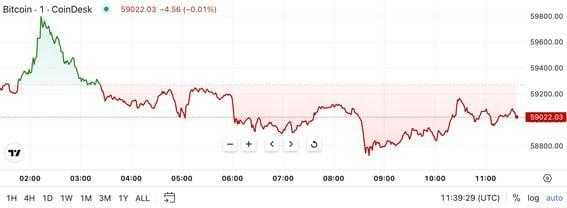
The latest price moves in crypto markets in context for Sept. 3, 2024. Latest Prices CoinDesk 20 Index: 1,857.87 +0.73% Bitcoin (BTC): $59.022 +0.84% Ether (ETH): $2,506 −0.53% S&P 500: 5,648.40 +1% Gold: $2495.38 −0.07% Nikkei 225: 38,686.31 −0.04% Top Stories Bitcoin rose above $59,000, though the rally was pared by suggestions of further interest-rate increases in Japan. Still, BTC remains 1% higher in the last 24 hours while the broader crypto market has risen around 0.9%, according to the CoinDesk20 Index. A slew of U.S. economic data is due this week, kicking off with the Institute of Supply Management's manufacturing purchasing managers' index for August later on Tuesday. A weak reading will strengthen the case for the Fed to cut interest rates, which would be expected to boost riskier assets like crypto. Bank of Japan Governor Kazuo Ueda reiterated that the central bank will raise interest rates further if the economy and inflation develop as expected. Ueda said the economic environment remains accommodative, with inflation-adjusted interest rates negative even after a late July increase in the benchmark borrowing cost. That was the first in decades and triggered an unwinding of yen carry trades, destabilizing risk assets. Ueda's comments drew bids for the yen, pushing the USD/JPY pair to 145.85 from 147. Futures tied to the S&P 500 slipped by 0.5% and bitcoin by 0.4% to $58,920, according to CoinDesk data. The BOJ's plan to tighten monetary policy poses a challenge for risk assets because the U.S. Federal Reserve is likely to start cutting rates in September. Japanese investment adviser Metaplanet, which adopted bitcoin as a reserve asset earlier this year, tapped SBI VC Trade to provide custody services. Crypto exchange SBI VC Trade, a unit of Tokyo-based SBI Holdings, offers the potential to use BTC as collateral for financing, Metaplanet said on Monday. In May, Metaplanet said it was adopting bitcoin as a reserve asset to hedge against the volatility of the yen. As of Aug. 20, it held 360.4 BTC ($21 million). The reserve-asset strategy mimics software developer MicroStrategy, which has been buying bitcoin since 2020 and now holds over 226,000 BTC, more than 1% of all the bitcoin that will ever exist. Chart of the Day The chart shows weekly open-interest adjusted cumulative volume delta (CVD) in the top 25 cryptocurrencies by market value. XMR and APT have positive CVDs, a sign of net inflows into the perpetual futures market tied to the two coins. The remaining cryptocurrencies, including BTC, have faced net selling pressure. Source: Velo Data - Omkar Godbole Trending Posts ‘Why Are You Doing This To Me?’: Detained Binance Exec Begs Prison Guard for Help in New Court Footage WazirX Hacker Starts to Move Stolen Ether Using Tornado Cash Brevan Howard-Backed Tokenization Firm Libre Arrives on NEAR Blockchain https://www.coindesk.com/markets/2024/09/03/first-mover-americas-bitcoin-gain-checked-by-hints-of-further-boj-rate-rises/
2024-09-03 12:01
The contracts will exist on a sidechain built on XRPL, developers said in a Tuesday post. Ripple will add Ethereum-compatible smart contracts via a new sidechain to XRP Ledger, expanding its functionality beyond basic transactions. This development includes using the Axelar network for cross-chain token transfers, with wrapped XRP (eXRP) acting as the primary token on this sidechain. Ripple is enhancing the XRP Ledger by integrating Ethereum-compatible smart contracts via a new sidechain, expanding its functionality beyond basic transactions to include complex applications like decentralized exchanges and token issuance. This development includes the use of the Axelar network for cross-chain token transfers, with Wrapped XRP (eXRP) acting as the primary token on this sidechain, facilitating broader interoperability and developer engagement. Ripple will soon add Ethereum-compatible smart contracts to the XRP Ledger using sidechain networks in a move that boosts the fundamentals of the closely related XRP token. Smart contracts are programs that automate the actions required in a blockchain transaction, allowing for features beyond mere transactions, such as issuing tokens, processing trades, and creating decentralized exchanges and financial applications. “Progress towards smart contract functionality is already underway in the XRP Ledger ecosystem with the XRPL EVM sidechain,” Ripple said in a release Monday. “This sidechain will bring Ethereum Virtual Machine (EVM) compatibility to the XRP community, allowing developers to employ familiar tools and programming languages, thereby broadening the XRP Ledger’s appeal to a global developer community.” XRP Ledger is an open-source blockchain network that uses xrp tokens to process and record financial transactions. Ripple first started testing a way for developers to deploy smart contracts made for Ethereum on the XRP Ledger (XRPL) blockchain in 2022. Ethereum Virtual Machine (EVM) is the software that runs smart contracts on Ethereum. A sidechain is a blockchain that runs parallel to a main blockchain (XRP Ledger in this case). The XRPL EVM sidechain will use the crypto bridging service Axelar to allow users to transfer tokens between itself and 55 other blockchains. Wrapped XRP (eXRP) - a representation of XRP on other networks - will serve as the native asset and gas token on the sidechain. https://www.coindesk.com/markets/2024/09/03/ripple-will-soon-add-ethereum-compatible-smart-contracts-to-xrp-ledger/
2024-09-03 11:54
Uyeda said the U.S. agency can work with crypto firms to figure out how to differentiate S-1 forms for digital assets. The SEC should create a version of the S-1 form for registering securities that's tailored to digital assets, said SEC commissioner Mark Uyeda. Uyeda has been one of the few supporters of the crypto industry in the agency, in stark contrast to SEC Chair Gary Gensler. SEOUL — The U.S. Securities and Exchange Commission (SEC) should create a special version of the S-1 form for digital assets, SEC commissioner Mark Uyeda said at the Korea Blockchain Week in Seoul, South Korea. The agency's current form, the primary application companies must fill out to register securities in the U.S., does not do justice to digital assets and other unusual financial products, Uyeda said. The regulator has not done enough for digital asset products looking to register in the country, he said. Uyeda has been one of the few supporters of crypto in the agency, in stark contrast to SEC Chair Gary Gensler who has been a vocal opponent of the industry. Uyeda noted that the regulator can work with crypto companies to figure out what parts should be added or removed from the present version. https://www.coindesk.com/policy/2024/09/03/sec-commissioner-mark-uyeda-calls-for-s-1-form-tailored-for-digital-assets/
2024-09-03 11:34
Companies can now apply for a license to become token service providers. Qatar has gone from banning crypto in 2018 to introducing a crypto regulations framework this month. The framework includes recognition of smart contracts, licensing for crypto companies, property rights in tokens and custody arrangements among other issues. Qatar introduced a regime to regulate digital assets, opening the way for companies to obtain licenses as token service providers and help develop the country's digital financial economy. The Qatar Financial Centre (QFC), which provides legal services for local and international companies, brought in the Digital Asset Regulations 2024 to establish the "legal and regulatory foundation for digital assets, including the process of tokenization, legal recognition of property rights in tokens and their underlying assets, custody arrangements, transfer, and exchange," it said Sunday. The framework, which also legally recognizes smart contracts, marks a shift from an earlier policy typified by a 2018 ban on crypto. Qatar began a public consultation process last year and regulation was expected by the end of the year. "We anticipate that this regulatory clarity will attract both domestic and international players, boosting Qatar’s financial services sector competitiveness," said QFC CEO Yousuf Mohamed Al-Jaida. The regulation is the result of discussions with stakeholders, coordinated through an advisory group of 37 domestic and international organizations. More than 20 startups and fintech firms have taken part in tests that began in October 2023 to help develop the framework. "As compared to other Middle Eastern countries, Qatar’s approach is notably advanced, offering a more structured and clear regulatory environment," said Navandeep Matta, a senior associate at Kochhar & Co. Legal. "This positions Qatar at par with the UAE’s Digital Assets Framework, establishing a robust regulatory regime that aligns with international best practices." https://www.coindesk.com/policy/2024/09/03/qatar-brings-in-crypto-rules-framework-in-a-sign-of-web-3-development-in-the-middle-east/