2023-11-16 10:40
The founder of Terraform Labs was sentenced to four months in prison, and faces extradition following the completion of his sentence. A Montenegro High Court has denied Terra founder Do Kwon's appeal of a four-month prison sentence over charges of falsifying documents, according to a Thursday statement. The High Court "rejected as unfounded the appeals of" a lower court judgment, which sentenced Korean citizens Kwon and fellow Terra executive Han Chang-Joon back in June. The founder of the crypto enterprise was arrested along with his associate in Montenegro in March nearly a year after the dramatic collapse of his crypto empire Terraform Labs. The two have remained in custody since their arrest, and Kwon faces extradition to South Korea or the U.S. once his sentence in the Balkan nation is complete. The four-month prison sentence is "adequate" punishment for the crime committed, a statement from the Basic Court of Montenegro capital Podgorica said. "The imposed security measure of confiscation of the objects of the commission of the criminal offense - passports and identity cards - was necessary in order to arrest the perpetrators. prevented them from committing criminal acts in the future," it added. https://www.coindesk.com/policy/2023/11/16/do-kwons-appeal-in-fake-passport-case-denied-by-montenegro-high-court/

2023-11-16 09:10
Options market positioning and dovish Fed expectations indicate the path of least resistance is on the higher side. Bitcoin will reach $40,000 – if not even $45,000 – by the year’s end, DeFi Research’s Markus Thielen said. Thielen explained that options market flows and dovish Fed expectations are likely to power the cryptocurrency higher into the year’s end. Bitcoin’s (BTC) bullish momentum will likely remain intact heading into the end of the year, lifting prices to the $40,000 mark, according to Markus Thielen, research head at crypto services provider Matrixport and founder of analytics portal DeFi Research. “Bitcoin will reach $40,000 – if not even $45,000 – by the year’s end,” Thielen said in a note shared with CoinDesk, citing options market positioning and dovish Federal Reserve (Fed) expectations as catalysts for continued price gains. The cryptocurrency has more than doubled this year, with prices rising nearly 40% in the past four weeks alone. The recent bullish action spurred demand for call options or derivatives, giving the purchaser the right to snap up the underlying asset at a predetermined price later. Per Thielen, the increased demand for the so-called bullish bets has left some market participants, mainly market makers, who are always on the opposite side of clients’ trades, exposed to continued upside in cryptocurrency. These entities will likely buy BTC and hedge themselves as prices rise, adding to bullish pressures around the cryptocurrency. “We have two colossal options expiries on Nov. 24 and Dec. 29 with $3.7bn and $5.4 billion open interest outstanding. There are 85% more calls outstanding than puts, with the 40,000 strikes having the most significant open interest. The closer we get to $40,000, the more people will have to buy bitcoin to hedge themselves,” Thielen noted. “There will be a broad interest in pushing prices to this $40,000 level. The odds are high that we reach this level,” Thielen added. At press time, bitcoin was changing hands at $37,445. Another factor supporting the bullish case is the receding U.S. inflation rate and hopes for rate cuts or liquidity easing by the Fed. The Fed rates by 525 basis points in 14 months to May 2023 to tame rampant inflation. The Fed’s rapid liquidity tightening disincentivized investing in risky assets and was partly responsible for last year’s crypto crash. The inflation rate, however, has markedly slowed in recent months, having reached as high as 9.1% in June last year. Data released Tuesday showed the U.S. CPI climbed 3.2% in the 12 months through October, following September’s 3.7% rise. Per UBS, slowing inflation means the Fed could halve the benchmark interest rate to 2.75% from the present range of 5.25% to 5.5%. Per the Fed funds futures, markets have priced in 90 basis points of rate cuts by the end of 2024. “The U.S. inflation headline CPI is currently at 3.2% while interest rates are at 5.25% – a difference of 2.0%. If our inflation model is current, then this spread would even be 3.0% – so we could expect 200 basis points of rate cuts next year. This is bullish,” Thielen said. Thielen expects inflation, as measured by the consumer price index (CPI), to drop below the Fed’s 2% target in 2024. Lastly, the spot ETF optimism could continue to support price gains. According to Bloomberg’s analysts, there is a 90% chance the SEC will approve one or more spot ETFs before Jan. 10. Read: Crypto Market Sees Net Capital Inflow for First Time in 17 Months https://www.coindesk.com/markets/2023/11/16/bitcoin-could-reach-45k-by-year-end-analyst-says/

2023-11-16 05:38
Ravi Menon, the Managing Director of the Monetary Authority of Singapore, said crypto has performed poorly as a medium of exchange or store of value. Stablecoins and central bank digital currencies (CBDCs), not crypto, will be part of the financial ecosystem in the future, the managing director of Singapore's central bank said during his keynote at the Singapore Fintech Festival. "There are four contenders for digital money," Ravi Menon said, naming them as privately issued cryptocurrencies, CBDCs, tokenized bank liabilities, and well-regulated stablecoins. But in Menon’s opinion, cryptocurrencies have failed the test of digital money because "they have performed poorly as a medium of exchange or store of value, their prices are subject to sharp speculative swings, and many investors in cryptocurrencies have suffered significant losses." Bitcoin (BTC) is up 121% this year, outperforming the S&P 500 and NASDAQ. The Monetary Authority of Singapore (MAS), he said, views well-regulated stablecoins as a promising digital currency complementing CBDCs and tokenized bank liabilities. During the speech, Menon listed StraitsX’s stablecoin and Paxos Digital's new USD-pegged stablecoin as examples. While Singapore has a reputation as a crypto hub in Asia, regulators would much rather prefer the nation be known as a digital assets hub, something which Menon emphasized in his speech by highlighting ways the technology can be used aside from crypto speculation. Menon mentioned how Project Guardian, led by MAS and industry partners, is tokenizing foreign exchange, bonds, and funds to enhance global liquidity, streamline cross-border transactions, and improve operational efficiency in financial markets, with trials by major global banks. “A larger vision that is emerging is of a network of interoperable systems that allows payment, clearing, and settlement to take place instantaneously and seamlessly,” he said. “Digital assets have two critical features that can fundamentally transform the nature of financial transactions.” A Singapore-Led Layer 1 Existing digital asset networks, Menon said, including public permissionless blockchains and private permissioned blockchains, face challenges such as lack of accountability, legal uncertainty, and interoperability issues, limiting their suitability as a global digital asset infrastructure. In response to this, the Monetary Authority of Singapore (MAS) is launching the Global Layer One (GL1) initiative. "GL1 is conceived as a global public good," Menon said. "It will facilitate seamless cross-border transactions and enable tokenized assets to be traded across global liquidity pools while meeting relevant regulatory requirements." GL1 is part of Singapore's push to ensure that FinTech has a "larger purpose", Menon said, emphasizing that FinTech should be focused on solving real-world problems and improving people's lives. “Together, digital assets, digital money, and a foundational digital infrastructure can help realize the vision of seamless financial transactions across the world,” he said. https://www.coindesk.com/markets/2023/11/16/cryptocurrencies-have-failed-the-test-of-digital-money-mas-managing-director-says/

2023-11-16 05:30
The fund snapped up COIN at an average price of $70.5 in the third quarter, achieving a 40% profit from investment. South Korean pension fund, National Pension Service (NPS), bought nearly $20 million worth of Coinbase (COIN) shares in the third quarter, local outlet News1 reported, citing the NPS’ latest stock holding report to the U.S. Securities and Exchange Commission (SEC). NPS snapped up 282,673 shares at an average price of $70.5, amounting to an investment of $19.92 million or nearly 26 billion Korean won (₩). The shares are worth around $27.74 million based on Coinbase’s last close on Wednesday. The investment in the Nasdaq-listed crypto exchange helped the fund achieve 40% profit in the quarter. COIN shares have rise 4% in the third quarter and 177% this year. The fund has reportedly added a digital assets company to its U.S. stock portfolio for the first time on record. South Korea's National Assembly has criticized the fund for taking exposure to businesses related to virtual assets. A key objection against pension funds investing in cryptocurrencies is that digital assets do not generate any cash, and the only way to make a return is by selling them to the next investor willing to pay more. Still, a survey by Pensions Age early this year found that pension schemes “overwhelmingly” regard digital assets as a major part of the investment landscape and view them as a portfolio diversification opportunity. https://www.coindesk.com/business/2023/11/16/south-koreas-pension-fund-bought-20m-coinbase-shares-in-q3-made-40-profit-report/

2023-11-16 03:46
Jason Fang and Sora Ventures have opened up shop with a marquee office in Taipei 101, and want to revolutionize science with the bitcoin blockchain. Hong Kong and Singapore are the usual destinations for crypto fund headquarters in Asia. Jason Fang, managing partner and co-founder at Sora Ventures, disagrees, picking Taipei as the place to open a new office and run the fund from and host the next iteration of its Sora Summit conference, which takes place on Dec. 16 during the Taiwan Blockchain Week. Fang says that the only crypto companies that really only need to be in these cities are exchanges, because of the legal clarity. It's not the case for venture capital firms. "A lot of these exchanges looked into areas like Hong Kong and Singapore, where regulation is a lot more black and white, which actually protects the exchange," he said. Taiwan doesn’t have the same sort of strict regulations and licensing. "In Taiwan, we don't have any restrictions in terms of any exchanges," Fang said. "So you can have anything you want. There are no restrictions, and you don't need a VPN to run anything." It's important, according to Fang, because as a VC he is working on the bleeding edge of tech and exploring new segments that aren't yet regulated. If he were licensed under Hong Kong or Singapore's law there would be plenty of restrictions on what he can invest in, or say. "Sora Ventures invests in forward-thinking, innovative areas often beyond current regulatory scope – ventures that are ahead of their time and not yet on regulators' radar," he said. Fang has plenty of experience in Hong Kong. Way back in 2018 – an eon ago in crypto years – Sora Ventures hosted its inaugural Sora Summit in Macau, a Chinese autonomous territory best known for its casinos. A young Sam Bankman-Fried was in attendance, and the conference left such a positive impression on him he canceled his return ticket to the U.S. and stayed in nearby Hong Kong to plot how to bring Alameda Research (and later FTX) to Asia, eventually opening an office for this hedge fund in the city, so he recalled in his trial. The rest is history. Crypto of the current year looks much different than in 2018. Beijing's attitude towards it has changed, and running a digital assets fund in Shanghai isn't the best idea from a compliance perspective. Developing drugs on Bitcoin Central to crypto's thesis is revolutionizing finance through decentralization, taking out rent-seeking intermediaries. DeFi, or decentralized finance, with all its flaws and epic hacks, is the synthesis of this, linking up parties and counterparties with efficiency that only smart contracts can provide. Decentralized Autonomous Organizations, or DAOs, are like the corporations of DeFi – a series of smart contracts that emulate an organization with roles, titles, and rewards. But what if these DAOs could be used to do more than create the next pepecoin? One incarnation might include DeSci – or decentralized science – hacking together answers to medical problems by building drugs via DAOs and not big pharma. "Another category that we're extremely bullish on, but again, a very, very early narrative, is decentralized science," Fang said. "Science, in general, is a much larger industry that can be disrupted." Fang's vision is to reduce the obstacles in drug development over time. Through DeSci he says the community can better reward scientists who make meaningful, real-world contributions, rather NFTs of frogs and monkeys. The idea, he says, is over the course of the coming years, and the goal is to be able to shrink a bottleneck for drug development while compensating scientists well for their time. Coinbase CEO Brian Armstrong is also a believer in DeSci and will be keynoting Sora Summit to promote ResearchHub, a platform he co-founded that rewards researchers with cryptocurrency for sharing their work and advancing science. Everything is so damn centralized Sora's DeSci ambitions, like everything else it is investing in, are based on the Bitcoin blockchain. There's a whole DeSci universe out there, and Sora isn't the first to make moves in this space. But it's the first to do it completely on Bitcoin. Fang views centralization in the crypto industry as a significant risk, particularly in its potential to stifle innovation and create vulnerabilities in blockchain projects. This is a hot topic within the crypto world, with centralization risk frequently coming up in conversations around layer-1s. Development on many layer-1s is directly funded by supporting foundations or venture studios attached to the layer-1, and if one of those vanishes the entire network would be "f---ed" he says. Bitcoin, he says, will walk a very different path because miners are the ones benefiting from development in bitcoin utility thanks to the higher fees and are, in turn, funding it. And a strong mining industry strengthens the decentralization and security of the network, like a sort of flywheel. "Miners are way richer than a foundation," he says. https://www.coindesk.com/business/2023/11/15/soras-first-summit-brought-sam-bankman-fried-to-hong-kong-now-theyve-got-their-eyes-on-taipei/

2023-11-15 20:28
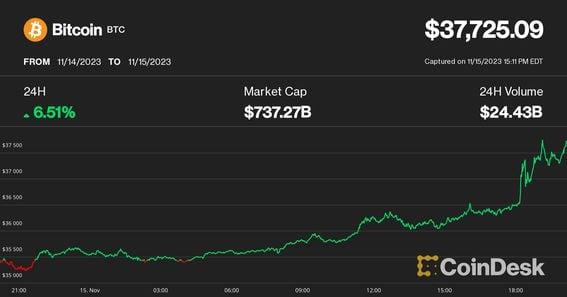
Solana's SOL continued to pace gains for altcoins. Cryptocurrencies Wednesday roared back from yesterday's drubbing, with bitcoin (BTC) nearing a new 18-month high just shy of $38,000 after tumbling below $35,000 at one point on Tuesday. Ether (ETH) advanced more than 3% to near $2,060, retaking the $2,000 level after yesterday's fall to nearly $1,900. Native tokens of layer 1 blockchains Solana (SOL) and Avalanche (AVAX) led gains among altcoins, with 18% and 23% jumps during the day, respectively. SOL has been a leader of altcoins for weeks now, nearly tripling in price over the past month, as concerns about FTX dumping its tokens subsided and demand among institutional investors increased. AVAX perhaps benefitted from a recent announcement that traditional-finance giants JPMorgan and Apollo used the network to demonstrate a "proof of concept" for how asset managers could tokenize funds, a red-hot trend in crypto. The CoinDesk Market Index (CMI), a market-cap weighted basket of almost 200 cryptos, was up 5%, underscoring the market-wide positive day for digital assets. Bitcoin outperforms gold and equities "Bitcoin is going mainstream, and the bear is behind us," Charlie Morris, founder of investment advisory firm ByteTree, said in a Wednesday market report. "The good times are here." ByteTree highlighted BTC's strong showing compared to traditional assets such as U.S. equity indexes and gold, which have also been advancing. "Bitcoin’s trend is not only strong in dollars, but strong against other key assets," Morris noted. "This is important for institutional adoption because they don’t buy alternative assets unless there’s a little extra return." Morris also noted the strengthening trend of altcoins as the market breadth improved after a grueling two years of crypto winter. The ByteTree Crypto Average (BCA) trend breadth indicator, which measures the equal-weight daily average price changes for the top 100 tokens, flashed a four-star rating out of five for the first time since April. "When the trend is positive, it is better to have higher exposure to crypto," Morris said. https://www.coindesk.com/markets/2023/11/15/bitcoin-bounces-6-threatens-38k-good-times-are-here-analyst-says/