2024-08-30 07:20
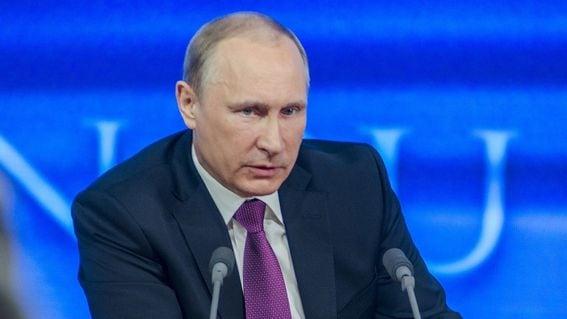
Experts doubt it will work, given the traceability of blockchains and the risk of even tougher sanctions for Russia. Russia will start its trial of cross-border payments using crypto next week. Recent statements from senior Russian leaders suggest the law’s purpose is to use crypto to counter sanctions. The law hands power to Russia’s central bank to oversee an “experimental” regime. Russia will begin trialing cross-border crypto payments next week in an effort to circumvent international sanctions – but this effort may not work, several policy and legal experts told CoinDesk. Legislation passed at the end of July and swiftly signed into law by President Vladimir Putin does not lift an existing ban on using cryptocurrencies as legal tender for regular payments within Russia, but instead allows cross-border payments with crypto. How the law will allow such payments remains unclear because the legislation doesn’t specify rules for such transactions. Instead it hands power to Russia’s central bank to oversee an “experimental” regime, experts said. Russia's economy has been hit hard by a suite of sanctions imposed by the U.S. and other nations following its invasion of Ukraine. Since Russia’s invasion of Ukraine in Feb. 2022, it’s faced 16,500 sanctions from the U.S., U.K., European Union, Australia, Canada and Japan. "The passing of these bills by the Russian government signals a continuation of Russia’s evolving strategy to circumvent Western sanctions," blockchain analytics firm Chainalysis’ director of investigations, Valerie Kennedy, told CoinDesk. The EU said about half of Russia’s total foreign currency reserves, worth 300 billion euros ($332 billion), including 70% of the assets of the Russian banking system, were frozen. Select Russian banks were disconnected by the interbank messaging system, the Society for Worldwide Interbank Financial Telecommunication (SWIFT). "It has been difficult for Russia to avoid the U.S. dollar and euro via the SWIFT system, which has created increasing risk of secondary sanctions," she added. Secondary sanctions are penalties designed to prevent any third party from trading with a sanctioned nation. What the law says Some details have emerged in the days leading up to the Sept. 1 implementation of the law. CoinDesk viewed a copy of the law using google translate. It said “during the circulation of digital currency in the Russian federation … special regulation may be established … by the experimental legal regime program.” That regime is still in the works. Before finalizing it, the central bank will consider proposals and suggestions from domestic stakeholders. “Some players, including us, have already come with our own proposals,” said Anti Danilevski, founder and CEO of Kick Ecosystem, a one stop shop for crypto, who has been closely engaging with regulators. “The central bank will decide if it fits with their view. They are moving very fast, so it won't take much time.” Bloomberg reported that Russia is planning to use the National Payment Card System, for swapping between rubles and cryptocurrencies when testing payments. The system was chosen because it already features infrastructure for functions like interbank settlement and is fully regulated by the central bank. If the trials are successful, Russia may allow the Moscow Exchange and the St. Petersburg Currency Exchange to set up crypto platforms next year, the report added. Ivan Chuprunov, an associate professor at the Research Centre of Private Law in Moscow, said the regime’s “exact parameters are not clear” because none have been published yet but the “central bank will likely publish some guidance in the coming weeks.” The law also appears to let the central bank change how it oversees these trials at any time. The legislation said that the provisions may “exclude or change” parts of the Federal Law in relation to transactions with “digital currency made in the implementation of foreign trade activities through an authorized organization.” The regime is “more a flexible one” because it’s “just the central bank who will be approving it,” said Chuprunov. “Whether they will have just one exchange, what currencies would be traded, how participants would get trading access, is still a big unknown.” Nor does the law clearly specify what rules now apply to crypto entities or businesses wanting to deal in crypto, because the central bank will determine which companies will participate in the experiment. While the law doesn’t specify what its exact purpose is, recent statements from senior Russian leaders pointed toward using crypto to counter sanctions. On July 17, 2024, in an economic affairs meeting, Putin said Russia should not “miss the moment” and should promptly set up a “legal framework” for crypto, which is “increasingly used in the world as a means of payment in international settlements.” Then, one of the authors of the bill said Russia views cryptocurrencies “primarily as a tool for circumventing sanctions,” followed by its central bank Governor Elvira Nabiullina saying that’s why we “softened our stance” on crypto at an event in Moscow recently. Centralized implementation uncertainty Uncertainty remains around how Russia will use this new law to exert more control and overcome sanctions. The experimental regime is a global first of its kind because it hands carte blanche control to the central bank to make any rules anytime and select any company it chooses to participate in the test. “Authorizing the Bank of Russia to create an electronic platform for digital currency transactions and monitor activities centralizes control,” said Jim Mignano, an assistant policy researcher at research organization RAND. Because the law allows such dynamic rule-making, it’s difficult to predict how geopolitics or new sanctions will make Russia’s government and central bank change the law every now and then. “I've been practicing Russian law for over 18 years. I cannot remember the word 'experimental' in a draft law,” said Svetlana London, managing partner at CIS London, a law firm specializing in advising clients about cross-border transactions related to the Commonwealth of Independent States (CIS), which includes Russia. “It's quite difficult to decipher, just based on the label, how exactly it will work.” Danilevski said the law gives the Central Bank of Russia the power to release an experimental legal regime (ELR) but that in its current form the ELR “won’t work effectively” and needs “significant refinement” for “practical implementation.” And then comes the question of whether Russia will even reveal how it chooses to implement the law. Sitting alongside Governor Nabiullina at that Moscow event last month, Andrei Kostin, head of Russia’s second largest lender, VTB, proposed that the implementation of such laws should be made a "state secret" because right now “somewhere at the U.S. embassy” someone is noting down every statement we make, to allow the West to react “very” quickly. West will respond in “new ways” Mignano told CoinDesk that the successful bypassing of sanctions by Russia could “prompt more aggressive enforcement measures or new forms of sanctions.” One of those growing threats is that of secondary sanctions. Last month after the bill passed, Governor Nabiullina told Reuters that "The risks of secondary sanctions have grown. They make payments for imports difficult, and that concerns a wide range of goods.” "While crypto assets may live and move outside the traditional financial system, the activity will be traceable and trackable allowing Western governments to follow and investigate transactions in new and innovative ways," Isabella Chase, Senior Policy Advisor of Europe Middle East and Asia at blockchain analytics firm TRM Labs said. Foreign partners and liquidity Despite the law's intent, experts questioned whether foreign partners will engage through crypto. Kennedy also said crypto markets don’t have the liquidity to support such evasion “en masse” without “either crashing the prices of crypto assets or drawing the attention of blockchain observers” suggesting that such evasion “will look like other forms of money laundering” – small amounts of crypto “gradually moved to cashout points.” Mignano said this problem might require Russia to “do more work.” It may need to offer “economic or political incentives to counterparties” to participate in crypto-based transactions, he said. Read More: Russia Legalizes Crypto Mining and Brings an Experimental Regime https://www.coindesk.com/policy/2024/08/30/russia-is-about-to-try-using-crypto-to-get-around-sanctions/
2024-08-29 21:48
The House Financial Services Committee is expected to look at DeFi, U.S. enforcement and "pig butchering" in a series of hearings the panel is set to schedule for next month. The U.S. House of Representatives' financial-services committee is said to be tackling a ton of crypto issues next month, including DeFi and Securities and Exchange Commission matters. Digital assets will likely be a hot topic for SEC Chair Gary Gensler, who is said to be scheduled to face the entire committee later in September. The U.S. House Financial Services Committee is poised to launch a series of crypto hearings digging into several aspects of the industry, according to a person briefed on the planning, including decentralized finance (DeFi), the Securities and Exchange Commission's oversight of digital assets businesses and the implications of "pig butchering" scams. The congressional panel, which has oversight over U.S. securities and most financial products, will set a September hearing calendar jammed with crypto-relevant topics, the person said. The committee chairman, Rep. Patrick McHenry (R-N.C.), is retiring at the end of the year and has said one of his top remaining priorities is finishing one of the bills to begin establishing tailored federal rules for crypto. The first of the hearings on Sept. 10 will be a long-awaited subcommittee examination of DeFi, an aspect of the crypto industry that's received mostly negative attention from regulators to date. A number of proposed rules at various federal agencies could have existential consequences for DeFi projects, including at the SEC and Internal Revenue Service. Read More: U.S. Treasury Issues Crypto Tax Regime For 2025, Delays Rules for Non-Custodians A busy day on Sept. 18 will feature two hearings – one in the morning on the enforcement practices of the SEC and one later on the implications of so-called pig butchering, the practice of posing as a romantic partner to scam people out of their assets. But a full-committee hearing on Sept. 23 could carry the most crypto weight, with the SEC set to testify. The House panel is said to be seeking testimony from Chair Gary Gensler and the rest of the five-member commission in the same hearing – a highly unusual approach. They'd appear just as the lawmakers are also negotiating legislation that could seek to hem in the agency's digital assets jurisdiction in favor of casting the Commodity Futures Trading Commission in a more prominent role. The possibility of crypto legislation remains dicey this year, though the calendar includes time for work on bills, and prominent lawmakers – including Senate Majority Leader Chuck Schumer (D-N.Y.) – keep saying they intend to get something done. A spokesperson for the committee chairman didn't immediately respond to a request for comment on the schedule planning. Read More: U.S. Crypto Bill Can Happen This Year, Senate's Schumer Tells Crypto Backers of Harris https://www.coindesk.com/policy/2024/08/29/us-house-committee-plans-for-heap-of-crypto-hearings-in-september/

2024-08-29 21:38
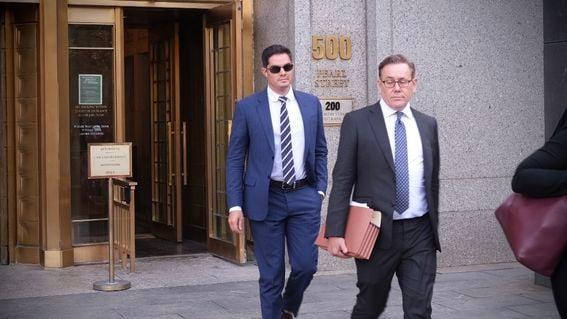
Salame agreed to a plea deal in order to get prosecutors to drop their investigation into Michelle Bond, his partner and the mother of his child. Ryan Salame, the former FTX executive sentenced to 7.5 years in prison in May, has withdrawn a legal request to a New York court asking that the conditions of his plea deal with prosecutors be enforced or that his plea be thrown out and his sentence vacated. Last week, Salame’s lawyers filed a petition with the court stating that prosecutors had obtained his guilty plea improperly, getting him to agree to plead guilty by dangling promises that they would cease their investigations into Michelle Bond, Salame’s long-time partner and the mother of his young child. In an order published Thursday night, Judge Lewis Kaplan ruled that he would still hold a hearing on the original petition regardless of Salame's motion to withdraw it. The judge made Salame's attendance at the hearing a part of his bail conditions. Salame’s petition was filed one day before charges against Bond were made public. Bond, a former U.S. Securities and Exchange Commission (SEC) lawyer who spent years leading a D.C.-based crypto advocacy group, was indicted in federal court on Aug. 22 for taking illegal campaign contributions from Salame and other FTX employees during her failed 2022 run for a Congressional seat. According to the petition, prosecutors threatened Bond during plea negotiations and implied that it would “discontinue investigating Bond if Salame pleaded guilty.” Now that Bond has been indicted, however, Salame is changing course. “Mr. Salame is withdrawing the Petition so that Ms. Bond may raise the matter in her proceeding,” Salame’s lawyers wrote in the new court documents. “To be clear, Mr. Salame stands by the facts set forth in the Petition and his accompanying declaration. Mr. Salame is withdrawing the Petition, however, to allow the facts to be developed by Ms. Bond, and a ruling to be made in her case.” “Since the primary relief sought in the Petition is dismissal of the indictment against Ms. Bond, it makes sense to adjudicate the issues raised in the Petition in the docket in which the indictment is pending,” Salame’s lawyers added. Bond appeared before a magistrate judge in the Southern District of New York (SDNY) on Aug. 22 and was released on a $1 million bond. She has been charged with four counts related to the alleged campaign finance violations – one count of conspiracy to cause unlawful political contributions, one count of causing and accepting excessive campaign contributions, one count of causing and receiving an unlawful corporate contribution, and one count of causing and receiving a conduit contribution. Each count carries a maximum five year sentence, if convicted. https://www.coindesk.com/policy/2024/08/29/jailed-ftx-exec-withdraws-his-request-to-compel-government-to-abide-by-plea-deal/
2024-08-29 19:17
AI-focused tokens such as FET, Render's RNDR and Bittensor's TAO slipped 7%-10% following Nvidia's post-earnings slump. Bitcoin's (BTC) attempt for a bounce faded yet again during Thursday's U.S. trading session, the price breaking back below $59,000 after climbing above $61,000 earlier. BTC was still holding on some of its gains over the past 24 hours, up 0.6%, in line with the broad-market CoinDesk 20 Index. Ether (ETH) was down 0.5%, barely holding above the $2,500 price level. Artificial intelligence focused cryptocurrencies led losses, dragged lower by chip making giant Nvidia's (NVDA) 6.4% slide after reporting quarterly results Wednesday evening. Native tokens of Render (RNDR), Artificial Superintelligence Alliance (FET) and Bittensor (TAO) were lower by 7%-10% for the day. U.S. stocks also gave up early-day gains, led by the tech-heavy Nasdaq, lower by 0.3% 40 minutes before the closing bell after being higher by more than 1.5% earlier. Bulls would have needed to push prices past $61,000, above key short-term moving averages on the 4-hour timeframe, to have a meaningful odds to rally to the upper side of the range, pseudonymous crypto analyst Skew pointed out. The price action suggests that crypto markets are in for more consolidation as the quick recovery from the early August plunge to below $50,000 continues to fizzle. The largest crypto has stuck in a downtrend since its all-time record of $73,000 in March, making lower highs and lower lows ever since. https://www.coindesk.com/markets/2024/08/29/bitcoin-returns-to-59k-as-bulls-fail-to-flip-key-resistance-ai-cryptos-lead-losses/

2024-08-29 19:08
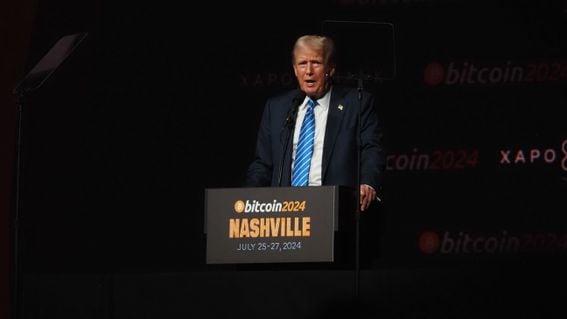
World Liberty Financial is "the only crypto DeFi platform supported by Donald J. Trump," according to homepage metadata. Former U.S. President Donald Trump's mysterious new crypto business plans to offer access to "high-yield" opportunities, according to a clue embedded in the website for the project called World Liberty Financial. Metadata on worldlibertyfinancial.com says "the only crypto DeFi platform supported by Donald J. Trump" will connect users to "decentralized finance's best tools for secure, high-yield crypto investments." It calls on users to "join the financial revolution today!" A trademark filed for World Liberty Financial in mid-July also points to an association with DeFi. The lawyer who filed the trademark papers, Alex Golubitsky, confirmed to CoinDesk on Thursday that the trademark relates to Trump's crypto ventures and directed further inquiries to a press office associated with worldlibertyfinancial.com. Trump and his son Eric have been teasing World Liberty Financial as the Republican presidential candidate's latest foray into crypto. Earlier this week, Trump launched a fourth NFT collection in a bid to repeat his previous million-dollar successes selling crypto collectibles. He is also separately promising to make the U.S. the "crypto capital of the planet" if elected. The press office for worldlibertyfinancial.com did not respond to a request for comment. https://www.coindesk.com/business/2024/08/29/trumps-new-crypto-business-to-offer-access-to-high-yield-investments-website-says/
2024-08-29 16:27
El Salvador now holds $400 million in its "public wallet alone," President Nayib Bukele said in an interview with TIME. Bitcoin brought "branding, investments and tourism" to El Salvador, President Bukele said in a TIME Magazine interview. The crypto, though, hasn't yet enjoyed the "widespread adoption" in the country as hoped for, he added. Under Bukele, El Salvador adopted bitcoin as legal tender and started purchasing it as a treasury asset in 2021. Nayib Bukele, El Salvador's pro-Bitcoin (BTC) president, said his plan to make the country a hotbed for the largest and oldest cryptocurrency has been "net positive" but adoption has fallen short of his expectations. "Bitcoin hasn't had the widespread adoption we hoped for," Bukele said in an interview with TIME Magazine. "I feel that it could have worked better, and there is still time to make some improvements, but it hasn’t resulted in anything negative." El Salvador, however, has benefitted in multiple ways from positioning itself as a Bitcoin-friendly country while the risks that institutions such as the IMF warned of have yet to materialize, according to Bukele. "It gave us branding, it brought us investments, it brought us tourism," he said. "I do believe that the positive outcomes outweigh the negative, and the issues that have been highlighted are relatively minor." El Salvador, under Bukele's leadership, became the first nation state to start purchasing bitcoin as a treasury asset in September 2021. It also adopted the cryptocurrency as a legal tender that year. The country also laid out plans for issuing bonds backed with BTC mined there and introduced a citizenship through investment scheme for foreigners who donate to the government. Bukele also reminded that El Salvador was a "first mover," and today Wall Street companies are offering numerous Bitcoin-related investment products and the crypto playing a sizable role in this year's U.S. presidential election El Salvador country has accumulated a sizable bitcoin stack through a combination of direct purchases and its citizenship program. The country, said Bukele, has about $400 million in BTC "in the public wallet alone." "I'm not going to say it's the currency of the future, but there's a lot of future in that currency," Bukele said. https://www.coindesk.com/markets/2024/08/29/el-salvadors-bukele-says-bitcoin-strategy-a-net-positive-but-adoption-lags/


