2023-11-03 21:11
The NFT platform, used to trade Bored Apes and Pudgy Penguins, laid off 50% of its employees as digital art collectibles' floor prices continue to fall. Non-fungible token (NFT) platform OpenSea has pared back its operating staff as digital art collectibles remain in the doldrums, the company's CEO Devin Finzer tweeted Friday. The sweeping layoffs may have affected as much as 50% of OpenSea's staff, crypto news outlet Decrypt reported earlier Friday. The job cuts come as the company prepares to launch a revamped marketplace christened OpenSea 2.0, at a time when NFT prices continue to fall. The platform can be used to trade and collect NFT collections including Bored Apes and Pudgy Penguins. "We’re building a new foundation so we can innovate faster and we’ll have some experiences to share with you soon," Finzer said in a post on X (formerly Twitter). "We will change how we operate - shifting to a smaller team with a direct connection to users." OpenSea previously laid off roughly 20% of its staff in July 2022, leaving it with a workforce of 230 employees, The Information reported. It is unclear how many people the company employed immediately before this latest round of layoffs. Nor is it immediately clear how OpenSea 2.0 will differ from its predecessor. Finzer didn't share details about the platform's planned product offerings or a timeline for its rollout. OpenSea didn't immediately respond to CoinDesk's request for comment. According to a Nansen report, prominent NFTs from well known or “blue-chip” collections saw their floor prices drop by more than 25% in August. An NFT's floor price is the lowest price at which a digital art piece from a particular collection, or drop, can be sold. Meanwhile, NFT prices have fallen more broadly as well, with the Nansen NFT-500 index dropping 55% during the year-to-date. https://www.coindesk.com/tech/2023/11/03/nft-marketplace-opensea-cuts-staff/

2023-11-03 19:00
Long-time watchers of the crypto space are mostly positive on what SBF’s conviction means for the future. But long-time critics in Congress are readying to crack down further on the industry. With Sam Bankman-Fried’s conviction yesterday on seven counts of fraud in federal court, the long-running FTX saga appears to be nearing a conclusion (though sentencing and several live issues are yet to be finalized fully). The question now is what the verdict means for the future of the industry? Will it prove a lasting stain on crypto’s reputation, making it impossible for companies to persuade users of the merits of digital assets? Or will it serve as a moment of closure, proof that the legal system, journalism and the industry itself can clean its ship? CoinDesk reached out to several long-time crypto watchers for comment and received several quotes unsolicited as well. They follow below (we’ll update with more as we receive them). Paul Brody, head of blockchain at EY: “It’s a wonderful moment for crypto. Accountability and the sense that bad actors will be punished is important – not just for deterring bad actors but to give confidence to those who are operating with integrity. If you’re investing in a business, you need to know that the competition will be on a level playing field and that integrity is not something that puts you at a competitive disadvantage.” Noelle Acheson, former head of research at CoinDesk and writer of the “Crypto Is Macro Now” newsletter: “The verdict came as a huge relief. While it looked increasingly likely as the trial wore on, there was always the outside chance that SBF would yet again embarrass the industry by showing that crypto fraud can be hard to prosecute. That didn't happen, and the swift and unanimous decision from the jury definitively shows that fraud is fraud, and crypto service providers can and should be held accountable. The closure of the SBF phase should help to show the next wave of investors that crypto markets can be grown up. And hopefully now we can get back to building the capital market infrastructure the ecosystem deserves.” Sheila Warren, CEO of the Crypto Council for Innovation: “This case was always about fraud, and this outcome confirms that the jury understood who and what was on trial here. “The jury heard evidence that Sam Bankman-Fried was out for himself, and that's reflected in the verdict. This case serves as a reminder that rules that have existed for a long time created a path to accountability for these crimes. “My hope is that we can turn the focus to the victims here rather than continuing to give airtime to the latest person who committed one of the oldest crimes on the books – fraud.” U.S. Senator Sherrod Brown (D-OH), chairman of the Senate Committee on Banking, Housing and Urban Affairs: “This verdict is a victory for everyone fighting fraud and scams in crypto. In this trial, we saw how crypto companies like FTX think the law doesn’t apply to them, gamble with consumers’ money and lie to the public. Americans continue to lose money every day in crypto scams and frauds. We need to crack down on abuses and can’t let the crypto industry write its own rulebook.” Preston Byrne, corporate partner and practices in the Brown Rudnick's Digital Commerce group: I would not read too much into the SBF trial result as a forward-looking matter. What’s done is done. SBF is off the board as a major player in crypto, probably for the rest of his working life. What this is, is a significant and decisive victory for the US Attorney’s office in the SDNY convincing a jury that fraud is fraud even in a context where complex, novel technology is involved. I would expect that the USAO has a lot more confidence today that they can win other big cases against bad actors in crypto than they did yesterday. Joshua Klayman, U.S. head of fintech and head of blockchain and digital assets at Linklaters: “People sometimes talk about divine justice. Yesterday’s verdict may just be sublime justice, with the criminal trial of Sam Bankman-Fried wrapped up in a bow exactly one year to the day after CoinDesk’s award-winning reporting about Alameda Research’s balance sheet revealed the empire to be, arguably, a house of cards. After a month-long trial, where SBF famously took the stand, the Manhattan jury took only a few hours to find him guilty of all seven criminal charges brought against him. “In terms of winners and losers for the crypto space, it remains to be seen. In my view, the prosecution was successful in convincing the jury that the case came down to things like basic fraud, which transcends any particular industry, and the swift verdict is likely to embolden prosecutors, who may be less willing to enter into plea arrangements and more likely to go to trial. “I also think that, in a way, this verdict is a win for the crypto industry itself. After all, it was the industry (including crypto journalists) that discovered and exposed SBF’s wrongdoing, and certain market participants that were themselves harmed by FTX and Alameda testified in the case against SBF. SBF being found guilty may be an important milestone or marker that enables the digital asset space and the broader market to move on from the events of 2022, because the bad actor is, in fact, being held accountable. “To the extent that digital asset market participants continue to emphasize that bad actors and fraud should be held accountable – and to emphasize key strengths of the technology, including transparency, that may help deter or root-out criminal behavior – I think that can lead to wins for the industry. Despite the rapid rise and fall of FTX and Alameda, builders have kept on building. Our space is resilient, and crypto lives on.” Michael Selig, counsel in the Asset Management Department, Willkie: "The trial verdict offers some degree of resolution and closure on the events of the past few years and provides an opportunity for a crypto industry reset with lawmakers and regulators. The events of the past few years inflicted immense reputational damage on the industry and caused countless regulatory investigations and Congressional inquiries into market participants and practices, overshadowing many recent technological innovations. "I have no doubt that the SEC and CFTC will continue to aggressively enforce industry compliance with legacy laws and do not expect Congress to pass new crypto legislation any time soon. Yet both the crypto industry and regulators were caught in the crosshairs of common enemies and this chapter is coming to a close. I am hopeful that industry and regulators can now turn the page and find common ground for a sensible regulatory solution." Kevin J. O’Brien, Ford O'Brien Landy LLP Partner, and a former assistant U. S. attorney: An appeal “doesn't appear very likely” for Sam Bankman-Fried, he said on CDTV today. "Mark S. Cohen, SBF’s attorney is a very able lawyer … but on the face of it, there doesn't seem to be much for them to work with here," O’Brien said. The "trial was very well-tried by the government." But he doesn’t think Sam Bankman-Fried will spend the rest of his life in prison, more like "something in the neighborhood of 15 years, or maybe even 20 years." "He's a relatively young man, his whole life is in front of him," O’Brien said. "I don't think the judge is going to want to destroy his chances of having a full and productive adult life." Yat Siu, Animoca Brands executive chairman: SBF's downfall had “really cast a dark shadow over the entire industry” and this verdict serves as “a new beginning.” This verdict made it clear this was “simply a case of fraud. It wasn’t a case of the industry having an issue.” The trial against Bankman-Fried demonstrates that there are consequences for bad actors and that "gives people a certain sense of more safety." https://www.coindesk.com/consensus-magazine/2023/11/03/sam-bankman-fried-verdict-the-crypto-industry-reacts/
2023-11-03 18:41
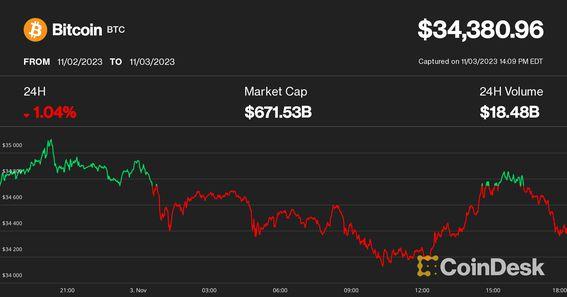
Layer 1 cryptocurrencies and DeFi tokens soared this week as bitcoin and ether chopped sideways. Bitcoin (BTC) tried and failed at holding above $35,000 this week, with one analyst arguing traders likely took their BTC profits and rotated into altcoins, pushing those prices higher. BTC price spent most of the week stuck between $34,000 and $35,000, with every attempt to break to the upside so far – even hitting a fresh yearly high almost touching $36,000 early Thursday – meeting with heavy selling pressure, pushing down the price. Bitcoin was changing hands at around $34,400 after weak U.S. jobs report, slightly up just under 2% for the week, with ether (ETH) up a similar amount. Meanwhile, large-cap tokens of layer 1 networks (L1) such as Avalanche (AVAX), Cardano (ADA) and Polkadot (DOT) jumped 10%-15% over the same time frame and Solana (SOL) hit a 14-month high Wednesday and Friday afternoon remained higher by 25% over the previous seven days. Decentralized finance (DeFi) tokens posted the biggest weekly advance among the CoinDesk Market Index sectors. The CoinDesk DeFi Index (DCF)jumped almost 10% in a week, driven by double-digit rallies by tokens of decentralized exchange UniSwap (UNI), SushiSwap (SUSHI), as well as lending platform Aave's native token (AAVE). Bankrupt crypto lender Voyager Digital's native token (VGX) also popped 20% Friday as some 30% of the token's supply was sent to a burn address, potentially to destroy. The CoinDesk Market Index (CMI), a basket of more than hundred cryptocurrencies weighted by market cap, outperformed the two blue chip cryptocurrencies with its 3.2% gain, underscoring the leadership of alternative cryptocurrencies (altcoins). Lucas Outumuro, research head of IntoTheBlock, said the outperformance of smaller, riskier tokens is a sign of capital rotation from bitcoin and ether after their sizable rallies, a typical behavior from investors during crypto bull markets. "Historically crypto cycles have followed the trend where BTC leads the first surge, then ETH, with capital progressively being allocated to lower cap and riskier bets," Outumuro said. "This week's trend suggests this rotation is beginning to take place as BTC and ETH trend sideways while DeFi and alternative layer 1 tokens record a strong rebound." "Despite the rotation into riskier assets, the demand flowing into crypto appears to be relatively organic, led by spot buying," Outumuro noted. "Even though the price momentum may be getting overheated short-term, there are signs of sustainable demand driving the crypto uptrend." https://www.coindesk.com/markets/2023/11/03/bitcoin-stalls-at-35k-as-gains-flow-to-altcoins-in-cryptos-early-bull-market-rotation-analyst-says/
2023-11-03 18:26
The trial verdict is an indictment of regulators and the VC industry. But the U.S. justice system and, yes, journalists, proved their worth more than ever. Well, it’s over. Sam Bankman-Fried has been convicted on all seven counts, with another trial on the docket for this spring to gauge SBF’s guilt and responsibility in a multi-year scheme to buy political favor for the FTX crypto exchange. At this point, Bankman-Fried faces up to 110 years in prison, though sentencing won’t happen for months. For many crypto fans, SBF’s conviction is the first of many that need to happen to rid the industry of bad actors, scammers and thieves that captured the public imagination and defined what this technology fundamentally is during the 2020-21 bull run. Over the long term, it’s entirely possible crypto polishes out the tarnish. Of course, SBF can appeal the decision and angle for a mistrial, arguing he didn't have adequate access to ADHD medication, his legal team (after being remanded into jail for repeatedly violating the terms of his bail) and, maybe, that District Judge Lewis Kaplan was heavy-handed in his oversight of the trial. But legal experts largely agree those claims are groundless, and that the former Boy Wonder is likely to spend the next few decades in prison. As is his wont, Bankman-Fried took a gamble that he could use customer and investor funds for essentially anything he wanted at the moment, illegally, and get away with it. The jury's complete, quick and decisive ruling is clear: Bankman-Fried lost that wager. But who or what, if anyone or anything, will come out ahead at the end of this trial? While prison time is a type of retribution for tens of thousands of victims of SBF, it will not exactly make anyone whole or eliminate the stink of the biggest public spectacle that has haunted crypto for the past year. First, we should talk about the losers. Sam Bankman-Fried: SBF was convicted on all counts of wire fraud as well as conspiracy charges to commit wire fraud, securities fraud, commodities fraud and money laundering. During the trial it came to light he had essentially founded FTX as a new source of capital for his hedge fund, Alameda Research, which was a money-losing operation while SBF was the helm and while he pretended he wasn’t. SBF’s scheme to pilfer money from FTX users and his Wall Street and venture capitalist backers to buy luxury property, political favor and FTX equity from rival Binance as well as finance venture investments unraveled, taking the MIT graduate down with it. Worse, Bankman-Fried, while at times admitting he “messed up,” was never exactly contrite and fought the damning accusations until the end, perhaps thinking he could get away with it all, one last time. The Bankman, Fried Family: SBF’s father, Joseph Bankman, a Stanford law professor and tax expert, was involved in FTX from the early days. He helped SBF spin up shell companies, advised on tax decisions and angled for a raise for his efforts. In trial testimony from SBF’s inner circle (i.e. Caroline Ellison, Gary Wang and Nishad Singh) as well as court documents, Bankman’s name came up time and again. He was present in recovered Signal chat groups, including some of the most pivotal communications between FTX operators as the exchange was failing and SBF’s meeting with Bahamian regulators — moments when SBF could have come clean. Bankman recommended they hire Dan Friedberg, FTX’s “fixer,” who SBF later tried to blame for his own failings in a terminal “advice-of-counsel” defense. SBF’s parents are thought to have partially financed their son’s criminal defense, and put their family home up as bail collateral. While it’s not yet clear whether they are fully implicated in this multi-million dollar fraud, they are being sued by the FTX bankruptcy estate. Barbara Fried, the founder of a political action committee that Sam funded, in part using customer funds, was previously best known for her offbeat views on justice and blame, which seem to have influenced Sam’s own skewed sense of morality. It’s likely both of their distinguished careers are over. Finally, Gabe Bankman-Fried, the younger son, will likely be overshadowed by his brother’s crimes. While not an FTX employee, Gabe ran a pandemic-prevention nonprofit financed by Sam’s “charitable giving” and apparently harbored equally grandiose ideas about spending other peoples’ money better than they could — at one time entertaining the thought of buying a private island. Effective Altruism: Although the U.S. Department of Justice lobbied successfully to keep the idea that SBF had “good intentions” out of court, arguing his charitable donations and image as a selfless billionaire would confuse the jury (and were, SBF disclosed, essentially lies), SBF has become synonymous with the effective altruism cause. The EA movement was both SBF’s ethical framework and recruiting ground. Coalescing during the latter half of the 2000s as a branch of utilitarianism, EA can be summed up as “earn to give.” It advocates for high-achieving individuals to pursue careers that enable them to “maximize their impact,” and could be interpreted as condoning crime if it ultimately leads to a better outcome. Adherents also tend to be “rationalists,” believing that outcomes can be weighed in advance by calculating the “expected value” of particular decisions. SBF, for instance, refused haircuts because his nonchalant brand supposedly helped him raise funds. Whether SBF is representative of EA, his conviction will indefinitely tarnish the movement, which is now known more for the fringe beliefs it incubated (like trying to prevent an AI apocalypse) than, say, delivering mosquito nets around the world. Author Zeke Faux referred to it as a philosophy where believers pretend they are superheroes. Sequoia, VCs and "Pattern Recognition": Yesterday, hours after SBF was convicted, Alfred Lin, a partner at VC firm Sequoia Capital and former chief operating officer of Zappos, posted that the company which had invested nearly a quarter billion dollars into FTX, was “deliberately misled and lied to.” He came to this conclusion after an “extensive review” of Sequioa’s due diligence processes over the course of its 18-month relationship with Sam Bankman-Fried, apparently without understanding that, ironically, “due diligence” is supposed to find fraud. Sequoia published an infamous hagiography of SBF at his peak – including details that the FTX CEO was playing “League of Legends” during his pitch meeting and had plans for FTX to become an “everything app” where users could buy anything from stocks to a banana – based on the idea of that he could have become the world’s first “trillionaire.” The VC firm has since written down its investment to $0. While Sequoia has come out looking more foolish than most, the company also stands as an indictment of venture capitalism and the prevalent practice of “pattern matching.” Often when investing in upstarts, there is little information to go on — and so VCs, whether they admit this to themselves or not, go by gut. This is how the world ended up with Adam Neumann, Elizabeth Holmes and Sam Bankman-Fried. U.S. Regulators: Although FTX was technically an overseas exchange, SBF made no bones that he ultimately wanted to capture the U.S. market. He helped craft regulation known as the “Digital Commodities Consumer Protection Act,” and presented it before Congress and regulators like the Commodity Futures Trading Commission. CFTC Commissioner Christy Goldsmith Romero, who reportedly met SBF three times, has since said this “bespoke regulation” was an attempt to plead “for special treatment” for his “fundamentally predatory model.” U.S. Securities and Exchange Commission Chair Gary Gensler, who knew Alameda CEO Caroline Ellison’s father, is also reported to have had a working relationship with FTX. These agencies are known as “disclosures regulators” in that they attempt to ensure companies are following the law, rather than proactively hunting down crime. Though FTX had grown so large, and had so many connections to the U.S. (including U.S. bank accounts, investments in U.S. firms and U.S. advertising campaigns), without these agencies looking in is a blackmark. It’s telling also, that one of the few FTX units to survive nearly unscathed was FTX Japan, which operated under that country’s stringent financial regulations. FTX’s Inner Circle: Caroline Ellison, Gary Wang and Nishad Singh all pleaded guilty to fraud charges and cooperated with federal prosecutors. It’s unlikely this conviction could have happened as quickly (or at all) without their testimony. However, they also participated in and facilitated one of the largest financial crimes in history, and it is a mistake to believe SBF acted alone. They waited until the fraud unraveled to speak up, and each ignored numerous opportunities to do the right thing and contact authorities while the looting was taking place. Ellison misled lenders, wrote fraudulent reports and then lied to the public. Wang and Singh made the code changes that enabled the theft. I do not believe prison time will necessarily help any of FTX’s victims, but the value of their testimony will forever be undercut by their earlier silence. Winners TradFi: Centralized crypto exchanges are essentially TradFi companies, and it turns out that hardwon business practices exist for a reason. Crypto exchanges must separate corporate funds from customer deposits. They nneed to separate their crypto custody and trading divisions. They must provide appropriate disclosures (and no, proof-of-reserves is not enough). Companies need active director’s boards, compliance teams and chief risk officers. It turns out the applecart crypto wants to upset moves slowly for a reason. Lawyers: FTX is being advised by 150 lawyers from Sullivan & Cromwell, who each reportedly stand to earn as much as $2,165/hour for their work. The bankruptcy estate already has spent more than $110 million in legal fees and recorded over $500,000 in expenses, according to the New York Times. While this seems like money well spent, considering John J. Ray’s aggressive clawback strategy and decision to hold onto lucrative investments like equity in AI startup Anthropic, it is still a massive expense for creditors. Ian Allison: CoinDesk’s star reporter broke the story that PayPal was getting involved in crypto at the beginning of the bull run and wrote the measured piece about Alameda’s FTT holdings that decidedly ended it. His work has won top financial reporting prizes, including a Polk Award and Loeb Award. But perhaps the most rewarding experience of all was seeing SBF convicted exactly one year to the date after Allison published his story about Alameda’s balance sheet, a seismic impact with little precedent in the history of journalism. Kudos also to former CoinDesker Tracy Wang, who blew the door open on the oddities happening at Sam Bankman-Fried's luxury penthouse at The Albany, which won a Polk Award (without mentioning the word "polycule") as well as CoinDesk's "Trial Team" who reported the ins and outs of SBF's five-week trial. The Verge's Liz Lopatto; the Ringer's Katie Baker; Protos' Cas Piancey, Bennett Tomlin and David Z. Morris; Wikipedia editor Molly White; Unchained founder Laura Shin and court reporter Matthew Russell Lee of Inner City Press, among others, also provided invaluable insight and commentary from the courthouse. U.S. Justice System: Several reporters who have spent the past five weeks at the Daniel Patrick Moynihan Federal Court in New York have said they are leaving the experience with a newfound respect for the U.S. legal system. U.S. Attorney Damian Williams announced the DOJ’s charges against SBF on Dec. 13, 2022, and less than a year later the trial has concluded and one of the biggest fraudsters in history is behind bars. Judge Lewis Kaplan ran the courtroom as a well-oiled machine, and U.S. prosecutors Danielle Sassoon and Nicolas Roos have emerged as cult heroes for their ability to craft a story and present evidence. Everyone has a right to a fair and speedy trial, and this one — which unfolded in the public eye — was no exception. Neutral Solana: (SOL) was one of many so-called "Sam Coins," or tokens that the FTX founder had a massive stake in. Pitched as a super-fast, app-friendly blockchain, Solana's reputation has long been tarnished by its early token sales to venture capitalists and insiders. SBF, for instance, reportedly had an opportunity to buy SOL for around $0.20. He also financed or backed many of the supposedly commercial applications on built on Solana, including the decentralized exchange Serum (another Sam Coin) and the fitness app STEPN. The Solana protocol is still a work in progress, and occasionally goes down, though it boasts one of the most vocal and committed developer communities in crypto. This dev ecosystem got a tepid vote of confidence from Ethereum create Vitalik Buterin, not long after SBF was arrested, and has seemingly been able to shake off the association with FTX. Recently, SOL has been ripping up, though in the longterm there are concerns that the 55.8 million SOL tokens held by the FTX estate will put downward price pressure on the coin for years, as that massive stockpile is liquidated. CoinDesk, the Cadmean Victor: Sorry to get meta again, but what can I say, CoinDesk broke the news about SBF's crooked accounting and brought the multi-billion dollar fraud to light — the type of achievement few media organizations can boast about. Allison's story kickstarted a contagion event that brought down or damaged a number of individuals and firms intertwined with SBF's crypto empire, including CoinDesk's parent company Digital Currency Group (DCG) and sister firm Genesis Capital. Suffice it to say that DCG, a crypto conglomerate that was once compared to Standard Oil, is now strapped for cash, and CoinDesk is for sale. Sam Trabucco: What's up with this guy? https://www.coindesk.com/consensus-magazine/2023/11/03/winners-and-losers-of-sam-bankman-frieds-trial/

2023-11-03 18:02
The whale wallet was the 14th-largest individual bitcoin owner in March, holding 46,500 tokens. A large bitcoin (BTC) investor sent 7,000 bitcoin – worth roughly $244 million – to crypto exchange Bitfinex late Thursday, potentially to realize profits from earlier purchases. Whales are crypto investors who control large amounts of digital assets. Their crypto purchases and sales may have a sizable impact on markets, thus crypto watchers closely follow their behavior to anticipate market movements. Moving tokens to exchanges usually signals intention to sell, however, blockchain data doesn't show what happens with the tokens once it's at the exchange. The moves of this whale are of particular note as whoever controls the wallet appears to have a good sense of timing. BitInfoCharts data shows the holder accumulated 46,500 bitcoin between November 2022 and January 2023 at prices under $20,000 per token versus the current price just under $35,000. The owner then moved to offload a total of 36,500 tokens onto Bitfinex in late March and early April at what was then roughly around the high for the year near $30,000. The holder then took advantage of bitcoin's decline to $26,000 in May to accumulate another 2,000 bitcoin. Blockchain data shows that those 46,500 bitcoins in March made the wallet the 14th-largest BTC owner globally. The whale's latest transaction on Thursday is an indication that at least some investors who bought bitcoin at lower prices are on the move to lock in profits after the crypto's spectacular run-up in October from $27,000. The $35,000 price level has proved to be a key resistance for any upward movement for the last two weeks, with any attempt for a breakout met with heavy sale orders pushing the price back down. https://www.coindesk.com/markets/2023/11/03/prescient-bitcoin-whale-moves-244m-in-btc-to-crypto-exchange-has-btc-price-topped/

2023-11-03 15:35
Bitcoin's recent strong performance at least in part is due to optimism regarding the imminent launch of multiple spot ETF products. It's not surprising that analysts expect to see negative short-term price action if a bitcoin spot ETF is rejected by the SEC. Analysts, however, pointed out that bitcoin certainly doesn't hinge its existence on an ETF. While markets appear to have fully embraced the idea that the U.S. Securities and Exchange Commission (SEC) will approve a spot bitcoin ETF (timing unclear), it's worth considering the chance of continued rejections and what that might mean for the price of the crypto. It's no surprise that analysts believe there would be at least some negative short-term price impact on SEC rejections, but what to expect following the knee-jerk reaction? “We could see a move downward and the target could be below $30,000,” said Laurent Kssis, a crypto trading adviser at CEC Capital. Any decline, Kssis noted, would have to be balanced against other bullish catalysts, such as the approaching halving. “A cluster at $25,000 is highly unlikely unless the SEC is categorical, but I sense it will be a back-to-the-drawing-board situation and hope will still be in the back of everyone's mind.” “If the ETF doesn't get approved, I anticipate it would be a significant letdown for the market," said Martin Leinweber, a product strategist at MarketVector Indexes. "The spot Bitcoin ETF is often viewed as a hallmark of institutional acceptance and integration into mainstream financial systems." Leinweber added that a rejection might also trigger some legal turmoil for the SEC, which in June suffered a major court loss when it was ruled the agency was "arbitrary and capricious" in its rejection of Grayscale's attempt to convert its Bitcoin Trust (GBTC) into a spot ETF. The SEC in October notably failed to appeal the ruling, helping to lead to current expectations of coming approvals. Leinweber notes that bitcoin, as a decentralized entity, certainly doesn't hinge its existence on an ETF, but “a rejection would undeniably cast a bearish shadow on bitcoin’s price in the short term.” “I believe that the absence of an ETF would impose a substantial drag on the crypto market," he said. "It would necessitate a period of adjustment and realignment, as the market would need to decouple and forge a new narrative moving forward." Other crypto assets such as ether (ETH) would likely not be immune to these repercussions, according to Leinweber, especially considering that the SEC would next shift its focus to the spot ether ETF applications. Bullish action goes beyond ETF “In the case that a spot ETF isn’t approved soon, we believe Bitcoin’s 2024 investment case remains very strong," said Hashdex’s CIO, Samir Kerbage. "More investors are beginning to appreciate the benefits of bitcoin as a store-of-value asset or type ofdigital gold.” Kerbage also noted that the next Bitcoin halving is approaching and “if history once again rhymes, the price of BTC will react positively to this scheduled reduction in supply." “Regardless of when a spot bitcoin ETF is approved, the outlook for the world’s first and largest cryptocurrency has never been stronger," he concluded. https://www.coindesk.com/markets/2023/11/03/what-happens-to-bitcoin-price-if-spot-etf-isnt-approved/