2024-08-29 15:00
Company officials told CoinDesk this was its biggest acquisition to date, bringing on 41 developers and engineers from the Bware team and increasing Alchemy's headcount to 190. Blockchain developer platform Alchemy has acquired Bware Labs, the main company behind infrastructure provider platform Bware. The deal is expected to increase Alchemy's headcount by about 25%. Alchemy disclosed the acquisition on Thursday without revealing the purchase price. However, company officials told CoinDesk this was its biggest acquisition to date, bringing on 41 developers and engineers from the Bware team and increasing Alchemy's headcount to 190. Bware Labs was founded in 2021 in Romania by five engineers. The company's stated goal was to provide affordable blockchain tooling and infrastructure solutions to web3 developers. With the purchase, Alchemy will expand its operational base into Europe. Currently, its operations are mainly focused on the U.S., as it has its two headquarters in San Francisco and New York City. Alchemy co-founder and CTO Joseph Lau told CoinDesk in an interview that the Bware team will integrate with Alchemy’s existing product teams, where they’ll be contributing to Alchemy’s core infrastructure products including their node API platform. “The EU represents about a quarter of the Web3 market, and so it's just even more important for us to be there today, as we look to expand,” said Lau. “So both from a serving-developers-better, and from a hiring standpoint, we really wanted to be in the EU.” https://www.coindesk.com/tech/2024/08/29/blockchain-developer-alchemy-buys-bware-pushing-into-europe-adding-25-to-staff/

2024-08-29 10:03
The digital assets industry has bounced back from the collapse of crypto exchange FTX and returned to growth in the past 12 months, the report said. The crypto market is back in growth mode following a period of consolidation, the report said. Canaccord noted that the launch of spot ETFs in the U.S. has led to broader institutional adoption of digital assets. Institutional allocations to crypto are expected to increase, the broker said. The digital assets industry has bounced back from the collapse of crypto exchange FTX in November 2022 and has returned to growth in the past year, broker Canaccord said in a research report on Wednesday. FTX, the crypto exchange founded by Sam Bankman-Fried, filed for Chapter 11 bankruptcy following a CoinDesk exclusive highlighting the weakness of the company's balance sheet. The company's collapse was a major contributor to the crypto winter and bear market for digital assets. "In the last year, we believe the broader digital assets industry has transitioned from a post FTX consolidation/recovery phase back to one focused on growth and business model/total addressable market (TAM) expansion," analysts led by Joseph Vafi wrote. The launch of spot exchange-traded funds (ETFs) in the U.S. earlier this year was a positive catalyst for the crypto market. With the approval of both bitcoin (BTC) and ether (ETH) spot ETFs, "we have also seen broader institutional adoption of digital assets and expect portfolio allocations here to continue to increase," the authors wrote. Spot ether ETFs started trading in the U.S. on July 23, about six months after the bitcoin funds. The broker praised Michael Saylor's MicroStrategy (MSTR) for its "continued evolution into a Bitcoin development company," and noted that the shares have risen around 325% in the past year, outperforming most asset classes including BTC, which has gained about 148%. Wall Street giant Citi (C) noted that the crypto market has struggled since the launch of spot ether ETFs in the U.S., in a report last week. https://www.coindesk.com/markets/2024/08/29/crypto-market-has-evolved-in-the-past-year-canaccord-says/
2024-08-29 10:00
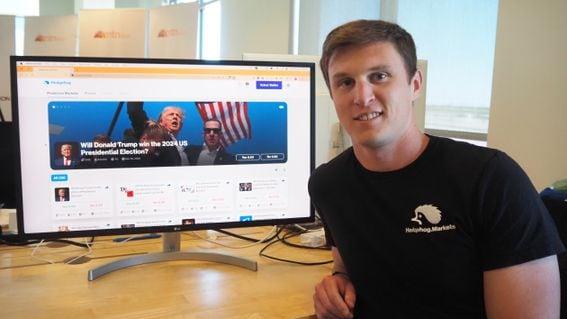
Hedgehog Markets, which runs on the Solana blockchain, wants to do for prediction markets what Pump.fun did for meme coins: Let anyone roll their own. SALT LAKE CITY — As Kyle DiPeppe sees it, crypto's prediction market fad has a looming expiration date: Nov. 5, 2024. Election day will bring judgment for hundreds of millions of dollars in bets placed on the U.S. presidential contest and the myriad other political races that have turned sector leader Polymarket into a massive success. Once these races are decided, so will their prediction markets, leaving their bettors with a win or a loss. What happens then? Will bettors keep prognosticating when the quadrennial Super Bowl of prediction markets is over? Probably not, says DiPeppe, an attendee at the semiannual mtnDAO hacker house gathering who runs far-smaller competitor Hedgehog Markets. He reckons that 90% of prediction markets trading volume is "all around politics," and will likely evaporate when this cycle is over, as it has before. DiPeppe mused: "Once November 6 hits, is there enough liquidity" to keep market makers and other behind-the-scenes players sufficiently interested to support trading on prediction markets? He doubts it. To weather the coming drought, Hedgehog Markets is building a type of prediction market that is less tradeable, but in his view more enduring than Polymarket's binary shares-based model for highly publicized events, which needs a lot of liquidity to work as designed. Hedgehog focuses instead on the "long tail" of bettable events that have fandoms willing to put money on their favored outcome but aren't too concerned about trading their position. It's more similar to sports betting experiences prevalent on DraftKings and FanDuel, where bettors take a gamble on odds and let it ride, than a stock market. "There's clearly people interested in sports betting. It's all short-term, same thing with crypto: It's a lot of memecoin, short-term trading," DiPeppe said. "So how do we cater with a market type that fits this shorter-term time frame?" Roll your own Doing away with stock market-type trading gives Hedgehog more flexibility in engaging its user base, said DiPeppe. For example, users can spin up custom prediction markets, place their own bet on the outcome, and hope someone else takes them up on the opposite point of view. (Polymarket allows community members to suggest markets in its Discord server, but the company decides which ones to publish.) DiPeppe thinks the same mindset behind memecoin factory Pump.Fun's success could pay dividends with custom prediction markets. There, any community can create a token in seconds and release it into the world where people trade it for "fun." He thinks there's fun to be found with prediction markets too. Custom prediction markets come with potential minefields. What happens when someone creates a betting market in which the outcome differs from the contemplated scenarios? (For example: a tie game where bettors only thought one team or the other could win). There's no clean way of resolving things when the prediction market is built atop a market maker or order book, according to DiPeppe. Even returning the pot 50-50 between opposing sides – a solution that might feel most fair – ends up rewarding those who bought in at, say, 20% odds, while punishing those who took 80%. Hedgehog's dispute resolution is cleaner, DiPeppe argued. A custom-made market that ends in purgatory can simply return the same amount of money to bettors that they originally put in, he said. Another potential problem: what if insiders play their own market? Perhaps someone created a market asking whether, say, a presidential candidate will mention the word "potato" onstage at a debate? Such a market might catch some bets from people thinking it to be unlikely (or from people who think otherwise). What if the candidate places a bet in that market, too? If they know what they're going to say, then they could place a large bet based on the insider information. Would that not be insider trading? Yes and no, said DiPeppe. Prediction markets are all about using trading to seek the truth. If someone who knows the truth trades on it, then other market participants, and bystanders among the general public, will become better informed. "Anybody could launch their own NFT collection, anybody could launch their own meme coin. Will communities want to do the same thing?" with prediction markets, DiPeppe asked. He's betting on it. https://www.coindesk.com/business/2024/08/29/can-prediction-market-boom-continue-after-election-this-crypto-team-has-a-plan/
2024-08-29 08:18
Bettors were fairly sure the Telegram CEO would be released in September. His release on Wednesday tossed the market on its head. Bettors on Polymarket were largely wrong about how long Telegram CEO Pavel Durov would be detained by French authorities. Durov was released on bail on Aug. 28, earlier than many bettors anticipated. French authorities are no longer holding Telegram CEO Pavel Durov, and as of Aug. 28 he was out on bail. The decision took bettors on Polymarket, a crypto-based prediction market, by surprise, costing them a total of $270,000 in missed winnings. Durov was formally indicted Wednesday and released on bail after he posted a 5 million-euro ($5.6 million) bond while agreeing to report to police twice weekly and to stay in the country. The quick release contrasted with bettors' overall sentiment that an extended detention was more probable. At one point, the chance of an August release was pegged in the mid-30%s while a release before October was priced 75%-90%. The August relase probabilty climbed to 50% in the hours before French authorities announced he was out on bail. Each bet comprises a "Yes" and a "No" side. Each share pays out $1 in USDC, a stablecoin, or cryptocurrency that trades at par with the U.S. dollar, if the prediction comes true, and zero if not. In total, bettors missed out on $270,000 by betting "No" on an August release, and "No" for before October. Likely, bettors had their money on French authorities keeping Durov for as long as possible. As a man of considerable wealth and multiple nationalities – including the United Arab Emirates, which does not extradite its citizens – Durov would have the means to flee the country, which is why bettors thought France would do all it could to keep him in detention. On the other side of the trade, user Champ correctly forecast Durov would be released in August and before October, and was the largest holder of the "Yes" side of both contracts. In total, Champ won $26,138 between the two contracts, meaning they took home $56,638 after the winnings were added to the value of the original bet. Another contract gives Durov a 6% chance of fleeing France by mid-month, meaning bettors expect him to comply with the terms of his bail. Despite Durov's legal challenges being the talk of the crypto community this week, it won't be center stage when Republican presidential candidate Donald Trump holds a live townhall in Wisconsin later Thursday. Bettors are only giving a 14% chance he'll mention Durov's name during the event, compared to a 92% chance he'll say "MAGA" and an 84% chance he'll use the term "Border Czar." However, Trump can often be unpredictable. In a recent interview with Elon Musk bettors wagered over $250,000 on the former president saying "Tesla," causing the bet to peak at 79%. Instead, he refered to the carmaker only as "your cars." https://www.coindesk.com/markets/2024/08/29/polymarket-bettors-miss-out-on-270k-due-to-pavel-durovs-early-release/

2024-08-28 20:06
Once again, the DOGS token is gumming up the works. The TON blockchain created by messaging app provider Telegram is suffering its second outage in as many days. "Block production issues began at 19:19 UTC" the team behind the project told users in a message posted to Telegram and X (formerly Twitter) on Wednesday during U.S. afternoon hours. "The disruption appears to be due to heavy load attributed to DOGS token minting. TON Core is working on a solution." The team emphasized that users' assets were not at risk. They followed with an "urgent" post on X asking mainnet validators to update their nodes and restart. According to the Tonscan block explorer, the last blocks were recorded on the chain at 12:23 Eastern time, or 16:23 UTC. The price of the blockchain's TON token didn't really budge due to this latest outage, falling 0.99% on a four-hour basis and down 4% over 24 hours at the time of writing, according to CoinDesk data. "As long I can finally withdraw my dogs 😅😅 - I can wait," one user wrote in a reply to the team's Telegram message. The previous outage occurred during Asia trading hours Wednesday and lasted about six hours. It, too, had little lasting effect on the TON price, which had already taken a hit several days earlier when Pavel Durov, Telegram's founder and CEO, was arrested in France. That earlier downtime was also partially blamed on the popularity of the DOGS airdrop, part of the Ton Foundation's effort to raise awareness of what it believes is the unjust arrest of Durov. https://www.coindesk.com/tech/2024/08/28/telegram-linked-ton-blockchain-suffers-second-outage/
2024-08-28 17:51
Rounding up commentary on the SEC's latest enforcement action. Will all NFTs be treated as securities? This morning, OpenSea said it had received a Wells Notice from the Securities Exchange Commission warning the agency was about to sue the leading NFT platform for violation of securities laws. The threatened action is the latest in a long line of similar moves from the SEC, and the reaction from the crypto industry has been fierce and near-uniform. Here is a small, representative sample. Tyler Winklevoss, founder of Winklevoss Capital Management and the Gemini exchange: Sheila Warren, CEO of the Crypto Council, a trade group (GG = Gary Gensler; leading an “anti-crypto army” was an ambition of Gensler ally Senator Elizabeth Warren (D-MA)): Third, we have Variant Fund's Jake Chervinsky, arguing that NFTs shouldn't be covered by laws invented many decades earlier (the Securities Act was passed in 1933): Next up: Gwart, self-described "crypto-Twitter troll," discussing the wider implications of the SEC apparently going after the very-expansive NFT category: Bankless co-founder Ryan Sean Adams: VC Adam Cochrane: Ex-CFTC Commissioner Brian Quintenz (now at a16z): Bitcoiner Jameson Lopp arguing that, if the SEC's intent is to protect investors, it's years late: Roham Gharegozlou, CEO of Dapper Labs, which has several NFT projects: Rep. Wiley Nickel (D-NC): And finally, Anthony Scaramucci, who says Gensler is wrecking recent Democratic efforts to make allies in the crypto community: Note: The views expressed in this column are those of the author and do not necessarily reflect those of CoinDesk, Inc. or its owners and affiliates. https://www.coindesk.com/opinion/2024/08/28/opensea-gets-sec-wells-notice-industry-reaction/