2023-10-30 12:10
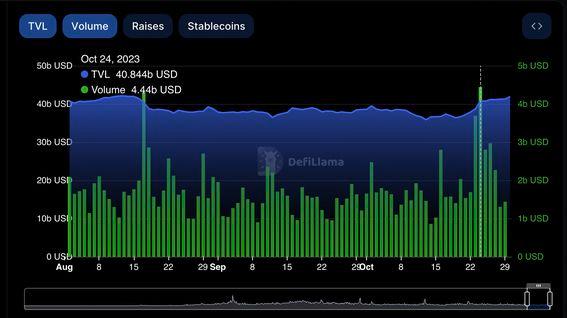
Total value locked across DeFi protocols has risen from $35.8 billion to $42 billion in two weeks. The total value of all assets locked on decentralized finance (DeFi) protocols has surged to a three-month high of $42 billion after being at its lowest point since February 2021 just two weeks ago, according to DefiLlama data. The resurgence of the DeFi market is based on two factors: rising asset prices and fresh inflows from participants that aim to generate a yield through staking and lending. Over the past two weeks, ether (ETH), the asset that underpins the majority of the DeFi market, has rallied from $1,590 to $1,810, while the likes of lido (LDO) and aave (AAVE) have posted 25% and 34% moves to the upside respectively. Alongside a hike in asset prices, transactional volume across DeFi protocols rose to its highest point since March, with $4.4 billion recorded on Oct. 24, according to DefiLlama. Solana’s most extensive lending protocol, Marinade, experienced a 120% jump in total value locked (TVL) this month following the release of its native staking product, which offers yields of 8.15% APY to complement its 7.7% rate on liquid staking. Marinade’s rival protocol, Jito, has risen by 190% to $168 million in TVL in the same period. On Ethereum, meanwhile, the amount of capital on Enzyme Finance, Spark and Stader have all risen by between 37% and 55%, outpacing the rise in asset prices to illustrate fresh inflows. Recently released layer one blockchains Sui and Aptos have also experienced positive growth this month, TVL on Sui has jumped from $34 million to $75 million. Aptos has been spurred by increased activity on lending platform Thala, with its overall TVL also hitting the $75 million mark this month. Despite a fruitful month, risks remain across the DeFi sector, as even the slightest slide in the price of ETH would trigger notable on-chain liquidations. Currently, there is a $76.2 million position on Aave that will be liquidated if ETH crosses $1,777, with over $100 million set to be liquidated if the price falls by 20%. https://www.coindesk.com/business/2023/10/30/defi-market-recovers-from-30-month-low-as-volume-hits-highest-point-since-march/
2023-10-30 11:02
OPNX in June sued the venture investor and crypto personality for defamation. OPNX, the crypto trading platform tied to Three Arrows Capital’s founders, has dropped its defamation suit against crypto venture investor Mike Dudas, according to court documents reviewed by CoinDesk. The multifaceted crypto exchange – it doubles as a trading hub for investors’ claims against bankrupt companies – moved to “voluntarily discontinue” its lawsuit on Oct. 27, the document said. In early June, OPNX sued Dudas for defamation over tweets in which he called its backers “unrepentant scammers” who bilked their former business partners. OPNX is associated with three crypto entrepreneurs with a history of helming bankrupt companies: Mark Lamb of CoinFLEX; and Su Zhu and Kyle Davies of defunct hedge fund Three Arrows Capital. That highly-leveraged hedge fund imploded last year, crippling the crypto credit industry and contributing to the eventual bankruptcy of multiple companies, including FTX. Zhu is currently jailed in Singapore for failing to comply with a court order related to 3AC’s ongoing liquidation. The lawyers representing OPNX did not immediately return a request for comment. Dudas declined to comment. https://www.coindesk.com/policy/2023/10/30/crypto-exchange-linked-to-3ac-founders-drops-lawsuit-against-mike-dudas/

2023-10-30 10:43
Project Guardian seeks to advance digital asset tokenization pilots for fixed income, foreign exchange and asset management products. Regulators in Singapore, Japan, the U.K. and Switzerland are planning asset tokenization tests for fixed income, foreign exchange and asset management products, according to a Monday announcement. The Monetary Authority of Singapore (MAS) has set up Project Guardian, a policymaker group that includes Japan's Financial Services Agency (FSA), the U.K's Financial Conduct Authority (FCA) and the Swiss Financial Market Supervisory Authority (FINMA) to advance cross-border collaboration in asset tokenization. Tokenization, which digitizes real-world assets using the blockchain, is all the buzz among banking giants and institutions worldwide with major economies testing bond issuance and fund tokenization to potentially improve the efficiency of global financial markets. Project Guardian is focused on discussing the legal and accounting treatment of digital assets, identifying potential risks and gaps in policy, as well as developing common standards for digital asset market design and best practices across jurisdictions. The project will also look to facilitate industry pilots for digital assets through regulatory sandboxes, according to MAS' announcement. "MAS’ partnership with FSA, FCA and FINMA shows a strong desire among policymakers to deepen our understanding of the opportunities and risks arising from digital asset innovation," Leong Sing Chiong, an MAS deputy managing director said in a statement. https://www.coindesk.com/policy/2023/10/30/singapore-japan-uk-swiss-regulators-plan-asset-tokenization-pilots/

2023-10-30 10:00
Bankman-Fried's testimony before a jury contradicts prosecutors' key witnesses in subtle ways. Sam didn't do it. He didn't defraud anyone, he didn't steal customer funds – he just built a company which "turned out basically the opposite" of the product he envisioned when he founded FTX: "A lot of people got hurt – customers, employees – and the company ended up in bankruptcy." At least, that's his story. "The biggest mistake was we did not have a dedicated risk management team, we didn't have a chief risk officer," he told the court Friday. "We had a number of people who were involved to some extent in managing risk, but no one dedicated to it, and there were significant oversights." Bankman-Fried – finally – took the stand to try and convince the 17 people overseeing his criminal fraud trial that FTX and Alameda Research's collapse were the result of screw-ups and errors, and of his hand-picked lieutenants' screw-ups and errors – not a deliberate fraud committed by the 31-year-old. Bankman-Fried's testimony echoed key parts of his attorney Mark Cohen's opening statement from the beginning of this month – issues happened because ex-Alameda CEO Caroline Ellison didn't hedge, because FTX was a fast-moving company doing big things quickly, because a number of market shocks hit and because Sam was just one person who couldn't be everywhere or do anything. We got a preview of sorts on Thursday, but Friday was the first time we saw Bankman-Fried really present his own case for why he shouldn't go to jail. The first half of Friday's testimony was basically "A History of FTX, presented by Samuel Bankman-Fried." For those following the case over the past year, nothing new. For those of us who have been tracking FTX since its founding, maybe a bit of useful detail but basically really nothing new. But we're not the intended audience – the jury is. One audience member in the overflow room, who said she did not have much familiarity with FTX or Bankman-Fried, said she found it useful. And I overheard a few people at the end of the day Friday say they found Bankman-Fried's version of events plausible. Shortly after lunch, Bankman-Fried's defense team's strategy continued to become clearer: It's not just that Sam didn't do it, it's that the Department of Justice's key witnesses are all lying. Bankman-Fried didn't say that, of course, but that seems to be the implication with a number of details. Take FTX's insurance fund. Former Chief Technology Officer Gary Wang told the court on Oct. 6 that this was functionally a random number that was posted to FTX's website and later posted to social media. Bankman-Fried said he did not calculate the numbers – implying what, I'm not entirely sure. My interpretation is he's implying someone else had the idea of putting a random number on the site. Or maybe FTX's 2021 revenue. Former Head of Engineering Nishad Singh testified that Bankman-Fried directed him to find a way to show that the company had generated over $1 billion in revenue for the year, and to backdate revenue details to do so – which he ultimately did by marking staking rewards from EcoSerum to FTX's balance sheet, at Bankman-Fried's direction. "Sam proposed charging EcoSerum to the account that paid the interest," he said. On Friday, Bankman-Fried said he "had not thought of EcoSerum staking" at all, and that he did not remember discussing backdating any documents tied to this. On hedging, Bankman-Fried said he discussed Alameda's risks with Ellison, the company's CEO at the time. "She ultimately said that she would look into hedging Alameda's exposure but I interpreted her to be far less enthusiastic than I was about it," he said. And while he discussed hedging with her "every month or two" through June 2022, this ultimately never happened. The June 2022 spreadsheet that keeps coming up this trial documenting Alameda's balances and liabilities once again showed its face (though not the infamous one that ultimately led to last year's bankruptcy). Ellison said on Oct. 11 that Bankman-Fried "suggested I should prepare some alternative ways of presenting" information about the figures, which led to her creating a sheet with seven alternative presentations. She later reiterated that "it was Bankman-Fried's" idea to do this. On Friday, Bankman-Fried said it was Ellison who "had thought about a few different ways of constructing" the balance sheet. Intriguingly, Bankman-Fried said he didn't find out about Alameda's $8 billion hole, as documented by the [email protected] account, until October of 2022. But there are also parts that – at least as of Friday – have not yet been addressed. Assistant U.S. Attorney Nicholas Roos asked Wang why Bankman-Fried said Alameda Research should take on loss from a MobileCoin exploit during their discussion about the insurance fund. "He said that FTX's balance sheets are more public than Alameda's balance sheets, that investors have access to FTX's finances but not Alameda's finances," Wang said. While Cohen asked Bankman-Fried about Alameda taking on the MobileCoin loss, the topic of investors having access to FTX's finances did not come up. And Ellison had previously testified that while she and Bankman-Fried had discussed hedging Alameda's risks, and that Bankman-Fried blamed her for not hedging, in her view it was his decision to make venture investments and other financial decisions which put Alameda in an unrecoverable position by the fall of 2022. "I felt that the fundamental reason we were in the situation was that we had borrowed these billions of dollars in open-term loans and used them for illiquid investments," – all of which were Bankman-Fried's idea, she said. Ellison had also testified that Bankman-Fried knew the only way for Alameda to pay its lenders was using the line of credit, which meant "using FTX customer assets." Again, these specific details did not come up. There's also the various group chats and written documents prosecutors have tied Bankman-Fried to, such as the one Singh testified about where Bankman-Fried, Bankman-Fried's brother, former FTX Digital Markets CEO Ryan Salame or political consultants organized political donations. On Friday, Bankman-Fried said he did not direct Salame or Singh to make specific donations, but he did hire political consultants (such as Guarding Against Pandemics, which his brother helped run). Bankman-Fried is going to continue his testimony on Monday, with Cohen estimating maybe two more hours of direct examination. Unfortunately for Bankman-Fried, and maybe the narrative he's crafting, that means that he'll again face Assistant U.S. Attorney Danielle Sassoon – you know, the prosecutor who figuratively punched him in the face repeatedly last Thursday – for what she described as a "significant cross-examination." She said she doesn't think the cross will take a day and a half but it'll certainly go into Tuesday. — Nikhilesh De Courtroom scenes Bankman-Fried's eyes flickered rapidly between the jury and the back of the room throughout his testimony on Friday – not necessarily weird or unusual in and of itself, but certainly noticeable. Bankman-Fried also continued his trend from Thursday of using many more words than he needed to answer the questions posed, to the point where a short-tempered Judge Lewis Kaplan and Cohen both tried repeatedly to just get him to answer the frickin' question please. I've been keeping a rough tally of how many people are attending. On days without Bankman-Fried or Ellison, it's been relatively uncrowded. There was a small crowd for Ellison. On Thursday, the first day people expected Bankman-Fried to testify, there were under 70 people in line by 9:00 a.m. ET. On Friday, there were well over 100. — Nikhilesh De What we're expecting The latest plan in what's frankly a pretty dynamic situation is this: Cohen will continue his direct examination of Bankman-Fried on Monday and expects to wrap up before noon. Sassoon will start her cross-examination and that will wrap up sometime Tuesday. AUSA Thane Rehn anticipates a two-hour rebuttal case. In other words, that'll probably go through to the end of Tuesday. Roos and Cohen both anticipate about two or three hours for their respective closing arguments. There will then be a charge conference, which Judge Lewis Kaplan "anticipates might be somewhat protracted," which is where everyone will argue over their various proposals for jury instructions. Judge Kaplan will deliver said instructions and jury deliberations may begin sometime Thursday, Friday or "conceivably Monday." — Nikhilesh De https://www.coindesk.com/policy/2023/10/30/sam-bankman-fried-implied-his-friends-lied-about-his-role-in-ftxs-collapse/

2023-10-30 09:37
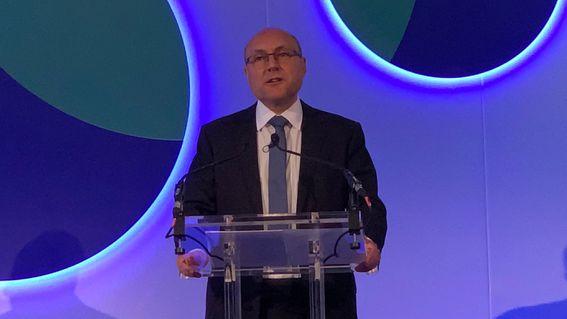
The government plans to propose legislation on fiat-backed stablecoins by early 2024. The government published its proposals for regulating the crypto ecosystem following industry complaints it was dragging its feet The government says it wants to make the U.K. a preferred destination for the industry. The U.K. government published its final rules for the crypto ecosystem, saying it plans a phased introduction of regulation, with legislation for fiat-backed stablecoins being introduced early next year. Other crypto areas, such as algorithmic stablecoins, will follow as the government brings activities like lending and trading into the fold of conventional financial regulation, according to an update published Monday. These rules will bring relevant activities under the purview of the Financial Conduct Authority (FCA). The plans are in line with an April 2022 policy set out by Rishi Sunak, then finance minister and now prime minister, to make the U.K. a crypto-asset hub and are likely to be welcomed by an industry that has complained the government has been dragging its feet. In a statement accompanying the document, Treasury Minister Andrew Griffith said he was "very pleased to present these final proposals for cryptoasset regulation in the U.K." The finalized framework would mean "the U.K. is the obvious choice for starting and scaling a cryptoasset business." The Treasury, the government’s finance arm, published a crypto consultation in February and the consultation closed in April. Parliament passed the Financial Services and Markets Act 2023 in June, enabling crypto to be treated like a regulated activity. The government has already set out that it wants to bring crypto within the fold of traditional financial service regulation – but Griffith has now modified some of his proposals clarifying the treatment of cryptoassets it already considers traditional financial instruments as well as non-fungible tokens (NFTs). "The proposed regime does not intend to capture activities relating to cryptoassets which are specified investments that are already regulated," such as traditional securities, the government document said, adding that unique NFTs that are akin to collectibles or artwork "should not be subject to financial services regulation." However, NFTs used as an exchange token, for example when a large number are released at once and do not vary much in price, might fall within future financial services rules. The FCA will soon consult on an authorization regime for crypto companies, the document said. And the government also plans on formulating equivalence measures for overseas firms: An overseas-regulated trading venue could apply to authorize its U.K. branch, the government proposed, but it will be up to the FCA to determine what this looks like. The government also said it does not intend to ban decentralized finance (DeFi), pointing out it's premature to regulate that aspect of the industry. Further documents published by the government set out that issuance or custody of stablecoins backed by fiat currency will become regulated under existing 2001 rules designed for financial services, with further rules to ensure that any digital payment system can safely fail without bringing down the financial system. The central bank first launched its consultation on a regime for systemic stablecoins in May. The government's plans have not been without controversy. Lawmakers in the House of Commons' Treasury Committee have previously argued that regulating the likes of bitcoin (BTC) and ether (ETH) on the lines of conventional financial services could lull users into a false sense of security, and the government has previously rejected calls to treat crypto like gambling. The crypto industry, meanwhile, has complained of delays and poor feedback from the FCA, while recently introduced rules restricting crypto promotions have led some well-known firms to cut U.K. services altogether. https://www.coindesk.com/policy/2023/10/30/uk-publishes-final-proposals-for-crypto-stablecoin-regulation/
2023-10-30 09:27
The number of transactions of over $100,000 on the Bitcoin blockchain rose to a new year-to-date high last week. Bitcoin's (BTC) onchain activity suggests whales, or investors with ample capital supply and the ability to influence market trends, have been active during the cryptocurrency’s recent move above $35,000. The number of transactions processed on the Bitcoin blockchain involving a movement of at least $100,000 worth of BTC rose to a year-to-date high of 23,400 last week, according to data tracked by blockchain analytics firm IntoTheBlock. The cryptocurrency's price topped the $35,000 mark last week, reaching the highest since early May 2022, according to CoinDesk data. The cryptocurrency has since traded sideways, around $34,000, boasting a 107% year-to-date gain. Prices have surged 27% this month, supposedly on the back of spot ETF optimism and increased haven demand. "The bitcoin spot ETF applications appear to have increased whales' and institutions' appetite for bitcoin," IntoTheBlock said in a newsletter on Friday. "Transactions of over $100k had previously spiked in late June after Blackrock's ETF filing and have now surpassed that level as Bitcoin sets new yearly highs." "The recent rise in institutional activity might be a harbinger for what comes in 2024," IntoTheBlock added. The U.S. Securities and Exchange Commission (SEC) is widely expected to approve several spot-based exchange-traded funds (ETFs) early next year. Analysts expect the impending financialization of BTC through ETFs to boost the cryptocurrency's market value to $42,000 and higher. Blockchain data show retail investors have also become more active in recent weeks. According to data tracked by Deutsche Digital Assets, small entities' onchain activity index, a metric to gauge retail investor activity, tapped a new-year-to-date high of 1.5 last week. "We saw an increasing activity both in small and large BTC wallet entities that implies that especially smaller investors are increasingly flocking into the market," André Dragosch, head of research at Deutsche Digital Assets, said in a note to clients. This can be seen in the significant increase in the median value of transfer volumes on the Bitcoin blockchain, which is indicative of small investor participation. "Note that (new) small investor participation is a necessary condition for a sustained bull market in crypto assets," Dragosch added. https://www.coindesk.com/markets/2023/10/30/bitcoin-whales-take-charge-as-number-of-100k-transactions-surge/