2024-08-26 18:40
The payments company's stablecoin entry was off to a slow start last year on Ethereum, but its recent expansion to the Solana blockchain and DeFi reward programs reignited the token's growth. PayPal's PYUSD reached $1 billion in supply, per CoinMarketCap data. The stablecoin benefited from its expansion to the bustling Solana ecosystem, with its supply on the network already surpassing that on the Ethereum blockchain. Yield incentives on DeFi protocols played a "huge role" in the growth, 21.co's Tom Wan said. Payments giant PayPal's (PYPL) stablecoin PYUSD surpassed the $1 billion mark in market capitalization last week, CoinMarketCap shows. Issued in conjunction with fintech company Paxos, PYUSD achieved this milestone as it more than doubled its supply since June. Despite the broader crypto markets cooling off during the summer doldrums, PYUSD user activity also surged. Monthly active wallet addresses topped 25,000 in July, up from 9,400 in May, according to Visa's stablecoin dashboard created with Alluvium. PayPal's entrance to stablecoins was touted as a "watershed" moment for the broader crypto industry last year, as observers envisioned the token to eventually compete with stablecoin giants Circle's USDC and Tether's USDT. However, early enthusiasm faded as the token's growth fizzled out on the Ethereum (ETH) network. Then came PYUSD's expansion to the Solana (SOL) network at the end of May. The token's supply on Solana went to $650 million from zero in three months, and is already larger than on Ethereum. Over the past month, PYUSD supply on Solana grew by 171% and is rapidly closing in on Tether's USDT on the network, DefiLlama data shows. "Incentives play a huge role" in PYUSD's recent growth, said Tom Wan, business development and strategy associate at digital asset investment product firm 21.co. Integrations with decentralized finance (DeFi) protocols also helped, he added. Solana-based protocols Kamino, Drift and Marginfi all introduced boosted rewards for PYUSD deposits, offering double-digit annualized yields for token holders. Most recently, crypto custody firm Anchorage Digital also introduced rewards for PYUSD deposits to institutions last week. However, concerns linger about how sustainable PYUSD's growth will be if incentives phase out. "My sense is that these incentives are not sustainable, but they are not designed to be permanent," David Shuttleworth, partner at research firm Anagram, told CoinDesk. "Part of the idea here is to get more PYUSD into circulation and get users, especially new ones, on-chain and active on the Solana ecosystem." https://www.coindesk.com/markets/2024/08/26/paypals-stablecoin-hits-1b-market-cap-as-incentives-boost-activity-on-solana/
2024-08-26 18:26
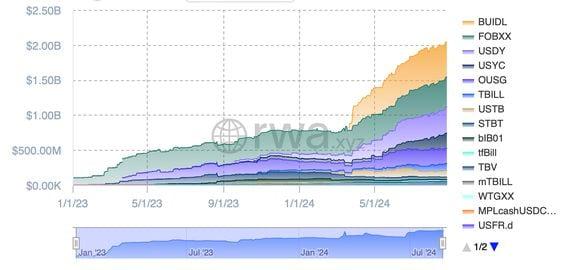
BlackRock's BUIDL has quickly topped $500 million in market cap. Tokenized Treasury notes passed $2 billion in market cap after rapid growth from Blackrock's BUIDL and other issuers. This comes only five months after the funds hit the $1 billion milestone in March. Less than five months after hitting $1 billion in market capitalization, tokenized Treasury notes have doubled in size again, crossing the $2 billion level on Saturday, according to data from RWA.xyz. Tokenized Treasuries are digital representations of U.S. government bonds that can be traded as tokens on blockchains such as Ethereum, Stellar, Solana, Mantle and others. While $2 billion is an impressive milestone for the recently launched funds, there is far more potential given the Treasury market's massive size of $27 trillion. The largest one, BlackRock’s USD Institutional Digital Liquidity Fund (BUIDL), is a big factor in this year's soaring market cap. ust six weeks after its late March launch, BUIDL became the largest tokenized Treasury fund at $375 million in market cap. Assets now stand at $503 million. Competitors include Franklin Templeton’s OnChain U.S. Government Money Fund (FOBXX) and Ondo’s U.S. Dollar Yield (USDY), both of which have also seen explosive growth. Most of the recent growth, however, came from smaller issuers, rwa.xyz data shows. Hashnote's offering mushroomed nearly 50% to hit $218 million over the past month. Meanwhile, OpenEden's and Superstate's products grew 37% and 18%, respectively, during the same period, both nearing $100 million market cap. Tokenized Treasury funds have become a popular investment vehicle for crypto traders looking to diversify their holdings and take advantage of the rapid rise in Treasury yields over the past few years while also being able to settle transactions at any time. The 10 year U.S. yield currently stands at 3.81% versus 1.5% four years ago. Similarly, the 2 year yield has risen to 3.92% up from near zero levels in 2020 and 2021. https://www.coindesk.com/markets/2024/08/26/tokenized-treasury-funds-pass-2b-market-cap-amid-blackrocks-explosive-growth/
2024-08-26 17:50
Tigran Gambaryan’s family says he can no longer walk and has battled multiple bouts of malaria pneumonia. The wife of Tigran Gambaryan, the American Binance employee detained in Nigeria, released a new video statement on Monday pleading for his immediate release from prison. "It has been six months since I last saw my husband, since our children last held their father’s hand," Yuki Gambaryan said in the video. "His health is deteriorating to the point where he can no longer walk. Between bouts of malaria pneumonia and the unimaginable mental toll of his detention, he is now reaching the point of no return." Gambaryan, a former Internal Revenue Service (IRS) agent and Binance’s current head of financial crime compliance, was detained in Abuja in February, shortly after voluntarily traveling to Nigeria’s capital city at the government’s invitation. At first, Gambaryan and another Binance executive, British-Kenyan national Nadeem Anjarwalla, were held under house arrest without explanation. But when Anjarwalla escaped in March, Gambaryan was transferred to the notoriously dangerous Kuje prison, where he has spent the last five months. After being transferred to Kuje, Gambaryan was charged with tax evasion and money laundering – seemingly as a scapegoat for his employer, which Nigerian officials have accused, without evidence, of tanking the value of the naira. The tax evasion charges against Gambaryan were later dropped, but he is currently being prosecuted for money laundering in a trial that began in June, but was suspended in July after the judiciary went on vacation. He has pleaded not guilty to all charges. In the harsh conditions of Kuje prison – which also holds members of the Boko Haram terrorist group – Gambaryan’s health has rapidly declined. In May, he collapsed in court due to malaria and in June was seen being pushed into court in a wheelchair. According to his family, complications from a herniated disc in his back has left him in excruciating pain and unable to walk. Gambaryan has also been prevented from accessing his lawyers, his family has said, and prison officials have refused to release his medical records or provide him with adequate health care despite a court order to do so. Now, his wife says Gambaryan needs immediate medical treatment or "risks permanent damage." Gambaryan’s plight has attracted attention from some members of Congress, including Rep. French Hill (R-Ark.) and Rep. Chrissy Houlahan (D-Penn.) who visited Gambaryan in prison in June and called for his immediate humanitarian release. The same month, a group of lawmakers wrote to U.S. President Joe Biden, Secretary of State Antony Blinken and Presidential Envoy for Hostage Affairs Roger D. Carstens urging them to treat Gambaryan’s case as a hostage situation and bring him back to the U.S. So far, the U.S. Government has failed to make any public statement about Gambaryan’s situation. The State Department said it was "aware of reports" of his detention in March, but did not mention Gambaryan by name. A White House spokesperson referred CoinDesk to the State Department two months later, after multiple requests for comment. "For six months, my life – my living nightmare – has been filed with pleas. Pleas to the Nigerian government. Pleas to the U.S. government. Pleas to the media. Pleas to anyone who will listen. I have been pleading for their mercy, for their understanding, for their humanity," Yuki Gambaryan said in the video statement. "Please help me bring my husband home." https://www.coindesk.com/policy/2024/08/26/my-living-nightmare-detained-binance-execs-wife-begs-for-his-immediate-release/
2024-08-26 16:13
Rumpel Labs seeking to create efficient secondary markets, going live in mid-September. Secondary markets for trading points will provide access for people who want to reduce or increase exposure to points but are unable to do so, and improve price discovery, said Rumpel Labs CEO Kenton Prescott. The project is backed by some big-name VCs like Dragonfly and Variant. Rumpel Labs, a startup that builds tokenization infrastructure for loyalty points, distributed by many decentralized finance (DeFi) and Web3 projects, has emerged from stealth with backing from some big-names in the venture capital arena, like Dragonfly and Variant. Dishing out loyalty points to incentivize user behavior and reward early adopters, often with a promise of airdropped tokens, has become a go-to strategy in the crypto space in recent years. Close to 50% of recent airdrops were distributed to point holders, with notable examples of the power of points programs demonstrated by the rapid proliferation of projects like NFT marketplace Blur, or Ethena’s USDe stablecoin. Airdrops, for crypto, refers to distributing free tokens or coins to users who participate in a particular blockchain network. The strategy is often used by crypto companies to incentivize users to engage with the project, attract new users and grow community engagement. While various projects have seen real value brought by the accelerated growth from leveraging points programs, there have been issues around unmet promises and users getting airdrops and payouts from their point programs that are much less than they were expecting, said Rumpel Labs CEO Kenton Prescott - a former developer of MakerDAO. Meanwhile, there are users out there who want to get extra exposure to these projects, but have no way of getting that, Prescott added. However, more formalized secondary marketplaces need to be created, with better capital efficiency, deeper liquidity and price discovery, while learning lessons from some of the existing attempts to trade point exposure, says Prescott. “These issues are just caused by not having the ability to effectively transfer and trade points,” Prescott said in an interview. “A secondary marketplace with capital efficiency, deep liquidity and price discovery, solves these problems simultaneously.” Rumpel will have its own points program and go live in mid-September. https://www.coindesk.com/tech/2024/08/26/crypto-startup-backed-by-likes-of-dragonfly-aims-to-create-market-to-trade-airdrop-related-points/

2024-08-26 10:31
Governor Shaktikanta Das said there should not be in any rush to roll out a system-wide CBDC. India's retail CBDC pilot has over 5 million users with as many as 16 banks participating. The nation's central bank Governor hinted at the possibility of avoiding a full-scale implementation. India's central bank Governor Shaktikanta Das has said that while their retail central bank digital currency (CBDC) pilot has over 5 million users, there should not be in any rush to roll out a system-wide CBDC. The senior most official of the Reserve Bank of India (RBI) was speaking at at a conference in Bengaluru on Monday. India's plans for a retail and wholesale CBDC were announced as part of the Finance Minister's budget speech in 2022. By 2022-end, the RBI launched pilots for both CBDCs. By 2023-end, the retail CBDC hit a million transactions, at least on one day, with a little help from its friends, the banks. On Monday, Das said as many as 16 banks are currently participating in the retail CBDC pilot but did not reveal a number for the daily transactions. The RBI has previously said it isn’t in a hurry to implement a full-scale, retail CBDC and has not shared any timeline. But on this occasion Das hinted at the possibility of avoiding a full-scale implementation. "Actual introduction of CBDC can be phased in gradually," Das said. "It is important to emphasize that there should not be in any rush to roll out system-wide CBDC before one acquires a comprehensive understanding of its impact on users, on monetary policy, on the financial system and on the economy." Since the start of 2023, the RBI has been exploring offline payments and programmability and Das said this was being tested. "The programmability feature of CBDC could serve as a key enabler for financial inclusion by ensuring delivery of funds to the targeted user," Das said while pointing to two use cases involving farmers launched as part of their pilot recently; Programming the end use for purchase of agricultural inputs to comfort banks and establish the farmer's identity; farmers getting purpose bound money for generation of carbon credits. Das also said other "new use cases aimed at testing features such as anonymity and offline availability are proposed to be rolled out gradually." Read More: India to Release Its Crypto Policy Stance by September After Stakeholder Consultations: Report https://www.coindesk.com/policy/2024/08/26/indias-cbdc-has-5m-users-can-be-phased-in-gradually-central-bank-governor/

2024-08-26 08:42
Trading volumes for the eleven ETFs crossed $3.12 billion to mark their highest level since July 19, SoSoValue data shows. BlackRock’s IBIT led trading activity and inflows at $1.2 billion and $83 million, respectively. U.S.-listed spot bitcoin ETFs saw significant activity with over $252 million in net inflows and trading volumes exceeding $3.12 billion, driven by positive market sentiment following comments at the Jackson Hole symposium. BlackRock's IBIT and Fidelity's FBTC led in inflows, while Grayscale's GBTC experienced outflows. Federal Reserve Chair Jerome Powell's hints at loosening monetary policy at Jackson Hole led to a surge in bitcoin prices above $64,000, with expectations set for a potential rate cut at the next Fed meeting on September 17. U.S.-listed spot bitcoin (BTC) exchange-traded funds (ETFs) recorded over $252 million daily net inflows on Friday, their highest level since July 23, as favorable comments at the Jackson Hole symposium buoyed risk assets, including bitcoin. Trading volumes for the eleven ETFs crossed $3.12 billion to mark their highest level since July 19, SoSoValue data shows. BlackRock’s IBIT led trading activity and inflows at $1.2 billion and $83 million, respectively. Fidelity’s FBTC was next with $64 million in inflows, while Bitwise’s BITB took in $42 million to cross the $2 billion AUM mark for the first time. Grayscale’s GBTC was the only product showing net outflows at $35 million. However, its mini bitcoin fund BTC was in the green with $50 million inflows. Federal Reserve chair Jerome Powell confirmed signs that the public agency is set to loosen monetary policy at the Jackson Hole symposium on Friday, with bitcoin rallying above $64,000 afterward. "The time has come for policy to adjust," Powell said in his speech. "The direction of travel is clear, and the timing and pace of rate cuts will depend on incoming data, the evolving outlook, and the balance of risks." Crypto traders widely expect the Fed to deliver its first rate cut at its next policy meeting scheduled for September 17. Tighter monetary policies typically dampen risk appetite in financial markets, while lower rates increase the allure of asset classes such as crypto as investors have cheaper access to capital pools. https://www.coindesk.com/markets/2024/08/26/bitcoin-etfs-log-250m-net-inflows-highest-since-july-after-rate-cut-signal-at-jackson-hole/