2024-09-25 12:10
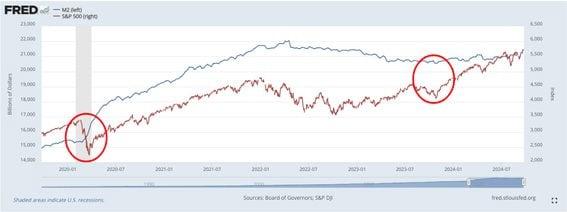
Expansionary policies by not just the Fed, but other global central banks, appear to be fueling asset price appreciation. In August alone, the M2 money supply rose nearly 1%, and the Fed since has trimmed interest rates 50 basis points, with what looks like another 50 basis point rate cut coming in November. Aggressive monetary easing by China and the U.S. Federal Reserve has driven asset price increases, with cryptocurrencies leading the charge since the recent FOMC meeting. The growth of the M2 money supply, with a CAGR of 7% in the past five years, has been closely linked to the performance of the S&P 500 and other assets, underscoring the critical role of liquidity in driving market performance. On Sept. 24, financial assets soared to record levels, among them the S&P 500, which reached a record high of 5,735 and gold, which climbed to $2,670 an ounce. The yellow metal, in fact, is now higher by 30% year-to-date, making 2024 the best-performing year for gold this century, according to Zerohedge. But what is driving these continual rallies in financial markets? A closer look reveals that liquidity and money supply are key factors. Central bank policies have significantly contributed to injecting liquidity into the global economy. As of Sept. 25, the combined balance sheets of the top 15 central banks worldwide exceeded $31 trillion, a level last seen in April 2024. This figure has been on the rise since July, reflecting a substantial monetary stimulus primarily in response to economic challenges and uncertainties, which has been crucial in supporting financial markets. China's commitment to substantial monetary easing, combined with the U.S. Federal Reserve's aggressive 50 basis point rate cut, has further fueled market momentum, making cryptocurrencies the best-performing asset since the FOMC meeting on Sept. 18. The CME FedWatch Tool now predicts a 60% chance of another 50 basis point cut at the Nov. 7 meeting, which would lower the fed funds rate range to 4.25-4.50%. Another key indicator of liquidity is the M2 money supply, which includes physical currency in circulation, savings and time deposits, and money market mutual funds. According to Trading Economics data, M2 money supply has shown consistent month-on-month growth, a trend that began in February 2024. In August alone, the M2 money supply increased by nearly 1% month-on-month, highlighting the ongoing monetary expansion. This rise in the money supply has been crucial in supporting asset prices. Historically, there has been a strong correlation between the S&P 500 and the M2 money supply, with both moving in tandem over the past five years. For example, during the early 2020 pandemic, M2 bottomed out at $15.2 trillion in February, just before the S&P 500 hit a low of around 2,409 points in March. A similar pattern occurred in October 2023, when monetary policy tightening led M2 to bottom at $21 trillion. Shortly afterward, the S&P 500 reached a low of 4,117. This connection highlights the critical role of liquidity in driving stock market performance. The compound annual growth rate (CAGR) of the M2 money supply has been 7%, while the S&P 500 has achieved a CAGR of 14% over the past five years. Although this represents strong performance, it is overshadowed by bitcoin's (BTC) impressive CAGR of 50% during the same period. Despite its volatility, bitcoin's higher growth rate reflects its increasing prominence as an asset class, often benefiting from the same liquidity dynamics that drive traditional markets. Central banks' expansionary policies combined with a rising money supply are fueling asset price appreciation across the board. Whether it’s gold, the S&P 500, or bitcoin, the correlation with monetary measures like M2 highlights how liquidity remains a key driver of asset performance in today’s economy. As long as central banks continue to provide support, financial markets may well continue to push higher, though the sustainability of this trend remains a question for the future. https://www.coindesk.com/markets/2024/09/25/us-m2-money-supply-approaches-new-highs-as-financial-assets-reach-record-levels/
2024-09-25 11:56
On-chain data shows the hacker, or hacker group, behind the massive theft has almost completed laundering the stolen funds. The hacker behind July's $230 million WazirX hack has nearly finished laundering the stolen funds, using Tornado Cash to obscure the transactions. Just $6 million worth of ether is left. WazirX has been restructuring following the hack, which compromised over 45% of its reserves, and is facing challenges in fund recovery and criticism for its crisis management. Whoever was behind India’s biggest cryptocurrency hack is almost done laundering over $230 million worth of tokens, on-chain data shows. A wallet holding funds stolen from WazirX, formerly one of the country’s largest exchanges by trading volume, in July, is down to only $6 million worth of ether (ETH). Blockchain data from Arkham show the funds are usually moved to new wallets before being sent to privacy service Tornado Cash. The hacker moved just over $50 million worth of tokens to Tornado in August and stepped up activity in September, as the chart below shows. The latest movement was a 3,792 ETH ($10 million) transfer to a wallet early on Wednesday. Tornado Cash allows crypto users to exchange tokens while masking wallet addresses on various blockchains. The service, by itself, is not nefarious but is commonly used by criminals to clean an online trail that could lead to the identity of those moving stolen funds. Alexey Pertsev, Tornado Cash developer, was found guilty of money laundering by a Dutch judge in May and sentenced to 64 months in prison. In July, WazirX was hit by a security breach in one of its multisig wallets, causing over $100 million in shiba inu (SHIB) and $52 million in ether, among other assets, to be drained from the exchange. The stolen funds accounted for over 45% of the total reserves cited by the exchange in a June 2024 report. The exchange has since filed for a restructuring process in Singapore to clear its liabilities. WazirX, still reeling from the financial and reputational damage, has engaged in efforts to recover the funds with limited success. It has faced criticism for its handling of the crisis, especially concerning user communication and fund recovery processes. Amidst this, Binance, which has had a contentious relationship with WazirX, clarified its lack of involvement in the security breach last week, emphasizing that it does not control or operate WazirX. That differs from what founder Nischal Shetty stated on X in August. https://www.coindesk.com/business/2024/09/25/wazirx-hacker-is-almost-done-laundering-230m-stolen-funds/

2024-09-25 11:07
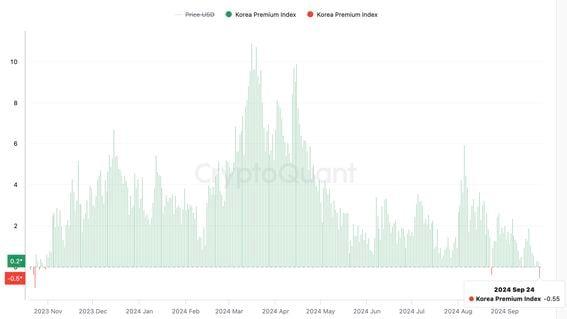
Smart traders have shifted to high-beta altcoins, data tracked by 10x Research show. Bitcoin is trading on Korean exchanges at the steepest discount since October 2023, according to CryptoQuant. Smart traders have shifted to high-beta altcoins, data tracked by 10x Research show. Crypto traders on South Korea-based exchanges seem to have shifted from bitcoin (BTC) to alternative cryptocurrencies (altcoins) amid bullish analysts' forecasts in the wake of the recent U.S. interest-rate cut. That's the message from analytics firm CryptoQuant's Bitcoin Korea premium index, which measures the price gap between Korean and offshore exchanges. The index turned negative Wednesday, sliding to -0.55, reflecting the deepest discount since October 2023. In other words, bitcoin has fallen out of favor in Korea. Trading volumes over Korean exchanges suggest the same, indicating a shift toward high-beta alternative cryptocurrencies. The chart by 10x Research shows daily Korean trading volumes over the past 40 days, with the most traded pair each day. Lately, traders have shifted from the bitcoin-korean won (BTC/KRW) pair to altcoins like UXLINK, CKB, ARK and PENDLE. Traders elsewhere are focusing on altcoins as well, anticipating more Federeal Reserve rate cuts in the coming months. "Quick-moving traders are seizing the opportunity to load up on their favorite altcoins, anticipating a strong Q4 rally," Markus Thielen, founder of 10x Research, said in a note to clients on Wednesday, noting the shift away from bitcoin. "As Bitcoin surged past $60,000 and set its sights on breaking $65,000, savvy traders have accumulated undervalued altcoins, including TAO, ENA, SEI, APT, SUI, NEAR, and GRT," Thielen wrote. https://www.coindesk.com/markets/2024/09/25/bitcoins-south-korea-discount-hits-highest-since-october-2023/
2024-09-25 10:12
A regulator's comment at a crypto summit sparked industry concerns that companies may look to move abroad. Australia's crypto industry is worried after the country's securities regulator signaled an expansion of its power. ASIC said it considers many crypto assets as financial products, adding a regulatory burden that may spur companies to move elsewhere. Australia's crypto industry is concerned companies may flee the country after the nation's securities regulator set off "the crypto fire alarm," by saying it considers most crypto assets to be financial products in what some observers interpreted as an expansion of its powers, experts told CoinDesk on Wednesday. Symbolically, a real fire alarm sounded – unnecessarily, it transpired – at a crypto summit hosted by the Australian Financial Review (AFR) shortly after the comment by the Australian Securities and Investment Commission's (ASIC) Alan Kirkland. He had told what the AFR called a hostile crowd at Monday's event that ASIC thinks "many widely traded crypto assets are a financial product.” Many, therefore, are likely to need a license under current laws. Kirkland's comments raised concerns the regulator is tightening its oversight and is likely to impose onerous conditions that could drive companies offshore. ASIC is adopting "a more stringent approach" and businesses are "feeling uncertain," which could drive them to explore opportunities abroad, Amy-Rose Goodey, the managing director of the Digital Economy Council of Australia told CoinDesk The comments "should prompt urgent industry consultation with policymakers" said Michael Bacina, a partner at law firm Piper Alderman. "If ASIC maintains their regulation by enforcement approach ... then ASIC will be taking a path the U.S. SEC took years ago. Having the courts set the regulatory perimeter is highly inefficient for both the regulator and the industry.“ ASIC has already resorted to court action against crypto companies, including one dismissed case against Finder Wallet. That company's founder, Fred Schebesta, was on the stage straight after Kirkland's comments when the fire alarm went off, AFR reported. The irony was clear. Schebesta told the audience that Kirkland's approach was like giving "the Wright Brothers a fine because they didn’t have a pilot’s licence," according to AFR. He later told CoinDesk: "The laws need to be updated to provide certainty" as even "the ongoing maintenance and compliance post-licensing can be quite burdensome." According to Kate Cooper, Australia CEO and head of APAC for Zodia Custody, said many crypto companies "are finding the status quo in Australia untenable, and are planning on seeking career or business opportunities in jurisdictions where regulation is much clearer like Dubai and Singapore." ASIC's approach highlights the gray area in the country's crypto regulation, with draft legislation that was announced in 2023 still not enacted. "There still remain many grey areas in regulation of crypto, especially with further delay to the introduction of the new regulation which is not expected until mid 2025 at the earliest," Cooper said in a WhatsApp message. Andrew Charlton, a member of parliament representing the government who was also at the event was unable to say whether the bill would appear before the next federal election. One is expected next year, but a date has not been set. ASIC did not respond to a CoinDesk request for comment before publication. https://www.coindesk.com/policy/2024/09/25/a-fire-alarm-interrupted-an-aussie-crypto-summit-the-symbolism-wasnt-missed-by-a-concerned-industry/

2024-09-25 09:11
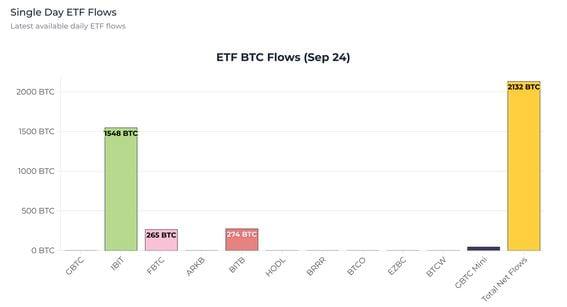
Ether ETFs experienced a $62.5 million inflow, marking its third-largest day since launch. Bitcoin ETFs recorded $136 million in inflows, with BlackRock’s IBIT contributing $98.9 million, equivalent to 1,548 BTC. Ether ETFs saw $62.5 million in inflows, led by BlackRock’s ETHA with $59.3 million, third-largest day for Ether ETF inflows since launch. Bitcoin (BTC) exchange-traded funds (ETFs) listed in the U.S. are doing their bit to boost supply scarcity in the crypto market. According to the latest data from Farside Investors, bitcoin {{btc}} exchange-traded funds (ETFs) saw an inflow of $136.0 million on Sept. 24. Leading this surge was BlackRock's IBIT ETF, which experienced a significant inflow of $98.9 million, marking its largest inflow since Aug. 26. This brings IBIT's total net inflows to over $21 billion, reinforcing its number one position in the market. Other notable contributors included Fidelity's FBTC, with $16.8 million in net inflows, and Bitwise's BITB, which attracted $17.4 million. More importantly, the inflows on Sept. 24 were equivalent to 2,132 BTC, with IBIT accounting for 1,548 BTC, per HeyApollo data. Given that the current daily issuance of Bitcoin is around 450 BTC, these inflows represent nearly five times the daily mined supply being removed from the market. Overall, bitcoin ETF inflows have reached $17.8 billion, underscoring continued investor interest in these investment vehicles. Ethereum ETFs Ether (ETH) ETFs recorded $62.5 million in total inflows on Sept. 24, making it the third-largest day for Ether ETF inflows since launch. BlackRock's ETHA led the charge with a $59.3 million inflow, its largest since Aug. 9. This rebound came just a day after Ether ETFs saw their largest outflows since July, underscoring the volatility inherent in the crypto markets. Despite the intense inflow day, total outflows from ether ETFs stand at $624.4 million, reflecting the broader uncertainty investors face with ether compared to bitcoin. As of press time, bitcoin is trading at $63,803, while ether is trading at $2,624, according to CoinDesk data. https://www.coindesk.com/markets/2024/09/25/bitcoin-etfs-remove-nearly-five-times-daily-supply-as-ethereum-etfs-see-strong-rebound/
2024-09-25 07:05
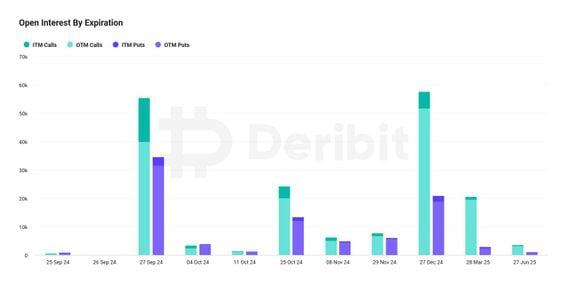
The so-called quarterly expiry is due Friday at 08:00 UTC. A notable amount of bitcoin and ether open interest is set to expire "in-the-money" on Friday, setting stage for price swings, Deribit's Luuk Strijers said. Options beyond the Friday expiry exhibit a bullish bias for bitcoin and ether. BTC's max pain level of $59,000 may weigh over prices, analyst at Presto Research said. The bitcoin (BTC) market may get busy in the next two days as options contracts worth several billion dollars are due to expire Friday at 08:00 UTC, cryptocurrency exchange Deribit told CoinDesk in a message Wednesday. As of writing, 90,000 BTC options contracts worth $5.8 billion were due for settlement alongside $1.9 billion in ether options. One Deribit one options contract represents one BTC or one ETH. Deribit is the world's leading cryptocurrency options exchange, accounting for over 85% of the global activity. Of the total bitcoin open interest of $5.8 billion, about 20% was "in-the-money" or having favorable strike prices compared to the cryptocurrency's going market rate. A similar positioning is seen in ether options. For call options, being in-the-money means having a strike price lower than the going market rate, while it's the other way around for ITM puts. Both allow holders to exercise their right to buy or sell profitably, setting the stage for market volatility. "Of the BTC options expiring, about 20% is in the money. This larger expiry is likely to heighten market volatility or activity as traders close or roll over their positions, which could also impact prices," Luuk Strijers, chief executive officer at Deribit, told CoinDesk in an interview. Rollover of positions means closing existing traders in the upcoming expiry and opening new ones in the subsequent expiries to extend the holding period. Profit-making positions are often rolled over as seasoned traders prefer to let winners run. What next? Activity is likely to remain robust in months ahead, as the U.S. SEC's decision to green light options tied to BlackRock's bitcoin ETF (IBIT) could accelerate institutional adoption. "One of the largest potential drivers is the options on ETFs. The SEC has given its blessing, but OCC and CFTC have yet to approve it and are not likely to do so this week," Strijers said. The way options expiring in the coming months are priced suggests a bullish outlook. "BTC and ETH put-call skew is negative after September expiry, which is a bullish indicator as calls are relatively more expensive than puts," Strijers noted. A call option provides buyer an asymmetric bullish exposure, protecting from price rallies while a put options provide insurance against market swoons. The bullish bias in the options market is consistent with the consensus that the Fed's renewed rate-cut cycle and similar moves from other central banks, including the People's Bank of China, will underpin demand for bitcoin and ether. According to analysts at Birtfinex, the rally could gather pace once bitcoin tops the $65,200 level. Max pain effect The max pain is the price level at which option buyers suffer the most loss on expiry. A popular theory in traditional markets often cites the max pain level as a magnet while heading into the expiry. That's because option sellers, usually large institutions with ample capital supply, trade the underlying asset to influence the spot price around the maximum pain point to inflict maximum loss on buyers. Bitcoin's max pain level for Friday's expiry is $59,000."The current max pain point of $59,000, approximately 8% below the spot price, does create some potential downward pressure as we approach expiry," Rick Maeda, an analyst at Presto Research, told CoinDesk. The max pain theory has been doing the rounds since 2021, although some believe the crypto options market is still relatively small to have a meaningful impact on the spot price. https://www.coindesk.com/markets/2024/09/25/bitcoins-58b-quarterly-options-expiry-may-spark-market-swings-deribit-says/