2024-08-19 06:10
Many crosscurrents influencing prices, such as U.S. monetary policy expectations and supply overhangs, might be responsible for the weak correlation between election odds and BTC prices. Comparison of three-day changes in BTC's price and Republican election odds between June 1 and Aug. 15 show lack of definitive correlation between the two variables. A lot could change in the coming weeks, according to FalconX. While the popular narrative suggests a strong positive link between bitcoin's (BTC) recent price performance and Republican candidate Donald Trump's victory odds in the U.S. presidency rate, market data suggests otherwise. Since Trump's mid-June meeting with bitcoin miners, crypto market experts have consistently associated the Republican candidate's performance on betting markets with bitcoin's price. The narrative strengthened after Trump survived an assassination attempt in July and as BTC came under pressure early this month amid Democrat candidate Kamala Harris' resurgence in betting markets. However, prime broker FalconX's analysis of the three-day change in BTC's price and the three-day change in Polymarket odds of Trump winning the presidential election between June 1 and Aug. 15 shows a lack of definitive trend or clear correlation between the two variables. The X-axis shows the three-day percentage increase or decrease in BTC's price between June 1 and Aug. 15. The Y-axis represents the increase/decrease in the odds of a Republican victory. Data has been sampled every 12 hours. The red dots represent the period between June 29 and July 29 when Trump's probability of entering the White House surged on Polymarket. The blue dots represent the so-called Democrat momentum period. The grey dots represent the rest of the period between June 1 and Aug. 15. The red dots show a scattered pattern, implying no connection between shifts in Republican odds and changes in BTC's price. The blue and grey dots show a similar pattern. “Interestingly, there has not been a noticeable relationship between election odds and BTC prices throughout the entire analysis period from June 1 to August 15, 2024. One reason for these weaker-than-expected relationships could be the many crosscurrents influencing prices, such as the path of monetary policy in the U.S., concerns around upcoming supply overhangs, and others, as we highlighted before," David Lawant, head of research at FalconX, said in an email to CoinDesk. Some of the crosscurrents, like aggressive selling by The German state of Saxony and fears of supply deluge from defunct exchange Mt. Gox's creditors, have reportedly capped the upside in BTC since June, overshadowing shifts in the Republican odds. Still, with Harris now catching up on crypto, the impending election could become a dominant driver of BTC prices. "Of course, a lot can change before November 5. As we get closer to election day, it’ll be fascinating to see if prediction market data reveals election news as a key driver—or even the dominant force—behind price action," Lawant noted. https://www.coindesk.com/markets/2024/08/19/trumps-election-odds-are-not-the-dominant-driver-of-bitcoins-price-data-show/
2024-08-16 12:22
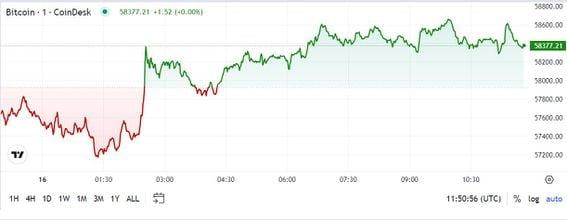
The latest price moves in crypto markets in context for Aug. 16, 2024. Latest Prices CoinDesk 20 Index: 1,888 −0.3% Bitcoin (BTC): $58,376 −0.7% Ether (ETC): $2,614 −1.0% S&P 500: 5,543.22 +1.6% Gold: $2,504 +2.1% Nikkei 225: 38,062.67 +3.64% Top Stories The crypto market was in quiet mode during the Asian and European mornings to end the week, with bitcoin 0.45% lower over 24 hours near $58,500. ETH lost 0.7%, while SOL led gains, adding 0.44%. The broader digital asset market, as measured by the CoinDesk 20 Index, is about 0.39% higher. Bitcoin capitulated to under $57,000 late Thursday, a drop for which there was no obvious catalyst, given that both the Nasdaq and S&P 500 were ticking upward at the time. South Korea's National Pension Service has bought almost $34 million worth of MicroStrategy shares. Following the software company's 10:1 stock split earlier this month, the pension fund now owns 245,000 MSTR shares valued at $32.32 million, based on Thursday's closing price of $131.93. The purchase can be seen as an indirect investment in bitcoin because MicroStrategy is the largest corporate holder of the largest cryptocurrency. Earlier this month, Wall Street broker Benchmark raised its price target on the Michael Saylor-led firm to $2,150 from $1,875. Benchmark raised the target even though MicroStrategy missed its second-quarter revenue target. NPS also holds over $45 million worth of Coinbase shares. The New York Stock Exchange scrubbed plans to list bitcoin ETF options, according to an SEC filing. The SEC extended its review period multiple times after publishing the NYSE proposal for public comment in February, eventually initiating formal proceedings in April. The proposal was withdrawn by the exchange before a final decision was made. CBOE, where a number of the bitcoin ETFs are traded, also withdrew its application, but has since refiled with a much more extensive proposal, according to documents spotted by Bloomberg's James Seyffart. The SEC hasn't provided public comment or feedback on the issue. Chart of the Day The chart shows the recent flows and total AUM of the U.S.-listed spot bitcoin ETFs. BlackRock's iShares ETF has recently eclipsed Grayscale's Bitcoin Trust as the largest in terms of AUM. Grayscale's GBTC, having already existed in a different form for several years, had a massive headstart on the debuting ETFs when they listed in January, but has experienced significant outflows to its competitors since. Source: Bloomberg, CoinShares - Jamie Crawley Trending Posts Donald Trump Holds Over $1M in Ether, Also Receives NFT Licensing Fees What's Next in SEC v. Ripple? Bitcoin's Programmability Draws Closer to Reality as Robin Linus Delivers 'BitVM2' https://www.coindesk.com/markets/2024/08/16/first-mover-americas-crypto-trades-little-changed-following-thursdays-slide/
2024-08-16 11:58
Recent flows show GBTC experiencing outflows, while BlackRock's ETHA saw inflows, contributing to this shift. BlackRock's spot Bitcoin (IBIT) and Ether (ETHA) ETFs have surpassed Grayscale's equivalent funds in assets under management. As of the latest data, BlackRock's ETFs collectively manage over $21.217 billion, slightly more than Grayscale's $21.202 billion. Recent flows show GBTC experiencing outflows, while BlackRock's ETHA saw inflows, contributing to this shift. BlackRock’s spot bitcoin (BTC) and ether (ETH) exchange-traded funds (ETFs) have flipped Grayscale’s products for the first time to become the largest crypto-focused publicly traded funds in terms of assets under management. BlackRock’s bitcoin ETF, IBIT, and ether ETF, ETHA, overtook Grayscale’s GBTC, BTC Mini, ETHE and ETH Mini, according to on-chain holdings on Friday. The company’s ETFs now have the largest collective holdings of any provider, on-chain analysis tool Arkham said in an X post. As of Friday, BlackRock’s ETF Holdings cumulatively held over $21.217 billion, compared to Grayscale's $21.202 billion across its ETFs. Flows data shows GBTC recorded outflows of $25 million on Thursday, while BlackRock had no net inflows or outflows. Grayscale’s ETHE recorded $42 million in net outflows, while BlackRock’s ETHA took on $740,000 in net inflows, SoSoValue data shows. IBIT became the biggest bitcoin ETF by assets under management in May, topping the $20 billion mark in June after their January release. Grayscale’s GBTC have lost $19.57 billion worth of BTC since January, data shows. https://www.coindesk.com/markets/2024/08/16/bitcoin-ether-held-in-blackrock-etfs-cross-those-of-grayscales-for-the-first-time/

2024-08-16 11:27
The fees represent a more than 95% drop from the 83.1 gwei levels in March, when the network saw a spike in activity. Ethereum's gas fees plummeted to a five-year low earlier this week, with some attributing the drop to users and applications migrating to trendier blockchains. Analyst Ryan Lee suggests that historical data shows a correlation between low gas fees and a subsequent increase in ETH price. A steep drop in fees paid to transact on the Ethereum could spell a bullish sign for the network’s underlying ether (ETH) tokens, one analyst said, citing historical data. “Every time ETH gas fees drop to rock bottom has often signaled a price bottom in the mid-term,” Ryan Lee, chief analyst at Bitget Research, in Friday note to CoinDesk. "ETH prices tend to strongly rebound after this cycle, and when this moment coincides with an interest rate cut cycle, the market's wealth effect is full of possibilities.” Gas refers to the necessary cost a user must pay to perform a transaction on the network. Fees dipped as low as 0.6 gwei (a unit of gas) earlier this week with low-priority transactions costing only 1 gwei or lower – a rare occurrence in recent years. The fees represent a more than 95% drop from the 83.1 gwei levels in March, when the network saw a spike in activity. Lack of demand for Ethereum block space and a preference for using applications on other blockchains has likely led to the drop in fees, Lee said. "The drop in Ethereum’s gas fee prices to a five-year low can be attributed to the migration of meme season and Dapp interactions to other faster and cheaper blockchains like Solana and Layer 2, as well as the long-awaited Dencun upgrade that had improved the network efficiency and, therefore, reduced the gas fees,” he explained. Dencun refers to two majors updates from March that changed how transactions were processed and validated on the Ethereum network. Since July, Solana-based application Pump has pocketed more fees than the entire Ethereum network in a single 24-hour period on a few occasions, most recently on August 13. Meanwhile, the lower amount of ether (ETH) being burned due to lower fees means that the token’s supply has begun to increase. Data shows that nearly 16,000 ETH, or nearly $42 million at current prices, was added to ether's total supply over the past week, pushing supply on track grow 0.7% this year. https://www.coindesk.com/markets/2024/08/16/record-drop-in-ethereum-gas-fees-marks-historically-bullish-signal-for-eth-analyst-says/

2024-08-16 09:54
Memecoins have become a key component of the recent crypto bull market. Sun.io, the DeFi platform associated with Tron founder Justin Sun, has released a token generator dubbed SunPump. The new platform will rival Solana's pump.fun token generator. $10 million has been set aside to provide resources to newly issued tokens and a review process put in place to avoid rug pulls. Sun.io, the decentralized finance (DeFi) protocol associated with Tron founder Justin Sun, has released SunPump, a platform that allows users to create memecoins on the Tron blockchain. The platform will rival the popular Solana equivalent, pump.fun, where transaction fees surged to an all-time high this week with a total of $5.3 million in 24 hours. Memecoins, despite often being issued as a joke, have become a key part of the recent crypto bull market. Several, including SHIBA, PEPE, WIF and FLOKI, have surpassed a $1 billion market cap. One of the key criticisms of platforms like pump.fun is that it creates a cheap way for bad actors to create a memecoin only to perform a rug pull once investors have added value. "To address this, the Sun team is committed to enhancing our review processes, introducing community oversight, and promoting transparency to ensure the safety and trust of our users," Sun said in an interview. "SunPump conducts a thorough vetting of creators and projects before they are allowed to launch on the platform, helping to ensure that they meet specific standards of integrity." When asked what sets the two projects apart, Sun said that due to a partnership with crypto exchange Poloniex, projects that maintain $1 million in daily trading volume for three days will be eligible to be listed on the platform. Tron and SunPump are also putting $10 million together to create the Meme Ecosystem Boost Incentive Program, designed to provide resources for newly launched tokens. https://www.coindesk.com/business/2024/08/16/justin-sun-bets-on-memecoins-with-tron-based-token-generator/

2024-08-16 07:35
NPS also holds over $45 million worth of Coinbase shares. South Korea's pension fund bought 24,500 shares of the Michael Saylor-led firm, before the 10:1 stock split. The MicroStrategy purchase can be seen as indirect investment in bitcoin (BTC). South Korean pension fund, National Pension Service (NPS), bought MicroStrategy (MSTR) shares worth nearly $34 million in the second quarter of this year, according to a filing made public earlier this week. The fund disclosed that it purchased 24,500 shares at an average price of $1,377.48, before MicroStrategy announced a 10-for-1 stock split in the beginning of this months. This brings the total number of shares to 245,000, valued at $32.32 million, based on MicroStrategy's last close of $131.93. The purchase by NPS can be seen as an indirect investment in bitcoin (BTC) as MicroStrategy is the largest corporate holder of the token. Earlier this month, Wall Street broker Benchmark raised its price target on the Michael Saylor-led firm to $2,150 from $1,875. Benchmark raised the price target despite MicroStrategy missing its revenue target for Q2. NPS also holds 229,807 shares of Coinbase (COIN), worth over $45 million, based on Coinbase's last close of $197.12. The fund started buying shares in the crypto exchange in 2023, snapping up 282,673 shares at an average price of $70.5. Read More: MicroStrategy Is Pioneering Bitcoin Capital Markets, Bernstein Says https://www.coindesk.com/policy/2024/08/16/south-koreas-pension-fund-snaps-up-nearly-34m-microstrategy-shares/