2024-08-06 06:55
The notice, a first step taken by the authority when it suspects tax evasion, was issued to Binance last week. Binance has been issued a tax showcause notice of nearly $86 million in India. Binance has challenged the notice, which covers the period June 2017-March 2024, according to a person familiar with the matter. Binance, the world's largest cryptocurrency exchange, is challenging a nearly $86 million tax showcause notice from India's Directorate General of Goods and Services Tax Intelligence (DGGI), a person directly involved with the matter told CoinDesk. DGGI's chapter from the western city of Ahmedabad issued the notice – a first formal step taken by the authority when it suspects a violation of tax rules – last week. It alleges Binance collected fees from Indian customers trading on its platform, the person said, and relates to the period July 2017-March 2024. While DGGI has previously taken action against Indian crypto exchanges, this may be the first time it has issued a showcause notice to an international crypto exchange. The DGGI is entrusted with “collection, collation and dissemination of intelligence relating to evasion of indirect tax” and functions under the purview of the Ministry of Finance. "We are currently reviewing the details of the notice and are fully cooperating with the Indian tax authorities," a Binance spokesperson told CoinDesk via email. DGGI did not immediately respond to a CoinDesk request for comment. In June 2024, Binance was fined about $2.2 million for providing services to Indian clients without adhering to the nation's anti-money laundering rules. The process also saw the exchange winning Financial Intelligence Unit (FIU) approval as a registered entity. The DGGI's investigation is independent from the FIU. It's worth noting that showcause notices do not always result in monetary penalties. Earlier this month, the DGGI dropped part of its allegations against Bengaluru, India-based Infosys after the global tech company challenged such a demand. Read More: The Inside Story of How India’s Crypto Exchanges Were ‘Inspected’ by Tax Agencies Binance is said to have earned more than $476 million (40 billion rupees) in transaction fees that were transferred to a Binance Group company, the Seychelles-based Nest Services, the Economic Times reported citing a source privy to the development. "Binance is, and has always been, committed to adhering to relevant domestic legislations applicable to us," the company spokesperson said. The services provided fall under the category of Online Information and Database Access or Retrieval Services (OIDAR), the person familiar said. These are services provided through the internet and received by the recipient online without having any physical interface with the service supplier. The categorization exists to avoid giving an unfair advantage to overseas service providers over an Indian service provider. https://www.coindesk.com/policy/2024/08/06/binance-has-challenged-indias-86m-tax-showcause-notice-source/

2024-08-06 05:57
Asian stocks and futures jumped higher Tuesday, recovering from one of the worst slides in recent years in Monday’s trading session. Bitcoin and Japanese stocks look to stabilize amid rate cut talks. Institutional investors sold spot ETFs Monday. Bitcoin (BTC) zoomed above $56,000 early Tuesday amid a broader market recovery in Asia as bargain hunters stepped in after Monday's steep price slide. CoinGecko data shows that BTC added 6%, its highest 24-hour price increase since May, triggering a wider market recovery. Ether (ETH) and XRP (XRP) added 8%, BNB Chain’s BNB rose 12%, and Solana’s SOL surged as much as 16%. The broad-based CoinDesk 20 (CD20), a liquid index of the largest tokens by market capitalization minus stablecoins, jumped 7.26% and recorded over $95 million in trading volumes. Japan's Topix jumped about 10% as the yen weakened against the U.S. dollar, snapping a five-day surge. Futures tracking the S&P 500 rose 1.5%, while the tech-heavy Nasdaq 100 jumped 2.1%. Renewed hopes for faster Fed rate cuts in the wake of Monday's global market slide seem to have restored risk sentiment. Read More: Bitcoin's Unreliable Death Cross Is Looming Again Still, crypto market watchers remain cautious about a continued rally among major tokens. “We might see a corrective rebound in Bitcoin's price,” Ruslan Lienkha, chief of markets at YouHodler, told CoinDesk in a Tuesday email. “However, this increase will likely be limited due to the prevailing pessimism in the broader markets.” “Overall, the recent drop in Bitcoin's price is not significantly worse than the decline in the Nikkei index, indicating that the current sentiment is driven by external factors rather than issues within the crypto market itself,” Ruslan said. “It is unclear if we are entering a bearish market, and much will depend on the performance of the equity markets this month.” On Monday, the crypto and global stock markets experienced one of their deepest losses in recent years. A strong Japanese yen triggered an unwinding of carry trades, accelerating a sell-off that started last week due to geopolitical tensions in the Middle East. Japan’s Topix 100 index posted its most significant drop since 2011. Meanwhile, bitcoin's yen-denominated price on the Tokyo-based bitFlyer exchange dropped nearly 15%, significantly more than its dollar-denominated price on Western exchanges Read More: These Two Bitcoin Indicators Offer Light in a Gloomy Market Institutional investors sold off spot BTC exchange-traded fund (ETFs) holdings amid a heavy volume day on Monday. The U.S.-listed products recorded $168.4 million in net outflows, bringing net withdrawals to over $300 million this month. https://www.coindesk.com/markets/2024/08/06/bitcoin-jumps-above-56k-solana-leads-recovery-from-mondays-rout/

2024-08-06 01:21
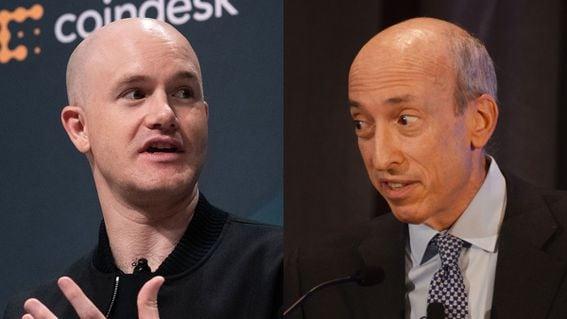
The regulatory agency has taken umbrage with Coinbase’s attempt to subpoena SEC Chair Gary Gensler’s personal emails. The U.S. Securities and Exchange Commission complained to a federal judge that Coinbase tried to dig too deep when it went after the records of agency Chair Gary Gensler. The SEC made the latest filing in the court case in which the regulator is pursuing the U.S. exchange for violating securities laws. Lawyers for the U.S. Securities and Exchange Commission (SEC) are pushing back against what they describe as Coinbase’s “breathtakingly broad” subpoena requests searching for “essentially all documents that in any way relate to crypto.” The court documents, filed Monday, are the latest jab in the ongoing fight between the SEC and Coinbase over the crypto exchange’s attempt to subpoena the agency and its employees, including Chair Gary Gensler, for communications and other records that could potentially be useful for Coinbase’s defense in its upcoming trial against the regulatory agency. The SEC filed civil charges against Coinbase last year, accusing the crypto exchange of operating as an unregistered securities exchange, broker and clearing agency. The SEC also charged Coinbase with the unregistered sale of securities in connection with its staking products. In April, Coinbase served the SEC with its first request for the production of documents. Two months later, Coinbase told the SEC that it also planned to subpoena Gensler’s personal communications related to crypto over the course of his tenure, plus four years before he was appointed Chairman. Coinbase also served a similar subpoena on Massachusetts Institute of Technology (MIT), where Gensler taught a class on blockchain technology before joining the SEC. However, the company recently informed the court that it wouldn't seek records from outside his agency role. Read More: Coinbase Narrows Demand for SEC Chair Gensler's Crypto Messages The request for Gensler’s personal communications appears to have been a bridge too far for the SEC, which has described the subpoena as a “blatant impropriety.” In a letter to the court on June 28, the SEC argued that the judge overseeing the case, District Judge Katherine Polk Failla of the Southern District of New York (SDNY), should reject Coinbase’s request. Failla called for a pre-trial conference, held by phone on July 11, to discuss the competing requests. From the outset, Failla appeared to be bewildered by Coinbase’s request for Gensler’s personal communications, particularly those predating his appointment as SEC Chairman. “I was kind of surprised and not in a good way,” Failla said of Coinbase’s motion on July 11. “I found the arguments, at least as articulated in the July 3rd response, to border on the fatuous… I was not moved by basically any of the arguments.” Failla sent Coinbase back to the drawing board, ordering its lawyers to file a motion to compel as a starting point for the parties to work through the discovery dispute. Following the conference, Coinbase submitted its motion to compel to the court on July 23, slightly narrowing the scope of its request but otherwise sticking to its guns. "If the SEC is going to engage in an unprecedented regulation by enforcement campaign, the least they owe to those they – and the public – is transparency," said Coinbase Chief Legal Officer Paul Grewal in a X post. https://www.coindesk.com/policy/2024/08/06/sec-asks-ny-court-to-deny-coinbases-breathtakingly-broad-subpoena-request/
2024-08-05 19:31
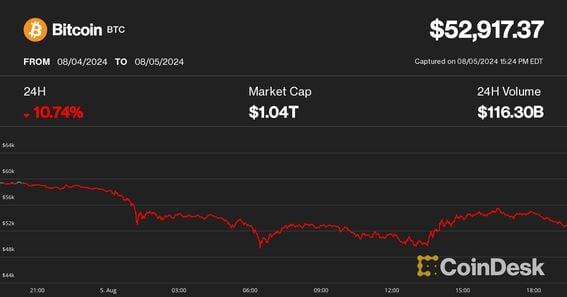
Bitcoin's 30% decline in a week was for some observers reminiscent of the March 2020 crash, but there's been multiple occasions of similar drawdowns during previous bull markets. Crypto prices rebounded only a bit with bitcoin (BTC) hitting $55,000 during the U.S. trading session Monday after earlier in the day plunging to just above $49,000. At press time, bitcoin was trading at $53,000, down 10% over the past 24 hours. The broad-market benchmark CoinDesk 20 Index also posted a similar rebound, but was still 13% lower than 24 hours ago. Ether (ETH), which saw an even steeper decline exacerbated by large crypto trading firm selling the asset, saw a similar bounce, but remains down 13% for the session. The rebound happened as U.S. equity markets also cut some of their early-morning plunge, with the Nasdaq lower by 3.6% shortly before the close versus an earlier tumble of more than 6%. Brutal but typical drawdown for BTC It was only a week ago when BTC traded near $70,000 with traders ecstatic about a likely Trump presidency and hopes of making the largest crypto a strategic asset. Since then, prices tumbled 30% from peak to trough, making it the steepest decline during this market cycle. While the action felt brutal, the magnitude of the drawdown was typical during previous bull markets, Alex Thorn, head of firmwide research at Galaxy, noted Monday. The rapid pace of the drawdown was reminiscent of the Covid-19 triggered crash of 2020, said Daniel Cheung, co-founder of digital asset venture firm Syncracy Capital, even though this was less severe. BTC plummeted 57% in six days in mid-March. "Expect crypto to recover relatively quickly given most of the selling at this point is forced and complete panic," Cheung said. "Ironically, the floodgates to a much greater bull market has been opened." Matt Hougan, CEO of asset manager Bitwise, also compared this weekend's crash to March 2020 in a market update. "It felt as if we might never recover. The media claimed bitcoin had failed its test as a hedge asset," Hougan said. "Emotions aside, history suggests that this weekend’s sell-off is a buying opportunity." While the current situation might offer a good long-term entry, short-term risks are present still. Markus Thielen, founder of 10x Research, said that BTC might dip to as low as $42,000 if the current economic weakness deteriorates further into a recession. https://www.coindesk.com/markets/2024/08/05/bitcoin-bounces-to-53k-after-brutal-sell-off-reminiscent-of-covid-crash/
2024-08-05 18:57
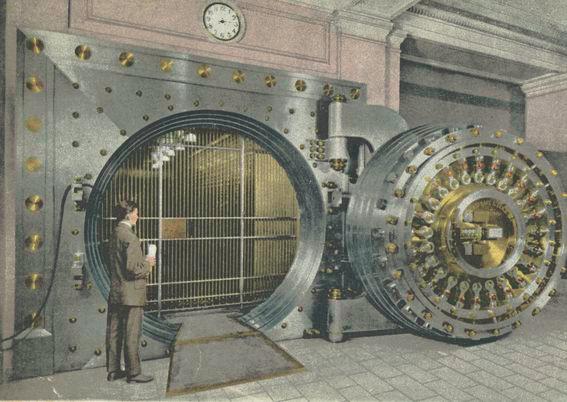
It depends on what you're trying to protect that value from. Market meltdowns like Monday's? No. Confiscation or monetary inflation? Maybe. On days like this, it's easy to scoff at bitcoin (BTC) – specifically, the claim that the original cryptocurrency is a store of value, the digital equivalent of gold. BTC tumbled along with the broader financial markets Monday and briefly dipped below $50,000, its lowest level since February, before retracing some of its losses. Early afternoon New York time, the asset was off 9% on a 24-hour basis, at $53,387.67. For skeptics, bitcoin's volatility was an invitation to echo an old Billy Crystal comedy routine: "Where's your messiah now?" "The Bitcoin 'store of value' thesis is getting blown up right now," Bloomberg columnist Joe Weisenthal crowed on X (formerly Twitter). "Bitcoin doesn't look like The New Gold. It looks like 3 tech stocks in a trenchcoat." But there's a more nuanced view on this question that requires zooming out the figurative lens. "We shouldn't confuse store-of-value assets with flight-to-quality assets," said my colleague Andy Baehr, head of product at CoinDesk Indices. "The former is a long-term expectations property and the latter is a flows and fast market property." The "long term" part is key. On a day like Monday, with the Nikkei falling 12% and the vibe inviting comparisons to 1987's "Black Monday," U.S. Treasury bonds "tend to become this flight-to-quality asset that everybody zooms into," Baehr said. Treasury yields, which move in the opposite direction as prices, are at their lowest levels since January. Bitcoin clearly doesn't enjoy flight-to-quality status. "It's still undoubtedly a volatile, in many cases speculative, in many cases levered, in many cases traded asset," Baehr said. "But its properties hold promise that, over time, its scarcity, its portability, and its lack of attachment to any government or corporation's policies make it a really interesting asset to consider as a store of value." Investors who look at bitcoin this way are thinking of it not as a safe haven from day-to-day market volatility, but rather as an insurance policy against the steady erosion of the greenback's purchasing power. The supply of bitcoin is predictable and fixed at 21 million, immune from the whims of policy makers. "Those who hold it for long periods of time, especially those who have concerns about … the national debt, central bank policy, all of these things … feel as if it's not so much bitcoin going up [that matters] but its denominator declining in value," Baehr said. Counterintuitive though it may seem, it is possible for something to be both a risk asset and a store of value at the same time, he added. "People who use bitcoin as a store of value are not unaware of its volatility." Arthur Breitman, a co-founder of the Tezos blockchain protocol and a crypto O.G., noted that bitcoin's resistance to confiscation makes it a "store of value" in another sense. "Bitcoin is a good store of value if … bank accounts are being seized," he wrote in a reply to Weisenthal on X. "It's contextual." In a separate reply to Weisenthal, Dan McArdle, co-founder of crypto data service Messari, quote-tweeted an old post in which he described how he expected bitcoin to perform during different types of calamities. It should "selloff under liquidity-crisis scenarios, ramp on sovereign-debt/fiat-confidence crises," McArdle wrote in 2018. Monday was an example of the former. As for a more time-tested store of value, the price of gold was down about 1% Monday afternoon. "It's unfair to judge bitcoin against something that's thousands of years old as a store of value when it's still in its infancy," said Alex Thorn, head of firmwide research at crypto investment bank Galaxy Digital, referring to comparisons to gold. Buying bitcoin is a "venture-like bet on its future as a store of value," he said. "Bitcoin is still becoming adopted. That's why it has both volatility and growth potential." https://www.coindesk.com/markets/2024/08/05/is-bitcoin-still-a-store-of-value/
2024-08-05 15:33
An Arizona candidate who received $1.4 million in crypto help, is maintaining a 67-vote lead several days after the primary election, with a small pile of votes left to verify and count. A deluge of crypto-industry money may have helped achieve a very narrow Arizona congressional primary win this week for Yassamin Ansari, a crypto-cheering Phoenix City Council member who faced a candidate backed by Sen. Elizabeth Warren (D-Mass.) But the race between Democrats Ansari and Raquel Terán, who'd been endorsed by leading crypto critic Warren, has come down to a 67-vote gap almost a week after that state's elections, and Ansari's lead has narrowed each time a new batch was tallied. Wider Maricopa County, which includes the 3rd district, still has an estimated 2,089 ballots to count, according to the secretary of state's office, and the current margin of less than 0.2% in Arizona's 3rd Congressional District is well below the half-percent threshold required for an automatic recount. Even if Ansari wins the first tally, she'd likely have to await a formal recount to make it official. Ansari's campaign saw about $1.4 million in crypto political action committee (PAC) spending that either supported her or opposed Terán, according to a PAC spokesman. Ansari, who had signed a recent letter to the Democratic National Committee in which lawmakers and candidates requested the party platform include a pro-crypto stance, has so far claimed about 44.6% of the vote against Terán's 44.5% in a district that would tend to favor a Democrat in November's general elections. The Fairshake super PAC and its affiliates generally purchase ads that support industry-favoring candidates without being directly approved by those candidates, and Fairshake has quickly become one of the country's largest PACs. This approach to "independent expenditures" allows the crypto sector and other industries to devote unlimited money to political contests under U.S. campaign-finance laws. In Ansari's case, the spending amounted to about $74 for each of the votes in her column. Read More: Crypto Giants Notch Wins in Expensive Quest to Sway U.S. Politics – Without Mentioning Crypto Fairshake spokesman Josh Vlasto declined to comment on the Arizona race, because the result isn't yet official. Ansari's own campaign netted a comparative $1.9 million in direct donations, according to Federal Election Commission disclosures, suggesting that Fairshake's similar spending level may have had a significant impact on the race. Whether it did or not, the candidate's opponent lashed out at Ansari for taking outside money from crypto interests. That support included ads from a PAC affiliated with Fairshake and also direct donations from Cameron and Tyler Winklevoss. Though some polling conducted as recently as April showed Terán with an advantage, the close race favors Ansari at this point. This is not the first time crypto support has been raised as a contentious campaign issue. Such accusations came up, too, in Shomari Figures' similar win in Alabama and in the Senate primary defeat for Rep. Katie Porter (D-Calif.). But voters haven't apparently been moved by worries about crypto-sector influence. The industry took two losses in Arizona, too, for candidates Fairshake's affiliate PACs supported. The PAC had backed Andrei Cherny in the Arizona 1st District Democratic primary, but he placed second in a crowded field. And it spent almost $600,000 on Republican Blake Masters in the 8th Congressional District contest, where the former Arizona Senate candidate similarly came in second among several candidates. Digital assets interests have already seen more than 20 favored candidates win primary elections this year, potentially including Ansari. While crypto legislation hasn't yet cleared the current Congress, next year's session will include a larger number of potentially supportive members in the House of Representatives and Senate. U.S. congressional primaries are in their final days, with the last few states finishing this week, meaning the towering crypto industry PAC will soon shift to the general election. Vlasto declined to comment on what Fairshake will do on the road to November. https://www.coindesk.com/policy/2024/08/05/crypto-candidate-in-arizona-is-winning-so-far-despite-sen-warrens-headwinds/