2024-08-05 14:01
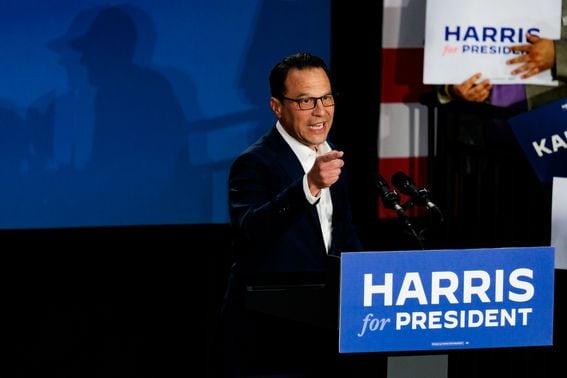
Also: the Democrat gains on Trump but hasn't closed the gap, unlike in polls; Polymarket punters trade on Olympic women's boxing controversy. This week in prediction markets: Kamala Harris will likely pick Pennsylvania Gov. Josh Shapiro as her running mate. Harris has gained on Donald Trump on Polymarket but hasn't closed the gap, unlike in polls. Traders are betting on the Olympic women's boxing controversy. The Fed will cut rates fast and hard in September, say bettors U.S. Vice President and presumptive Democratic nominee Kamala Harris is expected to announce her running mate by Tuesday, and prediction markets show a clear consensus on whom she'll pick. Josh Shapiro, the governor of Pennsylvania, has the highest probability of getting the nod, according to traders on Polymarket, the crypto-based betting platform. "Yes" shares for Shapiro were trading at 68 cents Monday during morning hours in New York, indicating the market sees a 68% chance he will be the Democratic nominee for vice president. Each share pays out $1 (in USDC, a stablecoin, or cryptocurrency whose value is tied to the dollar) if the prediction comes true, and zero if not. The bets are programmed into a smart contract on the Polygon blockchain. Minnesota Gov. Tim Walz trails behind Shapiro with 23% odds. All other listed candidates are showing single-digit probabilities. A total of $104 million has been bet on the Democratic vice presidential contract, making it Polymarket's third-largest by volume. Shapiro is popular among his constituents in a battleground state, with a 61% approval rating, according to a poll released by Fox News last month. Many on the left wing of the Democratic party dislike him for his support for Israel and school vouchers. PredictIt, a more traditional betting site where trades are settled in old-fashioned dollars, shows a similar pattern, with 66% odds for Shapiro and 26% for Walz. Polymarket, founded in 2020, has been enjoying a breakout year amid enthusiasm for election betting. Monthly volume more than tripled from June to $387 million in July, according to Dune Analytics. Prediction markets allow traders to bet on the outcomes of real-world events, from elections to sporting matches to the weather. Proponents say they are a more reliable measure of sentiment and source of forecasts than polls because bettors have money on the line and are strongly incentivized to do thorough research and express their true beliefs. Harris gains on Trump The last few weeks of prediction market sentiment and polling data show that the U.S. presidential race was less of a test of Donald Trump's popularity, and more of an expression of incumbent Joe Biden's unpopularity. Polls indicate Harris has effectively closed the gap with Trump, and is now tied in polling aggregator 538's averages. Harris has the same momentum in prediction markets, but hasn't yet closed the gap. Bettors on Polymarket are putting the race at 53-44 for Trump, with Harris up six percentage points in the past week. Traders are also putting their money on Harris flipping Trump on RealClear Polling's average, which currently has Trump at 47.7% versus Harris at 46.9%. Markets that measure a second-order effect of Harris' surge are also feeling an effect. While a balance-of-power contract still has a Republican sweep as the highest-probability outcome at 30%, markets that call for Democrats to take the presidency and at least one house of Congress have all seen gains. Likewise, another contract that asks if Trump will win every swing state is down four percentage points in the last week, and 35 percentage points in the last month since Biden's gaffe-ridden performance debating Trump. The market is waiting for the first Trump-Harris debate to be confirmed, an event that could certainly move markets. Trump's camp has said that a debate with Harris scheduled for Sept. 10 on ABC has been "terminated" with Biden's departure, and instead proposed a debate a few days earlier on Republican-friendly Fox News – complete with a full arena audience. So far the Harris campaign has said no, and the market agrees that she won't show up, pricing in a 37% chance of it happening before Oct. 15. Culture-war bets The International Olympic Committee says boxers Yu-Ting Lin, from Taiwan, and Imane Khelif, from Algeria, are biological females. On Crypto Twitter, which remained skeptical of IOC claims, a meme quickly emerged about the easy money to be made betting on contestants accused of being men competing in women's sports. But did this meme translate into a higher betting volume compared to other sports markets? Sort of. A contract on Polymarket asking bettors to pick the outcome of the Olympic Women's Welterweight boxing competition, where Khelif is competing, has just over $60,000 in volume, which puts it squarely in the middle of sports contracts on the site. Contracts asking bettors which country will win the most medals, and the outcome of basketball, soccer contests, men's tennis, or 100 meter dash all have significantly more market interest, with basketball leading the pack at $1.5 million. This makes sense because basketball and soccer are more popular than women's boxing, tennis has household names such as Novak Djokovic competing, and the photo-finish nature of the 100-meter dash brings out bettors' animal instincts. But the women's boxing contract still has much more volume than other well-known sports or personalities, like one asking about gymnast Simone Biles' – star of a recent Netflix documentary – medal count. If anything, controversy can be good for sports. Just look at the viewership ratings for the Olympics, which became a culture war flashpoint during the opening ceremony: they are way up. Rate cuts soon? The unwinding of the Japanese Yen carry trade made the Monday trading day a bloodbath for crypto, with over $1 billion in liquidations during Asia trading hours, pushing ether down 20% and bitcoin 15%, erasing gains made year-to-date. When markets opened in the U.S. the global selloff intensified. All this has accelerated the conversation about rate cuts in the U.S. Earlier this year, a sizable minority of traders said cuts weren't going to be on the agenda, with the market giving close to a 60% chance of there being at most one. Now, bettors on Kalshi, the U.S.-regulated prediction market platform where trades are settled in dollars, are punting on a 100 basis point cut happening this year, and a 90% chance of the first cut happening after the September meeting. On Polymarket, bettors have upped the ante, giving the possibility of an emergency Fed meeting – defined as a meeting called outside the usual planned schedule – a 60% chance of happening. Interestingly, traders in traditional markets via interest rate futures have priced in a 100% chance of 50 basis points or more of Fed rate cuts by the bank's September meeting versus Polymarket, where bettors are seeing just a 66% chance of the same thing. If there's an encouraging signal from all of this for crypto, it's that bitcoin won't fall much more. Bitcoin traded below $50,000 during Asia business hours Monday before recovering. Kalshi bettors say it will go to $44,000 at its lowest before year's end, while Polymarket bettors are giving it a 56% chance that it won't go below $45,000 by the end of August. https://www.coindesk.com/news-analysis/2024/08/05/harris-likely-to-pick-pennsylvania-gov-shapiro-for-veep-prediction-markets-say/
2024-08-05 09:37
Aave shows defiance during the sell-off by profiting off user liquidations. $350 million worth of DeFi positions were liquidated during the market sell-off. Aave secured $6 million in revenue from processing on-chain liquidations. One $7.4 million WETH position was liquidated, providing Aave with $802,000 in revenue. The founder of decentralized finance (DeFi) protocol Aave said the platform generated $6 million of revenue during Monday's crypto market sell-off. The plunge trickled down to DeFi after last week's Bank of Japan decision to hike interest rates and Friday's U.S. jobs report. Ether (ETH) is down by more than 20% over the past 24 hours whilst aave (AAVE) has lost 23.7% of its market cap. The sell-off led to more than $1 billion being liquidated across crypto derivatives markets, with a further $350 million liquidated on DeFi protocols, according to Parsec Finance. "Aave Protocol withstood market stress across 14 active markets on various L1s and L2s, securing $21B worth of value," Aave's Stani Kulechov wrote on X. "Aave Treasury was rewarded with $6M in revenue overnight from decentralized liquidations for keeping the markets safe." The decline in crypto prices led to several liquidations on Aave, including a $7.4 million wrapped ether (WETH) position, which yielded revenue of $802,000 for the company, according to on-chain data. The total value locked (TVL) on DeFi protocols is now at $71 billion having dropped from $100 billion at the turn of the month, DefiLlama data shows. https://www.coindesk.com/business/2024/08/05/defi-giant-aave-rakes-in-6m-in-revenue-as-crypto-market-plunges/

2024-08-05 09:35
Coinbase, MicroStrategy and miners fell as equity markets declined worldwide. Bitcoin and ether tumbled Monday as risk-off sentiment permeated global markets. Crypto-related company shares followed suit, with miners slumping and crypto exchange Coinbase losing 17%. Crypto-related company stocks slid Monday as escalating tensions in the Middle East and concerns about the strength of the global economy sent bitcoin (BTC) and ether (ETH) tumbling to their lowest levels in months. Crypto exchange Coinbase (COIN) slumped 17%. Software developer MicroStrategy, which has a policy of buying bitcoin and holds more than 1% of the total supply that will ever be issued, tumbled 21%. CoinShares, a crypto asset manager, fell 12% in Sweden. The declines follow data from the U.S. that indicated the world's largest economy may not be as robust as earlier thought. The Labor Department on Friday posted jobs figures that fell below expectations and a higher-than-forecast unemployment rate. In the Middle East, tensions flared as Iran threatened to attack Israel following the assassination of Ismail Haniyeh, the political chief of terror group Hamas, in Tehran last week. Haniyeh was designated a terrorist by the U.S. in 2018. Bitcoin, the largest cryptocurrency by market cap, fell as much as 15% on Monday, dropping below $50,000 for the first time since February. Ether, the No. 2, fell for the seventh straight day, posting its biggest drop since May 2021, and was recently 22% lower over 24 hours. The CoinDesk 20 Index (CD20), a measure of the broader crypto market, dropped 20% as of 13:45 UTC. Equity markets slid worldwide, with the Nikkei 225 plunging more than 12%. The Stoxx Europe 600 fell 3.3% and the S&P 500 lost 3.0%. Miners plunged alongside bitcoin. Marathon Digital (MARA) and Iren (IREN) both lost about 11%, as did Hut 8 (HUT). Riot Platforms (RIOT) lost 5.6%. https://www.coindesk.com/markets/2024/08/05/crypto-stocks-slump-as-bitcoin-ether-tumble/

2024-08-05 07:05
Carry trading, a popular strategy from the first quarter, involves profiting from pricing discrepancies between two markets. Bitcoin futures trade at par or meagre premium to spot prices. The decline in premium dents the appeal of cash and carry arbitrage strategies. Bitcoin's (BTC) latest price crash has narrowed the gap between futures and spot prices, denting the appeal of carry trades that seek to profit from discrepancies between the two markets. The leading cryptocurrency by market value has crashed over 18% to $50,000 in 24 hours, reaching its lowest level since February 2024. The sell-off, which is part of broad-based risk aversion in global markets, is likely caused by the sharp rise in the anti-risk Japanese yen and the U.S. bond market shenanigans. According to Velo Data, the annualized three-month futures premium on leading crypto exchange Binance has dropped to 3.32%, the lowest since April 2023. Crypto exchanges OKX and Deribit are seeing a similar slide in futures premiums. Meanwhile, futures on the regulated Chicago Mercantile Exchange, a preferred by institutions, are now trading pretty much in line with spot prices. It means the return on the classic cash and carry strategy, involving a long position in the spot market or the U.S.-listed ETFs and simultaneously selling futures, is now less than or at par with the 10-year U.S. Treasury note. The strategy was quite popular among institutions in the first quarter when futures traded at a premium of over 20% and supposedly accounted for a notable share of inflows into the spot ETFs. https://www.coindesk.com/markets/2024/08/05/bitcoin-price-crash-to-50k-dashes-carry-traders-hopes/
2024-08-05 06:34
Ether slumped by the most since May 2021. Ether posted its steepest single-day plunge since May 2021. The crypto fear and greed index flashed "fear" and fell to its lowest level in a month. The CoinDesk 20 Index dropped nearly 20%. Bitcoin (BTC) extended its slump during Asian trading hours on Monday, plunging below $50,000 before recovering to around $51,000, still the lowest level since mid-February, as rising tensions in the Middle East and concerns about the strength of the global economy ate into investor confidence. The world's largest cryptocurrency fell for a fourth straight day, dropping to as low as $49,112, data from TradingView show. Ether (ETH), the native token of the Ethereum blockchain, sank to as little as $2,060, the least since Jan. 3. The CoinDesk 20 index, which tracks some of the most liquid non-stablecoin tokens, dropped nearly 20%. Ether's near 25% slide is the worst single-day hit for the token since May 2021. The sell-off in ether was catalyzed by rumors of crypto market maker Jump Trading's liquidating assets. On-chain sleuth spotonchain identified a wallet supposedly belonging to Jump Trading that transferred 17,576 ETH, worth over $46 million, to centralized exchanges, a sign of possible liquidation. The bloodbath led to over $1 billion in liquidations in the crypto futures market, with ether registering over $350 million in liquidated bets, a rare oddity. The panic selling in bitcoin and the overall crypto market has been triggered by a wider fall in financial markets as fears of a global recession and rising tensions in the Middle East had investors hitting the panic button. Japan's Nikkei 225 Index slumped 12.4%, the Stoxx Europe 600 Index fell more than 3% and micro futures on the S&P 500 Index lost 3.3%. This has led to the crypto fear and greed sentiment index flashing “fear,” and reaching its lowest level since early July. The index tracks volatility, prices, and social media data to indicate whether participants are fearful – usually a sign of local bottoms – or greedy, which marks market tops. As if in anticipation, investors pulled $237.5 million from U.S. spot bitcoin exchange-traded funds (ETFs) on Friday, the most since May 1, according to data from SoSoValue. Ether ETFs were hit with $54.3 million of net outflows. Across the broader crypto market, digital asset investments ended four weeks of net inflows with outflows of $528 million last week, CoinShares said in its weekly report. Bitcoin assets lost $400 million and ether $146 million. CoinShares attributed the withdrawals to concerns of a U.S. recession and the geopolitical environment. https://www.coindesk.com/markets/2024/08/05/bitcoin-continues-to-bleed-falls-below-50k/

2024-08-05 06:12
A sentiment index that tracks crypto markets changed to “fear” early Monday as ETH recorded its worst single-day drop since May 2021. Crypto-tracked futures saw over $1 billion million in liquidations in the past 24 hours amid a market sell-off, with ether futures recording $304 million in liquidations. Over 200,000 traders were liquidated, with the largest single liquidation order worth $27 million on Huobi. Bitcoin and ether prices fell, with ether experiencing its steepest single-day drop since May 2021, and the crypto fear and greed index indicating "fear." Crypto-tracked futures recorded over $1 billion in liquidations in the past 24 hours as the market sell-off worsened on Sunday. The bloodbath was catalyzed by a stronger Japanese yen and rumors of market maker Jump Trading liquidating its crypto business. Ether (ETH) tracked futures recorded over $340 million in liquidated bets, data shows, with bitcoin futures losses leading at $420 million. Futures tracking Solana’s SOL, dogecoin (DOGE), xrp (XRP) and pepe (PEPE) took on $75 million in cumulative liquidations. Over 275,000 individual traders were liquidated, and the largest single liquidation order was on crypto exchange Huobi – a BTC/USD trade worth $27 million. The data shows that some 87% of all traders affected were long traders, or those that bet on higher prices. The liquidations came as bitcoin (BTC) slid more than 11% over 24 hours, while ether plunged as much as 25% before slightly recovering. TradingView data shows this was the worst single-day price fall for ETH since May 2021, when prices dumped from over $3,500 to $1,700. TradingView's daily candle shows performance for UTC 00:00 to 23:59. The drop caused the popular crypto fear and greed sentiment index to flash “fear,” reaching its lowest level since early July. The index tracks volatility, prices, and social media data to indicate whether participants are fearful—usually a sign of local bottoms—or greedy, which marks market tops. Liquidations occur when an exchange forcefully closes a trader's leveraged position due to a partial or total loss of the trader's initial margin. It happens when a trader is unable to meet the margin requirements for a leveraged position, that is, they don't have enough funds to keep the trade open. Crypto markets started to sell off last week amid geopolitical tensions in the Middle East and poor earnings reports by technology firms. These factors dampened the artificial intelligence (AI) hype among investors and created a flight away from risky assets. The rout worsened early Monday as the yen surged to seven-month highs due to heightened expectations of further rate hikes by the Bank of Japan and the unwinding of carry trades. Tokyo’s Topix 100 index posted to its biggest drop since 2011. https://www.coindesk.com/markets/2024/08/05/crypto-futures-witness-840m-in-liquidations-as-bitcoin-nosedives-ether-records-biggest-fall-since-2021/