2024-07-30 07:35
Third-party tokens are digital assets alleged to be unregistered securities by the SEC that were issued by various companies not named Binance. CORRECTION (July 30, 2024, 21:50 UTC): Corrects details to note that the SEC did not say how it intended to amend its complaint or that it intended to drop allegations tied to third-party tokens. The SEC intends to amend its complaint against Binance, including with respect to the 'Third Party Crypto Asset Securities," it said in a court filing. This likely means that the Judge won't have to decide whether 10 tokens such as Solana and Matic are unregistered securities or not just yet. The U.S. Securities and Exchange Commission (SEC) will be amending its ongoing lawsuit against Binance and related entities after a court hearing earlier this month where attorneys raised questions about whether a ruling in the case might affect allegations about certain tokens, according to a court filing early Tuesday morning. According to the filing, the SEC has already informed the defendants, Binance and affiliated entities (namely Binance.US and founder Changpeng Zhao), that it "intends to seek leave to amend its complaint, including with respect to the 'Third Party Crypto Asset Securities'... "obviating the need for the Court to issue a ruling as to the sufficiency of the allegations as to those tokens at this time." The issue of third party tokens came to a head in a hearing on July 9 when attorneys for Binance said they interpreted Judge Amy Berman Jackson's June 28 ruling on Binance's motion to dismiss the SEC's case as moving third-party tokens out of the case, CoinDesk reported earlier. The Judge made it clear that this was not her intention. Third-party tokens are digital assets issued by various companies apart from Binance, that were listed by the crypto exchange. The 10 tokens named in the complaint are SOL, ADA, MATIC, FIL, ATOM, SAND, MANA, ALGO, AXS and COTI. The SEC alleged that these tokens are unregistered securities. Tuesday's filing was a court ordered joint response to the positions of both sides on how to proceed further. It was expected that the judge would review what role third-party tokens may play in the SEC's ongoing case against Binance. The SEC did not share further details about how its This development has resulted in the defense wanting to see the amended complaint before allowing the process of discovery. "Until defendants have a set of proposed amended allegations in front of them, it is premature and unreasonable for the SEC to expect them to agree to conduct merits discovery for claims on which the SEC may soon seek leave to amend its allegations," the filing said. Read More: Opinion: A Second Look at Third-Party Token Allegations in the SEC's Case Against Binance https://www.coindesk.com/policy/2024/07/30/sec-intends-to-amend-complaint-against-third-party-tokens-like-sol-in-binance-case/
2024-07-30 07:00
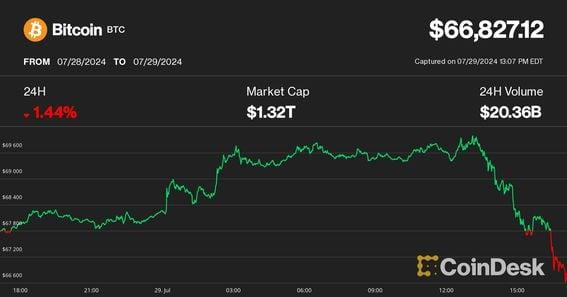
“It’s going to be extremely volatile this week, so I will not be surprised to see BTC price get another 10% drop/pump,” one analyst noted. Bitcoin's price dipped to $66,000 early Tuesday, erasing last week's gains. The slide came after the U.S. government moved $2 billion worth of bitcoin, raising concerns of potential selling pressure. Solana's SOL led major losses, dropping by 6%, reversing Monday's gains, while Ether showed relative strength despite recent outflows from newly-launched spot ETH ETFs. Bitcoin (BTC) inched toward the $66,000 level early Tuesday to pare all gains from last week as sentiment was dented as a significant amount of the asset was moved from U.S. government-linked wallets, instilling fears of looming selling pressure among traders. BTC lost as much as 5%, before slightly recovering, in the past 24 hours as the U.S. Marshals Service shifted $2 billion worth of BTC to two new wallets. Tracking service Arkham estimated that at least one of these wallets was likely to be a custodial service. Solana’s SOL led losses among majors with a 6% dump, reversing Monday gains. Token prices surged as memecoin trading heated up on the network over the weekend, with on-chain trading volumes surging over Ethereum, the usual leader. Other majors showed similar losses amid the bitcoin decline. Cardano’s ADA lost 5%, dogecoin (DOGE) and BNB Chain’s BNB fell 4%, while XRP lost 3%. Ether showed relative strength with a 1% decline, despite the newly-launched spot ETH exchange-traded funds (ETFs) seeing $97 million in net outflows on Monday, their fourth-straight day. Analysts Warn of Losses Market observers said macroeconomic decisions, as well as the lack of newer catalysts, could serve as market headwinds, pushing down prices in the near term. “The market received a boost last week with anticipation of Trump’s speech at the Nashville Conference, where he was expected to mention BTC as a strategic reserve asset,” Alice Liu, research lead at CoinMarketCap, told CoinDesk in an email. On Saturday, Republican candidate Donald Trump, during a speech at the annual Bitcoin 2024 conference in Nashville, promised to fire SEC head Gary Gensler and create a strategic Bitcoin reserve if elected. He also said he would be a "pro-Bitcoin" president and would not allow any of the 213,239 BTC seized by authorities and held in US government wallets to be sold. According to Trump, the US will become the world's cryptocurrency capital. However, Liu said optimism peaked on the 27th and led to a “sell the news” phase, adding that “there is no new sauce of optimism in the market now.” Liu further cautioned that interest rate decisions from three central banks – the Bank of Japan, Federal Reserve, and the Bank of England – on Wednesday and Thursday could further increase volatility in the crypto market. https://www.coindesk.com/markets/2024/07/30/bitcoin-slides-to-66k-in-wake-of-silk-road-btc-movements-solanas-sol-leads-majors-losses/

2024-07-29 17:11
The government is the owner of about $12 billion worth of seized bitcoin, according to Arkham Intelligence. Some $670 million of the assets was forwarded to an address that could belong to an institutional custody or service, Arkham analysts said. Bitcoin dropped nearly 5% from its session highs. The U.S. government moved $2 billion worth of seized bitcoin (BTC) on Monday, tanking already retreating prices and sparking investor concerns of selling the assets just two days after presidential hopeful Donald Trump's promise to begin stacking BTC. Blockchain data by Arkham Intelligence shows that a wallet tagged as "U.S. Government: Silk Road DOJ" transferred 29,800 BTC related to the Silk Road website to an unlabeled address with no prior history of transactions. Then, the address forwarded 19,800 BTC and 10,000 BTC to two different addresses. Arkham analysts suspected that the 10,000 BTC transfer worth $670 million was a deposit to an institutional custody or service. Prior movements often foreshadowed impending asset sales. BTC tumbled below $67,000 following the transfer, extending its decline from the $70,000 session high earlier today. At press time, bitcoin was changing hands at $66,700, down 1.6% over the past 24 hours. The broader CoinDesk 20 Index was flat over the same time period. Though not necessarily related, the government's move this morning followed Donald Trump's weekend promise at the Bitcoin 2024 conference in Nashville to create a "strategic national bitcoin stockpile" if elected. Prior to the transfer, the U.S. government held $12 billion worth of seized bitcoin, according to Arkham's data. https://www.coindesk.com/markets/2024/07/29/bitcoin-tumbles-below-67k-as-us-government-moves-2b-of-silk-road-tokens/
2024-07-29 16:03
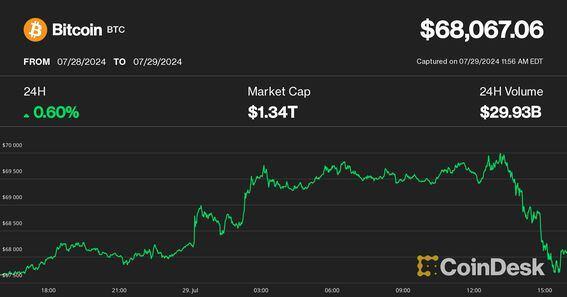
The price of bitcoin still appears poised to close out July with sizable gains after plunging below $54,000 earlier in the month. In what's become a familiar pattern over the past few months, a rally in bitcoin (BTC) to a key level was met with a wave of selling as the price during Monday morning U.S. hours quickly plunged more than 3% after pushing above $70,000 for the first time since early June. At press time, bitcoin was changing hands at $67,800, roughly flat over the past 24 hours. The broader CoinDesk 20 Index was higher by 1.1% over the same time frame, helped along by sizable gains for bitcoin cash (BCH), litecoin {LTC}} and solana (SOL). Traders will be familiar with this price pattern in 2024, which first manifested itself in mid-January when bitcoin climbed to a multi-year high of $47,000 just after the spot ETFs opened for trade. That move higher was reversed within minutes and bitcoin days later had tumbled below $40,000 before the uptrend began anew. Similar price action was seen in early March after bitcoin pushed to a what was then a new all-time high above $69,000 and just hours later found itself below $60,000. Later that month, a move to another record above $73,500 was snuffed out in quick fashion and more than four months later that level hasn't again been challenged. While the above might be frustrating to leveraged traders and their profit and loss, technicians might note a pattern as each of those examples shows higher highs and higher lows – the sort of "up and to the right" chart that bulls like to see. Indeed, earlier in July, bitcoin plunged below $54,000 as a German government entity began unloading its stash of 50,000 tokens seized as part of a criminal case. Yet just a couple of days before August hits, bitcoin is poised to close the month with a sizable gain from the $63,000 area in which it begun. https://www.coindesk.com/markets/2024/07/29/bitcoin-pulls-back-sharply-after-touching-70k/
2024-07-29 06:56
July 29 marks the 100th day since the Bitcoin blockchain cut per block mining rewards to 3.125 BTC from 6.25 BTC. July 29 marks the 100th day since the Bitcoin blockchain cut per block mining rewards to 3.125 BTC from 6.25 BTC. Data from past halvings show the bullish impact of the programmed code takes effect after 100 days. Moving past Republican presidential candidate Donald Trump's appearance at the Nashville Bitcoin conference, the crypto community will likely remember that July 29 marks the 100th day since the Bitcoin blockchain implemented its fourth mining reward halving. The bullish impact of the halving-led slowdown in bitcoin's (BTC) supply expansion tends to kick in after 100 days, new research by ETC Group shows. Bitcoin mining reward halving is an inbuilt code that takes effect every four years or after 210,000 blocks are mined on the blockchain. The quadrennial event reduces the reward miners receive for validating transactions by 50 percent. The primary goal is to control the supply of bitcoin and ensure it becomes scarce over time, unlike fiat currencies, which have ever-increasing supply (monetary inflation). Bitcoin's supply is capped at 21 million, and reward halving helps to manage how fast that limit is hit. The first halving, implemented in 2012, reduced the per-block reward paid to miners to 25 BTC from 50 BTC. Over the next two halvings, the per-block supply fell to 6.25 BTC. The latest halving, implemented on April 20, reduced it further to 3.125 BTC. The previous halvings paved the way for multi-fold price rallies, with most gains coming after the first 100 days. "Today marks exactly 100 days after the Bitcoin Halving event on April 20. The market tends to have a short memory, but the halving-induced supply deficit should just start taking effect from now on," Andre Dragosch, head of research at ETC Group, said on X. Dragosch reached that conclusion after scanning the performance data before and after the previous three halvings implemented in 2012, 2016, and 2020. The study showed that the mean excess performance – the difference between performance X number of days after the halving and X before halving – increases significantly 100 days after the halving and becomes statistically significant, with "T-values" exceeding 2%. The T-value is a statistical figure used in hypothesis testing to determine how far the sample mean is from the population mean, which is stabilized by the sample's variability. "The key takeaway is that 100 days after the Halving, the performance difference becomes statistically significant (T-value > 2) and then becomes increasingly significant until around 400 days after the Halving," Dragosch told CoinDesk. The chart shows that the mean excess performance rises above 100% from the 100th day after halving and eventually peaks into four figures. It remains to be seen if history will repeat itself. https://www.coindesk.com/markets/2024/07/29/the-clock-has-ticked-for-bitcoins-price-surge-100-days-after-the-halving/

2024-07-29 06:52
Mt. Gox payouts seem to have not spooked BCH holders as the forked version of bitcoin outperformed the market in an otherwise slow trading day. Bitcoin Cash is up double digits as the business week in Asia opens, despite expectations from analysts it would be the loser in the Mt. Gox trade. The token outperformed the broader CoinDesk 20 (CD20) index, which is up 3.6% Bitcoin neared the $70,000 mark for the first time since early June in Asian afternoon hours, days after Republican candidate Donald Trump revealed plans to make the asset a national strategic asset if brought to power in November. Bitcoin Cash (BCH), and BRETT, a relatively new memecoin on the Base blockchain led gains in the crypto market on Monday. Meanwhile, Solana's SOL jumped 6%, leading gains among major tokens, as BNB Chain's BNB, ether (ETH) and XRP rose between 2-5%. BCH is up over 10% as Mt. Gox finishes distributing tokens to its creditors, beating the CoinDesk 20, a measure of the largest and most liquid digital assets, which is up 3.6%. CoinDesk Indices data shows that bitcoin (BTC) is up 3%, trading above $69,500, while Ether (ETH) is up 4%, trading above $3300. This steady rise in price for BTC caused the liquidation of a $13.8 million short bet, while $11.4 million ETH short were wiped out, according to CoinGlass data. In a highly anticipated speech on Saturday, Trump said that if elected in November, he would fire current SEC Chair Gensler, build a strategic bitcoin reserve, and prevent the U.S. from selling its bitcoin holdings. He believes that the asset could compete with gold one day and be "the steel industry of 100 years ago." Initially, some analysts believed that BCH would be the loser in the Mt. Gox trade, as the bankruptcy redemptions would result in a disproportionately larger percentage of BCH coming into the market compared to Bitcoin, but that fear seems to have been unfounded. The market seems to be reacting favorably to BRETT, a 'mascot' memecoin on the already meme-heavy Base blockchain. BRETT is the roommate to Matt Furie's Pepe the Frog, a comical slacker character from Boy's Club. BRETT is up 11% in the last 24 hours, while POPCAT, a cat-themed memecoin is up 7%. Meanwhile, Trump-themed tokens continue in the red, despite a recent address by former-President at the BTC 2024 conference in Nashville. The MAGA (TRUMP) token is down 6% on-day, according to CoinGecko data, and down 18% in the last week. TREMP is trading flat, down 0.3% in the last 24 hours, while down almost 10% over the last week. https://www.coindesk.com/markets/2024/07/29/bitcoin-nears-70k-on-back-of-trump-speech-bitcoin-cash-and-base-memecoins-lead-crypto-market-gains/