2024-09-24 14:00
Citrea's aim is to use Bitcoin as a settlement layer to make it "the foundation for the world's finance." Zero-knowledge rollup Citrea has deployed its BitVM bridge on the Bitcoin testnet. Clementine harnesses BitVM, a computing paradigm designed to allow Ethereum-style smart contracts on Bitcoin and which could also pave the way for zero-knowledge computations. Bitcoin zero-knowledge rollup Citrea has deployed its BitVM-based bridge Clementine to the Bitcoin testnet. Citrea, which raised $2.7 million in seed funding led by Galaxy in February, aims to use Bitcoin as a settlement layer to make it "the foundation for the world's finance," according to an emailed announcement on Tuesday. In a blog post in March, the Citrea team described Clementine as a "trust-minimized two-way peg program," essentially a way of locking up bitcoin on the main chain and then minting an equivalent bitcoin token for use on Citrea; to reverse the process, that token is burned and the bitcoin can then be withdrawn on the Bitcoin blockchain. Clementine harnesses BitVM, a computing paradigm introduced last year by the Bitcoin developer Robin Linus, ultimately designed to allow Ethereum-style smart contracts on Bitcoin, and which could also pave the way for zero-knowledge computations. Citrea is compatible with the Ethereum Virtual Machine (EVM), the smart-contracts-executing software that powers the Ethereum protocol, similar to an operating system on a computer. "Citrea is an EVM-compatible layer, meaning all the applications on Ethereum can simply deploy on Citrea without having to change anything," Orkun Mahir Kılıç, CEO of Citrea builder Chainway Labs, told CoinDesk in an interview. BitVM is a conduit that can connect rollups to the Bitcoin network, allowing transactions to be settled away from the main blockchain to mitigate congestion and fees. The basic setup of BitVM involves using cryptography to compress programs into sub-programs that can then be executed within Bitcoin transactions, according to a white paper published by Linus along with five co-authors. Read More: Bitcoin Layer 2 Rootstock Verifies Zero-Knowledge SNARK https://www.coindesk.com/tech/2024/09/24/bitcoin-rollup-citrea-deploys-bitvm-based-clementine-on-testnet/

2024-09-24 12:51
The wallet first started moving bitcoin to Kraken three weeks ago and has moved 10 BTC so far in three separate transactions. An early Bitcoin miner from 2009 three weeks ago ended a decade of inactivity and earlier Tuesday sent an additional 5 bitcoin to crypto exchange Kraken. There has been notable activity from Bitcoin wallets dating back to the Satoshi era in the past year, including a wallet that moved $16 million worth of BTC after 15 years of dormancy. An early bitcoin (BTC) whale who mined the asset in its infancy in 2009 has transferred a portion of its holdings to crypto exchange Kraken after a decade of dormancy, data from on-chain tool Arkham shows. The whale, a colloquial term for entities holding a large amount of bitcoin, holds bitcoin mined just one month after the network first went live. It sent 5 BTC to Kraken earlier Tuesday, worth just over $300,000 at current prices. Arkham said the whale moved bitcoin several times from 2011 to 2014 to other wallets or exchanges, after which there was no activity on the wallet for nearly ten years. Its bitcoin holdings increased in value from $474,000 to over $80 million in that period. The wallet first started moving bitcoin to Kraken three weeks ago and has moved 10 BTC so far in three separate transactions. Moving a high value of tokens to an exchange is typically seen as an indication of selling for cash, stablecoins or other tokens. Late last week, another “Satoshi Era” bitcoin wallet showed activity for the first time in 15 years, sending $16 million worth of BTC to several different wallets. Satoshi era refers commonly to the period when bitcoin’s pseudonymous creator, Satoshi Nakamoto, was active on online forums from late 2009 to 2011. Several "Satoshi era" bitcoin have been active in the past few years. In July 2023, a wallet dormant for 11 years transferred $30 million worth of the asset to other wallets, while in August, another wallet transferred 1,005 BTC to a new address. Then, in December last year, over 1,000 BTC were sent to crypto exchanges - where they were likely sold off - marking one of the largest amounts from the Satoshi era moved to exchanges. https://www.coindesk.com/markets/2024/09/24/bitcoin-miner-from-networks-earliest-months-is-sending-btc-to-kraken/

2024-09-24 10:15
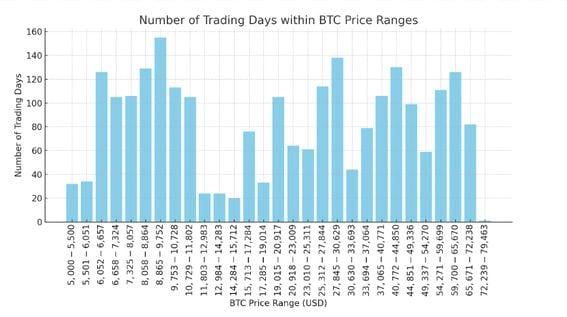
Defying typical September trends, bitcoin's resilience hints at a potential breakout from its prolonged downtrend. Bitcoin defies the odds with a 22% surge from the month's low, challenging September's bearish reputation. All eyes are on the $65,200 mark as bitcoin approaches a pivotal point in its trading channel. A 10% price increment analysis reveals bitcoin's potential for unexpected, significant moves. Bitcoin (BTC) has shown remarkable resilience this September, a typically bearish month, surging 22% from its monthly low of about $52,500. All eyes are now on the critical $65,200 mark, with market participants watching closely to see if it can break out of the current downtrend. Since climbing to a record high back in March, the largest cryptocurrency has been trading in a prolonged downward channel, creating a sense of ennui for many investors. To gain insights into bitcoin’s trading behavior, consider an analysis using a 10% price increment system. This provides a fairer comparison than using fixed dollar amounts, which can distort analysis as the price increases. By focusing on percentage changes, it's possible to better understand how bitcoin moves relative to its own value, rather than being skewed by absolute price changes. The analysis reveals that the longest trading range occurred between $8,865 and $9,752, lasting for 155 days. That's not surprising as it coincided with the 2018-2019 market cycle. During this time, bitcoin was consolidating after the post-2017 bull-market peak and before the recovery that started in mid-2019. Notably, this excludes the depths of the bear market from November 2018 to May 2019, when bitcoin was trading below $5,000. More recently, bitcoin spent 111 days between $54,271 and $59,699. And it has so far spent 126 trading days in its current range of $59,700 to $65,670, a period that could extend if history repeats itself. These prolonged periods of consolidation aren't unprecedented, as seen during the $8,000 to $12,000 range, where bitcoin traded for hundreds of days. This historical perspective suggests that bitcoin can continue to trade in its current range until the end of October without breaking out, based on past behavior. It’s a stark reminder that bitcoin often moves in extended cycles of consolidation, only to make significant moves when least expected. As bitcoin approaches critical levels, it’s essential to remain patient and consider these long-term trends. The market’s cyclic nature implies that while this downtrend may seem never-ending, breakouts, when they do come, often bring significant opportunities. Whether or not bitcoin breaks through $65,200 soon, understanding these trading ranges provides invaluable insight into the potential future direction of the market. Muted drawdowns in the current cycle These periods of consolidation and reduced volatility can be seen in a positive light. In the current cycle, drawdowns are the most muted compared to previous cycles, with the largest decline being just under 30%. This stability is crucial for new institutional investors, who may be unable to handle extreme volatility swings. Bitcoin is currently up by less than 1% in the third quarter, with only five trading days remaining. It's been a challenging period for bitcoin, with headwinds such as a sale by the German government and Mt. Gox redemptions. Moreover, the third quarter is typically the weakest for bitcoin, according to Coinglass. https://www.coindesk.com/markets/2024/09/24/bitcoins-trading-range-extends-beyond-125-days-as-september-shows-resilience/
2024-09-24 06:46
A move above the August high of $65,200 will invalidate the bearish lower highs pattern, analyst at Bitfinex said. A move above the August high of $65,200 will invalidate the bearish lower highs pattern, analyst at Bitfinex said. Weakening spot market buying pressure points to short-term consolidation, analysts added. Bitcoin (BTC), the leading cryptocurrency by market value, has rallied 16% since testing lows under $54,000 early this month. A bullish revival, however, is not yet confirmed, according to analysts at cryptocurrency exchange Bitfinex. In a note shared with CoinDesk Tuesday, analysts said the cryptocurrency needs to smash the August high of $65,200 to confirm the end of a prolonged downtrend, characterized by lower price highs since March. "BTC is now within touching distance of the Aug. 25 top of $65,200. The reason this level is important is because since the all-time high of $73,666 was reached on March 14th, BTC has still not managed to eclipse a single high before a local/new bottom was formed. This qualifies for the technical definition of a downtrend," analysts said, explaining why $65,200 is the level to beat for the bulls. The record high of over $73,000 reached on March 14, followed by the March 20 high of $60,780 and the subsequent lower highs and lower lows are represented by the falling trendline on the chart above. "This implies that the August 25th local high at $65,200 before our September 6th local bottom holds a lot of significance from a higher time frame perspective," analysts at Bitfinex noted. In other words, a convincing move above the August high would confirm the end of the interim downtrend and a resumption of the broader uptrend from the October 2023 lows under $30,000. The recent Fed rate cut, large stimulus announcement by China and the return of risk appetite to broader financial markets favor a move above $65,200. One reason to be cautious is the flattening of the cumulative volume delta indicator since prices rose past $63,500 over the weekend, per data tracked by Coinalyze. It's a sign of a slowdown in the spot market buying. The global cumulative volume delta indicator measures the difference between buying and selling volumes across centralized cryptocurrency exchanges over time. "It is now entirely possible that the price could form a new range near current prices and consolidate for a period, as we have seen following similar previous price rallies which have been initially prompted by spot buying, but then is followed by perpetual and futures markets activity. Another cause for caution is that spot market buying has slowed. This is evident in the Figure below where we can see the spot cumulative volume delta indicator flattening out once the price moved past $63,500," analysts told CoinDesk. https://www.coindesk.com/markets/2024/09/24/bitcoin-needs-to-top-652k-to-break-downtrend-bitfinex/

2024-09-24 06:11
The outflow comes despite a broader crypto market rally fueled by recent Federal Reserve rate cuts that helped lift ether prices by 11% over the past week. Ether ETFs experienced the largest outflows since July, with over $79 million exiting on Monday. The outflows were predominantly from Grayscale’s Ethereum Trust (ETHE), while Bitwise's ETHW saw minor inflows, highlighting the strength of Grayscale's influence on market dynamics. Despite an 11% rise in ether due to favorable macroeconomic conditions like Fed rate cuts, the ETF outflows indicate a disconnect between prices and investor sentiment toward ether's future. Ether may not resonate with traditional finance investors as much as bitcoin's "digital gold" narrative, some observers say. Ether (ETH) exchange-traded funds (ETFs) recorded their largest net outflows since July, with over $79 million exiting on Monday in a sign of waning institutional demand for the world’s second-largest token. Those figures are the highest since July 29, when ETH ETHs recorded a cumulative $98 million, and the four-highest since they first went live on July 23, data from SoSoValue shows. Nearly all of Monday’s outflows came from Grayscale’s ETHE product. Bitwise’s ETHW recorded just over $1.3 million in inflows. Other products showed no inflow or outflow activity. The outflow came despite a broader crypto market rally fueled by last week's Federal Reserve interest-rate cuts, which helped lift ether prices by 11% over the past week. The disconnect between ETH’s price momentum and ETF flows suggests that investors remain uncertain about the asset’s long-term growth prospects. A closely watched ratio tracking the relative price strength of ether and bitcoin (BTC) has dropped to its lowest level since April 2021, as CoinDesk previously reported, a sign the broader market favors bitcoin's perceived stability over ether's riskier, high-yield potential. According to Peter Chung, head of research at Presto Labs, the Ethereum blockchain’s “world computer” narrative does not resonate as easily with traditional finance (TradFi) investors as bitcoin’s “digital gold” meme. “TradFi investors may not respond as enthusiastically to ETH’s investment thesis than to BTC’s. Gold’s investment thesis as an inflation hedge is well-known, and therefore, it is not a leap for TradFi investors to wrap their heads around the idea of ‘digital gold,” Chung said in a message to CoinDesk, referring to an August report by the firm on the topic. “On the other hand, ETH’s ‘world computer’ narrative is much more difficult for non-technicals to grasp. “Even if they manage to come around, their conviction level would need to be high enough to justify adding a second digital asset exposure after a BTC ETF. This could be challenging because, for those who have already allocated to a BTC ETF in their portfolio, adding another digital asset exposure provides substantially less incremental diversification benefit than the first exposure,” he said. Bitcoin set fresh lifetime highs in March in U.S. dollars (before tumbling 20%), while ether is yet to break its highs from 2021 and is still about only half that level. Year-to-date, bitcoin has returned over 50% , while ether has gained just under 15%. Augustine Fan, head of insights at SOFA.org, noted that while ETH has gained on the back of the Fed’s dovish turn, the heavy ETF outflows indicate a fragile sentiment. “Will a continued price rally rescue ETH ETF inflows from their current doldrums? The answer likely depends on whether we see another blow-off top in equity markets before November,” Fan said. “Ethereum has gained 11% over the past week on no new developments. However, the latest heavy outflow from Ether ETFs indicates uncertain sentiment among investors on its future growth momentum.” Nick Ruck, an independent market analyst, pointed out that the recent outflows could be linked to broader pessimism about ether's growth narrative. “The surge in ETH ETF outflows may stem from investors allocating capital elsewhere due to the ongoing pessimistic outlook for ETH, and the current increase in the price of ETH is a good opportunity to exit the market,” Ruck said in a Tuesday message to CoinDesk. “Ethereum has been criticized recently for failing to push any narratives that could help attract more inflows. However, the new Pectra upgrade set to launch in Feb 2025 aims to enable users to pay gas fees with altcoins, among other benefits.” “Institutional investors may feel there are better opportunities elsewhere for the time being,” Ruck added. CORRECTION (Sept. 24, 07:55 UTC): Corrects month of bitcoin record high in sixth paragraph before the end. https://www.coindesk.com/markets/2024/09/24/ether-etfs-record-biggest-outflows-since-july-in-sign-of-low-institutional-appeal/
2024-09-24 04:38
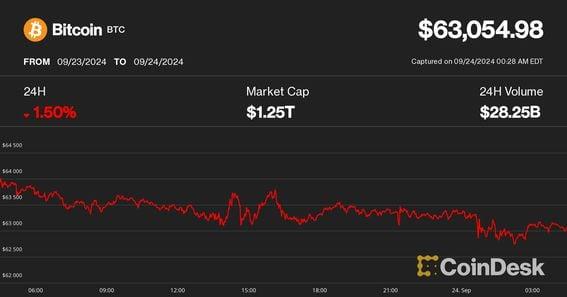
People’s Bank of China governor Pan Gongsheng announced a range of measures to stimulate the economy. Bitcoin and ether are slightly down after China's central bank announced aggressive stimulus measures. Local equities indices rose as investors moved into stocks as a result of the measures. Bitcoin (BTC) started to pare weekly gains early Tuesday, falling to $62,700 after reaching a nearly one-month high of $64,500 at the start of the week as China unveiled fresh stimulus to revive a slowing economy. The People's Bank of China (PBOC) said it was cutting the reserve requirement ratio for mainland banks by 50 basis points while also lowering the seven-day reverse repo rate – the interest rate at which a central bank borrows funds from commercial banks – by 20 basis points to 1.5%. In addition, the central bank cut the minimum down payment requirement for mortgages to 15%. BTC fell 2.2% in the past 24 hours with other major tokens also showing losses. Ether (ETH), BNB Chain’s (BNB), XRP (XRP) and Solana’s sol (SOL) lost up to 1.8%. Such drops are common after a large rally and may not be necessarily tied to China's rate decision. "Bitcoin's lack of response to this news, juxtaposed against rallying Chinese indices, highlights that its current beta appears more tightly linked to Fed policy and U.S. markets, as evidenced by near two-year high correlations with US stocks, particularly following last week's FOMC meeting," Rick Maeda, a Singapore-based research analyst at Presto Research, wrote to CoinDesk in a note. The broad-based CoinDesk 20 Index (CD20), a liquid fund tracking prices of the largest tokens, dropped 1.8%. Celestia's TIA tokens were among the few gainers, adding 17% following the announcement of a $100 million fundraise in a boost to its ecosystem. Stocks move on China cuts While digital assets didn't respond to the Chinese rate cuts and stimulus measures, stock indices around the region were deep in the green, suggesting that local traders were more fixated on equities rather than crypto. Hong Kong's Hang Seng index climbed 3.2% on the news, while the Shanghai Composite index added 2.3%. In a published note, Lynn Song, chief economist for Greater China at ING, wrote that the policy package is expected to weaken the yuan slightly, with the USD-CNY exchange rate rising in response to the PBOC's easing measures. However, medium-term factors like interest-rate spreads suggest a gradual appreciation of the CNY. Presto's Maeda says that with the PBOC hinting at further rate cuts and market support, "this decisive action comes at a critical juncture, with the [Shanghai Stock Exchange] recently dipping below the 2700 key resistance". Harris win unlikely to be “bearish” Elsewhere, traders at Singapore-based QCP Capital said in a Monday market broadcast that Democrat Kamala Harris becoming the next U.S. president may not be as bearish as the market assumes. “A Harris win this election may not be as bearish as the market thinks. In another bid to win over the crypto vote, Kamala Harris vowed at a fundraiser over the weekend to help the crypto sector grow,” QCP said. “This is on top of Anthony Scaramucci and other crypto advocates working alongside her campaign's crypto policies.” Harris said over the weekend that the party, if elected, will “encourage innovative technologies like AI and digital assets while protecting consumers and investors,” marking one of the few times the candidate has appeared warm toward the crypto sector. https://www.coindesk.com/markets/2024/09/24/bitcoin-little-changed-as-china-announces-stimulus-traders-say-harris-win-unlikely-to-be-bearish/