2024-07-26 15:29
FINMA's guidance explains how banks can limit the risks associated with guaranteeing stablecoin customers' deposits. Switzerlands' financial markets supervisor proposed new requirements to help mitigate the risks arising from banks providing a default guarantee to stablecoin holders. In the event of irregularities at the stablecoin issuer, the bank providing the default guarantee may suffer reputational damage, the regulator said. Stablecoin issuers operating in Switzerland create a risk for the banks they work with, the country's financial markets regulator, FINMA, wrote in guidance published on Friday. That's because the issuers, who take deposits from the public and might otherwise be treated as banks themselves, can obviate the need for a banking license by reaching an agreement with a registered lender to repay their customers in case of default. "This creates risks for the stablecoin holders and the bank providing the default guarantee," FINMA said in the guidance note. "In the event of irregularities at the stablecoin issuer, the bank providing the default guarantee may suffer reputational damage due to its contractual relationship with the issuer and may also be exposed to legal risks." Concern over the backing carried by issuers of stablecoins, which are crypto tokens whose value is tied to another asset such as the U.S. dollar or gold, has proliferated for years. As far back as 2021, Tether, whose USDT is by far the largest stablecoin by market cap, published its first account of reserves to deal with queries about its funding. Circle, whose USDC is the No. 2, followed suit in 2022. FINMA's guidance, which builds on an initial note from 2019, sets out a number of requirements to ensure adequate protection. Customers must have their own claim against the guarantee-providing bank, and the guarantee must cover the full amount of deposits and interest. In addition, the bank must ensure that the deposits it receives don't surpass the cover provided by the guarantee. The regulator plans to ensure that the risks associated with default guarantees are addressed in future discussions. https://www.coindesk.com/policy/2024/07/26/stablecoin-default-guarantees-pose-risks-to-the-issuing-banks-swiss-regulator-says/

2024-07-26 15:15
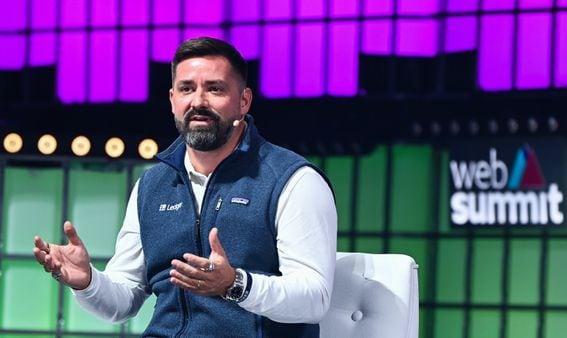
"Ledger Flex", like the Stax wallet which launched in May, incorporates touchscreen technology to "redefine the experience of self-custody," CEO Pascal Gauthier said Crypto wallet provider Ledger has unveiled its second new product of the year as it seeks to make self custody of cryptocurrency more accessible and convenient. Ledger has also unveiled its new Security Key app, which offers passkey capabilities as an alternative to conventional passwords. Take-up of self-custodial wallets may have been hindered historically by the seemingly unforgiving nature of having to store and remember one's own seed phrase. Crypto wallet provider Ledger has unveiled its second new product of the year as it seeks to make self custody of cryptocurrency more accessible and convenient. "Ledger Flex", like the more expensive Stax wallet which launched in May, incorporates touchscreen technology to "redefine the experience of self-custody," CEO Pascal Gauthier said in an emailed statement on Friday. Ledger has also unveiled its new Security Key app, which offers passkey capabilities as an alternative to conventional passwords. Instead of using a password, the app uses a cryptographic passkey login system where there is essentially a private key stored in the secure element for logging into the service. These are tied to the user's seed phrase that is used to restore access to coins in the event of losing access to one's wallet. Collapses of high-profile crypto firms in 2022 highlighted the importance of users taking custody of their assets rather than entrusting them to exchanges. However, take-up of self-custodial wallets may have been hindered historically by the seemingly unforgiving nature of having to store and remember one's own seed phrase - a random string of words that are used as a failsafe for restoring access to coins. Thus, Ledger is attempting to mitigate these concerns by embedding the recovery phrase in security tools that users are accustomed to when logging into mobile devices or websites, such as passkeys. Read More: Crypto Wallet Provider Exodus Aims to Solve Web3's User-Friendly Issue With 'Passkeys Wallet' https://www.coindesk.com/business/2024/07/26/ledger-unveils-second-new-wallet-of-2024/
2024-07-26 10:54
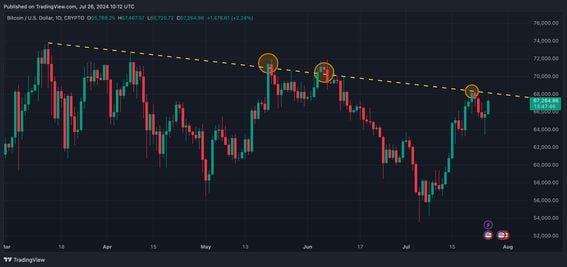
The Bitcoin mining hashrate, a leading indicator for bitcoin rallies, has improved, one observer said, explaining the bullish outlook. BTC is closing on a trendline hurdle that capped the upside on Monday and in May. Friday's U.S. core PCE and Trump's impending Bitcoin conference speech could power a stronger rally, BRN said. Blockchain fundamentals are biased bullish, Matrixport noted. Analysts are growing optimistic about bitcoin's (BTC) price prospects after a rebound toward a crucial resistance level that capped gains earlier this week. Since testing the 50-day simple moving average support near $63,500, the leading cryptocurrency has bounced sharply to breach $67,000, CoinDesk data show, and is closing on a resistance line identified by the trendline connecting March and April highs. The so-called descending trendline proved a tough nut to crack on Monday – as well as when it last came into focus in May – becoming a level to beat for the bulls. That might happen soon, if the mood among analysts is a guide. One trigger could be the U.S. core personal consumption expenditures (PCE) price index, the Federal Reserve's preferred inflation measure, scheduled for release at 12:30 UTC (08:30 ET). Another is Republican presidential candidate Donald Trump's impending speech at the Bitcoin conference in Nashville. "Incoming PCE data could be the final nail in the coffin for high interest rates and lead to imminent rate cut announcements, while Trump’s speech at the Bitcoin conference could start a stronger rally if rumours of an announcement of a national strategic reserve for BTC come true," Valentin Fournier, an analyst at digital assets analyst at advisory firm BRN, said in an email. These factors could bring bitcoin to new highs, Fournier added. The PCE reading is forecast to show a 0.1% rise in June, following virtually no change in May and gains of 0.3% in the preceding three months, according to FactSet. The annualized figure is forecast to print at 2.4% for June, the smallest increase since 2021. The continued progress toward the Fed's 2% target strengthens the case for interest-rate cuts by the central bank. Renewed liquidity easing against the backdrop of resilient economic growth highlighted by Thursday's US. GDP data could galvanize bids for risk assets, including cryptocurrencies. Crypto investors are also anticipating Trump's scheduled speech on Saturday. Speculation has swirled all week that he might announce a bigger role for BTC in the financial system. Other factors like the mining hashrate, which measures the amount of computing power dedicated to the network, and increasing stablecoin supply also flash bullish signals, according to crypto services provider Matrixport. "The Bitcoin mining hashrate, a leading indicator for bitcoin rallies, has improved. Instead of inventory slashing, Bitcoin inventories continue to increase. The inventory build-up suggests confidence in future price increases despite some miners shutting down unprofitable machines," Matrixport said in a note to clients Friday. Matrixport also noted that fiat-to-crypto inflows have picked up, as indicated by the recent increase in the market capitalization of the stablecoin sector. "Historically, such increases have been bullish, signaling a shift of funds from traditional financial markets into the crypto sector," it said. https://www.coindesk.com/markets/2024/07/26/bitcoin-analysts-express-optimism-as-price-nears-resistance-level-that-stymied-it-in-may/
2024-07-26 10:54
Logos for several tokens started to first appear on X, previously Twitter, in 2020, as a step to improve brand adoption and recall on the internet. Bitcoin and crypto hashtags on X no longer display emojis automatically. X did not publicly announce the removal, and the reason behind the apparent change is unclear. Automatically generated emojis no longer accompany bitcoin and crypto hashtags on the Elon Musk-owned social application X, which houses some of the largest active cryptocurrency communities. X's social media accounts or press pages did not publicly announce the removal as of European morning hours on Friday. Crypto users on X started to comment early Friday that they could no longer see emojis when posting “#bitcoin” on the service. Some later found out that hashtags for #bnbchain and #cryptocom, which also showed emojis, no longer display the brand images. As of Friday's European hours, an emoji for #MAGA that previously featured Republican candidate Donald Trump was also removed ahead of his scheduled appearance at the ongoing Bitcoin 2024 conference in Nashville. The Bitcoin emojis were first introduced in 2020 when Jack Dorsey owned X, then known as Twitter. Dorsey tried to popularize the bitcoin symbol to Unicode, a text encoding standard maintained by the Unicode Consortium designed to support the use of text in all of the world's writing systems that can be digitized. X, as Twitter at the time, reportedly charged companies up to $1 million to add a branded emoji or symbol after a designated hashtag to help differentiate their branding from that of their competitors and create a buzz amongst consumers. https://www.coindesk.com/markets/2024/07/26/elon-musks-x-quietly-removes-bitcoin-maga-emojis-from-hashtags/

2024-07-26 09:11
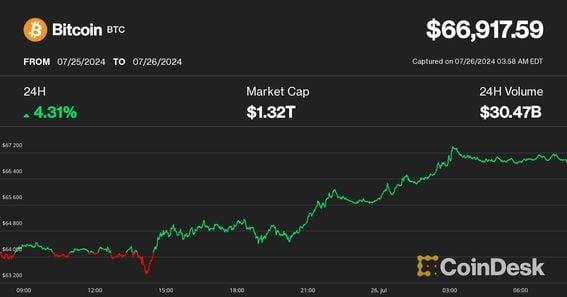
AAVE is surging following a token buyback proposal. BTC outperformed the wider crypto market as measured by the CoinDesk 20 Index during the Friday Asia trading session. One analyst said the performance of ether exchange-traded funds mirrors that of the bitcoin ETFs after their launch in January. Bitcoin (BTC) outperformed the broader crypto market during the Asia trading day, adding 4.4% to test $67,000 while the CoinDesk 20 Index (CD20) rose 3.3%. Solana’s SOL jumped over 5% to lead gains among major tokens, CoinGecko data shows, with ether (ETH), BNB Chain’s BNB and Cardano’s ADA adding 3%. Dogecoin (DOGE) rose 4%, while Solana-based memecoin popcat (POPCAT) jumped more than 8% to lead gains in that category. For the third day, ether products led liquidations across crypto futures, with over $70 million in longs liquidated compared with $55 million on BTC-tracked futures. Open interest – or the number of unsettled futures bets – dropped by $1 billion over the past 24 hours, indicative of money leaving the market. Bitcoin Outflows According to data from SoSoValue, bitcoin exchange-traded funds (ETFs) added a net $31.16 million, bringing the cumulative net flow since their introduction in January to just under $17.5 billion. Total net assets of the ETFs amount to $59.14 billion, or about 4.6% of the entire market cap of the largest cryptocurrency. Ether, the second-largest, rose 2.8% to top $3,200, according to CoinDesk Indices data. The ether ETFs experienced a net daily outflow of $152 million, SoSoValue data shows. Current cumulative flow for the ETFs since they started trading this week is negative $178.68 million. That's mainly owing to withdrawals from Grayscale Ethereum Trust (ETHE), which converted to an ETF. "This situation is very similar to the bitcoin ETF product launches at the beginning of the year," CoinShares analysts said in an emailed note. Outflows from the Grayscale Bitcoin Trust (GBTC), the world's largest bitcoin fund at the time, which converted from a closed-end structure into an ETF that allowed redemptions for the first time in 10 years, weighed on bitcoin's price over the first weeks. Later, inflows to rival funds overcame the negative trend, propelling BTC to an all-time high in March. The Grayscale Ethereum Trust is following the same path but faster, making the decline a "prime buying opportunity," said Mads Eberhardt, a crypto analyst at Steno Research. "If this trend continues, the outflow from the Grayscale Ethereum ETF could end much quicker than it did for bitcoin in January, perhaps as early as mid-next week," Eberhardt said. "After this, we estimate we will see strong net inflow, due to the inflow into the other ETFs as observed over the last few days." Rachel Lin, CEO and co-founder of SynFutures, disagreed, saying she expects short-term pain for ETH traders. “As we saw with Bitcoin, Grayscale's ETH ETF fund is becoming a net seller on the market with over $810 million in outflow since the ETF launch,” Lin said in an email to CoinDesk. “Grayscale currently holds over $8 billion worth of Ether, and nearly 10% of it was sold in just the past two days. If the trend continues, Grayscale might reach the 50% mark far sooner than with Bitcoin. However, that would also mean more downside for Ethereum." Aave outperforms Looking away from BTC and ETH, AAVE, the native token of the Aave decentralized finance (DeFi) protocol is up 15% as the market reacted to a token buyback proposal. The proposal, which is currently in a "temp check" phase, where feedback is solicited, would contribute more protocol revenue to buying back AAVE tokens from the secondary market and redistributing them to stakers. https://www.coindesk.com/markets/2024/07/26/btc-outperforms-broader-crypto-market-ether-price-drop-mirrors-bitcoin-etf-launch/
2024-07-26 08:01
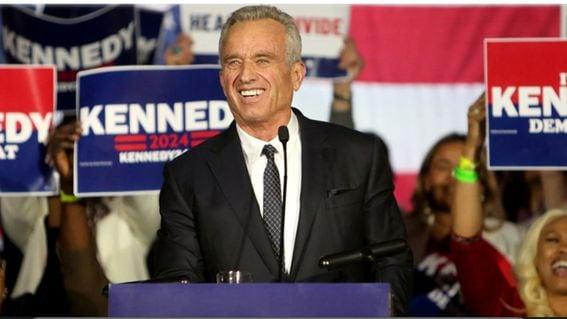
The presidential candidate said most of his wealth is in the digital asset. Robert F. Kennedy Jr. doubled down on his support for bitcoin during the BTC 2024 conference Crypto and its role in the economy has become a hot-button issue in the election. Independent presidential candidate Robert F. Kennedy Jr. doubled down on his support for bitcoin at the BTC 2024 conference in Nashville. "I am a huge supporter of Bitcoin. I have most of my wealth in Bitcoin," he said. I am fully committed." Bitcoin has become a hot-button issue in this electoral cycle with Republican nominee Donald Trump's campaign announcing it would accept crypto donations in May. Many crypto entrepreneurs have come out to support the Trump campaign, with Kraken co-founder Jesse Powell donating $1 million in crypto to Trump and the Winklevoss Twins donating to a Trump-aligned PAC. Kennedy, a libertarian-leaning candidate, took aim at the Federal Reserve, saying the central bank had the interest of bankers, not the general public, at heart. “The relationship between Congress and the Fed is both parasitical to our country, and it’s a symbiotic relationship. The Fed is not a public institution … The decision-makers are appointed by the banking industry," he said during a conference panel hosted by TheStreet. Kennedy also argued that Covid lockdowns were vastly in favor of billionaires and not "Main Street." "Lockdowns … shut down all the small business in this country, which is what we should be nurturing, and kept open the Walmarts, and the Amazons, and Facebook, and the oil industry, and the processed food industries, and Big Ag. They all flourished during that period," he said. Earlier this year Kennedy spoke at CoinDesk's Consensus conference in Austin, Texas where he said crypto is key to "transactional freedom." "We need sovereignty over our own wallets, transactional freedom and a currency that is transparent. We need to make sure America remains the hub of blockchain technology," he said during Consensus. https://www.coindesk.com/policy/2024/07/26/us-presidential-candidate-rfk-jr-says-hes-fully-committed-to-bitcoin/