2024-07-25 12:00
Inflows to Russia-based crypto exchange Garantex accounted for 82% of the crypto volumes that belonged to sanctioned entities internationally, the report added. Russian-speaking ransomware groups were responsible for at least 69% of all crypto proceeds from ransomware in 2023. In 2023 Russian-language darknet markets comprised 95% of all crypto-denominated illicit drug sales that occurred on the dark web. Inflows to Russia-based exchange, Garantex, accounted for 82% of the crypto from sanctioned entities, despite restrictions being imposed due to the war on Ukraine. Illicit use of crypto for ransomware, drug sales, and sanction evasion was rife in Russia in 2023 according to a report by TRM Labs on Thursday. Russian-speaking ransomware groups were responsible for at least 69% of all crypto proceeds from ransomware in 2023, which exceeded $500 million. Ransomware is a type of malware that prevents a user from accessing a device until a sum is paid. The two largest ransomware operators in 2023 were Lockbit and ALPHV/Black Cat, both Russian-speaking groups. However, in February the U.K. National Crime Agency said it had managed to take control of Lockbits services "compromising their entire criminal enterprise," according to an article at the time. In 2023, Russian exchange Garantex accounted for 82% of the crypto volumes from sanctioned entities internationally, the report said. Due to Russia's war on Ukraine, nations around the world placed sanctions on the country leading to some turning to crypto to evade them. U.S. sanctions watchdog, the Office of Foreign Assets Control (OFAC) blacklisted a bitcoin and ether address last year tied to sanctions evasion. Plus, U.S. federal prosecutors alleged in 2022 that five Russian nationals had laundered millions of dollars worth of crypto. In 2023 Russian-language darknet markets comprised 95% of all crypto-denominated illicit drug sales that occurred on the dark web, the report added. "Russian speaking threat actors are unique in the breadth of their malign activity," the report said. However, North Korea remains the world’s hacking superpower and has been responsible for stealing close to $1 billion in cryptocurrency in 2023 according to the report. https://www.coindesk.com/policy/2024/07/25/russian-speaking-groups-responsible-for-majority-of-crypto-ransomware-attacks-in-2023-trm-labs/

2024-07-25 11:06
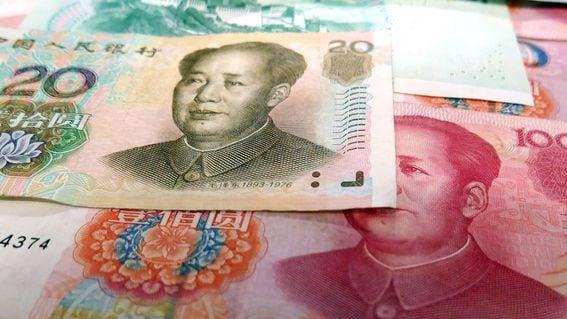
China's back-to-back interest-rate cuts signal urgency to shore up growth after the recent Communist party plenum offered little support to the nation's flagging economy. China's surprise rate cut signals panic, adds to risk aversion in the market. The steepening of the U.S. Treasury yield curve is the biggest risk, one observer said. Risk assets slid Thursday as China's second interest-rate cut in a week sparked concerns of instability in the world's second-largest economy. Bitcoin (BTC), the leading cryptocurrency by market value, fell almost 2% since midnight UTC to around $64,000 and ether (ETH) dropped more than 5%, dragging the wider altcoin market lower. The CoinDesk 20 Index (CD20), a measure of the broader crypto market, lost 4.6% in 24 hours. In equity markets, Germany's DAX, France's CAC and the eurozone's Euro Stoxx 50 fell over 1.5%, and futures tied to the tech-heavy Nasdaq 100 were slightly lower after the index's 3% slide on Wednesday, according to data source Investing.com. Early Thursday, the People's Bank of China (PBoC) announced a surprise, off-schedule cut in its one-year medium-term lending facility rate to 2.3% from 2.5%, injecting 200 billion yuan ($27.5 billion) of liquidity into the market. That's the biggest reduction since 2020. The move, along with similar reductions in other borrowing rates early this week, shows urgency among policymakers to shore up growth after its recent third plenum offered little hope of a boost. Data released early this month showed China's economy expanded by 4.7% in the second quarter at an annualized pace, much weaker than the estimated 5.1%, and slower than first quarter's 5.3%. "Equity futures are stable after yesterday's bloody session that shook views across all asset classes," Ilan Solot, senior global strategist at Marex Solutions, said in a note shared with CoinDesk. "The decision by the PBoC to cut rates in a surprise move only added to the sense of panic." Marex Solutions, a division of global financial platform Marex, specializes in creating and distributing customized derivatives products and issuing crypto-linked structured products. Solot noted the ongoing "steepening of the U.S. Treasury yield curve" as a threat to risk assets, including cryptocurrencies, echoing CoinDesk's reporting from early this month. The yield curve steepens when the difference between longer-duration and shorter-duration bond yields increases. This month, the spread between 10-year and two-year Treasury yields has risen by 20 basis points to -0.12 basis points (bps), mainly due to stickier 10-year yields. The so-called de-inversion or re-steepening from inversion (or negative spread) has historically coincided with risk aversion. "For me, the biggest concern is the shape of the U.S. yield curve, which continues steepening. The 2- and 10-year curve is not only -12bps inverted, compared to -50bps just last month. The recent moves have been led by rising back-end [10y] yields and falling short-end ones," Solot said. That's a sign markets expect the Fed to cut rates but see stickier inflation and expansionary fiscal policy as growing risks, Solot said. https://www.coindesk.com/markets/2024/07/25/bitcoin-stocks-bleed-as-china-rate-cuts-signals-panic-treasury-yield-curve-steepens/
2024-07-25 08:31
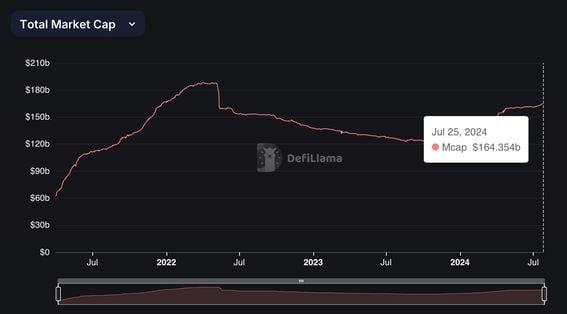
Renewed expansion in stablecoins is bullish for the broader crypto market. Expansion of the stablecoin market is bullish for the broader crypto ecosystem. BTC and ETH slid amid broad-based risk aversion on Wall Street. Stablecoins, which serve as a funding source for many crypto trading strategies, are experiencing growth after months of stagnation in a sign of renewed capital influx into the crypto market. The aggregate market capitalization of the stablecoin sector, which includes hundreds of coins, jumped to over $164 billion for the first time since the collapse of Terra in May 2022, according to data source DefiLlama and trading firm Wintermute. It had been languishing around the $160 billion mark. Stablecoins are digital currencies whose values are pegged to an external reference, such as the U.S. dollar. Tether's USDT, the leading dollar-pegged stablecoin, alone boasts a market capitalization of $114.26 billion. These coins help investors mitigate market volatility because they maintain a fixed value to the external reference. They are widely used to fund crypto purchases, derivatives trading and yield-generation strategies like lending through decentralized finance (DeFi). Stablecoins are also utilized for real-world payments and cross-border remittances. The expansion "indicates growing investor optimism, underpinning a bullish outlook," Wintermute said in a note shared with CoinDesk. "The increase in stablecoin supply indicates that money is being deposited into on-chain ecosystems to generate economic activity, either through direct on-chain purchases that can catalyze price appreciation or yield-generation strategies that could improve [market] liquidity. This activity ultimately fosters positive on-chain growth." Blockchain analytics firm Nansen voiced a similar opinion on X, calling the stablecoin expansion a bullish development. Still, the two biggest cryptocurrencies – bitcoin (BTC) and ether (ETH) – have declined 5.5% and 10%, respectively, this week, CoinDesk data show. The price swoon is likely due to a "sell the fact" reaction to Tuesday's debut of the highly anticipated spot ether ETFs in the U.S. and the sharp slide in Wall Street's tech-heavy Nasdaq 100 index. The index fell 3.7% on Wednesday, wiping out $1 trillion in market value. The ongoing decline in the copper-to-gold ratio and the steepening of the U.S. Treasury yield curve favors risk-off sentiment. https://www.coindesk.com/markets/2024/07/25/stablecoin-market-cap-jumps-to-164b-after-months-of-stagnation/
2024-07-25 07:29
“The policy stance is how does one consult relevant stakeholders, so it is to come out in the open and say here is a discussion paper these are the issues and then stakeholders will give their views,” said Ajay Seth who is the Economic Affairs Secretary in India's Finance Ministry. India is planning to release a discussion paper outlining its policy stance on cryptocurrencies by September, according to Senior Finance Ministry Official Ajay Seth. In September 2023, Seth said India would analyse and decide its own position on crypto in the "coming months." India plans to put out a discussion paper outlining its policy stance on cryptocurrencies before September, according to Indian news outlet Moneycontrol, citing an interview with Economic Affairs Secretary Ajay Seth. Seth's interview does not suggest a commitment to regulating crypto through a comprehensive legislation but instead a position based on stakeholder consensus on the matter. ““The policy stance is how does one consult relevant stakeholders, so it is to come out in the open and say here is a discussion paper these are the issues and then stakeholders will give their views,” said Seth who is the Economic Affairs Secretary. "At the moment, an inter-ministerial group, is looking into a wider policy for cryptocurrencies. We expect to come out with the discussion paper before September." The inter-ministerial group includes India's central bank, the Reserve Bank of India (RBI), and market regulator, the Securities and Exchange Board of India (SEBI). The RBI has been averse to legitimizing crypto or stablecoins, seeking instead to prohibit them because, it argues, digital assets pose macro economic stability risks for the emerging nation. SEBI has been not been opposed to regulating digital assets and has recently said that the oversight of cryptocurrency trading should be vested in several authorities. India does not have a comprehensive crypto legislation but has imposed stiff taxes on the sector. However, it has introduced a requirement for crypto entities to get registered with the country's Financial Intelligence Unit (FIU-IND) to adhere to anti-money laundering (AML) and terrorism financing standards set by global bodies such as the Financial Action Task Force (FATF), marking a credibility shift for the industry. “In India it (cryptocurrencies) is being regulated from the perspective of AML and EFT (Electronic Funds Transfer) alone. Regulation starts and ends there, it cannot be beyond that, so should the remit be more? What should be the policy stance? All that will come out in the discussion paper," Seth said according to the report. In September 2023, Seth said India would analyse and decide its own position on crypto in the "coming months" after considering global leaders' stance on an acceptable crypto rule framework. That statement had come on the sidelines of India's presidency of the Group of 20 in which it had prioritized consensus based framing of global crypto rules. Read More: India Springs Election Surprise, Sends Equity Market Crashing With Uncertain Implications for Crypto https://www.coindesk.com/policy/2024/07/25/india-to-release-its-crypto-policy-stance-by-september-after-stakeholder-consultations-report/

2024-07-25 07:00
The company already runs nodes on multiple blockchain networks and is considering bitcoin mining, its web3 head revealed last month at a conference. Deutsche Telekom will operate a standby masternode for XDC network. The telecom giant already runs nodes on other blockchains including Ethereum, Polygon and Polkadot. German telecommunications giant, Deutsche Telekom's subsidiary announced on Thursday that it will expand its Web3 services to the XDC Network (XDC), a blockchain focused on tokenized real-world assets (RWA), trade finance and decentralized physical infrastructure (DePin). Deutsche Telekom MMS, dedicated to cloud and internet infrastructure, joined the network as an infrastructure provider and will operate a standby masternode. This type of node does not validate transactions on the blockchain as default, but will be called into action if the number of operating validator masternodes drop below the required level of 108. "This addition utilizes our enterprise-grade infrastructure to enable secure blockchain-based applications, with a focus on the finance sector," said Dirk Röder, head of Deutsche Telekom MMS's web3 unit. The announcement is the latest example of the global telecom company's growing blockchain prowess, following Röder's comment last month at the Bitcoin Prague conference last month that the Deutsche Telekom MMS will start mining bitcoin (BTC). The company already runs nodes on Bitcoin and Lightning networks, he said then. On top of that, the company operates validators on a range of proof-of-stake blockchains including Ethereum (ETH), Polygon (MATIC) and Polkadot (DOT), and offers a staking service where customers can deposit tokens to earn rewards for maintaining the network. XDC is a layer-1 blockchain that's compatible with the Ethereum Virtual Machine (EVM), that claims to offer fast transaction speed and "near zero" gas fees. The network hosts euro and U.S. dollar stablecoins and tokenized versions of real-world assets such as gold and U.S. Treasuries. https://www.coindesk.com/business/2024/07/25/deutsche-telekom-joins-rwa-focused-xdc-as-infrastructure-provider-in-digital-asset-push/

2024-07-25 06:42
BTC nosedived from over $65,500 to $64,100 within minutes in the early hours of Thursday as Asian markets suffered. Bitcoin experienced a sharp decline of over 3% at the start of Asian trading hours amid a broader stock market downturn. Over $250 million in bullish bets were wiped out, marking the most substantial liquidation since early July. Bitcoin (BTC) nosedived over 3% at the start of Asian trading hours amid a broader stock market rout and weakening sentiment for risk assets such as cryptocurrencies. BTC fell from over $65,500 to nearly $64,000 within minutes at the start of Tokyo trading. The sudden plunge led to over $250 million bullish bets being liquidated, the worst hit since early July. Liquidations occur when an exchange forcefully closes a trader’s leveraged position due to a partial or total loss of the trader’s initial margin. Such data is beneficial for traders as it serves as a signal of leverage being effectively washed out from popular futures products – acting as a short-term indication of a decline in price volatility. The broad-based CoinDesk 20 (CD20), a liquid index tracking the largest tokens by capitalization, minus stablecoins, fell by 3.3%. Ether (ETH) longs lost the most at $100 million, driven by a 7.5% slump in the token amid outflows from the newly launched ETH ETF. Binance recorded the highest liquidations among exchanges at $118 million, of which 88% were long trades. OKX and Huobi – popular among Asia-based traders – recorded as much as 94% of long traders opened on their exchange liquidated. The dive came as U.S. technology stocks took a hit on Wednesday, causing the tech-heavy Nasdaq 100 index to lose 660 points, its biggest drop since 2022. Mixed quarterly earnings from Google parent Alphabet (GOOG) and Tesla (TSLA) saw shares of the firms close as low as 12% on Wednesday; in aggregate, the so-termed “Magnificent 7” tech stocks lost more than $750 billion in market cap on Wednesday, the most on record for the group. Losses spread over to Asian markets early Thursday as Japan’s Nikkei 225 slumped more than 3% amid concerns that the Bank of Japan could hike interest rates. https://www.coindesk.com/markets/2024/07/25/bitcoin-plunges-to-64k-as-us-tech-rout-hits-crypto-leads-to-250m-long-bets-being-liquidated/