2024-07-23 21:06
Daily cumulative net inflow hit $106.78 million, with most ETFs in the green on the first day of trading. Ether ETF volumes pushed past $1 billion on the first day of trading, with $106.78 million in net flow. In comparison, the bitcoin ETFs had $4.5 billion in trading volume on their first day, and $600 million in net flow. Investors traded over $1 billion worth of shares of the freshly launched ether (ETH) exchange-traded fund (ETF) issuers on the first day of their availability, data from Bloomberg shows. Of this $1 billion, there was a net inflow of $106.7 million, according to a tracker from SoSoValue. Most of the outflow came from Grayscale's Ethereum Trust (ETHE), which saw $484 million in outflow. The spot bitcoin ETFs, for example, saw $4.5 billion in trading volume on launch day but only roughly $600 million of that represented inflows. The BlackRock iShares Ethereum Trust ETF (ETHA) had the most inflow at $266.5 million, followed by Bitwise's Ethereum ETF (ETHW) at $204 million. With the overall trading volume maxing out at $1.077 billion, the funds saw roughly 20% of the trading volume that the spot bitcoin ETFs experienced on launch day in January. Many market observers had speculated that volume and flow for the ETH ETFs would be underwhelming due to a lack of staking mechanism. Ether is currently trading below $3500, according to CoinDesk Indices data. https://www.coindesk.com/markets/2024/07/23/ether-etf-volumes-top-1b-on-day-one/
2024-07-23 20:33
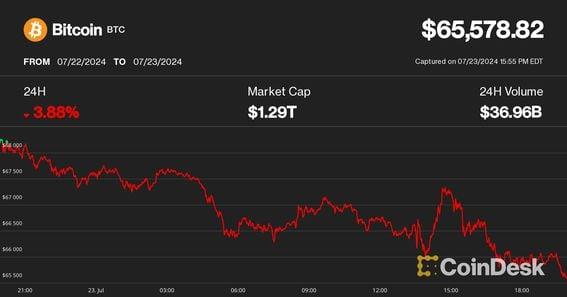
Bitcoin cash led with a 7% decline, while Solana's SOL, Ripple's XRP and Cardano's ADA also dropped 4%-5% as the news of the Mt. Gox distribution weighed on sentiment. Cryptocurrencies slid Tuesday as Kraken started to distribute assets to creditors of defunct exchange Mt. Gox, with the potential sell pressure weighing on the market. Bitcoin {{BTC}} tumbled to $65,500, down nearly 4% over the past 24 hours, while bitcoin cash {{BCH}} plummeted more than 7% over the same period. The broad-market crypto benchmark CoinDesk 20 Index declined 3%, with altcoin majors solana {{SOL}}, Ripple's XRP {{XRP}} and Cardano's ADA {{ADA}} down 4%-5%. Ether {{ETH}} outperformed most assets, trading mostly flat below $3,500, supported by the U.S.-listed spot exchange-traded funds (ETF) booking strong trading volumes on their debut day. The price action happened as multiple creditors reported to receive their cryptos after ten years of waiting from the estate of Mt. Gox, a one-time crypto exchange giant that imploded in 2014 after a hack. The estate started this month to transfer assets to several crypto exchanges, where users will be able to reclaim assets over the next weeks. The imminent distribution of nearly $9 billion worth of BTC and BCH has been a top source of concern for digital asset investors, pondering how much of those assets creditors will sell on the open market to capitalize on the massive price appreciation over the past ten years. Crypto prices often reacted negatively to news about Mt. Gox-related blockchain transfers recently. Earlier today, bitcoin slipped to near $66,000 after Mt. Gox wallets moved $2.8 billion worth of assets, including $130 million in BTC to Bitstamp, foreshadowing distribution to creditors. https://www.coindesk.com/markets/2024/07/23/bitcoin-slips-to-near-65k-as-mt-gox-creditors-receive-assets-on-kraken/
2024-07-23 19:34
Funds from Grayscale, BlackRock and Fidelity have seen the most volume, though analysts believe that Grayscale’s high amount comes from heavy outflows. The eight recently launched spot ethereum {{ETH}} exchange-traded funds (ETFs) posted nearly $600 million worth of volume in the first half of their first day of availability, according to data from Bloomberg. The race is led by Grayscale’s Ethereum Trust (ETHE) which had seen $250 million of its shares traded by 12:30 pm ET. BlackRock’s iShares Ethereum Trust (ETHA) is in second place with roughly $130 million. Fidelity’s Advantage Ether ETF had roughly $77 million in volume while Bitwise’s Ethereum ETF had seen $66 million. “We assume $ETHE volume is mostly outflows,” Bloomberg Intelligence senior ETF analyst Eric Balchunas wrote in a post on X. Grayscale's ETHE, in similar fashion to its Bitcoin Trust (GBTC), entered the race with over $9 billion in assets, thus giving rise to the idea that much of its volume is due to outflows. On the lower end of the volume spectrum were Invesco and 21Shares, whose ether ETFs after four hours of trading had not yet hit the $10 million mark. If volume continues at this pace, the newly launched ETFs are on track to reach roughly $940 million on the first day of trading, according to Bloomberg Intelligence ETF analyst James Seyffart. This would be a little over 20% of the volume that the spot bitcoin ETFs saw on the first day. Lower funding rates could stifle institutional interest Analysts have been predicting demand for the ether ETFs will be at most 20% of that of the bitcoin ETFs for several reasons, which include lack of name recognition and the inability to stake the cryptocurrency when buying shares of the funds. Another factor could be ether’s low funding rate, according to 10x Research founder Markus Thielen, who says that bitcoin’s funding rate when the ETFs launched in January was near 15% and increased to 70% in February. “This brought in many institutional arbitrage funds, which bought the ETFs and shorted the futures against them to pocket the spread,” he wrote Tuesday. “As we pointed out, their buying drove the bullish sentiment in a self-reinforcing process.” Ethereum’s current funding rate, said Thielen, is significantly lower at 7% to 9%, which could be too low for institutions to consider using the funds for an arbitrage investment, especially given that interest rates are currently at 5%. “Contrary to the strong Bitcoin Spot ETF flows in February, Ether ETF flows will likely not attract those arbitrage flows instrumental in driving positive sentiment,” Thielen wrote. https://www.coindesk.com/markets/2024/07/23/spot-ether-etfs-see-600m-in-volume-in-first-half-day-of-trading/
2024-07-23 19:23
"What I saw with Gensler was consistency. I watched him getting absolutely fried like a chicken in front of the Senate and he held his ground. He was consistent. He never varied." Kevin O 'Leary, chairman of O'Leary Ventures and "Mr. Wonderful" on "Shark Tank," spoke with CoinDesk's Jennifer Sanasie. The following is a lightly edited transcript of their interview. Jennifer Sanasie: Alright, I gotta talk about that background. It just looks so lovely. What? Where? Are you sitting by a pool right now? Kevin O'Leary: It's right behind me, it's the Hamptons. I thought it would celebrate a summertime moment. It's a great summer we're having, in particular with crypto policy, so why not enjoy? JS: Exactly. I am completely with you. Well, honestly, it sounds like you've been having a really fun summer. I saw you on stage on Twitter with the Jeff Tuohy band on X just living life, Kevin. KO: Yeah, I do that every year with Jeff’s band, keeps my chops up. He gets better and better. And of course we celebrate that. I do a lunch every July 5 with Jamie, who started Ring, a very famous Shark Tank deal that got away. He sold it to Amazon for $1.2 billion. We've become very close friends. We got our families together and then we went to Cisco Brewery and then I jam on stage. It's a great time. It's just a celebration of the 4th. JS: I'm so happy you brought up Ring because I got to ask you about some of your best and worst investments. Did you invest in Ring? KO: No, I was the only shark to make him an offer. I thought there'd be a lot of dilution and consequent rounds over and over again. I offered him $600,000 in debt with 2.5% warrants – non-dilutive warrants. He didn't take that offer. I understand why, but at least he got one. It would have been the biggest outcome in Shark Tank history, but you can't win them all. JS: It would have been a good one. When you think back, not only to Shark Tank history, but to your career, what's the worst investment you've ever made? KO: Well, I've made a lot of bad investments, but I've gotten better from experience and I've learned something interesting. I guess I would call it intuition over time. When you're writing a check and making an investment and it doesn't feel right in your stomach, that's because it isn't and it's going to go to zero and it does. And I've done that to myself a few times, but now I listen to my innergut on this, which I think is just years of experience. And if it doesn't feel right, I don't do it. And it's, I've been very fortunate, you know, I don't get it right all the time, but I get it right enough that it's, it's been an interesting ride. And it's really your winners that define your success. And I will say one thing about investing to everybody, cause I've been doing this a long time. Let's say I do 10 deals. I'll do, I'll probably do 17 deals. The ones I think are gonna be the winners are never the winners. It's the ones that I think, "that's a flyer," that five years later I get 100X, 200X, 300X on. You just don't know, which is why you need that diversification in your strategy. You need to do more than one, particularly if you're talking about venture capital. That's what we're talking about here. I don't just do venture, I do private equity, I do debt, I do other things. But on the venture portfolio, it's high risk and you need diversification. JS: I think that the lesson that you just outlined there also applies to the crypto market, very high risk, a lot of projects launching every day. It's really hard to kind of decide and also do due diligence on a lot of the projects that are launching a lot of the coins and the tokens that are coming to market. Would you say that that advice could apply to people who are investing in crypto? KO: I would also add liquidity to it because when you start to scale, you ask yourself, look, if I'm going to be putting millions of dollars into a crypto asset, can I get millions of dollars out? And, there's very few tokens that are liquid enough for let's say, a $20, $30, $40 million investment, which is where you get to when you start to grow a large portfolio. So for me, my largest positions are obviously in ETH and bitcoin. And I don't hold them in ETFs. I've never understood why anybody would do that. You're paying fees where you don't have to, but I prove that they've been made that way because it makes it a lot more accessible to individual investors. So it's great that it happened, but I don't use them. I use exchanges. I'm far more concerned about the exchange that I'm on. Is it compliant? Is it liquid? Can I get transparency on pricing? How secure is it? What domain is it in? You know, obviously, I do a lot of work in the UAE. So M2 is important to me. I own a big piece of WunderFi in Canada. I love the compliance they've got up there around 60 plus tokens. They're the largest there. They've got 1 .7 million accounts and now they're expanding into Australia. So I really like the idea of being able to work with my asset on an exchange with total transparency and compliance integrated into my financial reporting platforms. JS: We were just talking about the Hamptons and you on stage with Jeff Toohey and his band. I'm not sure that a lot of people get to actually walk up to you at events like this or when you're out in public, but when they do, if they do, what kind of advice are they asking from you about their investments? KO: Well, everybody's intrigued right now about crypto. They really are. We've kind of turned the corner from an asset class that was at war with the regulator to one that's generally accepted now. And as a result, I would say probably seven out of 10 questions I get are, what should I be doing with crypto, if anything? And where does it fit into my alternative asset class of my portfolio because we've always thought about it, OK. I'm going to buy some gold maybe, or I'm going to do some private equity, or I'm going to buy some real estate, which are a little different than traditional stocks and bonds, which are far more liquid. But crypto has found its way into the psyche of the average investor now. I would say it's more than half the questions I get and which crypto and how to hold it and all of that is definitely part of the narrative. JS: I know you're not a fan of the ETF. I think last I read it, I saw you have 11% of your portfolio invested in crypto. You can let me know if that's changed, but what do you tell those people? KO: It has changed. We just did our mark to market last week. We're at 18% now. We're probably going to cross 20 soon. You've got to remember, I also own positions in companies like Circle. I'm a big guy on the picks and shovels. I mean, want to own, think about this, if you could have gone back in time and somebody said to you, would you like to own a piece of the Nasdaq in its early days or the New York Stock Exchange and be an owner of the exchange where you're agnostic. You know, of course you'd say yes, because you're agnostic to the price of the assets that trade there. You get a fee every time they trade. And so for me, you know, when I start to think about digital payment systems outside of Tether, I really want to be USDC. Where do I get the leverage on USDC other than owning it? And I can stake it or lend it, which I do. JS: A resounding yes. It would be a resounding yes. KO: I want to own Circle, which is where USDC comes from. So I own a piece of Circle. So how do I mark to market the value of Circle? Obviously, its IPO was delayed, it seemed, perpetually. But now with the changing environment, and I have no inside knowledge of this, I'm just a shareholder, I think the opportunity for that platform to become a public platform is higher than it was just, say six months ago. And so I've held it for years. And so it's sort When I think about M2, I own M2 through a company called Phoenix that trades on the ADX. To me, M2 is going to actually take out Binance one day, slowly bleeding assets over to it because unfortunately, CZ is in jail and is a felon now. So a lot of institutions can't use that platform. He's one of the largest shareholders, if not the shareholder of Binance. Obviously that lack of transparency is frowned upon now by regulators. There's so much that has changed since we last talked. All the crypto cowboys are gone and now the regulators are in total control. And you have to think about that in the context of the global environment for owning this asset class. JS: Curious if you look at any crypto-adjacent stocks. I know you mentioned Circle. We have Coinbase, MicroStrategy, the bitcoin mining stocks that are now starting to diversify into AI. Are you looking at any of those as part of your portfolio or are you really kind of focused on what we've just talked about? And then of course bitcoin and ether. KO: That's a very intuitive question. And let's go to what's changed in bitcoin mining. Now that we know with certainty that the ETF is here to stay, now that we know with certainty that large financial institutions want bitcoin, let's just stay on bitcoin for a second before we go to ETH, just bitcoin. Where is this going to be produced? Because it used to be, if you went to a state like North Dakota, which has low cost of power, or Oklahoma or West Virginia, They were against bitcoin because it was at war with the regulator. That's changed now. So Oklahoma recently changed at the state level their taxes on bitcoin mining and now it's pro-bitcoin mining. So rather than invest in stocks of bitcoin miners, I'm just doing my own mining. I'm going and buying power contracts. I'm very fortunate to know some of the largest bitcoin miners so I can go into partnership with them and build facilities. BitZero is one of those I've got in Norway. So I'm an investor in mining my own bitcoin. And we hold those on the balance sheets of the companies that I'm a shareholder in. And that's the majority of my bitcoin positions, which is why I don't need ETFs. But, what a change in the last 12 months. I used to go to Capitol Hill and people say, we're never going to, in New York state, we're never going to mine bitcoin. Bitcoin is now going mainstream. So why wouldn't you want to be a miner of it, particularly when you're storing hydroelectricity that's going over a waterfall and turning it into an asset that holds value in perpetuity? You know, there's a different argument. It was a very big negative green thing initially that's going away now that there's solar wind, hydro. And so I see bitcoin mining almost like a real estate play. And we have right now three different projects within our shop. JS: I want to turn the conversation shortly over to the ETH ETF because you and I have spoken about this before you brought it up just now you're not a big ETF guy but this is big news in the crypto space those ETFs finally got approved yesterday several different market watchers asset managers are saying they expect to see billions in the next year or year and a half pour into these ETFs do you think that some of the advertising I've seen for the ETF or the education out there really seems like it's targeted to an older crowd, the boomers. Do you think that we're going to see these inflows into these products or do you think people are going to start learning more about the spot products and investing directly in the assets like you've just said? KO: Well, I think both. I think what will happen in ETH, it'll be 20% of the flow will be held in the ETF because so many advisers on their compliance back offices do not allow wallets of any kind. And so they can buy the ETF very much like a stock and show it directly to their clients on their statements. And, I think that will suck up a lot of demand. I think it'll be very successful. I just would never pay the fees myself. I can't even imagine why I would do that. It's sort of when you become educated about the whole crypto opportunity and digital payment systems eventually, and also when you look at what's going on, let's take back to up in Canada, Wonderfy, they're building their own second layer on top of their platform to provide wallets and security and make ease of use for holding assets in their own, you know, secure wallet system. And I think Coinbase did the same thing, and was very successful. So these exchanges and the one that WonderFi is going to do in Australia is going to do the same thing, M2, same thing. They're all going to do it so that you have a decision to make. Let's say you're going to put a 5% weighting into crypto or maybe 10%, 5% into ETH, 5% into bitcoin, the most liquid of the tokens. If you could just open an account on an exchange like M2 or WonderFi, transfer in whatever the dollars you want from Fiat, and then actually have that as an app that's secure and is completely compliant with your regulator and your tax authorities, why would you pay the fees on an ETF? I don't understand why you would do that. I think 80% of the people will eventually go to the exchanges the same way that they go to exchanges for stocks. And so, I see very low fees. I see total transparency. I see complete compliance and lots of liquidity in the traditional manner. So it's kind of ironic that we've gone through the whole crypto cowboy phase and we're right back to where crypto should be integrated into the world's global financial services system. It's been a remarkable ride. JS: I interviewed Anthony Scaramucci recently, and he told me, I'm actually curious to hear your thoughts on this. He told me that he thinks that Gary Gensler actually did a good thing for the industry by slowing it down and allowing the fraud, the dark parts of the industry to be washed out so that we could get to where we are now. KO: I actually took a lot of heat for my statements about Gensler. I went, I've spent a lot of time on the Hill. I'm an advocate for digital payment systems, you know, stablecoin bills, all the things that came through. I worked the Hill on those. What I saw with Gensler was consistency. I watched him getting absolutely fried like a chicken in front of the Senate and he held his ground. He was consistent. He never varied. So you got exactly his position. everybody else made the assumption you could just go in there and beat him up and he'd change his mind. He never did. He was completely consistent. And he said, I want this to be compliant over and over and over again. And after a while, I thought to myself, the guy has made it clear. If you're going to be successful in this space, you're going to have to get on board with his vision of what this looks like. And lo and behold, he went after... the FTX crowd, he went after the Binance crowd and he won. You know, they say, he lost cases. No, he didn't. These guys are in jail. I don't know how you say he lost and he's not even finished yet with the civil litigation on Binance. He just keeps going. And I think Congress has gotten comfortable with him. So I'm in his camp because I'm now in a safer place to be an investor in places like Binance or like M2. Sorry, I'm not an investor in Binance let me make that clear. M2, Wondrify, those are compliant. They're abiding, they abide by Gensler's code of, ADGM is the regulator in M2 over in Dubai and in Canada, it's a Canadian regulator, the OSC. But they listen to Gensler all the time. For me, I now feel comfortable that I'm not in some conflict with a regulator. I just don't want that. It's just, doesn't, what everybody learned, it creates no value. Going to war with Gensler is dumb. It's dumb. JS: It's interesting that you say you feel more comfortable because a lot of the industry says they they feel uncomfortable because of the slow move to get clear regulation. What would you say to those folks? KO: So what I would say to them is the reason you want to get on the Gensler train, even though you're holding your nose, is that gets you the other 80% of the market that won't play until they feel that they are compliant with their own compliance departments. These are large financial institutions, pension plans, sovereign wealth. They don't play until they're safe because the majority of their assets are trading on the S&P 500, where they have to be 100%. So they're not interested in a rogue 5% position. It's going to cause them headaches every day on a mark-to-market basis. And so I think a lot of the early pioneers, if you wish, you want to call them that, the crypto pioneers that are still around, understand that compliance was the key to unlock value. And it will remain that way. And I've certainly come to that way of thinking. I don't think any other way. I have no interest in raging against Gensler or any other regulator at all. Because I think the world has decided that bitcoin is here to stay, digital payment systems are here to stay, ETH is here to stay, some other tokens maybe too. Solana looks good right now. There's a lot of different ones. Everybody has their favorites. HBAR. I have a lot of positions and I keep them because I want diversification. And they're slowly been growing. JS: I asked you what the worst investment you ever made was. What's the best investment you've ever made? I know you've made a lot of good ones, but what sticks out to you as one of the best? KO: Well, I always say this to encourage people to take their first step. The best investment I've ever made was in myself to make the decision to go out on my own and at first start a business and then eventually become an investor. Two-thirds of the people never do that. They just can't get there from the risk profile. And I really urge people to do that. Your number one investment should always be yourself. And that will reward you in many good and bad ways. Obviously. I mean, it's not a life for everybody but the whole purpose of that comment is It's not about the pursuit of money. It never was about the pursuit of money, it's the pursuit of personal freedom that really is the reward of entrepreneurship and investing and being a business owner. It's where you decide what your life is going to be. Now, it's not easy. It's difficult and there's lots of challenges. But look at us right now. We're sitting here having this interesting conversation. I want to be doing it. I can afford to do it. If I want to jump in that pool, I can go do that. If I don't want to work at all today or take any phone calls, I can do that too. But I can do whatever I want. And I wish that for everybody. And my whole point is that it is my best investment. And yet, having said all that, I work harder today than I ever have. I work sometimes 20 hours a day and I love everything I do because I'm now a global investor. I was on the phone to the wee hours to Abu Dhabi yesterday. I mean, I just think it's what's going on in the world today. So interesting, such opportunities, you know, just I was working on a new watch it’s being designed in Geneva for 2025. I'm a big watch collector, a great asset class, one of my best performing. so, you know, things that really interest me. So that's my best investment. Now, specifically, recently, a remarkable outcome, and this is going to the idea that you don't know what's gonna work. I remember a woman named Aniskaya three years ago. Pitching me and I'm going to use Shark Tank platform again, although I do many deals that are not Shark Tank, but this one was. She came on and had a cat DNA testing kit. JS: I saw that episode. I remember it. KO: Yes, I'm glad. And I said, why would anybody spend $29 when you could buy a new cat for five? It made no sense to me. But she was so persuasive. She articulated such an incredible vision about collecting data. And nobody wanted to give her a dime, but I did because I just said, I mean, how can I say no to this woman? She just won't stop. I basically gave her a quarter of a million dollars to stop. And then she turned around and turned that into a huge company. It was so big, it was bought by Zoetis, which is a spinoff from Pfizer, and we had an NDA on the purchase price. It was an all-cash deal. I was stunned. I was stunned. Now I love cats. I used to hate cats. I love cats. I love cats. I mean, that company has gone on to do incredible things. And Anna has moved to Florida with me. She lives in Miami. Wonderful entrepreneur. It's really funny that 70% of my successes over 20 years have been companies run by women on the venture side of things. I'm very proud of it because I'm agnostic. I'd give money to a goat if I could make money. I mean, I'm not into this sexism stuff. I think women are fantastic managers. They reduce risk immensely. If you want something done, give it to a busy mother. I'm thinking about Sarah right now who runs Blue Land, another monster company that has crystallized cleaning fluids. She's gonna hit 50 million in sales this year. I invested in her when I think she had no sales. So I mean, it's another startup run by a woman who's just got myopic focus on success. She's a beast. And this is the kind of person I want to back and I want to invest in while I do the other things I do. So I've got a family of entrepreneurs. They keep me busy. I'm very active now, as we talked about. Bitcoin mining going just back to that, that's actually real estate. That's what that is. When you're building these data centers, these are real estate. I've got a deal I'm working on right now. Just before we got on, I was working on the P &L for this and I've got the contract to purchase the land. I won't say which state it is because it's very competitive, but it's over 100 acres. So, I'm very active in this space. JS: So would you say when we're looking at bitcoin miners, the real estate, the land that they're on is maybe worth more than the business as we hit more and more halvings and the rewards become less and less? KO: You're very, very astute on that. Here's what you need. You have to find a state with power. You need to find a state with fiber. You need to find a state with permits, and you need to find a state that allows backup generators. These are not easy to do. It's taken me years to form the relationships I have with states like Oklahoma, West Virginia, Pennsylvania, Montana, North Dakota. I have to go there. In fact, I'm going there this Saturday. I'm going to Iowa. I actually believe that these states have been ignored for so long and yet they have such tremendous opportunities from providing power and permits. You can't do business in New York on bitcoin, but you can certainly do it in other states. I mean, New York should be number one in bitcoin because they've got behind the meter at Niagara Falls, but you can't get anything done there. Everybody knows that. They're kind of in the penalty box right now and nobody invests there. But one day that could change with different management. So I work the path of least resistance. I go to states where the governors and the senators makes sense and are pro crypto and are pro digital payment systems, pro digitization, pro-bitcoin and pro-bitcoin mining and pro-data centers. JS: All right, Kevin, we gotta wrap it up, and I have to ask you about the election here in the United States before I let you go. As we know, President Joe Biden said that he's not gonna be running for reelection. Trump has emerged as this pro-crypto candidate. I would love to get your perspective on if you think that a new Democratic nominee could win over some of that crypto audience, and if you think a Trump presidency will be good for crypto. KO: Well, we have heard from Trump already on crypto and he is pro-digitization, pro-digital payment systems, pro-crypto, pro-bitcoin. So we know that's in his policy. We don't yet know any policy yet from it's just been hours since Kamala Harris has been, well, I don't know if it's firm yet. She doesn't have all the data. I mean, I'm a little surprised to be honest with you. They didn't run a process after the Biden dropout because she doesn't actually have much of a track record on anything. I'm not saying it's a bad thing. We're going to have to wait and hear what she's got. But I remember in 2020, she was the first to drop out of the race. She got no delegates. So she's never been tested. And I'm surprised the party just gave her this coronation, so to speak. I would have liked to have seen a process. But she's obviously an intelligent woman. So maybe she has to read the room a little. And the country has moved more to the middle. So we have to wait to hear her policy, including the crypto policy. But for me, as an investor in energy, I'm very interested to hear. I'm tired of, you know, I understand the rhetoric between parties. If you hate Trump, you hate Trump and you won't vote for him. But I don't really care about that. I care about the policy of each party. So I have the policies now on energy. I've got, you know, a tax policy from Trump. We've got border policy. We don't have much foreign policy, but some inkling of it. We had a speech from Doug Bergen last week, which many people think he will be, by the way, a North Dakota guy. So pro-energy for the energy secretary. That would be interesting. I have nothing yet from the Democrats. So I'm looking forward to hearing that. I think it'll be a very competitive race now. But it's really gonna boil down to a policy. And we've got to hear where the country wants to go. I think it wants to be in the center. I think it wants to be pro-crypto. It wants to be pro-digitization, pro-economy. I'm always an advocate for entrepreneurship. 62% of our jobs in America are created by companies between five and 500 employees. So want to see a lot of support for them. And then I will continue to do what I do. I mean, I'm kind of agnostic to politics. I don't make money with politics. KO: I make money with policy. And I would suggest to everybody to think about that a little bit. In the end, don't get emotionally involved in politics. That's a fool's game because it changes all the time. If you stay focused on policy, that's how you can actually become a good investor, a good manager, a good business owner, and you can pursue the American dream. It's all on policy. JS: Well, let me ask you this. I know you recently said that everyone in financial services knows that Jamie Dimon wants that Treasury Secretary position. I know you said that he would be fantastic at it. He has been outspoken against bitcoin. What do you think that would mean for the crypto industry if Dimon took that position? KO: He's pragmatic about crypto. His own clients want it. He's not a fan. He's sort of in the Warren Buffett camp. I don't think you're going to change his mind on it. But he's also pragmatic if his customers, the institutions he services, want, and they do. Larry Fink, the largest institution on earth, has basically said yes to bitcoin. It's going to get an asset allocation. The game's over. I mean, he's the largest asset manager in the world. And so I think Jamie Dimon understands that. I am an advocate for him to be somewhere involved in giving financial policy. I think it'd be very important to have that experience, that international experience. And so for either party, either for Trump or for the Democrats, he would be fantastic. I mean, I want the best for America. I want the best managers because I don't care who's in the White House. I care what the policy is. I want to see it well managed because I know who's ever there now could change in four years, but my investments won’t. https://www.coindesk.com/business/2024/07/23/shark-tanks-kevin-oleary-on-crypto-investing-ether-etfs-and-gary-gensler/

2024-07-23 16:20
News of the problem emerged just as Bloomberg reported dYdX v3 is for sale. Decentralized crypto-exchange giant dYdX said Tuesday that one of its on-chain trading services has been "compromised" and warned users against visiting dydx.exchange until further notice. Specifically, the website for dYdX v3, an older version of its trading platform that averages around $1.5 billion in weekly derivatives trading volume, "has been compromised," per a tweet. The attack does not appear to impact funds traders already have on dYdX, as only the web domain, and not the underlying smart contracts, appear to be being targeted, according to statements in dYdX's Discord server. "The attacker has taken over the v3 domain (dydx.exchange), and deployed a copy-cat website that when users connect their wallets to it, it asks them to approve via PERMIT2 transaction to steal their most valuable token," a member of dYdX's community team said in the project's Discord server. The larger dYdX v4 venue (which last week saw $6 billion in trading volume) is unaffected. The problem was announced just after Bloomberg reported dYdX v3 is up for sale, with interested buyers including major market maker Wintermute. https://www.coindesk.com/business/2024/07/23/defi-giant-dydx-says-its-v3-platform-is-compromised-just-as-its-reportedly-up-for-sale/
2024-07-23 12:42
Ethereum has more utility than Bitcoin with features like liquid staking, but the question among the ETH ETFs performing as well as BTC ETFs remains ahead of trading. Ether (ETH) price rose above $3,500 ahead of the opening of trade in the U.S.-based spot ETFs. Concerns exist about Grayscale's $9 billion ETH Trust potentially exerting downward pressure on the market through selling, which could counteract the positive effects of new inflows. Ether (ETH) jumped above $3,500 ahead of the spot exchange-traded funds (ETFs) that are expected to go live for trading on Tuesday, one that some onlookers say could see muted inflows in their first few weeks. “Market participants are also closely monitoring Grayscale's US$9 billion ETH Trust, as there are concerns that Grayscale's potential selling pressure could counteract the positive effects of the new inflows, potentially exerting downward pressure on the market,” wrote Vivien Wong, partner at HashKey Capital’s Liquid Funds, in a Tuesday email to CoinDesk. Wong’s HashKey helped launch one of the Ether ETFs in Hong Kong. It estimates that inflow will hit $3 billion in the first six months of trading in the U.S., citing bitcoin’s market cap being 30% of Ether’s and the lack of staking. Ether’s inflation rate, which increases token supply in the open market, is also a point of concern. “Over the past month, the ETH supply increased by around approximately 60k ETH, contrary to expectations,” Wong said. “While the ETH supply has decreased by approximately 300k ETH since the merge, continued inflation at this rate could negate this reduction within six months, potentially turning ETH into an inflationary asset again.” ETH reversed losses from Monday’s trading session to gain 0.57% in the past 24 hours, CoinGecko data shows, outperforming the broad-based CoinDesk 20 (CD20) index, which fell 1.7%. Eight issuers, including BlackRock, received approval for their latest S-1 filings from the U.S. Securities and Exchange Commission on Monday. Market onlookers are debating if the ETFs could mirror the performance of their bitcoin counterparts, which were issued in January and have since attracted over $17 billion in net inflows. “The leading question is will ETH ETFs do better than Bitcoin ETFs? In technicality, Ethereum has more utility than Bitcoin with features like liquid staking,” shared Danny Chong, co-founder of Tranchess, in an email to CoinDesk. “ETH ETFs were slow to live up to the industry’s expectations when launched in Hong Kong.” “However, I do believe that with a larger investor base, ETH ETFs should be able to perform better and bring in the liquidity we require,” Chong added. Citi wrote earlier this month that it expects approximately $5.4 billion in inflow within the first half-year, citing the lack of staking and Bitcoin’s first-mover advantage as to why it will underwhelm. Gemini puts the number at $5 billion, while JPMorgan estimates “as much as $3 billion” but as high as $6 billion if staking was allowed. https://www.coindesk.com/markets/2024/07/23/ether-rises-above-35k-ahead-of-eth-etf-trading-but-inflow-concerns-remain/