2024-07-23 05:27
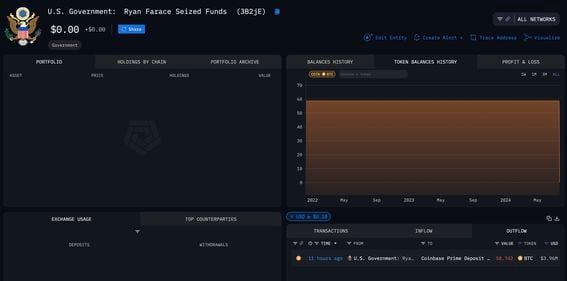
An address labeled "U.S. Government: Ryan Farace Seized Funds" moved BTC worth nearly $4 million to Coinbase 11 hours ago. An address labeled "U.S. Government: Ryan Farace Seized Funds" moved BTC worth nearly $4 million to Coinbase 11 hours ago, according to Arkham Intelligence. The potential selling pressure represents less than 1% of BTC's 24-hour trading volume. The U.S. government transferred 58.742 bitcoin (BTC), worth nearly $4 million, to Coinbase (COIN) on Monday, according to data tracked by blockchain analytics firm Arkham Intelligence. The transfer originated from an address labeled "U.S. Government: Ryan Farace Seized Funds" and identified onchain as 3B2jEBZi8fJWGEDrh6Pe7hDMaJ6iGfFtaU. The funds were seized three years ago from Ryan Farace, who was convicted in 2018 for selling Xanax pills on the dark web. Later Ryan's father, Joseph Farace, was convicted as well for laundering and trafficking bitcoin proceeds intended for federal forfeiture. The Department of Justice eventually recovered 2,933 BTC from the father-son duo and announced its intention to liquidate holdings in January of this year. The latest movement of funds, perhaps a move aimed at liquidation, has emptied the Ryan Farace seized funds address and represents less than 1% of bitcoin's 24-hour trading volume of over $35 billion, according to data source Coingecko. As such, the potential liquidation of funds through Coinbase is unlikely to negatively impact the spot price significantly as the recent large sale of BTC by Germany's Saxony state did. Saxony sold 49,858 BTC between June 19 and July 12, driving the token's spot price as low as $53,500 at one point. As of writing, the leading cryptocurrency by market value changed hands at $67,450. Meanwhile, the U.S. government still held over 213,000 BTC worth over $14 billion. https://www.coindesk.com/markets/2024/07/23/us-government-moves-4m-bitcoin-to-coinbase-arkham-data-show/
2024-07-22 21:52
The legislation would set up a federal group to assess crypto in terrorism and illicit finance and make recommendations for heading it off, but the bill isn't expected to clear the Senate. A narrow bill to create a U.S. working group to dig into crypto use in terrorism and money laundering passed the U.S. House of Representatives in a routine vote. The legislation isn't likely to get any further without a Senate counterpart, but it marks another congressional approval of a crypto measure. While Congress considered this latest crypto bill, industry representatives were reaching out to Vice President Kamala Harris on Monday and encouraging her to embrace cryptocurrency as a presidential candidate. The U.S. House of Representatives has approved another piece of cryptocurrency legislation with a routine voice vote, though the bill to set up a government working group to assess how to keep bad actors from using digital assets isn't likely to become a law as-is. Nunn's effort, which was approved unanimously in the committee last year, would establish a temporary working group under the Treasury Department to dig into the use of digital assets in terrorism and money laundering and make recommendations on how to address it. The group would include figures from the industry, including members from "blockchain intelligence companies." In a speech on the House floor, Nunn called the legislation "crucial in strengthening America's national security, protecting our digital assets and ensuring the next generation of financial and internet technology is built right here in America." Jaret Seiberg, a TD Cowen analyst, suggested this bill was primarily a political exercise. "For crypto critics, this is a way to register their demands for money laundering crackdowns," he said in a client note on Monday. "And for crypto advocates, this gives them political cover from attacks that their support for digital assets facilitates money laundering and criminal activity." Though crypto has risen to occupy a spot as a prominent political topic in the 2024 presidential contest, the likelihood that a narrowly divided Congress will agree on a long-awaited regulatory approach to the industry remains thin. To that end, crypto insiders are keeping a close watch on a few relevant provisions being considered for the National Defense Authorization Act – the annual bill setting the nation's defense priorities. Also on Monday, the Digital Chamber sent a letter to Vice President Kamala Harris – now being positioned by the party as the leading candidate to take the place of President Joe Biden as the Democratic nominee for president. The letter asked Harris to "take a forward-looking approach on digital assets and blockchain technology" by adding a positive crypto position to the party's official platform and picking a running mate "with a proven track record of engaging with digital asset technology and proposing pro-innovation policies." The letter echoed a number of other prominent industry participants, who similarly called for the potential Democratic leader to take a more crypto-friendly approach. Read More: U.S. House Approves Crypto FIT21 Bill With Wave of Democratic Support https://www.coindesk.com/policy/2024/07/22/us-house-passes-crypto-illicit-finance-bill-thats-likely-to-be-rebuffed-in-senate/
2024-07-22 20:52
Issuers received approval for their latest S-1 filings, which means that the funds could begin trading as early as Tuesday. U.S. regulators have given final approval for spot exchange-traded funds that hold Ethereum's ether (ETH), giving Americans access to a second major cryptocurrency via the easy-to-trade vehicles. The decision caps a years-long process to get ether ETFs approved by the Securities and Exchange Commission and follows the regulator's approval of bitcoin (BTC) ETFs in January. Packaging ether in an ETF wrapper could make them more palatable to conventional investors since the funds can be bought and sold through traditional brokerage accounts. Since their debut in January, bitcoin ETFs have attracted tens of billions of dollars of investment. Approval did not seem certain just weeks ago. But in late May, SEC officials abruptly began engaging with wannabe ETF issuers after a long silence. Then, on May 23, the regulator approved a key filing, opening up a pathway to full approval through the latest decision. "We've now fully entered the ETF era of crypto," Matt Hougan, chief investment office at Bitwise, said. "Investors can now access more than 70% of the liquid crypto asset market through low-cost ETPs." "Being the first to file for an Ethereum ETF back in 2021, we have long believed investors should have access to Ethereum exposure in a vehicle they find accessible and familiar," said Kyle DaCruz, head of digital assets at VanEck. "If Bitcoin is digital gold, then Ethereum is the open-source App Store and the gateway for exposure to the thousands of applications that will utilize blockchain technology." Impact on Ethereum's price The approval and beginning of trading of the spot bitcoin ETFs in January, which became the most successful launch in the history of exchange-traded products in terms of the speed of money rushing into them, pushed the price of the largest cryptocurrency up to new all-time highs after surging more than 58% within just two months. Some analysts predict that while a spot ETH ETF could move the price of ether up to $6,500, inflows into those funds won't be nearly as high as for their bitcoin-focused counterparts. Research firm Steno Research predicts that the newly launched ETFs could see $15 billion to $20 billion worth of inflows in the first year which is roughly the same that the spot bitcoin ETFs have taken in in just seven months. Ethereum doesn't have the "first-mover advantage" that bitcoin had and it lacks a strong narrative such as bitcoin's "digital gold" belief among many supporters, a report by the firm stated. https://www.coindesk.com/business/2024/07/22/sec-approves-spot-ethereum-etfs/
2024-07-22 20:25
Trading firm Wintermute expects inflows to be lower than consensus predictions while research firm Kaiko says data suggests “less conviction” regarding the launch. Initial demand for the spot ether ETFs could be less than anticipated, Wintermute and Kaiko predict. Wintermute sees roughly 62% less inflows over the next year than bitcoin ETFs have received in six months. A couple of prominent crypto firms see a relatively muted debut from exchange-traded funds that hold Ethereum's ether (ETH). Wintermute, a major market maker, sees ether ETFs collecting $4 billion, at most, of inflows from investors over the next year. That's below the $4.5 billion to $6.5 billion expected by most analysts – and that latter number is already roughly 62% less than the $17 billion that bitcoin ETFs have so far collected since they began trading in the U.S. six months ago. Wintermute does, however, see ether's price gaining as much as 24% over the next 12 months, driven by those inflows. The ETFs got regulators' final blessing Monday night, meaning issuers including BlackRock, Fidelity, Grayscale, VanEck, Franklin Templeton, Bitwise, 21Shares and Invesco can start offering the funds and they can begin trading Tuesday. U.S. regulators balked at issuers' request to allow ether ETFs to stake the crypto they own, which would've generated income that could've been shared with investors. "This loss reduces the competitiveness of ETH ETFs compared to direct holdings, where investors can still benefit from staking," Wintermute said in its report. Research firm Kaiko shares a similar outlook based on previous Ethereum-focused launches. "The launch of the futures based ETH ETFs in the U.S. late last year was met with underwhelming demand," Will Cai, head of indices at Kaiko, said in a report. "All eyes are on the spot ETFs' launch with high hopes on quick asset accumulation." He said that regardless of the long-term trend, the price of ether will likely be "sensitive" to inflow numbers in the first days of trading. According to data tracked by Kaiko, ether implied volatility increased sharply over the weekend, with contracts nearest to expiry (July 26) jumping to 67% from 59%. "This suggests less conviction around the ETH launch, as traders are willing to pay higher premiums to hedge bets," the report said. Issuers revealed their expected management fees in filings last week, clearing one of the last hurdles to getting final regulatory approval, with Grayscale's Ethereum Trust seeking to charge investors 2.5% while most other managers kept fees lower in the 0.15% to 0.25% range. https://www.coindesk.com/markets/2024/07/22/ethereum-etfs-could-see-underwhelming-demand-two-research-firms-predict/

2024-07-22 15:33
Markus Thielen, founder of 10x Research, fully expects Trump to win the November election, triggering an early exit for SEC Chair Gary Gensler. Traders should wait until after former President Donald Trump's speech at the Bitcoin Conference on Saturday to cash out on their bitcoin profits. Some expect Trump to announce plans to make bitcoin a strategic reserve asset if he gets elected in November, which could result in a "parabolic move" for bitcoin. Traders could be forgiven for wanting to cash in after bitcoin's (BTC) quick rise of more than 20% to the current $67,000 from its early July lows, but another possibly major positive catalyst might be just days away, said 10x Research founder Markus Thielen. “Taking profit, or even shorting bitcoin ahead of Trump’s Nashville speech, could turn out to be an expensive exercise,” wrote Thielen in his Monday newsletter. Former President and current Republican nominee for this year’s presidential election Donald Trump is scheduled to speak at the Bitcoin Conference in Nashville on Saturday and speculations are mounting that he will announce a plan to make bitcoin a strategic reserve asset. Thielen further noted that bitcoin is trading close to the previous bull market's all time high ($69,000), often touted by technicians as a "line in the sand" over which a possible "parabolic move" might occur if prices could successfully hold above that level. Thielen is of the opinion that Joe Biden's exit from the presidential race has essentially sealed the deal for a Trump victory in November. Per Thielen, this likely means an early exit for U.S. Securities and Exchange Commission Chair Gary Gensler, who has earned a reputation as a foe of the crypto industry. While Gensler's term doesn't officially end until June 2026, Thielen expects him to resign around the time of a Trump inauguration in early 2025. The former president is scheduled to speak in Nashville on Saturday at 3pm Eastern Time. https://www.coindesk.com/markets/2024/07/22/taking-profits-on-bitcoin-ahead-of-trump-conference-appearance-could-be-expensive-exercise-analyst/
2024-07-22 14:42
Bets on the U.S. presidential election winner rocketed past $300 million, while the punters have put $200 million in a market for the potential Democrat's nominee and $10 million for the party's VP. This week in prediction markets: It's market mania as President Joe Biden declines to run for a second term. One market went to the cats, as bettors debate the first billion-dollar cat-themed meme coin. Everyone thought CrowdStrike's follies would be fixed in a day. They were wrong. Joe Biden's decision not to seek re-election isn't completely unprecedented: U.S. presidents from James Polk to Lyndon B. Johnson also declined to serve another term for one reason or another. But what is unique is how late Biden decided to throw in the towel, only a month before the Democratic National Convention (where the party officially decides who its presidential candidate is), and only days after he told party faithful that the "elites" wouldn't succeed in kicking him out. The decision fueled a surge in bets on election-related contracts on the Polymarket prediction market, pushing volume to levels never seen in the platform's history. According to a Dashboard powered by Dune Analytics, daily volume on the platform pushed past a record $28 million as bettors raced to take a position on a presidential race that's unlike any other in recent history. In comparison, a month ago, the platform was doing $4 million to $5 million in average daily volume in the aftermath of the debate between Biden and Donald Trump, which is when calls for Biden to step down grew louder. The number of daily active accounts, or wallets, has also more than doubled in the last month, up to nearly 6,000 from roughly 3,000 a month ago. Bettors have also pooled well over $500 million on some of the largest political contracts on the site: The market for the U.S. presidential election winner has $319 million invested, one for the Democratic nominee is over $212 million (Vice President Kamala Harris is the overwhelming favorite), while another to decide who will be the Democratic candidate's vice presidential running mate has $10 million. Right now, the number to beat is $744 million, which was how much was bet on Betfair, the U.K.'s largest betting platform, for the 2020 election. But it's only July; there are still 3 1/2 months until the election. The question is, will Polymarket hit $1 billion? A meme coin cat topped $1 billion A Polymarket bet on market capitalizations for cat-themed tokens resolved late on Sunday, with the Solana-based pop cat (POPCAT) winning the race. The Polymarket contract asked the burning question: Which cat-themed meme coin would be the first to hit a $1 billion market value? In early April, POPCAT'sodds looked bleak at 2%, behind Keycat and Hobbes, two other cat-themed tokens. The market racked up $4.6 million in trading volumes since going live in March. In the running were tokens from several blockchains, such as Base, Ethereum and Solana. The resolution drew some drama, however, after a single $630,000 buy of the token apparently caused a spike that helped push it over the $1 billion market cap threshold – with some arguing it was an act of market manipulation. “Okay so this is interesting because that's clearly market manipulation, but technically it did cross $1 billion on 1 website. Someone here with a vested interest in Popcat has manipulated the market and pushed it over,” wrote Polymarket user @The_Guru55. “Literally a 1 second pump with 1 order on 1 website is pretty questionable,” the person added. Polymarket’s decision that POPCAT won remains in place and has not been disputed as of Monday, however. The market thought the CrowdStrike Windows snafu would be an easy fix. It was wrong. A faulty patch for security software CrowdStrike pushed out on Friday sparked chaos, as it bricked Windows computers around the world, first in Europe and Asia during their business days, then the United States, as the country woke up. As Asia's business day concluded and Europe awoke to PCs frozen with blue screens of death, a Polymarket market was fairly certain this wouldn't be a huge deal and a fix would happen by Friday night, putting the odds at 89%. But the market was wrong. As CrowdStrike engineers published instructions on how to do an initial fix – which required a significant amount of effort for each locked PC – the problems compounded. Over 2,500 flights were canceled and 8,000 delayed, with Delta Airlines still rebooking passengers as of Monday. "The scenario of any [anti-irus] software pushing an update that behaves like this has been a 'worst nightmare' for two decades," Steven Sinofsky, the former president of Microsoft's Windows division, posted on X. The "no" side of the contract – those betting a resolution wouldn't come Friday – was lightly held, with only three bettors holding a collective 45 shares. In total, just over $90,000 was on the line. Meanwhile, the largest holder of the "yes" side lost $2,800. https://www.coindesk.com/markets/2024/07/22/polymarket-trading-explodes-as-2024-election-enters-uncharted-territory/