2024-09-24 03:23
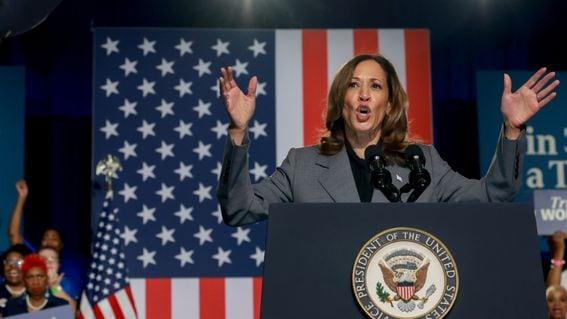
Senior campaign officials are meeting with a select group of crypto insiders to hash out policy concerns, but those in the discussions aren't expecting a big splash before the vote. Vice President Kamala Harris' bid for the White House is unlikely to include a deep dive into her crypto views, according to those with knowledge of her campaign's interactions with crypto insiders. The small number of digital assets advocates who are in talks with her campaign say they're seeing progress in the campaign's policy views. The presidential campaign for Vice President Kamala Harris made crypto waves with a brief comment about the sector over the weekend, but the industry shouldn't expect much more in the final weeks before the U.S. elections, insiders suggest. Harris was deliberately broad when she said her presidency would "encourage innovative technologies like AI and digital assets while protecting consumers and investors," according to a person with knowledge of the talks between her campaign and crypto insiders. Because the discussions about digital assets policy remain high-level and aren't likely to produce a detailed stance before voters decide who to elect, the person said, this likely leaves crypto as just one item among a range of economic innovations Harris will cite on the campaign trail. Senior Harris campaign officials have kept a dialogue running with a narrow group of industry executives and insiders, including from Ripple Labs and Coinbase Inc., said multiple people familiar with the discussions. Coinbase's chief legal officer, Paul Grewal, is among those who've sat down for campaign meetings. "The progress is real," he said in a Monday interview with CoinDesk. He said it's remarkable to see how far the Democratic candidate – and also her Republican opponent, former President Donald Trump – have come in just a matter of weeks. "All we want are sensible rules, and we'll follow them," said Grewal, who has helped lead the company's multi-front legal battle against the U.S. Securities and Exchange Commission. He said he's "encouraged" at the response from the Harris campaign. "Their understanding of what the industry and crypto investors alike need from a Harris administration, should one come to pass, is growing in sophistication and depth," Grewal said, though the actual policy choices may not be seen for a while. "Sometimes things just take a little bit longer than any of us might like," he said. Grewal suggested the crypto discussions with both the Harris and Trump campaigns are happening on a frequent basis. Ripple declined to comment on the talks, but others at the table cautioned realism from industry folks awaiting every utterance from the Harris campaign that only began two months ago – including from adviser Brian Nelson, who had been well-versed in crypto as the Treasury Department's undersecretary for terrorism and financial intelligence. "It's not as if the campaigns have the luxury to develop fully thought-out, complete approaches to regulating crypto any more than they do any other industry," Grewal said. "It's just not practical or realistic to expect that." Former Trump aide Anthony Scaramucci, founder and managing partner of SkyBridge Capital, said at a recent event that he's among those working with the Harris campaign on its crypto policy stance. The vice president's campaign didn't immediately respond to a request for comment on its crypto-policy strategy. Harris' supportive tone in her first mention of the technology echoes President Joe Biden's earlier position on crypto, when his famous executive order suggested the White House would support technological advances and U.S. competitiveness as long as crypto developments didn't harm consumers. That March 2022 order, though, was before the collapse of FTX and several other high-profile digital assets businesses, and U.S. financial regulators moved to partially wall off the banking system from crypto and pursue dozens of legal actions. The vice president's campaign intended her weekend remark to show that crypto enthusiasts have been heard on their hopes for a U.S. reset, according to the person with knowledge of the campaign discussions. The political calculus may not allow for much more than a rhetorical wink, since Harris can't know yet who will be steering the chambers of Congress if she wins and may need room to strategize on legislation. For his part, Trump's rhetoric is now all-in on crypto after years of skepticism, and one of his family's latest business pursuits is in decentralized finance (DeFi), though the early information on the Trumps' World Liberty Financial has drawn some critics among crypto advocates. He's lending his support to the crypto business from the campaign trail while also pushing for pro-digital assets policies in a potential second Trump administration, which he said would ensure that the U.S. become the "world capital for crypto." Polling paid for by the industry has indicated that cryptocurrency considerations could figure into voting preferences for some. "I think the crypto voter is speaking loud and clear in this race, and so campaigns are naturally oriented to the voices they think are going to matter most and turn out in the largest numbers come November," Grewal said. Read More: Ripple Co-Founder Among Kamala Harris' New Corporate Endorsers https://www.coindesk.com/policy/2024/09/24/candidate-harris-unlikely-to-make-full-throated-crypto-policy-before-election-source/
2024-09-23 23:15
The prediction market would use the potential token "as a way for users to validate the outcome of real-world events," the Information reported. It's unclear what that would mean for UMA, the oracle Polymarket uses. Riding high on U.S. election betting fever, crypto-based prediction market platform Polymarket is seeking $50 million in fresh funding, according to an article Monday in tech news site The Information. The New York-based startup is also considering issuing its own token, according to the article, which cited unnamed sources. Investors in the proposed round would receive warrants entitling them to buy the tokens should Polymarket go ahead with the issuance plan, the Information said. The article said Polymarket would use the potential token "as a way for users to validate the outcome of real-world events." It was not immediately clear whether this would be a supplement, alternative, or replacement for UMA Protocol, the "oracle" service Polymarket uses to resolve markets and adjudicate disputes via community votes. The Information did not mention UMA, and its token was up slightly following the article's publication. "Polymarket, at its core, is oracle agonistic," the prediction market startup says in its documentation. Neither Polymarket nor UMA responded immediately to CoinDesk's request for comment. Breakout year In May, Polymarket revealed it had raised a combined $70 million over two rounds, one for $25 million and a $45 million Series B led by billionaire Peter Thiel's Founders Found. The Information article did not specify whether investors in the proposed $50 million round would receive equity or just the token warrants, and mentioned nothing about Polymarket's valuation, which has not been disclosed. Polymarket is one of this year's breakout success stories, both for the long-obscure niche of prediction markets and for crypto itself. Bets made through the site are programmed into smart contracts on the Polygon blockchain and settled in USDC, a token that trades 1:1 for dollars. Monthly volume on Polymarket hit an all-time high of $472 million in August, and this month is shaping up to be at least its second-best, with $397 million in trades as of Monday, according to Dune Analytics data. Traders can use Polymarket to bet on the outcomes of everything from soccer matches to tensions in the Middle East, but the most popular subject by far is the U.S. presidential election, on which bettors have staked nearly $1 billion. Regulatory restrictions Under a regulatory settlement, Polymarket blocks users with U.S. IP addresses, although crafty American traders have reportedly gotten around the geofencing using VPNs. The startup's runaway success this year has been a sore point for Kalshi, a regulated, dollar-denominated prediction market that's been fighting a protracted court battle with its supervisor, the U.S. Commodity Futures Trading Commission, so it can list contracts on which party will control each house of Congress. The agency has been considering a proposed rule that would ban election event contracts at all the exchanges on its watch, which would push regulation of such activity to the states. CFTC Chairman Rostin Benham last week said he's got an eye on offshore election-betting platforms that are "providing exposure to U.S. customers." "If anyone, Polymarket or otherwise, conducts themselves in a way that breaks the law, we will use our civil enforcement authority to make sure that conduct stops,” Behnam said in response to a question at an event in Washington, Bloomberg reported. https://www.coindesk.com/business/2024/09/23/polymarket-reportedly-seeks-50m-in-funding-mulls-token-as-election-bets-surge/

2024-09-23 18:43
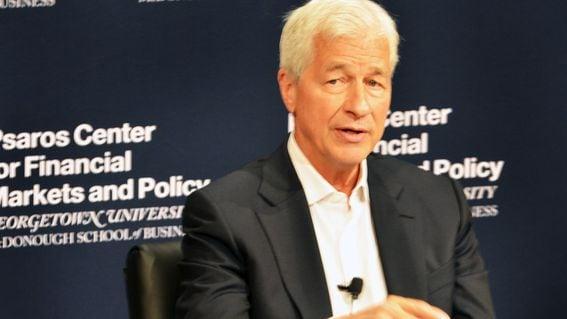
The transaction was a milestone for Onyx and SWIAT, which are collaborating to develop digital asset issuance products on blockchain rails for commercial banks. German industrial giant Siemens AG tapped global bank JPMorgan's blockchain-based payment system Onyx and SWIAT's private blockchain to issue and settle a tokenized version of its commercial paper, the companies said on Monday. Siemens issued €100,000 worth of crypto securities under the German Electronic Securities Act (eWpG) on September 13, then redeemed it three days later. The payments were conducted on the Onyx network using the JPM Coin System, while asset transfers were settled on the SWIAT network's delivery-versus-payment (DvP) mechanism. The whole process took 93 seconds from the confirmation of the trade by the parties on SWIAT to final confirmation of settlement sent to the parties that asset and payment transfers were completed. DekaBank also participated, acting as a regulated crypto securities registrar on the SWIAT network. The transaction marked the start of Onyx and SWIAT collaborating to develop asset issuance products on blockchain rails for commercial banks. Their goal is to shorten value chains, increase transaction flexibility and speeds, and ultimately make financial transactions via blockchain rails scalable for commercial banks, the companies said. Tokenization of traditional financial instruments, or real-world assets (RWA), has been a fast-growing area for blockchain technology with big banks getting increasingly involved. JPMorgan has been one of the early leaders in the space with Onyx and its JPM Coin blockchain-based settlement tech. Transactions with JPM Coin have "exploded" after introducing programmability to the network, with transactions reaching multiple billions of U.S. dollars on some days, Umar Farooq, former head of Onyx by JP Morgan, currently co-head of Payments, said in May during a panel discussion at Consensus 2024. "We're probably one of the bigger users of blockchain," said JPMorgan CEO Jaime Dimon at a recent event at Georgetown University, though he argued that the technology is just a database. Dimon has been an outspoken critic of cryptocurrencies, calling them "pet rock" on multiple occasions. Jesse Hamilton contributed reporting to the story. https://www.coindesk.com/business/2024/09/23/jp-morgans-onyx-blockchain-used-for-siemens-digital-commercial-paper-settlement/
2024-09-23 18:17
The news comes as as Celestia's native token, TIA, had fallen 54% since the beginning of 2024. Celestia Foundation, the team behind the Celestia blockchain network, said Monday that it has raised $100 in a fundraising round led by Bain Capital Crypto. The news comes as as Celestia's native token, TIA, is down 54% since the beginning of 2024, according to CoinMarketCap. Celestia had one of the hottest airdrops of 2023, issuing TIA to 580,000 of its users. The fresh round of capital means that the foundation has a total of $155 million in funds, and saw participation from Syncracy Capital, 1kx, Robot Ventures, Placeholder. The team did not detail what the new capital will be used for but highlighted that core developers are focused on its new roadmap unveiled earlier this month. “When Celestia launched last year as the first modular data availability layer, it scaled blockspace from the dial-up era to the broadband era,” said Mustafa Al-Bassam, co-founder of Celestia, in a blog post shared with CoinDesk. “Now, the core developers have introduced the technical roadmap to scale blockspace to the fiber optic era – while keeping it verifiable and low latency.” Celestia is part of a growing field of modular blockchains, aimed to solve scalability issues with features that enhance the speed or execution of transactions. It is also a provider of data availability, which is pitched as a cheaper alternative to storing data on layer-1 blockchains like Ethereum. https://www.coindesk.com/tech/2024/09/23/blockchain-data-availability-project-celestias-foundation-raises-100m/

2024-09-23 14:05
Plus: the market is skeptical about Qualcomm's Intel deal; prediction markets were in vogue at Token2049 in Singapore. This week in prediction markets: Caroline Ellison most likely won't serve time in prison as part of plea deal, market suggests. Will Qualcomm's bid for Intel succeed? Probably not. Prediction markets were trendy at Token2049. A little more than a week after FTX CEO Sam Bankman-Fried was formally charged in December 2022, Caroline Ellison, his former lover, and CEO of Alameda Research, filed a plea deal asking for leniency in exchange for full cooperation with prosecutors. Fast forward to earlier this month, and counsel for Ellison was before a U.S. court in Manhattan, arguing that she should get supervised release at most owing to her "extraordinary cooperation with the government." Her sentencing hearing is scheduled for Tuesday afternoon in New York. Traders on Polymarket are betting the court will show mercy, with "yes" shares for "no prison time" trading at 48 cents, meaning the market sees a 48% chance she'll be released. Each share pays out $1 (in USDC, a cryptocurrency that trades 1:1 for dollars) if the prediction comes true, and nothing if it doesn't. But there's also a slight possibility (20%) that Ellison gets 12 to 13 months. Polymarket bettors have a mixed track record on guessing prison sentences. While they correctly guessed that former Binance CEO Changpeng Zhao would spend less than six months in prison (he was sentenced to four, much less than what the Department of Justice wanted), they were way off on Bankman-Fried's sentence, which came in at 25 years while the market was giving a 27% chance to 20-30 years, and a 28% chance to 40-50 years. The intel on Qualcomm-Intel deal The semiconductor industry was rocked this weekend, when news broke that Qualcomm had approached Intel about a possible takeover deal with analysts on the ground in Asia confirming that talks are taking place. Polymarket bettors are only giving this a 13% chance of happening by Oct. 31. From a purely financial perspective, Intel's shareholders would certainly welcome such a deal. The beaten-down stock is worth the same as it was 20 years ago because Intel missed the artificial intelligence gold rush as its efforts to create a competitive AI chip by 2017 failed, its efforts to compete against the likes of TSMC and Samsung in the foundry (chip facotr) business are foundering, and it lacks a GPU product that's competitive with Nvidia for the ultra-high-margin data center industry. Plus, Qualcomm's Snapdragon chips, which are based on ARM designs, are now in laptops and impressing reviewers with their performance while Intel's rivals are falling behind. Regulators, on the other hand, are going to have a field day with this. If there's one thing that Taiwan and China agree on, it's that Qualcomm acts as a monopoly in the mobile phone space, with regulators on both sides of the strait fining the company. Last week, the company lost an appeal in Europe to have a 2019 fine tossed which accused Qualcomm of predatory pricing. Taiwanese trade publication Digitimes writes that Qualcomm's acquisition of Intel would face antitrust, and financing hurdles, and the company may be biting off more than it can chew – which is why Polymarket bettors are skeptical that the deal will go through. In vogue Two of the biggest names in crypto want to enter the prediction market space. During last week's Token2049 event in Singapore, decentralized exchange (DEX) dYdX said it plans to launch perpetual futures on prediction markets, which dYdX Foundation CEO Charles d'Haussy explained in an interview with CoinDesk would offer decentralized finance (DeFi) "a unique opportunity to regain attention." DYdX's upcoming entry into prediction markets is expected later this year as part of its major dYdX Unlimited upgrade. Expect more specifics, like the categories of markets, as the launch date gets closer. Also at Token2049, Wintermute announced it's launching OutcomeMarket, a prediction market where outcomes are tradable as tokens listed on exchanges. Naturally, the first market launching is for the U.S. election, where users can punt TRUMP or HARRIS tokens. The first exchanges to launch these tokens will be Bebop, WOO, and Backpack, but the exact date for the first day of trading isn't yet known. https://www.coindesk.com/markets/2024/09/23/caroline-ellison-most-likely-wont-serve-time-polymarket-traders-bet/

2024-09-23 13:52
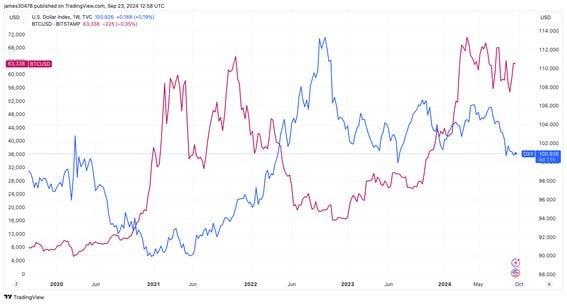
A less-widely followed report from the Chicago Fed indicated the easiest conditions since November 2021. The Chicago Fed's NFCI fell to -0.56, the loosest financial conditions since bitcoin's 2021 cycle high. Financial conditions and bitcoin show a negative correlation suggesting the crypto thrives in risk-on environments. Bitcoin has more than doubled in the last 12 months as financial conditions ease, signaling potential for further gains. The Chicago Fed’s National Financial Conditions Index (NFCI) offers a weekly update on U.S. financial conditions across money markets, debt and equity markets, and the traditional and shadow banking systems. The NFCI is a valuable tool for assessing the health of financial markets, providing insights into liquidity, credit availability, and market risk. The index is structured so that a negative NFCI value indicates looser-than-average financial conditions, suggesting an environment where liquidity is more readily available. Conversely, a positive value indicates tighter-than-average conditions, where access to capital becomes more restrictive. For the week ending Sept. 13, the NFCI registered at -0.56, indicating that financial conditions eased even further from the already looser than average level of the previous week. This level of financial ease hasn't been seen since November 2021, a period during which bitcoin (BTC) reached its 2021 cycle high of $69,000. A noteworthy analysis on the relationship between the NFCI and bitcoin was recently shared by Fejau, host of the Forward Guidance Podcast. In an X thread, Fejau pointed out the negative correlation between the NFCI and bitcoin, arguing that looser financial conditions often act as a tailwind for risky assets. According to Fejau, when financial conditions loosen, easing increases, leading to a risk-on environment where speculative assets, including bitcoin, tend to rally. Fejau’s analysis traces this negative correlation across several market cycles. In 2013, as financial conditions eased, bitcoin surged from around $100 in July to over $1,000 by November. This coincided with the NFCI index registering a low of around -0.80, indicating significantly looser than average financial conditions. Similarly, in 2017-2018, the loosening of financial conditions coincided with bitcoin's dramatic rise from $2,000 to $20,000 in just six months at the end of 2017. However, during the COVID-19 pandemic, financial conditions tightened significantly—the most restrictive since 2009—leading to a crash in both traditional risk assets and bitcoin. Most recently, Fejau notes that as financial conditions have loosened over the past twelve months, bitcoin has once again surged, climbing from $25,000 to over $73,000 in March 2024 even before global central banks started to cut interest rates. Which shows financial conditions have been loose for the past twelve months. This relationship is not entirely straightforward, with other factors like the DXY index (a measure of the U.S. dollar's strength) also influencing bitcoin's trajectory. A rising DXY tends to have negative implications for bitcoin, as a stronger dollar makes speculative assets less attractive. As financial conditions continue to ease, the outlook for bitcoin and other speculative investments could remain positive, provided other economic factors remain supportive. https://www.coindesk.com/markets/2024/09/23/bitcoin-could-surge-thanks-to-looser-financial-conditions/