2024-11-01 11:38
The broker raised its price target for the software company to $300 from $173 while maintaining its buy rating. MicroStrategy is one of the best ways for equity investors to gain bitcoin exposure, the report said. Canaccord raised its price target for the company to $300 from $173, while maintaining its buy rating on the shares. The broker said it was bullish about bitcoin's outlook following spot ETF approval in the U.S. and the halving event. MicroStrategy (MSTR), the software company founded by Michael Saylor, remains one of the best ways that equity investors can gain exposure to bitcoin (BTC) given the company's intelligent leverage strategy, broker Canaccord said in a research report on Thursday. The broker raised its MicroStrategy price target to $300 from $173 while maintaining its buy rating. The stock rose 0.4% to $245.50 in early trading Friday. "If stock price is the true test for any business model, then in our view MSTR is hard to beat," analysts led by Joseph Vafi wrote, noting that since the firm adopted its bitcoin acquisition strategy in 2020 it has significantly outperformed both equities and the world's largest cryptocurrency. The software company announced a $21 billion at-the-money offering of its own stock on Wednesday to raise money to buy more bitcoin, as part of a wider plan to buy another $42 billion of the crypto in the next three years. MicroStrategy's leverage strategy "provides the potential for additional premium to spot to re-emerge in MSTR shares," the authors wrote. Canaccord is also bullish about bitcoin's outlook. It said the cryptocurrency was biased higher due to the approval of spot exchange-traded funds (ETFs) in the U.S. and their ensuing adoption, and supply constraints following the halving event earlier this year. https://www.coindesk.com/markets/2024/11/01/microstrategy-remains-one-of-the-best-ways-to-gain-exposure-to-bitcoin-given-its-intelligent-leverage-strategy-canaccord/

2024-11-01 11:23
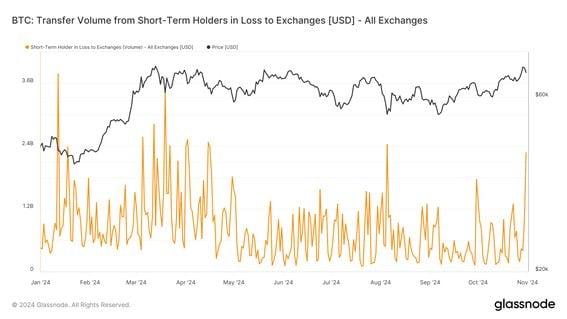
Over $2 billion worth of bitcoin was sent to exchanges at a loss on Thursday, the most since August's yen carry trade unwind, as bitcoin fell below $70,000. On Thursday, short-term holders sent over $2 billion worth of bitcoin to exchanges at a loss, the most since the yen carry trade unwind on Aug. 5. In the past three days, short-term holders sent more than $6 billion worth of bitcoin to exchanges at a profit, locking in gains as the month drew to a close. Disclaimer: The analyst who wrote this piece owns bitcoin. Short-term holders of bitcoin (BTC) sent about $2.3 billion, some 32,000 tokens, of the largest cryptocurrency to exchanges at a loss on Thursday as the price dropped below $70,000 after approaching an all-time high earlier in the week. The panic selling was the most since Aug. 5's yen carry trade unwind. Short-term holders — investors who have held bitcoin for less than 155 days — tend to panic and sell when the price drops, and buy when there is euphoria or greed in the market. In total, they sent over 54,000 BTC to exchanges on Thursday, the highest amount since Mar. 27. A number of factors may be playing into the recent drop, which has taken BTC to about 6% below its record. A U.S. presidential election is coming on Nov. 5, with investors most likely reducing their exposure to risk, which they tend to do on the last day of the month. We also witnessed an almost $1 trillion wipeout of the U.S. stock market on Thursday, with every one of the so-called magnificent seven tech stocks in the red. Breaking down Thursday's 54,000 bitcoin into profit and loss, CoinDesk research has shown continued profit-taking as bitcoin inched closer to March's record high. On Thursday, 22,000 BTC was sent to exchanges in profit, and over the past three days, over $6 billion of bitcoin was sent to exchanges in profit. Bitcion rose 11% last month. Considering the 155-day timespan to be considered in this category, the investors would have most likely bought this week. Bitcoin rose above $70,000 in May and July and holders then didn't seem phased by the subsequent 20% drawdowns, a sign they're not likely to be shaken out by a 6% price drop. Due to uncertainty around the U.S. election, bitcoin will likely not reach new all-time highs until after result is known. https://www.coindesk.com/markets/2024/11/01/bitcoins-drop-on-thursday-spurred-panic-sales-among-short-term-holders-van-straten/
2024-11-01 08:45
At current prices, a $10,000 punt on Harris could equal a $25,000 payout if she wins the U.S. presidential election. On Polymarket, Kamala Harris' odds of winning the U.S. presidential election have increased from 33% on Oct. 30 to nearly 39%. Donald Trump's have dropped 61%. The increase in Harris' odds might be due to traders hedging their bets, with trades above $10,000 suggesting both large bets on Harris and strategic trading to protect against a Trump loss. Reports of voting irregularities against Trump could be influencing market bets. The odds on Democrat candidate Kamala Harris winning next week's U.S. presidential election are rising on betting platform Polymarket, with some observers suggesting the increase reflects hedging positions among traders who've also bet on a victory for her Republican rival, Donald Trump. Harris’ odds have risen to almost 39% from 33% on Oct. 30. Trump's odds dropped in tandem, suggestive of lower expectations of him winning, though at 61%, he's still the preferred candidate. Some market watchers attributed Friday’s crypto market slide to Trump’s slump on Polymarket: The CoinDesk 20 Index (CD20) has dropped 4.4% in the past 24 hours. Polymarket is fundamentally a betting market place where users can buy “shares” in the outcome of any prediction, winning $1 per share if the outcome occurs. If a Yes share for an event costs $0.60, the market interprets this as a 60% chance of the event occurring. The odds are dynamic, changing with each trade. Polymarket works on a blockchain-based order book that lists all the buy (bid) and sell (ask) orders for shares in an outcome, similar to how any asset exchange works. The market's relatively low liquidity can induce wild swings in prices, with one large purchase briefly driving Trump shares up to 99% last week. The increase in the price for Harris’ shares could reflect traders buying them as a hedge on their Trump bets, market observers say, as some allege reports of voting irregularities pitted against Trump that could influence market bets. The change may also reflect results from traditional polls, with three new surveys showing Harris leading Trump in Michigan, Pennsylvania and Winsconsin, Newsweek reported Friday. Trump needs to win at least one of those to gain the White House, Newsweek said. At current prices, a $10,000 punt on a Harris victory could equal a $25,000 payout if she wins. That's a 150% return on capital. For large holders of Trump’s win shares, a bet on Harris’ win acts as a hedge. Polymarket data shows a flurry of activity in trades of more than $10,000 in the past 12 hours with large amounts of Harris “yes” shares and Trump “no” shares being purchased. Clumpyclumsy, a Polymarket user who joined in October, has alone purchased over $250,000 in Harris "yes" shares since early Friday. Some users on X also pointed out an arbitrage opportunity for traders participating in various election-based markets. “Theres a great arbitrage at the moment if you can access both Robinhood Securities and Polymarket,” noted @Kevin_Bolger. “You can load a bag on Trump on Robinhood, another on Harris on Polymarket and whoever wins, you win - assuming transaction fees dont eat the difference. Big difference between both.” Such market activity comes as Trump and allies allege election fraud in key states, claiming voting irregularities even as local election officials push back. https://www.coindesk.com/markets/2024/11/01/harris-odds-rise-on-polymarket-as-election-fraud-allegations-ramp-up-trump-hedge-bets/

2024-11-01 07:24
The CEO of the dYdX Foundation sees parallels between the internet of the 1990s and where Decentralized Finance (DeFi) is today. DeFi today is where the internet was in the 1990s, and DeFi has a lot to learn from its growth. DeFi and CeFi both have different roles to play, and the market needs both he argues. HONG KONG -- Regulations and increasing demand for consolidated products could propel growth in the niche decentralized finance sector (DeFi), one that's stuck in a market lull in the past year but could have its “internet” moment as retail offerings grow. That's the view held by Charles D’Haussy, CEO of the dYdX foundation, which supports the development of the onchain perpetual trading protocol dYdX – one of the first such platforms that currently boasts $266 million in locked value, according to DeFi Llama data, and has a $674 million market capitalization by token value. D’Haussy spoke to CoinDesk at the sidelines of the Hong Kong Fintech Week earlier this week, predicting growth in the DeFi market to be similar to the internet's recent years - where people interact mainly using application instead of web explorers or browsers. "The internet, in my opinion, is becoming the split internet, with walled gardens...People don’t go to web explorers; they go into apps,” he said in an interview with CoinDesk. "The internet’s evolution into silos shows a massive change in how web products are distributed, and DeFi needs to follow users into these spaces." D'Haussy sees parallels between the regulatory evolution of the internet and DeFi. In the 1990s, regulators struggled to understand and control the decentralized nature of the internet, seeking a "CEO of the internet" that didn’t exist, and eventually shifted focus to regulating access providers like AOL and ISPs, he explained. While DeFi operates as an open, unpredictable financial ecosystem without central control, regulators will not target the protocols themselves but will instead focus on centralized finance (CeFi) platforms and other gateways as points of regulation, he argued. “The distribution of DeFi is evolving. CeFi could fill the gaps by providing a bridge for users who want decentralized options within regulatory limits. When Binance or another exchange enables a non-custodial wallet, it lets users do more with DeFi than CeFi regulations alone allow,” D’Haussy said. And once the market figures out how to integrate CeFi and DeFi, working out the regulatory and technical challenges, we’ll have the future of finance, he concluded. Where will this happen? Probably in Hong Kong – one of crypto’s most strategic and important hubs. https://www.coindesk.com/markets/2024/11/01/defi-to-have-walled-garden-moment-as-internet-of-money-matures-dydxs-dhaussy/

2024-11-01 07:15
A tracker for market sentiment reached “extreme greed” levels on Thursday, which has historically preceded market corrections. Bitcoin prices dropped nearly 4% in the last 24 hours, moving from $72,500 to just above $69,000, with the overall crypto market cap decreasing by 5.5%. The Fear and Greed Index indicated "extreme greed" on Thursday, potentially signaling a market top. By Friday, the index showed "greed," suggesting further price corrections might occur. Nearly 90% of the futures positions were long (expecting price increases), highlighting a bullish market sentiment before a sharp correction. Bitcoin (BTC) price fell nearly 4% in the past 24 hours amid continual profit-taking ahead of the weekend, causing a wider market retreat that led to over $250 million in bullish bets liquidated. BTC fell from $72,500 early Thursday to just over $69,000 early Friday, paring down gains made by the token since Monday. Other major cryptos fell in tandem, with overall market capitalization falling 5.5%. Meanwhile, the widely-watched Fear and Greed Index, a sentiment and volatility tracker for the crypto market, flashed “extreme greed” levels on Thursday, historically a sign of local tops. The index aims to measure emotional responses in the crypto market, highlighting that extreme fear might present buying opportunities, while extreme greed could signal an upcoming market correction. The index is flashing “greed” as of Asian afternoon hours Friday - suggesting prices could correct further. The price caused pain for futures traders. Bets on BTC-tracked futures recorded $88 million in losses, CoinGlass data shows, followed by $44 million in liquidations on ether (ETH) futures and nearly $15 million in losses each on SOL and DOGE futures. Nearly 90% of all futures bets were bullish, or expecting higher prices over the weekend ahead of the U.S. elections on November 5. Market conditions in the past few weeks, including global monetary policies and U.S. political support, indicated a continued bullish trend, with some traders targeting $80,000 for BTC in the coming weeks. A liquidation occurs when an exchange forcefully closes a trader's leveraged position due to the trader's inability to meet the margin requirements. Large-scale liquidations can indicate market extremes, like panic selling or buying. A cascade of liquidations might suggest a market turning point, where a price reversal could be imminent due to an overreaction in market sentiment. The liquidations came as bitcoin open interest hit record high levels earlier this week at over $43 billion, dropping to just over $41 billion early Friday. https://www.coindesk.com/markets/2024/11/01/bitcoin-price-drop-leads-to-250m-bullish-liquidations-crypto-sentiment-indicator-signals-top/

2024-11-01 07:11
The firm’s IMX token is down over 13% at $1.16 following the announcement. Immutable said that it received a notice from the SEC related to the sale of its IMX tokens in 2021. The web3 firm accused the SEC of “regulation by enforcement” and slammed regulators for not providing regulatory clarity. Web3 gaming firm Immutable has been issued a Wells Notice by the U.S. Securities and Exchange Commission, the company said in a statement on Friday. The company said the notice was received hours after the company’s “first interaction” with the SEC, and “cited statutory provisions and contained limited meaningful detail about the nature of the investigation”. “With this action, the SEC is continuing to indiscriminately assert that tokens are securities. While not specified in the notice, we believe its claims are targeting the listing and private sales of IMX in 2021,” Immutable said, referencing a blog post about a pre-launch private purchase of Immutable’s token IMX by Huobi Ventures Blockchain Fund. The firm’s IMX token slipped over 13% at $1.16 over the past 24 hours. A Wells Notice is a letter sent to people or companies following an investigation by the SEC. It informs them that the regulator is planning a lawsuit against them. Several high profile crypto companies have received such notices over the past few years including Coinbase, Consensys, Ripple, OpenSea and Crypto.com. The CEO of Immutable and the Digital Worlds Foundation, the parent entity of the issuer of Immutable’s IMX token, also received separate notices. Immutable also said it was aware of “related inquiries, but no actual or proposed legal action, from the DOJ.” “To manufacture a case on a listing that occurred in 2021, with practically no direct communication with the company, is precisely the reason the industry is so skeptical of any attempts from this SEC to argue it is attempting to provide clarity,” it said. “Despite the SEC indiscriminately claiming that tokens across the industry are securities, we are confident the IMX token is not. If the manner of providing clarity to the industry is by winning against this attempted regulation by enforcement, then Immutable is happy to do so.” https://www.coindesk.com/policy/2024/11/01/sec-goes-after-another-crypto-firm-slaps-immutable-with-wells-notice/