2024-10-30 20:13
The company reported its third quarter earnings results after the close of trading on Wednesday afternoon. Self-described Bitcoin development company MicroStrategy (MSTR) didn't add to its bitcoin (BTC) holdings since mid-September, but the firm announced an audacious plan to raise $42 billion of capital over the next three years in order to purchase more of the world's largest crypto. Led by Executive Chairman Michael Saylor, the company's so-called "21/21 Plan" calls for $21 billion of equity raises and $21 billion of debt offerings over the next three years. "As a Bitcoin Treasury Company, we plan to use the additional capital to buy more bitcoin as a treasury reserve asset in a manner that will allow us to achieve higher BTC Yield,” said Phong Le, president and CEO in the third quarter earnings press release. MicroStrategy's most recent previous disclosure was in mid-September when it announced the purchase of 7,420 bitcoins (BTC) for $458.2 million. That brought its holdings to that point to 252,220 bitcoins acquired for a total of $9.9 billion, or an average price of $39,266 each. At the current price of about $72,000 the company's bitcoin is worth more than $18 billion. As of the end of the quarter, the company had $891.3 million of dry powder remaining from a previous capital raise. MicroStrategy also revised higher the target range of its "BTC Yield" to 6%-10% from the previous 4%-8%. Created by the Saylor and team, the BTC Yield is considered by MSTR to be a key performance indicator (KPI), describing how well the company does in acquiring bitcoin in an accretive manner to shareholders. The BTC Yield for Q3 was 17.8%. Shares are lower by 10% in after hours trade, but remain roughly 250% higher year-to-date. https://www.coindesk.com/business/2024/10/30/michael-saylors-microstrategy-plans-to-raise-42b-to-buy-more-bitcoin-over-next-3-years/

2024-10-30 20:13
Singh, who was sentenced to time served, is the fourth FTX executive to be sentenced for his role in the fraud. NEW YORK – Nishad Singh, former director of engineering at FTX and a one-time member of Sam Bankman-Fried’s inner circle, was sentenced to time served by a federal judge on Wednesday, meaning he's not going to prison like his former colleagues. He was also ordered to pay $11 billion in restitution. Singh, 29, who pleaded guilty to six criminal counts including wire fraud and conspiracy in February, is the fourth FTX executive to be sentenced for his role in the fraud. Bankman-Fried was sentenced to 25 years in prison in March for his role as ringleader. Former FTX Digital Markets CEO Ryan Salame, who did not testify against Bankman-Fried, recently began serving his 7.5 year prison sentence. And Caroline Ellison, former Alameda Research CEO and one-time girlfriend of Bankman-Fried, was sentenced to two years by the same judge, District Judge Lewis Kaplan of the Southern District of New York (SDNY), last month – her sentence heavily discounted by her prompt and extensive cooperation with prosecutors. Though Kaplan sounded sympathetic to Ellison during her sentencing last month, he contrasted her long-time involvement in and awareness of Bankman-Fried's fraud with Singh, who was out of the loop until only two months before the exchange collapsed. "Your case is not the case that Miss Ellison's was. She was involved from the beginning. She knew for years," Kaplan said before handing down the sentence. Kaplan and prosecutors highlighted Singh's extensive cooperation with prosecutors, during which he incriminated himself repeatedly and informed the government of crimes they did not yet know about. While Singh did promptly cooperate with the prosecution after FTX collapsed – as well as the FTX bankruptcy estate, as highlighted in an Oct. 29 letter from current FTX CEO John J. Ray III to the court – including testifying against his childhood-friend in Bankman-Fried’s trial last October, he admitted he knew of the $8 billion hole in FTX’s balance sheet by September 2022, two months before the exchange collapsed. Despite knowing about the disastrous financial situation at FTX, Singh also went through with the purchase of a $3.7 million estate in Washington's Orcas Island in October of 2022, which his lawyer, Andrew Goldstein of Cooley LLP, described as a "deep mistake." Wednesday's sentence was surely welcome news to Singh and his legal team, who requested that the former FTX executive serve no prison time. In a court filing earlier this month, Singh’s lawyers urged the court to consider his “limited” involvement in the scheme, as well as his cooperation with the prosecutions of Bankman-Fried and Salame. The filing described him as an “uncommonly selfless individual” and attached more than 100 letters from friends and family. More than 20 friends and family members – including Singh's fiancee Claire Watanabe, his parents and his younger brother – attended the sentencing on Wednesday. Watanabe gasped with relief at the news that Singh would not be going to prison. Both parents shed tears. Before Kaplan dismissed the court, he spoke to Singh's parents, emphasizing that he was speaking from his personal perspective and not as a judge. "I don't see anything you did wrong," Kaplan said. https://www.coindesk.com/policy/2024/10/30/ftxs-nishad-singh-gets-no-prison-time-for-role-in-crypto-exchange-collapse/

2024-10-30 17:27
The T-REX 2X long MSTR Daily Target ETF (MSTU) has rallied 235% since its introduction six weeks ago, an annualized equivalent return of 57,000%, according to Bloomberg analysis. Since launch, MicroStrategy-tracking ETF MSTU has surged 235% and rival MSTX has gained 176%. MSTX raised the leverage on its ETF from 1.75x to 2x to match MSTU's. MicroStrategy reports third-quarter earnings after the close of U.S. markets. Disclaimer: The analyst who wrote this piece owns shares of MicroStrategy (MSTR). Two MicroStrategy (MSTR) exchange-traded funds (ETFs) have started up this year. The Defiance Daily Target 1.75X Long MSTR ETF (MSTX), introduced Aug. 15, initially promised investors 1.75 times the daily percentage change in the software maker's share price. The fund saw 176% returns in 2.5 months, prompting the issuer to raise its leverage — and change its name — to 2x. The increase brought the product to the same level as the T-REX 2X Long MSTR Daily Target ETF (MSTU), which started trading a month later, on Sept. 18, and generated even better returns. The ETF promises investors twice the daily performance of MSTR and has generated returns of 235%. MSTR has gained 87% in the same period. “T-Rex's 2x Microstrategy ETF MSTU launched a mere six weeks ago and is already up 225% (annualized equivalent of 57,000%) and trades half a billion in volume (Top 1% among ETFs),” said Eric Blachunas, a senior Bloomberg ETF analyst. "It's so funny they've long had 3x MSTR ETFs in Europe but no one cares, no assets, volume. It's the market for that amount of heat, no degens. The U.S. on the other hand, it's 'make it volatile and they will come.'" MicroStrategy, together with executive chairman Michael Saylor, has been one of the key crypto narratives in 2024 as investors look to gain exposure to bitcoin (BTC) without investing directly into the digital asset. Shares of MSTR, which reports third-quarter earnings after the close of U.S. markets, have more than tripled this year and holds 252,220 BTC. https://www.coindesk.com/markets/2024/10/30/degens-are-searching-for-further-leverage-on-microstrategy-and-winning-massively/

2024-10-30 17:08
As much as a third of the prediction market's volume is inflated by traders acting as the buyer and seller — an illegal practice in TradFi — on the same trades, Fortune reported. Some could be doing it to farm a future token airdrop. Prediction market Polymarket is "rife" with wash trading, a type of market manipulation that's illegal in traditional finance and involves the identical person acting as both buyer and seller on a given trade, Fortune reported Wednesday, citing analyses by blockchain sleuthing firms. The Fortune article, which debuted about a week after suspicions of a different kind of manipulation on Polymarket, cited research done by two blockchain analytics firms. One, Chaos Labs, "concluded that around one-third of trading volume — and overall users — on the presidential market alone was likely wash trading, along with across all markets." The other, Inca Digital, "found that a 'significant portion of the volume' on the market could be attributed to potential wash trading," the magazine said. Wash trading is banned in TradFi because it can give a false impression of the untainted demand and pricing for assets. A Polymarket spokesperson told CoinDesk: "As the researchers themselves note, a single trader taking positions on both sides of a market is hardly unique to Polymarket and not in and of itself problematic." Unlike on Wall Street, the spokesperson went on, "Polymarket makes all transactions on its platform transparent and publicly available, including to researchers" and the company's terms of service "expressly prohibit market manipulation." The Fortune article hinted that these alleged wash trades are motivated by something more prosaic than influencing the outcome of next week's U.S. presidential election. It noted that Polymarket is reportedly considering issuing its own token and that wash trading is often done in crypto to become eligible for token giveaways to active users, a practice known as "airdrop farming." In a post on X (formerly Twitter), prominent crypto investor Nic Carter suggested that airdrop farming would be the most plausible driver of any such activity, rather than political shenanigans. Polymarket does not currently charge trading fees, which would inhibit repeated buying and selling. Flip Pidot, a veteran prediction market trader who has tracked activity on Polymarket closely, said that without seeing firsthand the research by Chaos Labs and Inca, it would be hard for him to evaluate the Fortune article's central claim. But he took issue with a secondary claim in the article, which called it an "anomaly" that Polymarket counts each trade as $1 in volume, even when a trader paid as little as a cent for a "yes" share in Hillary Clinton winning this presidential election. "Volume in prediction markets (and indeed futures markets generally) is routinely quoted in terms of notional value (i.e. payout value), which as the article states, is what Poly is doing," Pidot told CoinDesk. "If you buy a $1 payout position for $0.01 (and someone buys the other side at $0.99), that's $1 of notional volume." Fortune's claim of wash trading on Polymarket is different than the one that made mainstream headlines a week or so ago. That earlier narrative, which many market experts called dubious, was that a "whale" trader was trying to drive up Donald Trump's odds of winning the presidency on the platform, possibly to influence voter turnout or give Trump a pretext to dispute election results if he loses. While Polymarket has confirmed that a handful of accounts with large bullish positions on Trump are controlled by the same French national, market watchers said the whale's trading patterns suggested they were buying shares strategically rather than trying to inflate the price. https://www.coindesk.com/business/2024/10/30/fortune-claims-polymarket-is-rife-with-wash-trading/

2024-10-30 15:59
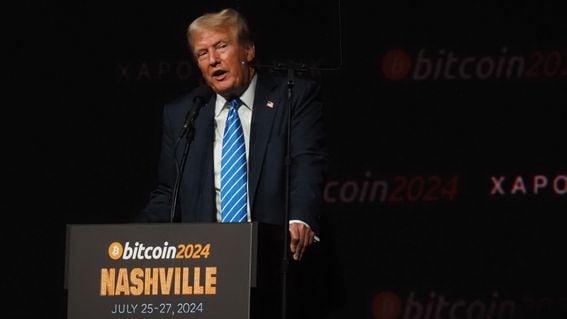
Citing presidential candidate Donald Trump's remarks on a U.S. strategic crypto reserve, Florida Chief Financial Officer Jimmy Patronis is pushing the idea for state pension funds. The top financial official for Florida was so impressed by Trump's rhetoric on the U.S. building a bitcoin stockpile that he wants to shift some state pension money into crypto. Florida Chief Financial Officer Jimmy Patronis said in a letter to the state's investment managers that they should check out that option. Florida's chief financial officer proposed that the funds that support retired state workers should dabble in crypto, inspired by Republican presidential candidate Donald Trump's support for the U.S. government stockpiling bitcoin (BTC). "I believe this forethought and innovative thinking from a successful businessman like President Trump must not be taken for granted," state CFO Jimmy Patronis said in a letter to the executive director of Florida's State Board of Administration, advocating for his state to join others that have already made such investments. "Bitcoin is often called 'digital gold,' and it could help diversify the state’s portfolio and provide a secure hedge against the volatility of other major asset classes." He suggested the organization that manages the state pensions that serve Florida's retired firefighters, teachers and other public workers should study how crypto investing may fit into one of its funds and offer "potential benefits we cannot afford to overlook," according to the letter dated on Tuesday. Patronis, who is one of three trustees along with the governor and state attorney general, asked the organization to come back with a report that can inform state lawmakers before the next session. If Florida were to make that change, it would follow in the footsteps of states such as Wisconsin and Michigan. Read More: As a Pension Embraces Bitcoin, Hope Grows for Cryptocurrency's Long-Term Prospects Even Among Conservative Pros "There’s no telling what the future of cryptocurrency will be, but it’s important that the State of Florida stays ahead of the curve when considering new investments and providing the best returns for Floridians," he wrote. Patronis indicated he'd been inspired by Trump's rhetoric earlier this year at a prominent Bitcoin conference in Nashville, where the former president spoke of a strategic crypto reserve for the U.S. Such an idea has also been discussed by U.S. lawmakers, though it hasn't yet made significant progress. https://www.coindesk.com/policy/2024/10/30/inspired-by-trump-florida-official-eyes-state-bitcoin-stockpile-for-retirees/
2024-10-30 15:53
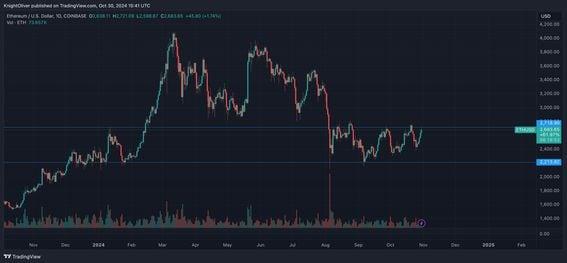
The second-largest crypto has been locked in a sizable downtrend relative to bitcoin. Ether has bucked its recent trend of underperformance against bitcoin, rising by 2.5% in the past 24-hours whilst bitcoin has edged lower. $17 million worth of short bets on ether have been liquidated on derivatives exchanges. Continued negative sentiment around ETH's loss of market share could lead to a short squeeze. Ether (ETH) might be primed for a period of upside price action after sharply underperforming against bitcoin (BTC) in recent months. Skeptics have claimed that the emergence of layer-2 networks has seen Ethereum fall out of favor among DeFi traders, but the data tells a different story. Has the move begun today? Maybe, maybe not, but ether is higher by 2.5% over the past 24 hours against a very modest decline in the price of bitcoin, according to CoinDesk data. Alongside, $17 million worth of ether short bets were liquidated across derivatives exchanges thanks to ETH's gain. Prior to today, ether had been down more than 10% over the prior 6 months versus a 22% advance for bitcoin, bringing the ETH/BTC ratio to its weakest level since April 2021. Ether itself has remained in the same trading range since early August, with the current level of $2,700 providing two firm rejections on Sep. 27 and Oct. 21. During that period bitcoin surged from below $60,000, yesterday testing its record high from March of just shy of $73,800. Ether remains about $2,000 below its record high set all the way back in November 2021. The relative underperformance of ETH in recent month has led to widespread bearish sentiment and disappointment in the asset, which has a market cap of $322 billion. One catalyst behind the negative narrative is the abundance of layer-2 networks which are taking market share, liquidity and volume away from the main Ethereum network. Several key metrics including new wallets and number of transactions have also continued their respective downtrends. These metrics can lead traders to heap on short positions, which can lead to a turbulent "short squeeze." Data from DefiLlama, however, shows that Ethereum still commands more than 55% of the total value locked (TVL) across all DeFi networks and protocols, with the figure topping $50 billion. This means that when capital flows into altcoins, ether is primed to be one of the main beneficiaries. https://www.coindesk.com/markets/2024/10/30/ether-gains-25-primed-for-more-upside-as-negative-sentiment-leads-to-dangerous-short-skew/