2024-10-28 09:38
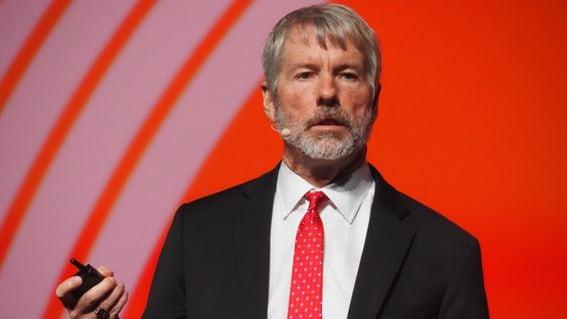
The launch of options on spot bitcoin exchange-traded funds in the U.S. will reduce the incentives for investors to hold MicroStrategy stock over these ETFs, the report said. MicroStrategy's almost 300% premium to its bitcoin holdings is unsustainable, the report said. The positive effects of the company's recent stock split are wearing off and the launch of options on spot bitcoin ETFs will also lessen demand, Steno said. The report noted that during the 2021 crypto bull market MicroStrategy's premium hovered below 200%. MicroStrategy's (MSTR) current premium relative to its bitcoin (BTC) stack is unlikely to last, Steno Research said in a report Friday. "This conviction is reinforced by the diminishing effects of MicroStrategy's recent stock split," analyst Mads Eberhardt wrote, adding that the launch of options on spot bitcoin exchange-traded funds (ETFs) in the U.S will also lessen the motivation for investors to hold the stock over these ETFs. The software company founded by Michael Saylor carried out a 10-for-1 stock split in August, a move that according to Steno has contributed to the recent rally. Steno noted that the company's premium relative to its bitcoin horde has recently surged to almost 300%. This suggests that the firm's valuation is "diverging significantly from a straightforward calculation of its asset and and business fundamentals," the report said. As regulators become more favorable to bitcoin and crypto in general, investors may choose to hold bitcoin directly instead of MicroStrategy stock, Steno said. If Donald Trump is re-elected this regulatory trend is expected to continue. Bitcoin is expected to perform strongly this quarter and into 2025, which means that an "even higher buying demand would be required to sustain MicroStrategy's current premium," the note said. MicroStrategy's existing premium is unsustainable, especially given the fact that during the 2021 crypto bull market it was below 200% for most of the time, the report added. The stock recently hit a new all-time high, having surged over 240% year-to-date. https://www.coindesk.com/markets/2024/10/28/microstrategys-current-premium-relative-to-its-bitcoin-stack-is-unlikely-to-last-steno-research/
2024-10-28 09:17
"Given the uncertainty, Maelstrom has 5% of the fund in staked USDe (Ethena USD), earning roughly 13%," Hayes told CoinDesk. Maelstrom has parked 5% of its funds in staked USDe, Hayes told CoinDesk in an email interview. The fund will rotate that money into crypto after the election results are clear and the losing side accepts the defeat, Hayes added. It doesn't matter who wins beyond the short-term, Hayes quipped. With the U.S. election just a week away, markets are waiting with bated breath for the political event that has created "high uncertainty." Arthur Hayes, chief investment officer at digital asset investment fund Maelstrom and co-founder of BitMEX, is hedging the election risk with Ethena Lab's USDe stablecoin while maintaining large bullish bets in bitcoin (BTC), ether (ETH) and other cryptocurrencies. "Given the uncertainty, Maelstrom has 5% of the fund in staked USDe (Ethena USD), earning roughly 13%. We maintain our large long positions in Bitcoin, Ether, and other tokens," Hayes told CoinDesk in an email. Ethena's USDe is a synthetic dollar, which uses collateralized stablecoin and a hedged cash-and-carry arbitrage strategy to retail the $1 price peg. The funding fee collected from shorting perpetual futures tied to BTC and ETH as a part of the carry trade represents the yield. Staking USDe and acquiring staked USDe, or sUSDe, a reward-bearing token, automatically grants the user access to protocol rewards. The fund's allocation in the delta-neutral product will guard against potential market price swings in the lead-up to the election on Nov. 5 and results, due three days later on Nov. 8. Maelstrom is an investment fund focused on digital assets and managed by the family office of Arthur Hayes (co-founder, BitMEX). The fund’s mandate is to build a portfolio of infrastructure companies that will serve as the foundation of the next wave of trustless decentralization. In addition to managing the fund, Hayes writes the industry-leading monthly newsletter Crypto Trader Digest. Watch out for a sore loser Hayes expects risk assets, including cryptocurrencies, to see increased price turbulence for a while if the losing side takes to the street, causing social unrest. According to traditional media, Republican Donald Trump and Democrat Kamala Harris are locked in a dead heat. Meanwhile, betting on decentralized prediction platforms has the supposedly pro-crypto Trump leading his rival Harris by a significant margin. "If the election comes and goes with no social unrest, the markets will rip and roar. Post the election, once we know who wins, and the other side accepts the results, then we will deploy all sUSDe into crypto," Hayes said. As of Friday, bitcoin options listed on Deribit signaled volatility of nearly 3.8% for Nov. 8. BTC has historically seen more giant swings on random non-event days. It doesn't matter who wins The outcome of the U.S. election is unlikely to significantly alter Bitcoin's broader bullish prospects, as budget deficits are likely to continue rising irrespective of who takes the presidency. Bitcoin and gold are perceived as safe haven assets, offering a hedge against budget deficits, which tend to be inflationary. "Both Trump and Harris will print money in the trillions of dollars. In the medium term, it doesn't matter who wins. Crypto will do well. In the short term, the market understands the ways in which Trump will stimulate the economy because that is the traditional way it has been done in the past. Tax cuts combined with business-friendly deregulation but with no cuts in benefits is what he will do," Hayes explained. Legendary trader Paul Tudor Jones voiced a similar opinion last week, saying inflation will continue to rise regardless of whether Donald Trump or Kamala Harris wins the presidency. Several crypto traders are betting on a bitcoin rally to $80,000 and higher after the election. Potential war is a short-term risk Looking past the election, a potential escalation of war in the Middle East or Ukraine could lead to short-term pain for risk asset holders. "The biggest macro risk is if friends and foes of the U.S. engage in aggressive military action while there is confusion as to who is in charge after the election. War is un-investable in the short-term and this would lead to a global risk off," Hayes quipped, saying that the war's inflationary impact would eventually bode well for crypto. "The way to play this risk is to size positions accordingly and use little to no leverage," Hayes said. https://www.coindesk.com/markets/2024/10/28/arthur-hayes-maelstrom-hedges-us-election-uncertainty-with-staked-usde-holds-large-btc-eth-bullish-bets/
2024-10-28 07:07
BTC's best years have been characterized by copper's outperformance relative to gold. The widely-tracked copper-to-gold ratio continues to slide in the wake of China's stimulus announcements, offering negative cues to risk assets. BTC's best years have been characterized by copper's outperformance relative to gold. From the increasing probability of pro-crypto Republican candidate Donald Trump winning the upcoming U.S. presidential election to expectations for Fed rate cuts, bitcoin (BTC) bulls have several things to cheer about. However, the widely-tracked copper-to-gold ratio, continues to slide, flashing a red signal for risk assets, including cryptocurrencies. The ratio, which represents the division of price per pound of copper by per ounce price of gold, has hit a fresh year-to-date low, reaching the levels seen in late 2020, according to data source TradingView. The metric, considered a proxy for the global economic health and investor risk appetite, has dropped over 15% this year, the biggest loss since 2018. Telltale sign of economic malaise? What's probably more concerning is that the ratio has declined by 10% since China, the world's factory and largest importer of commodities, unveiled a string of stimulus measures in late September to support its ailing economy. The U.S. Federal Reserve (Fed) delivered an outsized 50 basis points interest rate cut in September, supposedly kicking off the so-called liquidity easing. However, that too failed to put a floor under the ratio. The persistent slide could be a telltale sign of a grittier economic picture that risk assets are probably overlooking. Copper, being an industrial metal, tends to do well when the global economy is expanding, and has historically reacted positively to China's stimulus announcements. Gold, meanwhile, is considered a safe haven. Hence, a falling copper-to-gold ratio is widely seen as a risk-off signal. BTC vs copper-to-gold ratio As of writing, BTC was up 60% for the year, trading near $67,800, according to CoinDesk data. However, most gains occurred in the first quarter and since then, the bulls have consistently failed to secure a new base above the $70,000 mark. The bull failure has been attributed to several factors, including supply overhang fears stemming from defunct exchange Mt. Gox's credit reimbursements. Coincidentally, the slide in the copper-to-gold ratio began in May, offering risk-off cues. The downtrend gathered steam in July, presaging the brief early August risk aversion in financial markets that saw BTC slide from $65,000 to $50,000. Besides, data from TradingView show that BTC's best years – 2013, 2016-17, and 2020-21 – have been characterized by an uptrend in the copper-to-gold ratio. If the past is a guide, the plummeting copper-to-gold ratio casts doubt on bullish BTC expectations, calling for a rally to $100,000 by the year's end. https://www.coindesk.com/markets/2024/10/28/bitcoin-has-a-lot-going-for-it-except-the-persistent-slide-in-copper-gold-ratio/

2024-10-26 13:00
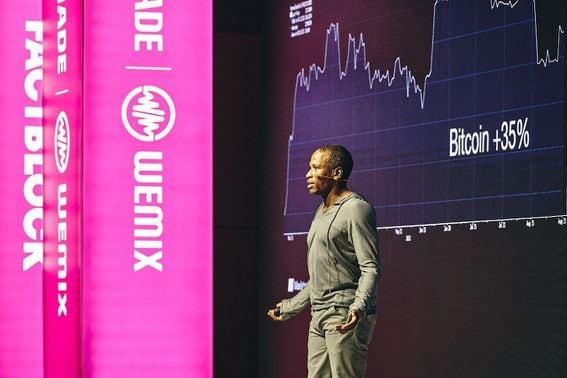
A longtime regular on the crypto scene, Sovryn and BitcoinOS founder Edan Yago learned the importance of financial sovereignty at an early age. From ages 9 to 11, Edan Yago smuggled gold, hidden in his clothes by his mother, out of South Africa. The apartheid government had instituted capital controls to stabilize the rand amid international sanctions. The authorities were hunting some of his family members whom it had designated as "terrorists." “Eventually, we were forced out of South Africa,” Yago told CoinDesk in an interview. His family were no strangers to tyranny. Some relatives had survived the Holocaust; others weren't so lucky. That background, combined with his education in neuroscience and data science, led him to a career working in Bitcoin, with its value proposition of wealth that governments can't easily confiscate and transactions that central authorities can't veto. “Throughout, my focus has been on trying to develop tools for greater sovereignty,” Yago said. A self-described "bitcoin accelerationist," Yago is the founder of Sovyrn, a decentralized bitcoin lending and trading platform. He is building BitcoinOS, a "rollup" stack for the world's largest cryptocurrency designed to process more transactions and more complex operations like smart contracts than the blockchain could handle otherwise. Technical achievements In July, BitcoinOS achieved its milestone of verifying a zero-knowledge proof on Bitcoin mainnet. “This is a big deal,” Yago said. “We're building a platform which is going to allow rollups on bitcoin, and through that, allow us to maintain the security of bitcoin without introducing any changes to smart contracts, build scalability and privacy." The goal is "transforming bitcoin into an operating system, not just a system for transacting bitcoin.” His team is now working with a company called Emurgo to turn Cardano (ADA), the blockchain whose native ADA token is the 11th-largest cryptocurrency according to CoinDesk data, into a smart contract layer for Bitcoin. The first technical step will be integrating the BOS Grail bridge with Cardano’s open-source ecosystem to allow “trustless bridging of BTC and Bitcoin assets using BOS’s ZK-based BitSNARK verification protocol, bringing Bitcoin’s unparalleled liquidity into Cardano,” according to a Thursday announcement. A crypto OG Yago has been a regular on the blockchain scene for more than a decade. In 2013, at an early Bitcoin conference in San Jose, California, he pitched the idea of a "cryptocurrency-based political zone." Three special economic zones in Honduras emerged from that project; they are fighting a legal battle with the government there. The concept was a harbinger of Balaji Srinivasan's network states. In the years since, the early adopters' lofty visions have been overshadowed by later entrants' obsessions with candlestick charts and Lamborghinis. “The whole crypto ecosystem’s challenge is that it's a mixture of high-minded idealism with the most speculative casino stuff and that’s a difficult thing to navigate," Yago told CoinDesk. Nevertheless, he sees a silver lining in the sleaze. "While it's tempting for ideologically driven people to completely reject memecoins, centralized exchanges and all the nonsense that's going on, the truth is that that is a gateway drug for people to actually discover how they can be more in control of their financial lives,” Yago said. What's more, he is trying to rehabilitate an idea associated with one of the more unsavory chapters in crypto history. ICOs redux Yago said he wants to form a “coalition of established DeFi’s and crypto companies to bring back the age of initial coin offerings.” As then-CoinDesk columnist David Z. Morris wrote last year, the 2017 ICO boom was an “orgy of fraud and scammy behavior” but it also “funded many crypto success stories.” Yago said it is no longer necessary to issue tokens through centralized entities. The correct way is through decentralized autonomous organizations (DAOs), ones that are decentralized in more than name. “Imagine if large collectives or DAOs or, say, six projects come together and say 'This is important for us to preserve the privacy of our users so we are launching a crypto application or project together,'" he said. "The SEC can try and figure out who's to blame. That’s the secret. We don’t need to fight it directly.” The arrest of Tornado Cash co-founder Alexey Pertsev has not deterred Yago because “Tornado Cash still works,” he said. Neither has North Korea’s use of Tornado Cash to launder funds. “If you’re not taking casualties, you’re not fighting," Yago said. "The cost of an open society with freedom of speech is that sometimes a terrorist will find the book which teaches him how to make an explosive." https://www.coindesk.com/policy/2024/10/26/from-smuggling-gold-out-of-africa-to-bridging-bitcoin-and-cardano/

2024-10-25 18:24
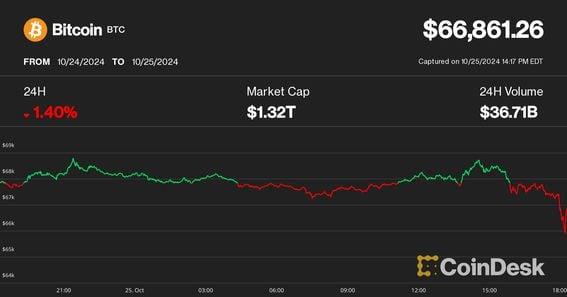
Bitcoin appeared poised to make another run at $70,000, but a WSJ story of a criminal probe into the stablecoin issuer sent prices tumbling. Cryptocurrency prices have reversed early gains and are broadly lower during U.S. afternoon hours on Friday following a Wall Street Journal report that the U.S. is probing stablecoin issuer Tether for violations of sanctions and anti-money laundering rules. Stablecoins are a type of cryptocurrency whose value is pegged to another asset, typically the U.S. dollar. With a market cap in excess of $120 billion, tether (USDT) is by far the most widely used stablecoin. Earlier in the session, crypto prices had been on the rise, with bitcoin (BTC) nearing the $69,000 level and perhaps readying for a late-day or weekend challenge of topping $70,000 for the first time in three months. In the minutes following the news on Tether, bitcoin had tumbled to as low $66,500, down nearly 2% over the past 24 hours, before modestly bouncing back to $66,800. The broader market gauge CoinDesk 20 Index was lower by 2.3% over the same time frame. Taking to X shortly following the story, Tether's Chief Executive Officer Paolo Ardoino said the WSJ is "regurgitating old noise." There is no indication, said Ardoino, that Tether is under investigation. The stablecoin firm subsequently released a statement dismissing the WSJ article. https://www.coindesk.com/markets/2024/10/25/crypto-rally-foiled-by-report-of-doj-probe-of-tether/
2024-10-25 11:45
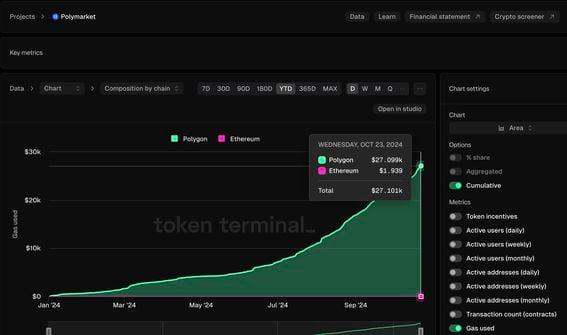
One of the major breakout successes this year for the team behind layer-2 blockchain Polygon is Polymarket. But according to data, Polymarket has only brought in about $27,000 of transaction fees for Polygon PoS in 2024. Polymarket – the decentralized predictions market – has been a massive success for the Polygon blockchain, in terms of being an app that is organically breaking out, getting mainstream usage and attention. But according to data, Polymarket has only brought in $27,000 in fees on Polygon’s PoS blockchain in 2024. Polygon Labs CEO Marc Boiron agreed that $27,000 is a low figure, but argues that this shows how cheap it is to use the blockchain – a selling point. The fees for transacting on Polygon is about $0.007, easily below the sub-cent threshold that several teams have targeted. Boiron arguest that apps like Polymarket aren’t expected to bring in large revenues in transaction fees, as one might expect from more transaction-intensive applications like decentralized crypto exchanges. One of the major breakout successes this year for the team behind layer-2 blockchain Polygon is Polymarket – the decentralized predictions market where users have flocked this year to place bets on everything from presidential politics to the conclusion of an HBO documentary. What's less clear to crypto analysts examining Polygon's performance metrics is whether the coup will bring relief to holders of the project's ailing tokens, down 65% this year. Polymarket has soared in popularity among mainstream users, allowing them to make bets on the upcoming U.S. presidential election. Polymarket bettors have added nearly $2.4 billion on the question of whether Donald Trump or Kamala Harris will win the election in November. Bettors also recently made a market on whom a recently debuted HBO documentary about Bitcoin would attempt to identify as inventor Satoshi Nakamoto. Polymarket is built on the Polygon PoS blockchain, and the application is one of the first major organic successes for the team – known for a past marketing strategy of paying partners like Starbucks to use the network. So given the application's boom in usage, why has it only produced a small amount in dollar figures for the Polygon team, and barely any bump in the price of the native POL token? According to data from Token Terminal, as of Oct. 23, Polymarket has only brought in about $27,000 of transaction fees for Polygon PoS in 2024. The answer, in part, is that the fees are market-based. And lately, transacting on Polygon PoS is extremely cheap. The average transaction fee on the Polygon PoS chain on that same day was $0.007. Anytime a Polymarket user makes a bet, they’re creating a transaction on Polygon PoS. As part of those transactions, they pay fees to Polygon PoS, which is split up into a base fee and a priority fee. The base fee does not go towards validators; instead it is burned – sent to a null address that theoretically should benefit tokenholders by helping to reduce the supply. “That base fee is adjustable and it's based off of network congestion,” Polygon Labs CEO Marc Boiron told CoinDesk in an interview. “So as the network gets more congested, that base fee increases.” The priority fee is paid out to a validator. “You're paying the validator to say, Please include me in a block," Boiron added. "The higher a fee you pay, the earlier the validator will include you in a block if there's more congestion.” If there's ample blockspace, there's less of a need to pay up. Another issue is that, in the grand scheme of things, while Polymarket's bettors are quite active, the volume of transactions doesn't come close to the level of high-intensity applications like decentralized crypto exchanges (DEXs). So far this month, 5.2% of transactions on the Polygon PoS chain came from Polymarket, according to Polygon’s research team. Chainlink makes up 10.38% of transactions on PoS, while transfers of the stablecoin USDT make up 4.89%. Just to take the example of a recent day's activity. On Oct. 23, Polymarket accounted for about 8% of the "gas" used on Polygon PoS, based on data from the blockchain explorer PolygonScan. That made it the largest individual contributor. In blockchain terminology, gas is a measure of the computational intensity required for any given batch of transactions. “I look at how it's built," Boiron said. "I would never expect a lot of fees from Polymarket, because it doesn't have a massive amount of composability, like Uniswap. It has some, but not a lot. It's really just users coming there. They’re executing a transaction, and then stopping. So it's inherently never going to drive that much until, like, the number of users goes way up.” Attention is the reward Polygon for long has looked for its mainstream breakthrough moment, pouring millions into the partnerships with Starbucks and Meta to try and bring Web3 to the masses. Those deals never really took off. The Polygon team is encouraged by the enormous attention that Polymarket has been getting, hoping the attention will feed into bigger numbers in the wider Polygon ecosystem. Boiron told CoinDesk: “The question is, like, why is Polymarket so interesting if they are only bringing $20K? The obvious reason is just, let's call it attention.” The success shows that “you can have an amazingly successful app on Polygon PoS that, like you can, you hardly even know that you're using a blockchain,” he said. To look on the bright side, “Paying only $20K in transaction fees, frankly, just reflects how cheap it is to use Polygon PoS,” Boiron said. The organic explosion of Polymarket has contributed to Polygon’s success because of the attention it brings to the ecosystem, he said. “Different applications have different roles," Boiron said. "For me, Polymarket’s role includes: We're giving them super cheap transactions that make it really easy. And attention is the thing – that is the value add – that Polymarket brings for us.” “Now, that's very different from, let's say there's somebody who comes and builds an order book DEX on Polygon PoS," he said. "If they were doing $20,000 of fees over multiple months, it would be a massive failure, because you would expect massive numbers of orders placed and canceled and filled, then that would drive huge numbers of transactions. So the key here is like, different applications have different intended purposes.” https://www.coindesk.com/tech/2024/10/25/polymarket-is-huge-success-for-polygon-blockchain-everywhere-but-the-bottom-line/