2024-10-25 06:28
The blockchain will process over 400,000 transactions per second, according to Improbable. The Somnia blockchain will enter its DevNet phase in the coming weeks. Improbable claims that the blockchain will process over 400,000 transactions per second. Improbable, the British metaverse technology company creating Yuga Labs’ Otherside platform, has said the Somnia blockchain will enter its DevNet phase in the coming weeks. The blockchain will process over 400,000 transactions per second (TPS) with sub-second latency and low fees, as well as being Ethereum Virtual Machine (EVM) compatible, according to Improbable. “The blockchain [will] enable very, very high transaction throughput and the ability to put more things on-chain,” Improbable co-founder and CEO Herman Narula told CoinDesk. “Over the last 10 years, no one has managed to build a high-performance blockchain. I think the incentives in the space have really skewed people towards short term wins, pumping tokens [and] not actually solving real problems,” he said, adding that average transaction volumes on some chains are in the single digits. The project is spearheaded by the Virtual Society Foundation, which Improbable helped to initiate in March this year. It is funded by Improbable’s M2, a network of interoperable metaverses backed by investors such as a16z and SoftBank. He said his team had spent the last two years researching and building new technology that allows for hundreds of thousands of transactions a second, which is “really essential for building any kind of real applications.” In a tweet thread earlier this year, Narula said the industry needs a better layer one to build real metaverses at consumer scale. He used the analogy of a restaurant to explain the current challenges. “Parallel execution means more waiters so more tables can be served, that's fine unless everyone's orders start referring to everyone else’s orders… then things go horribly wrong. This needs a very different solution, one that is surprisingly similar to what we needed to do to handle billions of movement updates when a crowd exists in a single spot.” he said. “Therefore our plan is not more waiters… to use a non technical analogy, we intend to give a single waiter a whole bunch of drugs to make them go faster... In conclusion, Somnia: Let’s give the EVM crack.” https://www.coindesk.com/tech/2024/10/25/improbable-the-company-building-yuga-labs-otherside-to-launch-somnia-blockchain-devnet-phase/

2024-10-24 23:11
The proposal from the National Center for Public Policy Research, a conservative think tank, argues that bitcoin is an “excellent, if not the best, hedge against inflation.” The National Center for Public Policy Research, a conservative think tank, has notified shareholders of Microsoft that it intends to propose a Bitcoin Diversification Assessment at the company’s annual meeting on Dec. 10, a filing shows. In a Schedule A filing with the U.S. Securities and Exchange Commission on Thursday, Microsoft laid out issues that will be discussed at the company’s next shareholder meeting. One of the proposals suggests that the tech firm should look into bitcoin to hedge against inflation and other macroeconomic influences. The board recommends shareholders to vote against this proposal, the filing reveals, arguing that Microsoft already “carefully considers this topic.” “Past evaluations have included Bitcoin and other cryptocurrencies among the options considered, and Microsoft continues to monitor trends and developments related to cryptocurrencies to inform future decision making,” according to a company statement in opposition of the proposal. “As the proposal itself notes, volatility is a factor to consider in evaluating cryptocurrency investments for corporate treasury applications that require stable and predictable investments to ensure liquidity and operational funding. Microsoft has strong and appropriate processes in place to manage and diversify its corporate treasury for the long-term benefit of shareholders and this requested public assessment is unwarranted,” it said. The National Center for Public Research, a member of Project 2025 argued that bitcoin is an “excellent, if not the best, hedge against inflation,” and that at minimum, companies should invest 1% of its total assets into the cryptocurrency. Microsoft’s top shareholders include Vanguard, BlackRock and State Street. https://www.coindesk.com/business/2024/10/24/microsoft-urges-shareholders-to-vote-against-a-proposal-to-assess-bitcoin-as-a-diversification-investment-filing/
2024-10-24 23:09
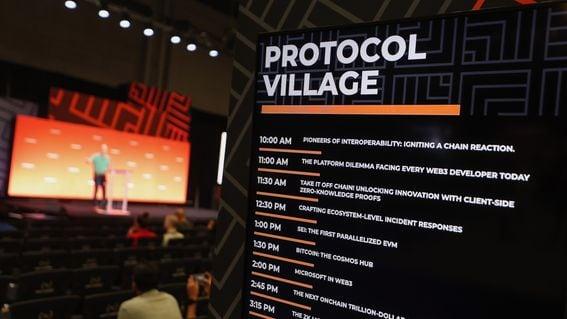
The latest in blockchain tech upgrades, funding announcements and deals. For the period of Oct. 24-30. In today's edition: UI Charitable, Base58, Unchained, Sound Advisory, Plan B, Tether, GnosisDAO, Flare, Google Cloud Marketplace. Friday, Oct. 25 Lisa Neigut's Base58 Gets First-Ever Bitcoin Grant From Donor-Advised Fund, Via UI Charitable on Recommendation of Donor Through Partnership With Unchained UI Charitable, a manager of donor-advised funds (DAFs), has distributed the first grant from a DAF sent directly in bitcoin to a nonprofit organization. According to a press release, "The grant was sent to Base58 School of Engineering (EIN: 93-4881116), a charity dedicated to educating software engineers about the bitcoin protocol." Base58 is a nonprofit led by Bitcoin Core and Lightning engineer Lisa Neigut. "This grant will be used this fall as a scholarship fund for five software engineers who want to learn the basics of programming bitcoin," according to the release. "This grant came at the recommendation of one of our valued donors through our partnerships with Sound Advisory and Unchained, where we provide collaborative custody solutions for bitcoin Donor-Advised Funds. Through multisig vaults, donors can contribute, hold, and distribute bitcoin without needing to convert it to and from U.S. dollars at any point in the process. This is the first DAF solution to enable contributions, custody, and giving entirely in bitcoin." Tether-Backed Initiative 'Plan B' Unveils Satoshi Nakamoto Statue in Lugano, Switzerland "Plan B, an initiative founded in collaboration with Tether and the City of Lugano to promote the use of Bitcoin and blockchain technology, on Friday hosted blockchain industry leaders, government officials and Bitcoin enthusiasts to unveil a life-sized statue of Satoshi Nakamoto at the Third Annual Plan B Forum in Lugano. In front of Lugano’s Villa Ciani, the presentation of the Satoshi Nakamoto statue marked a significant moment in honoring the vision and legacy of the anonymous creator of Bitcoin," according to a press release: "The statue was created by Valentina Picozzi, who was inspired by the idea of capturing both the mystery and the enduring legacy of Satoshi Nakamoto." Gnosis Chain Ecosystem to Get New $40M Venture Fund for Early-Stage Projects GnosisDAO, the community behind the EVM-compatible layer-1 network Gnosis Chain, has approved a proposal to finance a new $40 million GnosisVC Ecosystem Venture Fund. According to the team: "Under this proposal, GnosisDAO will invest $20 million into the Fund, with the remaining $20 million being raised by external limited partners. With a focus on RWAs, decentralized infrastructure and financial payment rails as target verticals, the fund will deploy into early-stage projects in line with Gnosis 3.0, which aims to bridge the gap between blockchain technology and practical, high-quality applications for the masses." Data-Focused Chain Flare Launches 'Blockchain Machine Images' for Node Deployment in 'Click of a Button' Flare, a layer-1 EVM-compatible smart-contract blockchain designed to handle data, has launched Blockchain Machine Images, in partnership with Google Cloud Marketplace. According to the team: "Blockchain Machine Images is a service that significantly accelerates the deployment of blockchain nodes – from hours to minutes. This collaboration leverages Google Cloud's infrastructure to provide developers with a streamlined way to launch full blockchain nodes for over 20 networks, including Flare's own mainnets and testnets." Here's the upshot, from a press release: Pyth, Blockchain Oracle, Announces 'Crypto Redemption Rate Feeds' to Source Values Directly From Smart Contracts Contributors to Pyth, a blockchain oracle project, announced the launch of Crypto Redemption Rate Feeds. According to the team: "It marks the unlocking of two new and popular asset classes: liquid restaking tokens and yield-bearing stablecoins." A blog post explained: "Crypto Redemption Rates provide the exact value at which a crypto asset can be redeemed, sourced directly from its underlying smart contract. Unlike traditional price feeds that aggregate market prices from several sources, these feeds capture the programmatically defined exchange rate set by the asset's protocol. This design is especially important for assets like liquid staking derivatives or interest-bearing tokens, whose values change based on internal mechanisms like accumulated rewards or interest accruals." Redemption Rate Feeds are initially set to include Ondo Finance's USDY, StakeStone's STONE, Ethena Labs' sUSDe, Mountain Protocol's wUSDM and Crypto.com's CDCETH, according to the post. Thursday, Oct. 24 Arbitrum Developer Unveils 'Fast Withdrawals,' Cutting Finality to 15 Minutes From 7 Days Offchain Labs, the initial developer of Arbitrum, the biggest Ethereum layer-2 network, announced "Fast Withdrawals" – described as "a new feature allowing select Orbit chains and RaaS providers to achieve withdrawal finality in under 15 minutes, compared to the usual wait time of up to seven days." According to the team: "Implementing Fast Withdrawals cuts withdrawal times by over 90%, making the process extremely similar to withdrawing funds from a bank account. Although it is not identical, it represents a substantial improvement over the traditional blockchain standard, bringing it much closer to the experience of conventional TradFi funds transfer." According to a press release, "Orbit chains that plan future support for the new feature include Apechain, Cheese, Nova, Sanko, Xai and others. RaaS providers include Offchain Labs, Alchemy, Altlayer, Ankr, Caldera, Conduit, and Gelato." Here's how it works, according to the press release: SenseiNode, Provider of Institutional-Grade Staking as a Service, Achieves SOC 2 Type II Compliance SenseiNode, a provider of institutional-grade staking as a service in Latin America, announced that it has achieved SOC 2 Type II Compliance. According to the team: "This certification, conducted by Decrypt Compliance, validates the company's robust security controls and processes, ensuring they meet the criteria set forth by the AICPA." Key areas covered include: 1) Access control 2) Incident response 3) Vendor management 4) System resilience. “This achievement reflects our dedication to safeguarding sensitive information with the highest standards,” says Pablo Larguia, CEO of SenseiNode. Hana Network Raises $4M in Builder Round From SushiSwap, Alliance, Orange DAO Hana Network, a startup developing Hypercasual Finance with social network effects, has raised $4 million in a builder round from builders such as SushiSwap, Alliance and Orange DAO. The valuation of this round have not been disclosed. According to a press release: "Hana was founded last year by Kohei Hanasaka. The team has been tackling onboarding experience challenges for quite a while and launched Hana Gateway, trustless on/off ramp, in January 2024. Leveraging the insights gained from Hana Gateway, they are presently focused on developing Hypercasual Finance, which emphasizes user-driven distribution with existing open social networks." According to the release: "The mainnet will be divided into four major phases. They have already achieved a successful launch of Mainnet Phase 1 with the hyper-casual card Lego game Hanafuda, where users can earn rewards while playing. New experiences will be gradually introduced from Phase 2 to Phase 4." DeFi Protocol Synthetix V3 Expands to Arbitrum DeFi protocol Synthetix V3 is expanding to Arbitrum, "representing a big step in its push to go multi-chain," according to the team: "With this launch, Synthetix is set to deliver high-performance perpetuals trading to Arbitrum users, building upon its proven success on Optimism and Base, where it has facilitated over $50 billion in trading volume. Kwenta, the leading perpetuals marketplace, has teamed up with Synthetix to spearhead the launch of Synthetix V3 on Arbitrum." Decentralized AI Model-Training Platform FLock.io Partners With Aptos Foundation for Coding in Move FLock.io, a decentralized AI model-training platform, has "partnered with the Aptos Foundation to elevate the capability of large language models (LLMs) in generating accurate code for the Move programming language on the Aptos network," according to the team: "The initial version of FLock.io’s Aptos Move-tuned LLM demonstrated superior performance in testing compared to ChatGPT-4o – from simple "Hello World" scripts to more complex programs such as yield tokenization with AMM trading functionality. Additionally, the FLock model exhibited greater accuracy and adherence to Aptos-specific requirements. Raise, Retail Alliance Foundation Launch Support Network to Help Bring Gift Cards On-Chain Raise, a payments provider focused on gift cards, announced that a non-profit coalition called the Retail Alliance Foundation has launched, "committed to reshaping the future of a transparent and equitable gift card and loyalty economy." In partnership with BFG Labs, a wholly owned subsidiary of Raise, the foundation will launch and govern the Retail Alliance Network, which aims to bring the multi-trillion-dollar gift card industry on-chain. According to the team: "The network offers brands greater control, security and transparency over their gift cards by using blockchain to combat fraud, cut costs and improve operations. This marks a key moment where blockchain addresses legacy inefficiencies, unlocking new growth and engagement opportunities." Domain Network D3 Global Partners With Identity Digital to Tokenize Domains D3 Global, a next-gen internet infrastructure company developing the first authoritative domain network, on Wednesday announced a strategic registry partnership with Identity Digital, a leader in connecting the online world with domain names and related technologies. The partnership aims to tokenize new domains for billions of users on the Domain Name System (DNS) to deliver interoperability Web2 and Web3. D3 is also launching two new programs to expand the ecosystem, the D3 Developer Program and the D3 Proof of Ownership Protocol Program, which will support efforts to bridge Web2 and Web3 systems." BitGPT, Project From Former SingularityNET Co-Founders, to Unveil AI Platform at Binance Conference BitGPT will be unveiling its groundbreaking AI platform to onboard the next billion users to Web3, in an announcement at this year's Binance Blockchain Conference. According to the team: "Developed by the co-founders of SingularityNET, the first to merge Web3 and AI in 2017, BitGPT is the world’s first AI network for Web3, placing AI agents directly into user’s pockets. By translating user needs into Web3 transactions – regardless of language or literacy – BitGPT simplifies complex wallet operations into a single prompt and interface, bridging Generative AI with Web3's onboarding challenges." Variational, Protocol for Leveraged P2P Trading of Customizable Crypto Derivatives, Raises $10.3M Variational, a protocol enabling leveraged peer-to-peer trading for customizable crypto derivatives, announced Wednesday it has secured $10.3 million in seed funding. The round was co-led by Bain Capital Crypto and Peak XV Partners (FKA Sequoia India) with support from Coinbase Ventures, Dragonfly Capital, North Island Ventures, HackVC, Brevan Howard, and many other VCs, angel investors, and industry leaders. Uniswap Labs Collaborates With Across to Lay Groundwork for Crosschain Swaps Uniswap Labs has integrated Across's intent-based bridging to enable secure, fast transfers of ETH, stablecoins and WBTC across nine chains – all within the Uniswap app. According to the team: "Doing so, Uniswap Labs and Across are laying the groundwork for any-asset to any-asset swapping. The upcoming ERC-7683 standard, co-authored by Uniswap Labs and Across, will further help unify the Ethereum ecosystem by standardizing how cross-chain interactions are expressed as Intents." Mantra, L1 Chain for Tokenized RWAs, Launches Mainnet Mantra, an institutional-grade layer 1 blockchain for tokenized real-world assets (RWAs), announced the official launch of its mainnet. According to the team: "As a purpose-built layer-1 blockchain specifically designed to integrate traditional finance with blockchain technology, the Mantra Chain mainnet aims to quickly become the preferred ledger of record for RWAs. The Mantra Chain mainnet consists of a customizable suite of tools that is built with reliable network security and regulatory compliance at heart." Stokr, EU-Based Digital-Asset Marketplace, Raises €7.4M ($8M) Stokr, a digital-asset marketplace in the EU, has raised €7.4M ($8 million) in a funding round led by Fulgur Ventures, with a significant portion earmarked to establish one of Europe’s first corporate Bitcoin treasuries. According to the team: "Stokr also plans to expand its tokenized Bitcoin asset offerings on layer-2 technologies like the Liquid Network and transition to a regulated Crypto Asset Service Provider under MiCA." Sygnum Bank Opens New Office in Lugano, Plans 'Bitcoin Competence Centre' Sygnum Bank announced the launch of its new office in Lugano, Switzerland. According to the team: "The office will be a hub for expert Bitcoin banking solutions and improve physical interactions between Sygnum and its local clients and partners. Sygnum will also launch the first global Bitcoin Competence Centre. This strategic initiative, timed with the prestigious Plan B Forum event, focuses on research alongside strategic partnerships, innovative product and technology development, and active community engagement." Rocketon Labs Raises $1.2M for Firecoin, 'Flagship AI-Powered Token Insights Platform' Rocketon Labs has raised $1.2 million for Firecoin, its flagship AI-powered token insights platform on The Open Network (TON). According to the team: "With over 3 million users and recognized as the 'CoinGecko for TON, on steroids,' Firecoin democratizes access to crypto trading, empowering everyday users with essential tools for informed decisions. The funding will enable further development and expansion of the platform." BlockFills, Institutional Crypto Trading and Tech Firm, Hires Amy Shelly as CFO BlockFills, a digital-asset technology and trading firm for institutions and professional traders, has appointed Amy Shelly as chief financial officer (CFO). According to the team: "The firm is preparing to launch international offices, expand the BlockFills product offering and position itself for major growth in the institutional digital assets space. Shelly has 30+ years of financial services management experience, including six years as CFO for the Options Clearing Corporation (OCC), the world's largest equity derivatives clearing organization. A licensed CPA, Shelly has garnered numerous recognitions." Separately, founding partner Neil Van Huis was promoted to chief strategy officer. GOAT Network Launches 'Founders Club' for Collaborators, Says Testnet Live for Builders, Developers GOAT Network announced the launch of Founders Club, a program designed to empower individuals and teams to contribute to the development and growth of GOAT Network. According to the team: "Founders will have the opportunity to participate in key tracks, collaborate on projects and become valued members of the GOAT ecosystem. Members can choose between three distinct tracks tailored to different stages of project development, from ideation to adoption. In addition, GOAT Network's testnet is now live for builders and developers." https://www.coindesk.com/tech/2024/10/23/protocol-village/
2024-10-24 20:12
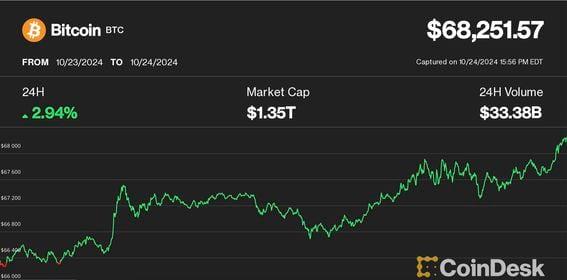
Bitcoin Cash and Uniswap led CoinDesk 20 gains, each rising more than 5%. Cryptocurrencies rallied after three days of modest downward action, with the CoinDesk 20 bouncing 2.7% in the last 24 hours. Solana's market cap dominance is approaching all-time highs at 3.70%. Crypto-related stocks gained as well, with MicroStrategy jumping nearly 10% to a new 25-year high. Cryptocurrencies rallied on Thursday, reversing what had been a slight downturn since bitcoin's (BTC) failed attempt to regain $70,000 very early on Monday. The CoinDesk 20 - an index of the top 20 cryptocurrencies by market capitalization excluding stablecoins and exchange coins - was up over 2.7% in the past 24 hours, with Uniswap's (UNI) and bitcoin cash (BCH) leading the charge, each gaining more than 5%. Bitcoin at press time was changing hands at $68,100, ahead 2.9% over the past 24 hours. Ether (ETH) continued to underperform bitcoin and the broader market, gaining just 1.1% and touching a new 3.5 year low relative to the price of BTC. Solana (SOL) continued to outperform, rising 3.0% and marking a new record high relative to ether. Ether is now notably just over $2,500, but below the max pain price – the level at which most options expire worthless – of $2,600 for Deribit's options expiry on Oct. 25. Ether's troubles Ether continues to languish behind bitcoin and solana in terms of performance. In the past month, ether is down 2.1%, while bitcoin is up 7.4% and solana has added 18%. “I think from a pure on-chain perspective there has generally been an outperformance of network activity in both Bitcoin and Solana vis-à-vis Ethereum,” Andre Dragosch, European Head of Research at crypto investment firm Bitwise, told CoinDesk. “Transaction count on Bitcoin has outpaced that of Ethereum, which tends to be highly correlated with the relative performance,” Dragosch said, noting that there had been “stronger on-chain capital inflows into bitcoin [than] ether.” “In this context, it’s not so much a weakness of ether but rather a strength of bitcoin,” Dragosch added. The nominal market capitalization difference between bitcoin and ether has reached a new all-time high. With bitcoin at a $1.33 trillion market cap and ether at $303.6 billion, the difference is now over $1 trillion for the first time ever. Solana's market capitalization dominance, currently at 3.64% of the crypto market, is approaching its old record of 3.70%. Crypto stocks gain, led by MicroStrategy MicroStrategy (MSTR) added another 10% on Thursday, reaching its strongest level since the dot com bubble 25 years ago. The company is in a unique position because it was completely misunderstood, well-followed capital advisor Punter Jeff told CoinDesk. “Never before has a company converted its balance sheet entirely into a finite asset, let alone a revolutionary asset like Bitcoin,” Jeff said. “It positions MicroStrategy as a pioneer in corporate finance while establishing a significant competitive moat; it holds over 2.25 times more Bitcoin than all other publicly traded companies combined that have Bitcoin on their balance sheets.” Other crypto names posting gains included Coinbase (COIN), adding 5% and bitcoin miner Riot Platforms (RIOT) rising 4.3%. https://www.coindesk.com/markets/2024/10/24/bitcoin-climbs-3-to-retake-68k-with-solana-outperforming-ether-showing-relative-weakness/
2024-10-24 18:51
Better Markets is using Polymarket's "French connection" as ammo against the prediction market's regulated competitor. In its long-running legal fight to offer event contracts on U.S. elections, Kalshi regularly emphasized it is a regulated exchange, in contrast to its much-larger, crypto-based, offshore rival Polymarket. That hasn't stopped Better Markets, an activist group that advocates for stricter financial regulations, from citing activity on Polymarket as one reason to stop Kalshi from letting traders make political bets. In a 39-page friend-of-the-court brief filed Wednesday supporting the Commodity Futures Trading Commission's appeal of a case the regulator lost to Kalshi, Better Markets noted recent reports about a handful of Polymarket accounts that have made bets worth tens of millions on Donald Trump winning the presidency. (Polymarket confirmed to the New York Times this week that these accounts are all controlled by the same French national.) Better Markets repeated theories, floated in Wall Street Journal and Newsweek articles, that the Polymarket whale could be manipulating the market or trying to create a false impression of momentum for Trump, in order to influence the election's outcome or give him a pretext for challenging the results if he loses. "If the trading amounts to any one of these species of election or market manipulation, then it is also likely to artificially skew the pricing of contracts in a way that is divorced from election 'fundamentals,' thus creating volatility that will undoubtedly harm many smaller retail investors who have placed their own bets," Better Markets said, urging the U.S. Court of Appeals to overturn a lower court's decision that freed Kalshi to offer election markets. "Allowing election gambling contracts to trade threatens to undermine election integrity, harm countless investors, and burden the CFTC with an inappropriate duty to police elections," the group said, reiterating common arguments against political prediction markets. However, Filip Pidot, a prediction market veteran and board member of the Coalition for Political Forecasting, said there is "virtually no chance" the French trader is placing these bets for electoral purposes. "I think the motives are clearly profit-driven," Pidot, who has been closely tracking the whales' activities on his blog, The Super Model, told CoinDesk. "If the goal was to move the price, you'd do the opposite" as the French national. "Instead of having several accounts trading strategically with limit orders, you'd just keep plowing money in blindly and let yourself get filled at worse and worse prices, since that would be optimal if your goal was to artificially inflate the price," he said. Polymarket told the Times the trader was “taking a directional position based on personal views of the election" and it found no evidence of attempted manipulation. While Polymarket has seen billions in volume this year from political betting, Kalshi had to sit on the sidelines until this month, when the appeals court lifted an administrative stay pausing the company's election contracts. Thursday afternoon in New York, both platforms showed Trump ahead, with a 62.5% probability of winning on Polymarket ($2.1 billion in volume) and 59% on Kalshi ($60 million). So did PredictIt (58%, about $10 million) and Manifold Markets (58%, play money). https://www.coindesk.com/policy/2024/10/24/activist-group-says-kalshis-election-market-should-be-shut-due-to-manipulative-whales/
2024-10-24 18:49
While USDC has been popular in developed markets, it has seen significant growth in emerging regions among fintechs and brokers servicing businesses and households, Jeremy Allaire told CoinDesk in an interview. Stablecoins could capture 5%-10% share of the global money supply over the next decade, Circle CEO Jeremy Allaire said. Next year will be pivotal for stablecoin regulations, Allaire said, anticipating many countries in the G20 group and emerging markets having laws in place by the end of 2025. The stablecoin market could grow to a $5 trillion to $10 trillion market in 10 years as digital money wins a larger slice of the global financial system, Jeremy Allaire, CEO of Circle, the company behind the USDC and EURC stablecoins, said in an interview with CoinDesk. Allaire said he envisions stablecoins – a type of cryptocurrency whose value is pegged to a conventional currency like the U.S. dollar or euro – capturing a 5% to 10% share of a global money supply of $100 trillion over the next decade as the technology spreads like previous internet-based innovations such as video streaming and online shopping. "We are at the very early stages of stablecoin adoption but over the next 10, 20 years, this technology will be part of the global financial system," he said. Stablecoins are one of the most popular innovations in crypto, bridging government-issued fiat currencies on traditional financial rails with blockchain-based digital assets, facilitating trading and transactions. Taken together, all stablecoins have a market capitalization of about $170 billion. Because of their non-volatile nature combined with blockchain's speed and near-instant settlements, they are increasingly used for everyday economic activities such as payments and remittances, especially in developing countries with less robust banking systems and rapidly devaluing local currencies like Argentina and Nigeria. Circle's USDC token is the second-largest stablecoin on the market, growing to $35 billion since it was started six years ago with crypto exchange giant Coinbase. It's bigger rival, Tether's USDT, has a $120 billion market cap. Market observers partly attributed Tether's faster growth to its focus on emerging regions where dollar access is limited versus Circle's focus on developed and heavily regulated markets like the U.S. and European Union. Allaire, however, said he sees substantial growth of USDC use in emerging markets such as Latin America and Southeast Asia, especially among fintech companies servicing local businesses and households. One of the "cool examples," Allaire said, is that more local foreign currency brokers specializing on cross-border payments and currency conversions leveraging USDC for settling trades between small and medium enterprises. Another instance was an anecdote from one of Circle's partners who told Allaire about "a multi-$100 million energy order between a supplier in the Middle East and a buyer in Africa" that was facilitated by USDC. Another example of growing USDC adoption as a payments vehicle is U.S.-based fintech firm Stripe reintroducing USDC transactions for merchants this October. In the first 24 hours, users from 70 countries chose the USDC payment options, Stripe product manager Jennifer Lee posted on X. "There's a new [company] every week that uses USDC, and they don't even have to do deals with us" to build and use Circle's products, he said. "The beauty of what we've built is it's an open, public infrastructure for digital dollars on the internet." Global stablecoin regulations Circle laid out plans to go public earlier this year, but the upcoming U.S. elections in November and the uncertainty about the next administration's view on crypto weighs on many U.S.-based digital asset firms. Allaire said he remains committed to taking the company public regardless of who wins the elections in November, but acknowledged that the results may potentially impact the timeline when it could become reality. "Circle is focused on building a highly transparent and compliant financial infrastructure, and we believe becoming a publicly traded company will reinforce that trust and accountability," he said. He emphasized that stablecoin legislation enjoys bipartisan support in the U.S., and the Payment Stablecoin Act is at a very advanced stage. It's not just the U.S. Regulating stablecoins is a top priority globally and next year will be pivotal, Allaire said. "Most major financial hubs already have stablecoin laws that are either on the books or are in consultation or in the legislature," he said. "By the end of 2025, huge numbers of G20 countries and many emerging markets will have stablecoin regulation." https://www.coindesk.com/business/2024/10/24/circles-allaire-stablecoins-could-expand-by-trillions-in-10-years-will-be-integral-part-of-global-financial-system/