2024-10-09 04:49
The MOVE index, which measures expected volatility in U.S. Treasury notes, spiked to the highest since January, hinting at tighter financial conditions ahead. BTC trades listless in a price range defined by key averages. The spike in Treasury market volatility, represented by the MOVE index, can lead to risk aversion. The slide in Chinese stocks may reverse the money flow to Asian stocks and cryptocurrencies. Bitcoin (BTC) traded listless between key averages early Tuesday amid elevated volatility in the U.S. bond market and sharp losses in Chinese stocks. The leading cryptocurrency by market value held above $62,000, with the Bollinger bandwidth, an unbound technical oscillator, falling to levels seen ahed of the mid-June downside price turbulence. Bollinger bands are volatility bands placed two standard deviations above and below the 20-day simple moving average of the asset's price. The bandwidth is calculated by dividing the spread between the volatility bands by the 20-period SMA. Rising bandwidth values indicate high volatility and falling values suggest otherwise. A volatility explosion often follows a prolonged period of low readings. The bitcoin market, however, showed no such signs at press time, with prices locked within a narrow range between the 200-day simple moving average (SMA) resistance at $63,550 and the 50-day SMA support at $60,819. The MOVE index, which measures expected volatility in U.S. Treasury notes, surged 24% Monday, reaching the highest since early January, according to TradingView. Increased volatility in the Treasury notes, which play a prominent role in global collateral and finance, often causes financial tightening and risk aversion. The situation benefits the U.S. dollar, potentially weighing over risk assets, like stocks and bitcoin. The path of least resistance for the dollar index is on the higher side as the notion of an aggressively dovish Fed has faded. According to ING, the dollar index could rise to 103 by the end of the month. The index was steady at around 102.45 at press time. Chinese stocks slide China's Shanghai Composite Index fell by 4.6%, ending a ten-day winning streak, likely due to disappointment over the government's lack of fiscal stimulus. Beijing announced a slew of stimulus measures in late September, torching a sharp rally that supposedly sucked out capital from other Asian equity markets and bitcoin. As such, the renewed slump in Chinese stocks may reverse the money flow, supporting other regional indices and cryptocurrency prices. https://www.coindesk.com/markets/2024/10/09/bitcoin-trapped-between-50-and-200-day-averages-as-bond-market-volatility-spikes-china-stocks-slide/

2024-10-08 21:50
Traditional risk assets like stocks surged while gold and oil tumbled, but cryptos didn't get the memo. Cryptocurrencies belied their reputation for volatility, as they didn't seem to react to the large moves in major traditional assets on Tuesday. Bitcoin (BTC) continued to tread water slightly above $62,000, with each drop below that price level quickly reversing but otherwise trading aimlessly. It was down 1.2% over the past 24 hours, in-line with the broad-market benchmark CoinDesk 20 Index's performance. Ethereum's ether (ETH) was nearly flat during the same period, while layer-1 blockchain Aptos's native token (APT) stood out with a 6% gain. Memecoins, perhaps the riskiest corner of the crypto space, sold off as traders took some profits off the table after the past few days' surge. Large-cap meme tokens pepe (PEPE), dogwifhat {{WIF}} and popcat declined roughly 5% during the day. That's a lackluster showing on a day when U.S. stocks rallied, with the tech-heavy Nasdaq climbing 1.5%. Traditional risk-off haven gold sold off 1.5%, with crude oil and silver both tumbling 4% after their run over the past few weeks. The cause behind the risk of action might be easing concerns about spiraling escalation in the Middle East after a Hezbollah leader reportedly supported efforts for a potential ceasefire with Israel. "It feels like there is less mental bandwidth for traditional finance players to think about crypto given the preponderance of macro narratives and tradable opportunities around Israel/Iran, China stimulus, the Fed cuts, and Trump election odds," Joshua Lim, co-founder of crypto trading firm Arbelos Markets, said in a Telegram message. "Crypto volumes and volatility have languished while the crypto-native community itself has increasingly rotated into short-lived memecoin narratives and away from majors," he added. Crypto investors who overwhelmingly anticipated October to be a bullish month have been disappointed with prices down to flat for the month so far. Zooming out to a longer timeframe, bitcoin is just consolidating below its all-time record, building a launchpad to much higher prices next year, well-followed trader Bob Loukas said. "An 8 month base has been built, sentiment reset, and rates are easing," Loukas said in an X post. "Bitcoin closes the second year of the four-year cycle next month, entering the third and historically explosive year." BTC's all-time high this March was well ahead of past market cycle patterns, Crypto trader CryptoCon noted, so it's reasonable that it takes more time to digest the move and build out the market structure. "We are still ahead of all other cycles. 2012 and 2016 wouldn't see new all-time highs for another 5-6 months," CryptoCon said in an X post. "Perspective is key; Bitcoin is doing great." https://www.coindesk.com/markets/2024/10/08/bitcoin-wavers-at-62k-amid-major-swings-in-stocks-gold-memecoins-falter-as-profit-taking-sets-in/

2024-10-08 21:34
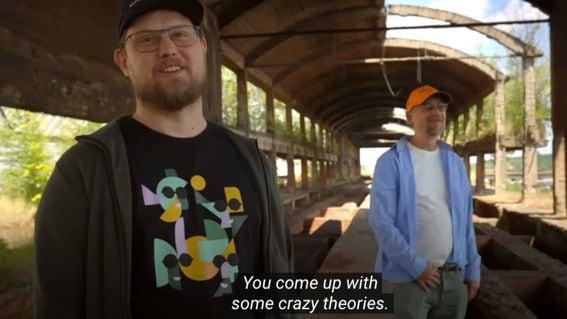
"Of course I'm not Satoshi," Todd told CoinDesk Tuesday, saying that filmmaker Cullen Hoback was "grasping at straws." Peter Todd, an early Bitcoin developer, denied to CoinDesk that he is Satoshi Nakamoto, the pseudonymous creator of the original cryptocurrency. Todd commented hours before the debut of an HBO documentary that suggests Todd is Satoshi. Clips from HBO's Satoshi Nakamoto documentary, which leaked hours before the firm premiered Tuesday night, seemed to finger former Bitcoin developer Peter Todd as the cryptocurrency's creator – but Todd denied it. In an email to CoinDesk, Todd said filmmaker Cullen Hoback, best known for identifying the person behind the QAnon conspiracy theory in an earlier series for HBO, was "grasping at straws" if he's identifying Todd as Satoshi. "Yes, that interview did happen and I believe that specific shot isn't deepfaked," he confirmed, though he added he had not yet seen the documentary. "Of course, I'm not Satoshi," Todd said. "It's ironic that a director who is also known for a documentary on QAnon has resorted to QAnon style coincidence-based conspiracy thinking here too." Even in the clips circulating on social media, Todd called the theory that he is Satoshi "ludicrous." On Tuesday afternoon in New York, hours before the scheduled premiere of "Money Electric: the Bitcoin Mystery," the odds on Polymarket's bet over whom the film will identify as Satoshi overwhelmingly favored "Other/Multiple." At the time of the Polymarket bet's creation, Todd was not listed as a possibility, so anyone who wanted to bet on him being the film's "reveal" would have to choose "Other/Multiple." Previously, cypherpunk Len Sassaman and then computer programmer Nick Szabo held the lead on Polymarket's list of possible HBO-toshi's. No firm evidence The documentary, which lasted about 100 minutes, delved into the history of both Bitcoin and other crypto projects, but did not present any firm evidence supporting the idea that Todd was Satoshi. There was some circumstantial evidence, including Todd's interest in cryptography from a young age, his relationship with Adam Back (who emailed with Satoshi), his technical ability and Satoshi's use of British/Canadian spellings juxtaposed with the fact that Todd is from Canada. The film's most tangible evidence hinged on a 2010 public forum post in which Todd responded to one of Satoshi's posts. Hoback argued Todd's post was a continuation of Satoshi's post, but accidentally sent from an account with Todd's name on it instead of Satoshi's. However, the documentary did not definitively conclude that Todd was indeed Satoshi. Even the final confrontation between Hoback and Todd – the clip that was earlier leaked on social media – was speculative. Hoback followed up by citing another blog post where Todd said he was "probably the world's leading expert" on how to sacrifice bitcoin, though even the filmmaker acknowledges this was a tenuous confirmation at best. "It was hard not to read this as an admission, like Peter wanted his inner circle to trust that he had, in fact, sacrificed the bitcoins and destroyed all access," he said. "But this wasn't proof." Bitcoin that Satoshi mined has never moved from its wallet, leading to speculation Satoshi is either dead or purposefully prevented themselves from touching the coins. The confrontation In the documentary, Hoback confronts Todd, laying out his theory of how and why Todd hid his supposed involvement in the invention of Bitcoin. Todd shakes his head and laughs at Hoback's assertions. "I will admit you're pretty creative. You come up with some crazy theories. It's ludicrous," Todd said in the film. "But I'll say, yeah, of course I'm Satoshi. And I'm Craig Wright." This is clearly a joke, not a confession: Todd has previously made similar cracks that he "is Satoshi," telling "What Bitcoin Did" podcast host Peter McCormack in a 2019 interview: "I am Satoshi, as is everyone else." Todd, still laughing, warns Hoback that he's drawn an incorrect conclusion. "This is going to be very funny when you put this into the documentary and a bunch of bitcoiners watch it," Todd said. "I suspect a lot of them will be very happy if you go this route because it's yet another example of journalists really missing the point in a way that's very funny." (PubKey, a bitcoin bar in New York City, showed the documentary Tuesday night. Viewers there laughed at the suggestion Todd is Satoshi. Someone said: "They left enough plausible deniability that you [a random person] could be Satoshi.") Hoback responds by asking what the point is. "The point is to make bitcoin the global currency," Todd responds. Back, the CEO of Bitcoin development firm Blockstream who is standing next to Todd in the confrontation scene, did not respond to a request for comment from CoinDesk. Though an early Bitcoin developer and someone deeply involved in the early years of Bitcoin, Todd has never been a prime suspect in journalists' years-long hunt for Satoshi. Figures like Hal Finney, Nick Szabo and Back are most frequently suggested to be Bitcoin's creator, though all have denied it. During the McCormack podcast, Todd said that he bought his first bitcoin when the price per coin was 20 cents (which would mean he made the purchase around October 2010, two years after the bitcoin white paper was released). Back posted on X Monday that, "for people betting, they are betting on what the documentary concluded. Which is probably not going to be true, because no one knows who Satoshi is. So they should keep that in mind." Previous attempts by the media to unveil Satoshi's true identity have failed, with outlets incorrectly naming figures like programmer Dorian Nakamoto and known-pretender Craig Wright as Satoshi. https://www.coindesk.com/business/2024/10/08/former-bitcoin-dev-peter-todd-denies-hes-satoshi-hours-before-hbo-documentary-airs/
2024-10-08 20:18
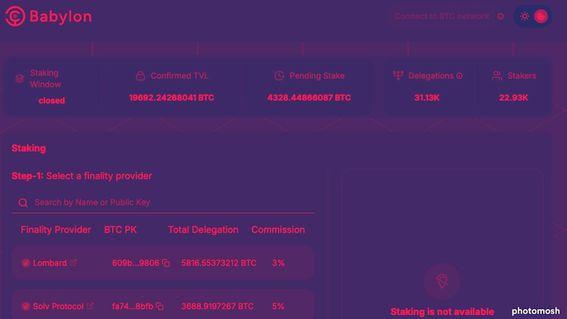
The round, known as "Cap-2," allowed users to add staking deposits to the platform for over the course of about 10 Bitcoin blocks on Tuesday. Bitcoin protocol Babylon completed its second staking round on Tuesday, increasing deposits to about 24,000 BTC ($1.5 billion) from about 1,000 BTC previously. The staking round was "duration-based," meaning it lasted for 10 Bitcoin blocks. Babylon, a Bitcoin staking platform billed as a new way of providing the original blockchain's security to new protocols and decentralized applications, pulled in about $1.5 billion worth of bitcoin on Tuesday after briefly opening to additional deposits. The uptake could show robust demand for a growing decentralized finance (DeFi) ecosystem atop the 15-year-old Bitcoin blockchain, previously confined to alternative networks like Ethereum and Solana. David Tse, Babylon's co-founder, who also has an appointment as an engineering professor at Stanford University, told CoinDesk in an emailed statement that the inflows were "way beyond our expectations." According to Babylon staking dashboard, some 18,601 BTC had already been staked as of 20:03 UTC (4:03 p.m. ET), with an additional 5,419 BTC pending in the staking queue. The cap was lifted for about 10 Bitcoin blocks over the course of one hour and 23 minutes, with the only restriction being that users could only stake up to 500 BTC per transaction. (Many transactions are typically included in each block.) Because of that structure, the round of new staking deposits was described as "duration-based," in a departure from the initial opening in August, where the cap was set at a fixed 1,000 BTC and filled up in an hour and 14 minutes. Babylon's aim is to allow proof-of-stake chains to acquire capital from the deep reserves stored in BTC. It is one of a large number of initiatives aimed at introducing utility to Bitcoin – commonplace on networks such as Ethereum but historically largely absent from the world's first blockchain. The project turned heads in May this year when it completed a $70 million funding round, following an $18 million round the previous December. Read More: Bitcoin's Programmability Draws Closer to Reality as Robin Linus Delivers 'BitVM2' https://www.coindesk.com/markets/2024/10/08/bitcoin-protocol-babylon-pulls-in-15b-of-staking-deposits-as-cap-lifted/
2024-10-08 18:30
The bank's analysts remained bullish on bitcoin and crypto in general no matter who wins the presidency in November. Solana (SOL) looks overvalued compared to Ethereum (ETH) based on several metrics, but each token's relative performance to each other and bitcoin (BTC) depends heavily on who will be the next president of the U.S., a Tuesday report by Standard Chartered Bank said. Led by Geoff Kendrick, the global head of digital assets research, the bank's analysts expect more accommodating crypto regulations and higher chances of approval for spot-based solana ETFs if Donald Trump gets elected, while a Kamala Harris-led administration could weigh on smaller, riskier cryptocurrencies. That being said, the team forecasts SOL to be the top performer of the three in a Trump administration, followed by ether and then bitcoin (BTC). Under Harris expect the opposite, said StanChart, with bitcoin leading ETH and SOL bringing up the rear. The bank's analysts, however, remain bullish on crypto no matter who wins the November election, seeing ETH rallying to $7,000 by the end of 2025 under Harris and $10,000 under Trump. The bank previously had a year-end 2025 ETH price target of $14,000. Bitcoin could surge to $200,000 during the same period, regardless of who gets elected, the report said. Solana overvalued versus ETH Ethereum has been the dominant layer-1 network for blockchain applications, but Solana's increasing blockchain activity and SOL's rapid price surge convinced many crypto observers that a change in leadership is due. While crypto valuations aren't standardized as in traditional assets, Standard Chartered analysts noted several metrics that showed SOL being overvalued compared to ETH. SOL's ratio of market capitalization versus network fee revenues is 250, more than double than ETH's 121. Solana's supply grows around 5.5% annually, while ETH's token inflation rate stands around 0.5% a year, they added. Higher inflation means that SOL's real staking yield is 1%, compared to ETH's 2.3%. Meanwhile, 38% of all established developers in the blockchain industry work on the Ethereum ecosystem, with Solana claiming a 9% share. "SOL valuation metrics suggest the market is pricing in a very bright growth future for Solana, with a 100-400x increase in throughput expected," said Kendrick. "Such valuations would be easier to justify under a Trump administration than a Harris one," he added. In order to uphold its current valuation, Solana will need to claim dominance in multiple crypto sectors with high traffic such as finance, consumer and decentralized physical infrastructure (DePIN) and activate the Firedancer client that allows increased efficiency, the report said. https://www.coindesk.com/markets/2024/10/08/solana-is-richly-valued-versus-ether-but-could-still-outperform-if-trump-gets-elected-standard-chartered/

2024-10-08 14:27
The team said that the SCR token would be the first step in its roadmap to decentralization. Scroll, the team behind the layer-2 network, shared Tuesday that it plans to launch a SCR token to support the blockchain. In a blog post, the team said that the SCR token would be the first step in its roadmap to decentralization. “SCR will be used as a primary governance mechanism of the protocol and progress to being a protocol utility token as Scroll becomes more decentralized,” the team wrote. After the governance has made progress in decentralization, the token will also be used to support decentralization of Scroll’s prover and sequencer. The team shared that 15% of its total token supply will go towards airdrops, with this first one, happening on Oct. 22, having 7% of the share. There will be a total of 1 billion SCR tokens. Some 17% will be allocated to investors, and 10% will go towards the Scroll Foundation. The rest will be split up for the Scroll ecosystem as well as Scroll contributors. The token will be launched via Binance Launchpool, which will receive a 5.5% token allocation in rewards. “We are ready for the next chapter of Scroll – to build scalable, secure infrastructure and drive towards real-world adoption with global distribution,” the Scroll team wrote in a blog post. https://www.coindesk.com/tech/2024/10/08/layer-2-scroll-shares-plans-for-scr-token-airdrop/