2024-10-08 13:40
The case seeks to prevent the SEC from "unlawfully expanding its jurisdiction" to cover secondary-market sales of certain network tokens sold on the exchange. Crypto.com has sued the SEC after receiving a Wells Notice from the U.S. regulator. The notice, a warning the agency is considering bringing charges against the crypto exchange, was sent on Aug. 22. CEO Kris Marszalek said it brought the case to limit the SEC's "unauthorized overreach and unlawful rulemaking" and "protect the future of crypto in the U.S." Cryptocurrency exchange Crypto.com said it sued the U.S. Securities and Exchange Commission, Chair Gary Gensler and its four commissioners after the regulator sent a Wells Notice – a warning that an enforcement action might be coming – to the company. The court filing was made "to protect the future of crypto in the U.S.," CEO Kris Marszalek said in a posting on X. The suit is "a warranted response to the SEC's regulation by enforcement regime which has hurt more than 50 million American crypto holders." The Wells Notice was sent to Crypto.com on Aug. 22, the filing revealed. Such notices are preliminary warnings stating charges the SEC may bring. They usually lead to enforcement actions. The SEC has been regulating the crypto sector through a series of enforcement activities, an approach that Crypto.com and others in the industry, including Binance, Ripple and Coinbase, are fighting. In August, OpenSea received a Wells Notice alleging non-fungible tokens (NFTs) on its platform were securities. OpenSea CEO Devin Finzer said at the time the company was "shocked" but ready to "stand up and fight." In April, decentralized crypto exchange Uniswap also received one, which it urged the SEC to withdraw. Crypto.com "seeks declaratory and injunctive relief to prevent the Securities and Exchange Commission ('SEC') from unlawfully expanding its jurisdiction to cover secondary-market sales of certain network tokens sold on the company's platform," the suit said. The suit was filed by Foris DAX Inc., a company incorporated under the laws of the state of Delaware and operates under the business name of Crypto.com. The filing said the SEC determined network tokens, except for bitcoin (BTC) and Ethereum's ether (ETH), as securities and thus issued the notice to Crypto.com, which offers trading of other cryptocurrencies, "for operating as an unregistered broker-dealer and securities clearing agency under the federal securities laws." Separately, Crypto.com filed a petition the SEC and the other primary U.S. markets regulator, the Commodity Futures Trading Commission, "to confirm via joint interpretation that certain cryptocurrency derivative products are solely regulated by the CFTC." The SEC does not comment on the existence of a possible investigation, an agency spokesperson told Bloomberg. The agency did not immediately respond to a CoinDesk request for comment. Crypto.com's filing revealed that the SEC had been investigating the company for more than two years, with a formal investigation initiated on March 28, 2023. Crypto.com's case Crypto.com argues that the SEC is defining "every network token in existence" as a security and "arbitrarily exempting only bitcoin and ether from its scope despite substantial similarities." The regulator has not said which tokens traded on the company's platform it considers as securities, according to the filing. Crypto.com is seeking a ruling that none are securities and that it "does not operate as an unregistered securities broker-dealer or securities clearing agency." The industry has been calling for the U.S. to create bespoke rules for the sector to provide clarify for participants. In May, the House of Representatives approved a wide-ranging crypto bill, the Financial Innovation and Technology for the 21st Century Act (FIT21), which has yet to be considered by the Senate. Cronos (CRO), the native token of the Cronos blockchain that Crypto.com introduced, fell as much as 4.7% after Marszalek's posting on X and was recently trading 2.4% lower. https://www.coindesk.com/policy/2024/10/08/cryptocom-sues-sec-chair-gary-gensler-after-receiving-wells-notice/

2024-10-08 12:33
Investors rewarded mining companies that've diversified into AI and high-performance computing. Investors continue to pay a premium for miners diversifying into AI and HPC data centers, despite pure-play miners gaining market share. Marathon, Riot and CleanSpark all saw higher production numbers in September than August. Marathon produced more bitcoin in September than in any other month since the April halving. Disclosure: The author of this story owns shares of the following bitcoin miners: IREN (IREN), MARA Holdings (MARA), Cipher Mining (CIFR), Bitfarms (BITF), Riot Platforms (RIOT) and CleanSpark (CLSK). Bitcoin (BTC) miners are facing the strangest sort of existential threat in this era of scant profits: They can pivot to powering artificial intelligence (AI) or high-performance computing (HPC) and watch their stocks soar, or they can stick around and dominate their original turf, but see a languishing stock price. That was the tale of mining in September, anyway, in terms of equity returns. Miners with the largest market capitalizations – MARA Holdings (MARA), Riot Platforms (RIOT) and CleanSpark (CLSK) – all increased their share of the total amount of bitcoin mined last month versus August. These companies have much stronger balance sheets and larger mining operations, which is helping them navigate the reduction in mining profitability spurred by the bitcoin halving in April. However, investors aren't paying a premium for their stocks, as they continued to underperform in September. Meanwhile, miners putting focus on AI and HPC computing, such as Core Scientific (CORZ), TerraWulf (WULF) and IREN (IREN), beat bitcoin in September. The shift in investor sentiment isn't surprising, as the halving in April – which cut by 50% the reward for mining BTC – has made mining more competitive with narrower profit margins. Adding to the negative sentiment, the recent approval of spot bitcoin exchange-traded funds (ETFs) in the U.S. has reduced investors' appetite for mining stocks. Instead, investors are rewarding miners that now use part of their data centers to host AI- and HPC-related machines to diversify their revenue. AI and HPC computing require a large amount of power, which bitcoin miners have already secured, making them an attractive resource for AI and HPC companies that want to quickly ramp up their businesses. In fact, looking at the share prices of publicly traded miners in September, stocks of miners with larger market caps rose between 4% and 9%. Miners with links to AI and HPC saw gains as large as 25% for the month. Bitcoin's price rose about 7%, while the CoinDesk 20, a broad crypto market benchmark, climbed about 12%. Miners are already surging in October, too, despite bitcoin trading relatively flat. Riot is up 12% and Cipher Mining (CIFR) is up 8%. October is also historically one of the strongest months for bitcoin, earning it the nickname "Uptober." September's takeaway Mining economics are tough after the halving. The hashrate of the Bitcoin network, on a seven-day moving average, rose to an all-time high of 693 exahashes per second, or EH/s, while maintaining an average hash rate of 630 EH/s. Hashrate, a proxy for how competitive mining is, measures how much computing power is online on the network. September also saw bitcoin difficulty – a measure of how hard it is to mine a new block in the network – hit an all-time high. Bitcoin's difficulty is a measure of how hard it is to mine a new block in the network, which adjusts every 2,016 blocks based on the computational power, ensuring the blocks are consistently mined every 10 minutes. Meanwhile, the hashprice, a measure of miners' profitability, hit a one-month high at $48.0 PH/s, according to Glassnode, despite remaining near all-time lows. Drilling down into the individual miners' monthly data, it seems MARA – the largest publicly traded miner with a market cap of $4.8 billion, and the company formerly known as Marathon Digital – had a successful September, increasing their energized hash rate by 5% in September to 36.9 EH/s. MARA also mined 705 BTC, a 5% increase from the previous month and the most mined in a single month since the halving in April. The firm also increased its BTC holdings to 26,842, the second-largest bitcoin stockpile among publicly traded companies, trailing only MicroStrategy. At the same time, it remained on track to reach 50 EH/s by the end of 2024. The third-largest miner by market cap, Riot Platforms, also increased its mined bitcoin by 28% during September, as the company increased computing power across its facilities. Riot estimates to hit a hashrate of 36.3 EH/s in the fourth quarter of 2024 and 56.6 EH/s by the second half of 2025. Riot currently holds 10,427 BTC in its balance sheet. Hurricane Helene, selling BTC for land Among other trends that stood out during September include impact from Hurricane Helene. CleanSpark, the fourth-largest miner by market cap, was among that were affected. The company said it didn't see any material losses to its infrastructures but had to shut down some operations due to the storm. With tough capital markets for bitcoin miners, the companies started to use creative means of raising funds to grow their operations. One, Cipher Mining, stood out in September by mining 155 BTC for the month and selling 923 bitcoin to buy a 300MW mining site, which will be used for HPC hosting. The miner now owns 1,512 BTC. https://www.coindesk.com/markets/2024/10/08/bitcoin-miners-at-a-crossroads-gain-market-share-or-go-all-in-on-ai/

2024-10-08 12:08
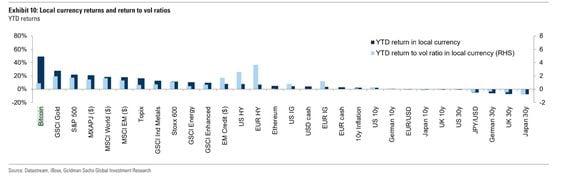
Gold has a significantly higher volatility ratio than bitcoin in 2024, according to analysis by Goldman Sachs. BTC's price surge doesn't compensate for the price volatility risks, a chart by Goldman Sachs shows. Gold's relatively higher risk-adjusted returns explains its safe haven appeal. Bitcoin (BTC) has surged over 40% this year, outshining major equity indices, fixed-income securities, gold and even oil, which recently rose on the back of geopolitical tensions. However, according to data tracked by Goldman Sachs, its stellar performance in absolute terms is not sufficient to compensate for its volatility. Bitcoin's year-to-date return to volatility ratio is under 2%, significantly lower than gold's industry-leading risk-adjusted return of around 3%. The ratio gauges the return an investment generates per unit of risk/volatility. The yellow metal has gained 28% in absolute terms. In fact, Ethereum's native token ether, Japan's TOPIX index, and the S&P GSCI Energy Index are the only non-fixed income growth-sensitive investments with return to volatility ratios lower than bitcoin, the chart from Goldman's Oct. 7 note titled "Oil on the boil" shows. That relatively low risk-adjusted performance validates crypto skeptics' long-held view that bitcoin is too volatile to become a safe haven like gold. It also helps explain why gold rose and bitcoin tumbled alongside equity markets last week after Iran launched missiles at Israel, ratcheting up tensions in the Middle East. The low risk-adjusted returns make directional bets unattractive and likely explain the popularity of the bitcoin cash and carry arbitrage among traditional institutions. The arbitrage strategy allows traders to bypass price volatility risks while profiting from price discrepancies between spot and futures markets. 12:25 UTC: Corrects BTC and gold's YTD return to volatility ratios to less than 2% and around 3%, respectively. https://www.coindesk.com/markets/2024/10/08/bitcoin-up-40-ytd-but-gold-wins-on-risk-adjusted-returns/
2024-10-08 12:00
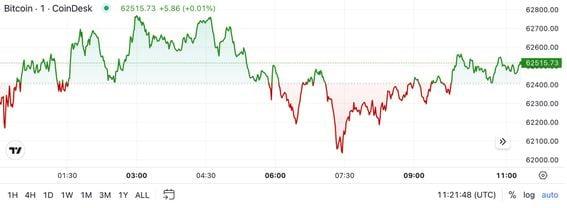
The latest price moves in crypto markets in context for Oct. 8, 2024. Latest Prices CoinDesk 20 Index: 1,929.84 -0.85% Bitcoin (BTC): $62,503.74 -0.55% Ether (ETH): $2,433.31 -0.78% S&P 500: 5,695.94 -0.96% Gold: $2,646.96 +0.14% Nikkei 225: 38,937.54 -1% Top Stories Bitcoin pulled back after China's stimulus plans fell short of expectations. Risk assets such as BTC have been buoyed over the last week by the prospect of a massive stimulus package from the People's Bank of China stirring some life into the country's economy. However the National Development and Reform Commission's (NDRC) briefing seemed to lack urgency or specifics, denting market sentiment. Bitcoin traded at around $62,500, about 0.5% lower in the last 24 hours. The broader digital asset market fell about 0.8%, as measured by the CoinDesk 20 Index. Ether ETFs in the U.S. saw no money flow in or out on Monday for only the second time since their listing in July. Bitcoin ETFs, meanwhile, enjoyed their highest inflows since Sept. 27, adding a net $235.2 million. Fidelity's FBTC led the gains with $103.7 million while BlackRock's IBIT garnered $97.9 million. In contrast, the nine ether ETFs registered zero flows in either direction. The only other time this occurred was Aug. 30. The figures underline the differing fortunes of BTC and ETH products in the U.S. Bitcoin ETFs have seen inflows of nearly $18.75 billion since they listed in January, while their ether equivalents are $500 million in the red since becoming available in July. Consensus among Polymarket bettors is divided over who will be identified as Satoshi Nakamoto on Tuesday's HBO documentary, "Money Electric: the Bitcoin Mystery." Odds climbed as high as 55% that the late Len Sassaman would be revealed as Bitcoin's elusive creator, but these have sunk to 7.5% following an interview with his widow in which she said he was not Satoshi. The overwhelming favorite choice on Polymarket is now "Other/Multiple", which carries 65% support. The leading individual candidate is Nick Szabo with 12.5%. The program will be screened at 02:00 UTC on Wednesday (9 p.m. Tuesday ET). Chart of the Day The chart shows privacy-focused cryptocurrency monero's (XMR) weekly candlestick price chart since mid-2021. Prices have again turned lower from the long-held resistance at $180, extending its prolonged range play. Cryptocurrency exchange Kraken recently said that it will delist XMR/USD and XMR/EUR pairs on Oct. 31, aligning with regulatory and compliance obligations. Source: TradingView - Omkar Godbole Trending Posts UN Agency Recommends Criminalization of Unlicensed VASPs in Southeast Asia to Counter Cyber Fraud Hong Kong Gearing Up to Approve More Cryptocurrency Exchange Licenses by Year-End: SFC Delaware Judge Approves FTX Estate’s Bankruptcy Plan https://www.coindesk.com/markets/2024/10/08/first-mover-americas-bitcoin-drops-as-chinas-stimulus-plans-disappoint/
2024-10-08 09:51
Bitcoin ETFs enjoyed their highest net inflows since Sept. 27, with FBTC and IBIT leading the way. The nine ether ETFs in the U.S. registered zero flows in either direction, the second time this has occurred, the other being on Aug. 30. Bitcoin ETFs have seen inflows of nearly $18.75 billion since they listed in January, while their ether equivalents are $500 million in the red since they became available in July. Ether (ETH) exchange-traded funds (ETFs) in the U.S. saw zero flows on Monday for only the second time since their listing in July, according to data gathered by SoSoValue. Bitcoin (BTC) ETFs, meanwhile, enjoyed their highest inflows since Sept. 27, adding a net $235.2 million. Fidelity's product (FBTC) led the gains with $103.7 million while BlackRock's fund (IBIT) garnered $97.9 million. In contrast, the nine ether ETFs registered zero flows in either direction. The only other time this has occurred was Aug. 30. The figures underline the differing fortunes of BTC and ETH products in the U.S. Bitcoin ETFs have seen inflows of nearly $18.75 billion since they listed in January, while their ether equivalents are $500 million in the red since becoming available in July. Read More: Will Ether’s Supply Crunch Lead to Higher Prices in Q4? https://www.coindesk.com/markets/2024/10/08/ether-etfs-see-zero-flows-for-second-time-as-bitcoin-etfs-post-biggest-inflows-in-6-days/

2024-10-08 09:37
Some service providers are facilitating transactions for fraud outfits and high-risk gambling sites, the report said. The UNODC has released a set of recommendations for combating cyber-enabled fraud in Southeast Asia. It also warned scammers are diversifying into new tactics and making use of new technologies such as AI. The United Nations Office on Drugs and Crime called on Southeast Asian nations to make operating a money service business or virtual asset service provider (VASP) without a license a criminal offense. Some VASPs – including those with links to known criminals – are facilitating transactions for fraud outfits and high-risk gambling sites, the agency said in a report published Monday. One unidentified entity engaged in “at least hundreds of millions of dollars” in transactions with criminal operations, according to the report. Among them were groups connected to or directly involved in large-scale drug trafficking, human trafficking, cybercrime and child sexual abuse material, as well as entities sanctioned by the U.S. Office of Foreign Assets Control (OFAC) and wallets linked to North Korea’s Lazarus Group. “It is more critical than ever for governments to recognize the severity, scale and reach of this truly global threat, and to prioritize solutions that address the rapidly evolving criminal ecosystem in the region,” Masood Karimipour, UNODC's regional representative, said in a statement. The agency also recommended greater monitoring of organized crime involvement in casinos, junkets, cyber fraud operations and other businesses linked to scam operations, as well as better training for authorities in online gambling operations and money laundering methods enabled by sophisticated technologies, particularly cryptocurrencies. While not all the scams run out of the region involve crypto, it is a popular payment choice with scammers “due to the ease with which rapid cross border transactions can take place, widespread misinformation and low levels of understanding about how cryptocurrency functions, and, in some cases, the breakdown of cross-border law enforcement cooperation, investigation, case intake, and asset recovery,” the report said. Run out of unassuming office blocks or casino complexes, online fraud has mushroomed into a huge industry in the region, though scammers and victims are usually from elsewhere. A previous UN report estimated that around 220,000 people work in scam centers in Cambodia and Myanmar alone, some against their will after having been lured to the countries under the pretense of a legitimate job. Among the scams is pig butchering, a type of romance scam where the operators befriend unsuspecting victims online before coaxing them to invest in fraudulent platforms. The report found that scammers are diversifying, adding approaches including impersonation scams, job or task scams, asset-recovery scams and targeted approval phishing scams. It also found an increase in the use of new technology such as AI and deep fakes to help run their operations. https://www.coindesk.com/policy/2024/10/08/un-agency-recommends-criminalization-of-unlicensed-vasps-in-southeast-asia-to-counter-cyber-fraud/