2025-08-21 19:12
Aug 21 (Reuters) - The Trump administration is considering a plan to reallocate at least $2 billion from the CHIPS Act to fund critical minerals projects and boost Commerce Secretary Howard Lutnick's influence over the strategic sector, two sources familiar with the matter told Reuters. The proposed move would take from funds already allocated by Congress for semiconductor research and chip factory construction, avoiding a fresh spending request as it seeks to reduce U.S. dependence on China for critical minerals used widely in the electronics and defense industries. Sign up here. Boosting Lutnick's role over critical minerals financing would also help centralize the administration's approach to the sector, a push sought by White House officials after the rollout of the Pentagon investment in rare earths company MP Materials (MP.N) , opens new tab last month sparked questions about the U.S. government's minerals strategy, one source said. The White House did not respond to requests for comment. Pentagon officials were not immediately available to comment. MP Materials declined to comment. The Commerce Department oversees the $52.7 billion CHIPS Act, formally known as the CHIPS and Science Act. The act, signed into law by then-President Joe Biden in 2022, has provided funding so far for research while also seeking to lure chip production away from Asia and boost American domestic semiconductor production. But since taking office in January, Trump has moved to change the CHIPS Act - legislation he has called "a horrible, horrible thing" that amounts to a giveaway to companies - largely by renegotiating grants to chipmakers. Repurposing some funds for mining-related projects would align in part with the spirit of the CHIPS Act as the semiconductor industry requires abundant supplies of germanium, gallium and other critical minerals over which China has tightened its market control, said the sources, who are not permitted to speak publicly about the deliberations. "The administration is creatively trying to find ways to fund the critical minerals sector," said the first source. The plans are under discussion and could change, the sources added. Mining companies themselves could benefit, but also processing and recycling firms. Most of the minerals considered critical by the U.S. government are not processed inside the country. Kent Masters, CEO of North Carolina-based Albemarle (ALB.N) , opens new tab, the world's largest producer of lithium for rechargeable batteries, told Reuters last month that the company's stalled plans to build a U.S. lithium refinery are "difficult now without some type of government support or partnership." It was not immediately clear if the Trump administration aimed to use the funds for grants or equity stakes in mining companies, but Lutnick aims to "get the $2 billion out the door" as soon as possible, the first source said, adding that the administration aims to find other funds to reallocate in the near future. A former U.S. official said the Biden administration considered using CHIPS Act grants for rare earths but decided it was uneconomical, required many environmental exemptions and was best left for the Department of Energy to handle. The administration is also looking to use CHIPS Act-related funding to take equity stakes in Intel INTC.O and other chip makers in exchange for cash grants, Reuters reported on Tuesday. Trump moved quickly to expand U.S. critical minerals production since taking office in January by signing executive orders to boost deep-sea mining and domestic projects. On Tuesday he met with the CEOs of Rio Tinto RIO.L and BHP BHP.AX at the White House despite the ongoing negotiations with European leaders over Russia's invasion of Ukraine, a move aimed at underscoring his support for U.S. mining. The CHIPS Act deliberations come after the Energy Department last week proposed $1 billion in spending for some critical minerals projects, with funds tied to the 2021 Bipartisan Infrastructure Law. LUTNICK The White House aims to give Lutnick a greater role over funding decisions for critical minerals by giving him oversight of the decision making process within the administration, the sources said. The Pentagon's multibillion-dollar investment in MP Materials and its move to extend a price support mechanism - a deal negotiated by Deputy Defense Secretary Steve Feinberg - was seen by White House Chief of Staff Susie Wiles as uncoordinated as it sparked confusion over whether Washington would guarantee a price floor for all miners and forced the administration to clarify that it does not intend for MP to have a rare earths monopoly, the two sources said. Much of the funding for MP's deal - including Washington's equity stake, loans and purchase agreements - still needs to be allocated by Congress. Two weeks after the Pentagon announced its MP investment, administration officials rushed to meet at the White House with rare earths firms and their customers to underscore broad support for the entire sector, Reuters reported. Lutnick will now help coordinate the administration's funding decisions, taking the lead from the Pentagon and other agencies, the sources said. Lutnick ran brokerage firm Cantor Fitzgerald (CNTOR.UL) before he joined Trump's cabinet. Cantor is a large shareholder in Critical Metals Corp (CRML.O) , opens new tab, which Reuters reported in June is under consideration for a loan from the U.S. Export-Import Bank. https://www.reuters.com/world/us/trump-weighs-using-2-billion-chips-act-funding-critical-minerals-sources-say-2025-08-21/
2025-08-21 19:12
All eyes on Fed chair's address at Jackson Hole Odds of Fed rate cut next month at 74% Jobless claims rise by most in three months US business activity picked up pace in August NEW YORK, Aug 21 (Reuters) - The dollar gained on Thursday before a highly anticipated speech by Federal Reserve Chair Jerome Powell on Friday will be evaluated for any new clues on whether the U.S. central bank is likely to cut interest rates next month. Traders ramped up bets on a cut at the Fed’s September 16-17 meeting after an unexpectedly weak jobs report for July. The risk of higher inflation as President Donald Trump's administration enacts new trade tariffs, however, remains a wild card that is making some policymakers hesitant to ease. Sign up here. The Fed’s Jackson Hole theme this year is “Labor Markets in Transition,” and “I guess it depends on how much (Powell) wants to lean on cracks in the labor market,” said Eric Theoret, FX strategist at Scotiabank in Toronto. “Whether it's the payrolls and the revisions, or whether it's the claims that continue to climb higher, there is a narrative there that he can definitely push on,” Theoret said. The dollar briefly pared gains on Thursday after data showed that the number of Americans filing new applications for jobless benefits rose by the most in about three months last week. It later added to its rally after a separate report showed that U.S. business activity picked up pace in August, led by a resurgent manufacturing sector that featured the strongest growth in orders in 18 months. The dollar index , which measures the greenback against a basket of currencies including the yen and the euro, was last up 0.38% on the day at 98.60, with the euro down 0.34% at $1.1611. The Japanese yen weakened 0.65% against the greenback to 148.29 per dollar. Sterling fell 0.27% to $1.342. Economists at Goldman Sachs expect Powell on Friday to modify his comments from the July Fed meeting, when he said that the U.S. central bank is "well positioned" to wait for more information. "Instead, he might note that the FOMC is well positioned to address risks to both sides of its mandate but emphasize that downside risks to the labor market have grown following the July employment report, while reiterating that tariffs are likely to have only a one-time effect on the price level," the economists said in a report. "We do not expect him to decisively signal a September cut, but the speech should make it clear to markets that he is likely to support one," they added. Powell is seen as unlikely to clearly signal a rate cut with data for August still due before the September session. Fed funds futures traders pared expectations for a September cut ahead of Powell's speech and are now pricing in 74% odds of a September cut, down from 82% on Wednesday, according to the CME Group's FedWatch Tool. They are also pricing in 49 basis points of cuts by year-end, down from 54 basis points. Atlanta Fed President Raphael Bostic said on Thursday that he still thinks the U.S. central bank can cut its interest rate target once this year, while noting there is a lot of uncertainty around that view as the economy undergoes considerable change. Kansas City Fed President Jeffrey Schmid said there seems no rush to cut interest rates, with inflation still above the central bank's 2% target and the labor market still in solid shape. Cleveland Fed President Beth Hammack also said that based on where the economy is right now, ongoing issues with inflation mean it is not the time to cut the central bank’s interest rate target. Meanwhile, the U.S. Justice Department plans to investigate Fed Governor Lisa Cook, with a top official informing Powell of the probe and encouraging him to remove her from the board, Bloomberg News reported on Thursday. Trump on Wednesday called on Cook to resign, citing allegations made about mortgages she holds in Michigan and Georgia. In cryptocurrencies, bitcoin fell 1.77% to $112,466. https://www.reuters.com/world/middle-east/dollar-gains-before-key-powell-speech-jackson-hole-friday-2025-08-21/
2025-08-21 19:01
BUENOS AIRES, Aug 21 (Reuters) - Miner and trader Glencore will aim to produce nearly 1 million tons of copper annually at its planned El Pachon and Agua Rica projects in Argentina over the next 10 to 15 years, the company's CEO in the Latin American country said on Thursday. Argentina does not currently produce any copper, but several major miners are proposing projects that could make the country an important global supplier. Sign up here. Glencore earlier this week applied for its Argentina projects to qualify for the government's Large Investment Incentive Regime (RIGI), saying it would spend $4 billion to develop Agua Rica and $9.5 billion to develop El Pachon. Glencore's Argentina CEO Martin Perez de Solay said he anticipated initial production of 500,000 metric tons of copper a year from the projects, and that El Pachon in particular was poised for significant growth in output. "Glencore could be producing close to 1 million tons of copper in Argentina in 10 to 15 years," he said at an event organized by the Council of the Americas. He did not give a timeframe for production to start, but said he anticipated strong prices by the time the copper went on the market and global copper demand was likely to reach 35 million tons by 2035. De Solay said seven of the main projects in Argentina could produce 2 million tons of copper annually in 10 years, with investment ranging from $35 billion to $45 billion. "Two-thirds of the investment remains in Argentina, so it's essential for the foreign exchange balance," de Solay said He estimated that the output could yield $20 billion a year in exports. Argentina has not produced copper since the closure of the Bajo de la Alumbrera mine in 2018. https://www.reuters.com/world/americas/glencore-targets-1-million-tons-copper-argentina-over-coming-decade-2025-08-21/
2025-08-21 18:52
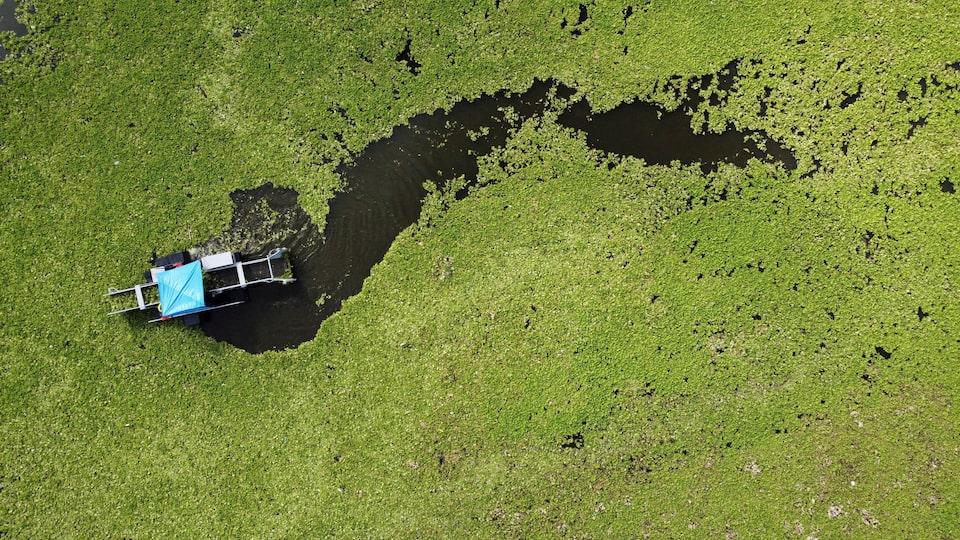
SUCHITOTO, El Salvador, Aug 12 (Reuters) - The proliferation of water lettuce on El Salvador's largest wetland reservoir, known as Lake Suchitlan, is jeopardizing a key source of the country's hydropower generation as well as local species and communities, authorities said on Tuesday. Residents armed with excavators and dump trucks among other tools venture out to the reservoir on a daily basis to remove swathes of the bright green aquatic plants, which are growing rapidly due to flows of nutrients, debris and pollution, exacerbated by seasonal downpours. Sign up here. The free-floating invasive weed, which is not generally considered edible for humans, can smother native plants and choke waterways. The reservoir is El Salvador's largest freshwater body and plays a key role in the country's hydropower operations. It is also a specially designated wetland site, home a rich variety of migratory birds, aquatic species and native plants. Since late July, workers have cleared the equivalent of nine soccer fields of vegetation from the water's surface, weighing around 1,270 metric tons, according to CEL, the government's local hydroelectric commission. https://www.reuters.com/sustainability/climate-energy/pollution-fed-aquatic-weed-overruns-el-salvadors-largest-reservoir-2025-08-13/
2025-08-21 18:49
Aug 21 (Reuters) - The U.S. Justice Department does not plan to target software developers that create decentralized platforms for transmitting cryptocurrencies without criminal intent, a Justice official said on Thursday. Marking the latest sign of the U.S. government's changing views on crypto, acting Assistant Attorney General Matthew Galeotti of the DOJ's criminal division said the department will move away from bringing charges over failure to register as a money transmitter business. Sign up here. "Our view is that merely writing code, without ill-intent, is not a crime," Galeotti said in remarks prepared for a crypto summit in Wyoming. Money transmitters, such as Western Union and payment apps like Venmo, need to be licensed and follow certain rules for vetting customers and reporting suspicious activity to prevent money laundering. Such rules have become a flashpoint for the crypto sector, especially for decentralized exchanges which often say they have no visibility or oversight over transactions on their platforms. A jury earlier this month found a co-founder of Tornado Cash, a firm which makes cryptocurrency transactions harder to track, guilty of a conspiracy to operate an unlicensed money transmitting business. Anti-corruption advocates say such firms make it easier to launder illicit funds. But critics of the case said the co-founder, Roman Storm, merely created the computer code. The jury in the case deadlocked over whether he was guilty of money laundering and sanctions evasion. Those charges were brought by the U.S. attorney's office in Manhattan under the Biden administration. The DOJ under Republican President Donald Trump, whose family has been building a crypto business, has dramatically shifted its approach to the crypto sector. The Justice Department has disbanded its crypto enforcement team, and the U.S. Securities and Exchange Commission, a civil regulator, has walked away from a number of cases against crypto firms and executives. https://www.reuters.com/sustainability/boards-policy-regulation/us-doj-back-off-money-transmitter-cases-shift-backed-by-crypto-2025-08-21/

2025-08-21 18:37
WASHINGTON, Aug 21 (Reuters) - The U.S. Commerce Department said on Thursday it has opened a national security investigation into the import of wind turbines and components. Earlier this week, the department said it was adding wind turbines to a list of products that will face 50% tariffs on the aluminum and steel content. The "Section 232" investigation, which was opened on August 13 but not made public until now, could be used as a basis for even higher tariffs on imported wind turbines. Sign up here. Energy research firm Wood Mackenzie said approximately two-thirds of the value of a typical U.S. wind turbine is imported. U.S. imports of 2023 wind-related imported equipment were valued at $1.7 billion, the lowest volumes since 2013, the firm added, with Europe being the biggest exporter (41%), followed by Mexico (34%), and India (around 15%), the firm added, saying Chinese imports have diminished due to increased trade tensions. Since taking office in January, President Donald Trump has repeatedly sought to stall development of wind and solar energy, calling them unreliable, expensive and overly dependent on Chinese supply chains. The Commerce Department is seeking comments on the role of foreign supply chains in meeting U.S. demand for wind turbines and on "the impact of foreign government subsidies and predatory trade practices on the competitiveness of the wind turbines and their parts and components industry." The United States is self-sufficient for nacelle assembly and tower supply, while maintaining limited blade manufacturing capacity. However, the majority of blades, all drivetrains and other electrical components are imported, Wood Mackenzie analyst Endri Lico said. The department has opened numerous probes into the national security ramifications of imports of airplanes, semiconductors, pharmaceuticals, heavy trucks, copper, timber and lumber, critical minerals and drones. The offshore wind industry has struggled in recent years with soaring inflation and logistical problems that have raised costs. It faced a further setback when Trump suspended licensing on his first day back in office in January. https://www.reuters.com/business/energy/us-opens-national-security-probe-into-imported-wind-turbines-components-2025-08-21/